
Results
-
 £19.99
Clarion Alarum (Brass Band - Score and Parts)
Clarion Alarum: Fanfare No.1 for Brass Band is a short fanfare for brass band, contrasting the brilliance of the sound of cornets and trombones with the warmer tones of horns, euphoniums and tubas.Suitable for 1st Section Bands and aboveDuration: 2.30
Estimated dispatch 7-14 working days
-
£94.95
Contest Music (Brass Band - Score and Parts)
Butlins 2018 Champsionship Section. One of the three choices of set works. The others were Year of the Dragon (Sparke) and Concerto for Brass Band No.1 (Venables).
Estimated dispatch 7-14 working days
-
 £34.95
Deep River (Eb Solo with Low Brass Ensemble - Score and Parts)
Solo for Eb Bass with Low Brass Ensemble (Euphoniums 1 & 2, Eb Bass 2 and Bb Bass 1 & 2)Deep River is one of the best known of the spirituals originating among the enslaved Africans in the United States during the 18th and 19th centuries. Although primarily expressions of religious faith, spirituals were also veiled protest songs, the sense of oppression conveyed in the lyrics being clear to present day performers:Deep River,My home is over Jordan.Deep River, Lord.I want to cross over into campground.Oh, don't you want to go,To the Gospel feast;That Promised Land,Where all is peace?(Includes treble and bass clef parts)
Estimated dispatch 7-14 working days
-
 £69.99
Fanfares and Love Songs (Brass Band - Score and Parts)
Fanfares and Love Songs was commissioned by the National Children's Brass Band of Great Britain for performance on 25th July 2009. Its three movements contrast the extrovert and lyrical qualities of the traditional brass band. The fanfare with which the work opens involves the whole cornet section. The second movement is reflective in mood, beginning somewhat pensively on muted brass, and building to an emotional climax before subsiding back to a distant pianissimo chord. The finale is a fast dance, which with a final recapitulation of the opening fanfare drives on to a breathless close.Suitable for Advanced Youth/3rd Section Bands and aboveDuration: 12.00
Estimated dispatch 7-14 working days
-
 £39.99
Four Cornish Dances Op.91 (Brass Band - Score and Parts)
Ray Farr's arrangement of Malcolm Arnold's suite Four Cornish Dances brilliantly retains the atmosphere of the orchestral original with its evocation of Cornish sea-farers, of deserted tin mines, of marching bands, Methodism, May Days and Moody and Sankey hymns.Suitable for 1st Section Bands and aboveDuration: 10.00
Estimated dispatch 7-14 working days
-
 £44.99
Keystone Kops (Brass Band - Score and Parts)
The Keystone Kops was a series of silent comedies featuring an incompetent group of policemen. They first appeared in the 1912 film Hoffmeyer's Legacy but it was the 1913 feature The Bangville Police that confirmed their popularity. The Keystone Kops were renowned for making mistakes, particularly with a great deal of energy and activity, and all done with a major lack of coordination. Carl Davis's 3-minute tour de force is a fine encore piece!Recorded on Polyphonic QPRL218D Master Brass (Volume Fourteen)Duration: 3:00
Estimated dispatch 7-14 working days
-
 £44.99
Lord of the Rings: The Fellowship of the Ring (Brass Band)
A music selection of key themes from Howard Shores film score to the 1997 blockbuster, The Lord of the Rings: The Fellowship of the Ring, arranged for brass band by Andrew Duncan.Suitable for Advanced Youth/3rd Section Bands and aboveDuration: 7 minutes
Estimated dispatch 7-14 working days
-
£59.99
Lyonesse (Brass Band - Score and Parts)
Lyonesse was commissioned by the Brass Band Heritage Trust as the test piece for the Finals of the National Youth Brass Band Championships held in Manchester in April 2005. This atmospheric music, ideal as a test piece for First and Second section bands, takes its inspiration from the lost kingdom of Lyonesse, the mythical spur of land linking Cornwall and the Scilly Isles, and its associated legend of Tristan and Isolde.Suitable for 1st Section Bands and aboveDuration: 13.00
Estimated dispatch 7-14 working days
-
 £44.95
The Red Novae (Euphonium Solo with Brass Band - Score and Parts)
The title of this euphonium solo, The Red Novae, is derived from two sources; the description of a stellar explosion thought to be caused by the merger of two stars, and as a form of anagram of the dedicatee's name (Dave Thornton).The work offers the soloist an opportunity to exploit a variety of sound worlds including the use of optional electronics. (Supplied with treble and bass clef soloist parts).
Estimated dispatch 7-14 working days
-
 £34.99
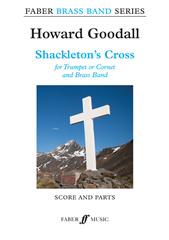
Shackleton's Cross (Cornet Solo with Brass Band - Score and Parts)
Shackleton's Cross was inspired by a painting created in 1957 by the English artist Edward Seago (1910 1974). The title refers to a cross which was erected to the memory of Sir Ernest Shackleton, who led a number of explorations to the Antarctic. Shackleton died in 1922 whilst on a Polar expedition, and the cross can be found on a promontory at the entrance to the bay at Grytviken Whaling Station in South Georgia. The painting is owned by HRH The Duke of Edinburgh, and was part of an exhibition at Buckingham Palace from October 2011 to April 2012. Originally scored for oboe, trumpet and small orchestra, Daniel Hall's sensitive arrangement for trumpet or cornet and brass band follows the composer's alternative version for solo trumpet and organ, created for Crispian Steele-Perkins (trumpet) and David Goode (organ). Duration: 5.00
Estimated dispatch 7-14 working days