
Results
-
 £38.95
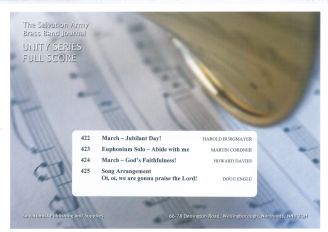
Unity Series Band Journal October 2014 Numbers 422 - 425
No. 422 March - Jubilant Day! (Harold Burgmayer)This accessible march was written for the small, but faithful, corps band in Lock Haven, Pannsylvania, USA, on the occasion of the corps' 125th anniversary.No. 423 Euphonium Solo - Abide with me (Martin Cordner)A sensitive three-verse setting of William H. Monk's well-known tune for Euphonium and band.No. 424 March - God's Faithfulness! (Howard Davies)This march was written to assist celebrations for a recent Salvation Army Congress held in the Indonesian Territory. The music is deliberately written in the style of a 'parade (or street) march' with a steady and unhurried tempo.No. 425 Song Arrangement - Oi, oi, we are gonna praise the Lord! (Doug Engle)This chorus by Doug Horley uses some 'invented' words, but it clearly communicates how our response should be to a God who loves us.
Estimated dispatch 7-14 working days
-
 £95.00
A Wartime Sketchbook (Brass Band - Score and Parts)
Early in 1941 William Walton, 39, received his call-up papers. He was by then one of the most eminent of British composers and was exempted from military service on condition that he provided music for films deemed to be of 'national importance'. Scoring Lawrence Olivier's Shakespeare epic Henry V in 1943 was the most substantial of these wartime projects. His role in patriotic films from 1941 and 42 like The Foreman went to France, Next of Kin, Went the day Well and The First of the Few was to provide appropriate title music and some underscoring at key moments. Walton extracted the most substantial portions of the latter as the popular Spitfire Prelude and Fugue for orchestra. The remaining music remained unpublished until 1990, when Christopher Palmer assembled the highlights into A Wartime Sketchbook. I was intrigued to hear these examples of Walton's wartime music and having discovered that they would fit naturally and idiomatically onto the brass band, I arranged six of the numbers into a suite for Besses o' th' Barn Band, which I was conducting at the time.In 1995 the brass band suite was recorded by the famous Black Dyke Mills Band as part of an all Walton album which I produced for the ASV label (ASV CD WHL 2093). This award- winning CD also included Walton's First Shoot, in the edition by Elgar Howarth, my transcription of movements from Music for Children and two substantial brass versions by Edward Watson of the suite from Henry V (with narrator) and the March and Siegfried Music from The Battle of Britain music.Prologue: This is the stirring title music from Went the day Well, a screen play by Graham Greene about a German airborne invasion of an English village. The main theme leads toBicycle Chase: Characteristic musical high-jinks for J.B.Priestley's The Foreman went to France.Refugees: From the same film, this is a poignant accompaniment to the long march of refugees. As Ernest Irving, the film's musical director, put it, "this really makes your feet sore and your knees sag."Young Siegfrieds: This lively movement comes from the music that Walton composed for The Battle of Britain in 1968, with the assistance of Malcolm Arnold, but which the film's producer rejected. It portrays first the Berliners, cheerfully ignoring the black-out and then, in the trio, the Young Siegfrieds of the Luftwaffe, courtesy of a parody of Siegfried's horn call from Wagner's opera.Romance: A soldier and a Dutch refugee snatch a few tender moments together in Next of Kin.Epilogue: At the end of The Foreman went to France, the French look forward with hope and optimism to eventual liberation.- Paul HindmarshDuration: 14.00
Estimated dispatch 7-14 working days
-
£40.00
A Wartime Sketchbook (Brass Band - Score only)
Early in 1941 William Walton, 39, received his call-up papers. He was by then one of the most eminent of British composers and was exempted from military service on condition that he provided music for films deemed to be of 'national importance'. Scoring Lawrence Olivier's Shakespeare epic Henry V in 1943 was the most substantial of these wartime projects. His role in patriotic films from 1941 and 42 like The Foreman went to France, Next of Kin, Went the day Well and The First of the Few was to provide appropriate title music and some underscoring at key moments. Walton extracted the most substantial portions of the latter as the popular Spitfire Prelude and Fugue for orchestra. The remaining music remained unpublished until 1990, when Christopher Palmer assembled the highlights into A Wartime Sketchbook. I was intrigued to hear these examples of Walton's wartime music and having discovered that they would fit naturally and idiomatically onto the brass band, I arranged six of the numbers into a suite for Besses o' th' Barn Band, which I was conducting at the time.In 1995 the brass band suite was recorded by the famous Black Dyke Mills Band as part of an all Walton album which I produced for the ASV label (ASV CD WHL 2093). This award- winning CD also included Walton's First Shoot, in the edition by Elgar Howarth, my transcription of movements from Music for Children and two substantial brass versions by Edward Watson of the suite from Henry V (with narrator) and the March and Siegfried Music from The Battle of Britain music.Prologue: This is the stirring title music from Went the day Well, a screen play by Graham Greene about a German airborne invasion of an English village. The main theme leads toBicycle Chase: Characteristic musical high-jinks for J.B.Priestley's The Foreman went to France.Refugees: From the same film, this is a poignant accompaniment to the long march of refugees. As Ernest Irving, the film's musical director, put it, "this really makes your feet sore and your knees sag."Young Siegfrieds: This lively movement comes from the music that Walton composed for The Battle of Britain in 1968, with the assistance of Malcolm Arnold, but which the film's producer rejected. It portrays first the Berliners, cheerfully ignoring the black-out and then, in the trio, the Young Siegfrieds of the Luftwaffe, courtesy of a parody of Siegfried's horn call from Wagner's opera.Romance: A soldier and a Dutch refugee snatch a few tender moments together in Next of Kin.Epilogue: At the end of The Foreman went to France, the French look forward with hope and optimism to eventual liberation.- Paul HindmarshDuration: 14.00
Estimated dispatch 7-14 working days
-
 £40.00
Abide With Me (Euphonium Solo with Brass Band - Score and Parts)
My arrangement of William H. Monk's tune of 1861, uses the euphonium soloist as the central figure for the melodic line in the three verses. Surrounding the solo line is an irregular pulsed figure in the percussion to give the music an unsettled feel whilst the muted ensemble lightly colour the melodic contour of the soloist. From the low beginnings of the piece, where no high instrumentation is used, we are led through the darkened texture to a bright finale, although the sense of the forbidding is always present.Abide With Me has always been a favourite hymn of mine and it was when watching the film 28 Days Later that I believed it would make a rather striking arrangement for brass band. This was confirmed further when the hymn was used at the 2012 opening ceremony of the London Olympics. The juxtaposition between the static, slow moving melody and the rhythmic effects of the dancers was something that I thought could be captured in an arrangement.- Paul McGheeDuration: 5.00
Estimated dispatch 7-14 working days
-
 £29.95
Judd: Marching to Glory
This energetic piece focusses on the Christian's life goal of 'marching home to Glory' which is described in the first verse of William James Pearson's song.We are marching home to Glory, Marching up to mansions bright,Where bright golden harps are playing,Where the saints are robed in white.There's a golden harp in Glory,There's a spotless robe for you;March with us to the hallelujah city,To the land beyond the blue.
Estimated dispatch 7-14 working days
-
 £14.95
Marching to Glory (Score Only)
This energetic piece focusses on the Christian's life goal of 'marching home to Glory' which is described in the first verse of William James Pearson's song.We are marching home to Glory, Marching up to mansions bright,Where bright golden harps are playing,Where the saints are robed in white.There's a golden harp in Glory,There's a spotless robe for you;March with us to the hallelujah city,To the land beyond the blue.
Estimated dispatch 7-14 working days
-
£29.95
The Land of the Long White Cloud (Score Only)
Dating from 1979, The Land of the Long White Cloud (Aotearoa) was Philip Sparke's first test-piece. It was commissioned by the New Zealand Brass Band Association for their 1980 National Championships (their centenary year) and set for the European Brass Band Championships, the same year, at the Royal Albert Hall in London. Aotearoa was the name given to New Zealand by its Polynesian settlers whose first sight of the islands was a long, flat cloud lying low over the land. The work has no specific programme although many have seen pictures of the surging ocean in the opening bars. A faster dance-like section leads to a slow, haunting solo for soprano cornet; this is taken up by the whole band before earlier material returns. The dance-like tune is, this time, given a fugal treatment and the opening bars return to close the work.Philip Sparke was born in London and studied composition, trumpet and piano at the Royal College of Music, where he gained an ARCM. It was at the College that his interest in bands arose. He played in the College wind orchestra and also formed a brass band among the students, writing several works for both ensembles.At that time, his first published works appeared - Concert Prelude (brass band) and Gaudium (wind band). A growing interest in his music led to several commissions, his first major one being this featured piece for the Centennial Brass Band Championships in New Zealand - The Land of the Long White Cloud. He has written for brass band championships in New Zealand, Switzerland, Holland, Australia and the UK, including three times for the National Finals at the Royal Albert Hall.In September 2000, he was awarded the Iles Medal of the Worshipful Company of Musicians for his services to brass bands and in 2005 Music of the Spheres won the National Band Association/William D. Revelli Memorial Band Composition Contest. In 2011, he received the BUMA International Brass Award for his contribution to brass music.His conducting and adjudicating activities have taken him to most European countries, Scandinavia, Australia, New Zealand, Japan, Taiwan, South Korea, Canada and the USA. In May 2000, he took the major step of becoming a full-time composer by founding his own publishing company, Anglo Music Press. The company is devoted to publishing his brass band, concert band, fanfare band and instrumental publications as well as recordings dedicated to his latest works.
Estimated dispatch 7-14 working days
-
 £17.50
The Mansions of Glory (Score Only)
"A young, talented and tender-hearted actress was passing along the street of a large city. Seeing a pale, sick girl lying upon a couch just within the half-open door of a beautiful dwelling, she entered, with the thought that by her vivacity and pleasant conversation she might cheer the young invalid. The sick girl was a devoted Christian, and her words, her patience, her submission and heaven-lit countenance so demonstrated the spirit of her religion that the actress was led to give some earnest thought to the claims of Christianity, and was thoroughly converted and became a true follower of Christ. She told her father, the leader of a theatre troupe, of her conversion and of her desire to abandon the stage, stating that she could not live a consistent Christian life and follow the life of an actress. Her father was astonished beyond measure and told his daughter that their living would be lost to them and their business ruined if she persisted in her resolution.Loving her father dearly, she was shaken somewhat in her purpose and partially consented to fill the published engagement to be met in a few days. She was the star of the troupe, and a general favourite. Every preparation was made for the play in which she was to appear. The evening came and the father rejoiced that he had won back his daughter and that their living was not to be lost. The hour arrived; a large audience had assembled. The curtain rose and the young actress stepped forward firmly, amid the applause of the multitude. But an unwonted light beamed from her beautiful face. Amid the breathless silence of the audience, she repeated: 'My Jesus, I love thee, I know thou art mine,For thee all the pleasures of sin I resign;My gracious Redeemer, my Saviour art thou,If ever I loved thee, my Jesus, 'tis now.' This was all. Through Christ she had conquered and, leaving the audience in tears, she retired from the stage, never to appear upon it again. Through her influence her father was converted, and through their united evangelistic labours many were led to God." 1. My Jesus, I love thee, I know thou art mine,For thee all the pleasures of sin I resign;My gracious Redeemer, my Saviour art thou,If ever I loved thee, my Jesus, 'tis now.2. I love thee because thou hast first lovd me,And purchased my pardon on Calvary's tree;I love thee for wearing the thorns on thy brow,If ever I loved thee, my Jesus, 'tis now.3. I will love thee in life, I will love thee in death, And praise thee as long as thou lendest me breath; And say, when the death-dew lies cold on my brow; If ever I loved thee, my Jesus, 'tis now.4. In mansions of Glory and endless delight,I'll ever adore thee and dwell in thy sight; I'll sing with the glittering crown on my brow: If ever I loved thee, my Jesus, 'tis now. William Ralph Featherstone
Estimated dispatch 7-14 working days
-
 £42.95
Ubi Caritas
Composed for the marriage of His Royal Highness Prince William of Wales, K.G. to Miss Catherine Middleton and first performed by the Choirs of Westminster Abbey and Her Majesty's Chapel Royal, St James's Palace, conducted by James O'Donnell, at Westminster Abbey, Friday 29 April 2011.
Estimated dispatch 7-14 working days
-
 £69.95
Henry V (Brass Band - Score and Parts)
Set as the 4th Section Test Piece for the 2011 National FinalsThis work was probably composed in 1933-34, and it is interesting to know that ten years later, when William Walton used 'Rveillez vous Piccars' to represent the French army in his music for the film 'Henry V', the tune was suggested to him by Vaughan Williams.
Estimated dispatch 7-14 working days