
Results
-
 £17.50
The High Council (Brass Band - Score only) - Steadman-Allen, Ray
This march was written at the request of the then Chief of the Staff, Commissioner Arnold Brown for the welcome meeting of the 1974 High Council, a gathering of The Salvation Army's top leaders from around the world who meet to elect a new General. The scintillating music is filled with many wonderful and surprising shifts of key, rhythm and instrumental colour. Evangeline Booth's song 'The world for God' provides the international reference while at the trio's peak, the composer joins three tunes in impressive counterpoint; 'We're the Army' (cornets), 'A Robe of White' (horns and baritones) and 'Bound for Canaan's Shore' (trombones). The march ends with a dazzling shift into triple time and an impressive molto allargando codetta.
Estimated dispatch 7-14 working days
-
£119.95
Call of the Cossacks (Brass Band - Score and Parts) - Graham, Peter
Call of the Cossacks is part of the series of 'travelogue' features by Peter Graham, following in the footsteps of Cry of the Celts and Windows of the World. The Cossacks were a nomadic people whose ethnic makeup included Ukrainians, Tartars, Poles and Jews. A similarly wide range of Eastern European folk music features in this work, from Gypsy to Klezmer. Includes: Procession of the Tartars; Gypsy Dream; Cossack Fire Dance; Doyle's Lament; Cossack Weddig Dance. Each movement can be programmed separately. Recorded on Polyphonic QPRL235D Master Brass Vol.23. Duration: 10:00
Estimated dispatch 7-14 working days
-
 £44.50
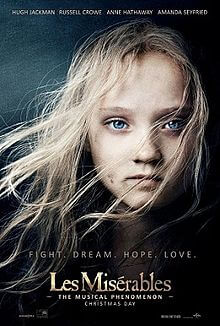
Les Miserables (Concert Suite) - Alain Boublil and Claude-Michel Schonberg - Gavin Somerset
Based on the book by Victor Hugo, Les Misrables has been entertaining audiences around the world since its first performance in London in 1985. Whilst the initial critical reviews were not favourable, the paying public disagreed and the success of the West End musical led to a Broadway production. The show had a big revival in 2012 with the release of the hit film. In this new specially arranged Concert Suite, which features a built in encore - the Epilogue to the show (should you wish to use it) and an optional cut omitting the more difficult sections (making the work accessible to lower section bands), this work gives your band the chance to bring a touch of Broadway to your audience. The Suite features the Prologue, On My Own, Bring Him Home, Master of the House, One Day More & Can You Hear The People Sing? A great audience pleaser and grand concert or contest work that belongs in every bands library.
In Stock: Estimated dispatch 1-3 working days
-
You're My World - Umberto Bindi, Gino Paoli, Carl Sigman - Len Jenkins
"You're My World" is a ballad originally recorded in 1963 as "Il Mio Mondo" ("My World") by Umberto Bindi, who co-wrote the Italian-language version with Gino Paoli. Although the original Italian version was not a hit, even in Italy, the song came to the attention of UK record producer George Martin, who commissioned an English version to be recorded by his protegee Cilla Black. The English lyrics were written by Carl Sigman. Cilla's recording at Abbey Road Studios was made with Johnny Pearson conducting his orchestra and The Breakaways providing background vocals. Her road manager and future husband Bobby Willis also sang on the track. "You're My World" reached No. 1 in Britain on the chart dated 30 May 1964 and remained there for a total of four weeks, one week more than Cilla's preceding single "Anyone Who Had A Heart" (Also available as a Brass arrangement from Wobbleco Music). Although Cilla returned to the UK Top Ten eight times, "You're My World" was her final No. 1 hit. Two quite different arrangements are available; one for Full Brass Band and one for Brass Quintet with optional Glockenspiel. Both attempt to retain the style of the original recording.
-
 £79.95
Lost Village of Imber, The - Christopher Bond
The village of Imber on Salisbury Plain had been inhabited for over one thousand years when it was evacuated in 1943 to make way for military training in the Second World War. At the time, with preparations for the Allied invasion of Europe underway, most villagers put up no resistance, despite being upset, with the belief that they'd return once the war had concluded. To this day, Imber and its surrounding land remain a military training ground. The villagers never returned, and just the shell of what was once a community remains. Structured in three movements, it is on this very real story that the work is based, setting out the series of events of 1943 in chronological order. The first movement, On Imber Downe, portrays a sense of jollity and cohesiveness - a community of individuals living and working together before news of the evacuation had broken. Sounds of the village are heard throughout, not least in a series of percussive effects - the anvil of the blacksmith; the cowbell of the cattle and the bells of the church. The second movement, The Church of St. Giles, begins mysteriously and this sonorous, atmospheric opening depicts Imber in its desolate state and the apprehension of residents as they learn they have to leave their homes. Amidst this is the Church, a symbol of hope for villagers who one day wish to return, portrayed with a sweeping melodic passage before the music returns to the apprehension of villagers facing eviction around their sadness at losing their rural way of life. In complete contrast, the third movement, Imemerie Aeternum, portrays the arrival of the military, complete with the sounds of the ammunition, firing and tanks - sounds which were all too familiar to those living in the surround areas. To close, the Church of St. Giles theme returns in a triumphant style, representing the idea that the church has always been, even to this day, a beacon of hope for the villagers and local community - both the centrepiece and pinnacle of a very real story. The work was commissioned by Bratton Silver Band in celebration of the band's 160th Anniversary, with funding from the Arts Council National Lottery Project Grants Fund and the Brass Bands England Norman Jones Trust Fund.
Estimated dispatch 10-14 working days
-
 £60.00
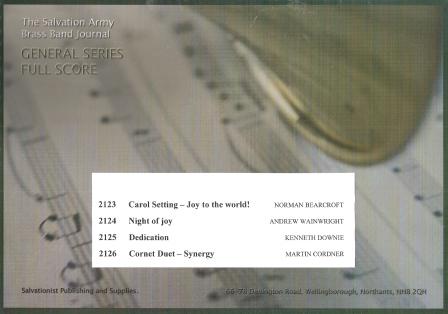
General Series Band Journal August 2013 Numbers 2123-2126
No. 2123 Carol Setting - Joy to the world! (Lieut. Colonel Norman Bearcroft)'Joy to the world' is a melody often attributed to Handel, but it is a bringing together of a couple of brief snippets of themes from his oratorio, 'Messiah'. These were put together by Lowell Mason to form the tune, 'Antioch', which we use for this carol. The carol has been arranged in majestic style by Lieut-Colonel Norman Bearcroft.No. 2124 Night of Joy (Andrew Wainwright)'Night of Joy' is based on a traditional Spanish Christmas song entitled 'Cantemos a Maria' ('Let's sing to Mary').No. 2125 Dedication (Dr Kenneth Downie)A setting of Colonel Brindley Boon's beautiful song of dedication, 'I dedicate myself to thee' (Musical Salvationist, November 1950).No. 2126 Cornet Duet - Synergy (Captain Martin Cordner)This piece celebrates the Biblical principle of believers working together in the Body of Christ and incorporates the song with words by Catherine Baird 'We're in Gods Army and we fight together with the composers own melody to Philip Paul Bliss's words 'Whosoever heareth! shout, shout the sound.
Estimated dispatch 7-14 working days
-
 £30.00
Pioneers (Brass Band) - Steve Robson
The 19th Century was a time of great pioneering spirit, where developments in industry, and transport were to begin a process, which was to transform societies around the world beyond recognition.In the vast, so-called "New World" of America these changes were exemplified as the railways spread out to reach hitherto remote and largely unexplored expanses.Steve Robson has composed Pioneers as a three movement piece for brass band, written in the spirit of John Philip Sousa (1854 - 1932), Stephen Foster (1826 - 1864) and Scott Joplin (1868 - 1917).The three movements consist of:March - The US Marine Band (1880)Spiritual - I'm Lookin' Up To HeavenRagtime - Canonball RagAlso available for brass and percussion ensemble.
In Stock: Estimated dispatch 3-5 working days
-
 £20.00
Pioneers (Ensemble) - Steve Robson
The 19th Century was a time of great pioneering spirit, where developments in industry, and transport were to begin a process, which was to transform societies around the world beyond recognition.In the vast, so-called "New World" of America these changes were exemplified as the railways spread out to reach hitherto remote and largely unexplored expanses.Steve Robson has written Pioneers as a three movement piece for brass and percussion ensemble (and also now available as a full brass band version), written in the spirit of John Philip Sousa (1854 - 1932), Stephen Foster (1826 - 1864) and Scott Joplin (1868 - 1917).The three movements have been written for the following instrumentation:2 x Bb cornet1 x flugelhorn1 x Eb Tenor Horn1 x tenor trombone1 x euphonium1 x Eb Bassdrumkit and percussionand consist of:March - The US Marine Band (1880)Spiritual - I'm Lookin' Up To HeavenRagtime - Canonball RagAlso available for brass band.
In Stock: Estimated dispatch 3-5 working days
-
£25.00
Zephyrus - Andrew Duncan
The Big Blow', was a formal record attempt to create the largest brass band in the world. It took place at Butlin's Resort, Skegness on 20 January 27 and in addition to the fun generated by the event itself, it's main goal was to raise money in support of the work of Brass Band Aid, and specifically to provide long-term sponsorship for two children in the village of Adet, Ethiopia.The Music Company (UK) Ltd were one of the Official Partners of The Big Blow, providing the performance piece for the record attempt. As Editorial Director of the company, Andrew Duncan wrote 'Zephyrus' to mark the occasion.Originally presented at the event as 'March - The Big Blow', the published re-titling of 'Zephyrus' provides a more subtle alternative, taking its name from the Greek God of the West Winds.'Zephyrus' is a traditional British brass band march with an interesting African-feel lilt to the trio. This is enhanced by optional percussion instruments including djembi and bongos, which can also be covered by standard drum kit. A positive, upbeat concert march to reflect the sentiment behind 'The Big Blow' record attempt.There were 443 participants in total, including:Soprano Cornets x 12Cornets x 152Flugels x 19Tenor Horns x 68Baritones x 32Euphoniums x 32Trombones x 55Eb Basses x 35Bb Basses x 17Percussionists x 21The Music Company are pleased to continue their support of Brass Band Aid by offering a donation to this worthy charity for every set of this music sold.
In Stock: Estimated dispatch 3-5 working days
-
 £74.95
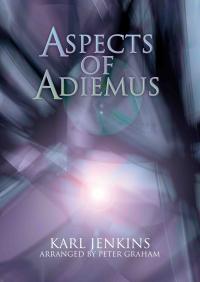
Aspects of Adiemus (Brass Band - Score and Parts)
Aspects of Adiemus is a collection from one of the world's most popular composers, Karl Jenkins. Adiemus, literally translated, means 'we will draw near' and represents a musical language which can be heard on five award winning albums from the composer.Since Adiemus has risen in popularity around the world, it has become a growing entity meaning many different things to many different people. Vocally, the spread of influence grows wider all the time, taking in Arabic and African sounds as well as "Celtic" and ecclesiastical ones. The percussion too has expanded using Indian, Middle Eastern, Japanese, Chinese and even Australian instrumentation.The evolving nature of Adiemus has meant that it has been difficult to categorise. New age, classical crossover, world music, even pop. Karl sees this as a good sign: "To me, Adiemus transcends labels. The fact that it reaches people of different backgrounds, faiths and cultures gives it a universal appeal which is special. The compositions can be spiritual, religious, meditative - it's open to 'move' people in any away they choose to experience."Ironically, the Adiemus project 'got off the ground' initially due to a television commercial for an airline. Karl Jenkins explains, "I'd been toying with a new idea, completely separate to my work in advertising, but at this time, Jenkins Ratledge were commissioned to come up with the music for an airline commercial. We presented the client with a demonstration tape of one of my completed compositions and they loved it."That composition became known as Adiemus. The music for the airline commercial was aired and immediately drew interest from the public. Karl: "It's ironic that a piece of music not originally intended for a TV commercial should end up on a TV commercial, and that this music became the springboard for the success of the Adiemus project."Expertly arranged by Peter Graham, Aspects of Adiemus features the eponymous 'Adiemus', an uplifting and instantly recognisable opener. 'Chorale - Za Ma Ba' and 'Chorale - Vocalise' are songs of sanctuary, the latter featuring a chamber group from within the band. The vibrant 'Song of the Spirit' is a cornet feature, and the finale, 'Song of the Plains' combines intense rhythmic energy with tribal harmonies. Duration is variable depending on movement selection and optional cuts.Duration: 20.00
Estimated dispatch 7-14 working days
 View Music