
Results
-
 £39.95
Song of India - Rimsky-Korsakov arr. Eric Wilson
'Song of India' (or more accurately the 'Song of the Hindu') from Rimsky-Korsakov's 'opera-bilina' Sadko provides a technical challenge as well as a musical one, requiring a great degree of control and accurate intonation as the subtly varied chromatic phrases weave their way over a gently undulating, almost hypnotic accompaniment. Also available with piano accompaniment (Order Code: 0317)
Estimated dispatch 7-9 working days
-
 £39.95
I Believe My Heart (Score and Parts) - Andrew Lloyd Webber arr. Tony Rickard
The Ofcially Authorised brass band arrangement of this chart success. Tony Rickard's arrangement brilliantly captures the essence of this marvellous song and will make all grades of band sound like champions! What the papers say about The Woman in White... "...return to spectacular form" Sunday Times "A dazzling white hit" Daily Express "Andrew Lloyd Webber's best score in years" Guardian Tony Rickard is a skilled arranger whose work has been played and recorded by The London Trumpet Sound and Canadian Brass. He is the co-author of the highly sucessful Well Easy Trumpet Book.
Estimated dispatch 7-9 working days
-
 £62.00
Montage (Score only) - Peter Graham
Each of the movements of the symphony take as their starting point forms originating in music of the 16th and 17th centuries. The first, an intrada, introduces the main thematic material (based on the interval of a minor third) in its embryonic state. As the piece progresses, this material is developed and manipulated in a variety of ways. The interval of the third remains central to the overall scheme of the work, even unifying the three movements on a tonal plane (I: F (minor); II: A flat (major); III: C flat (minor). The internal structure of the intrada is an arch form: ABCBA, roughly modelled on the first movement of Concerto for Orchestra by Witold Lutoslawski, to whose memory the movement is dedicated. A chaconne follows - the basic material now transformed into expansive solo lines underpinned by a recurring sequence of five chords (again, a third apart). The movement's structure combines both ternary form and golden section principles and the chaconne's continuous cycle of chords may be visualised as circles. The final movement, a rondo, bears the dramatic weight of the entire work, as the underlying tonal tensions surface. A musical journey ensues, making diversions through lyrical territories as well as through more spiky, jazz-flavoured ones. The aural (and visual) montage is perhaps most apparent towards the climax of the piece, where three keys and polyrhythms sound simultaneously in the upper brass, xylophone, horns, and timpani. The climax itself combines the lyrical music heard earlier with the rondo theme, now presented by cornets and trombones in canon. The teleological thrust of the movement (if not the entire work) can be symbolized by the flight of an arrow, as it steers a predetermined course towards its target. Duration: 16:00
Estimated dispatch 7-9 working days
-
 £74.00
Montage (Parts only) - Peter Graham
Each of the movements of the symphony take as their starting point forms originating in music of the 16th and 17th centuries. The first, an intrada, introduces the main thematic material (based on the interval of a minor third) in its embryonic state. As the piece progresses, this material is developed and manipulated in a variety of ways. The interval of the third remains central to the overall scheme of the work, even unifying the three movements on a tonal plane (I: F (minor); II: A flat (major); III: C flat (minor). The internal structure of the intrada is an arch form: ABCBA, roughly modelled on the first movement of Concerto for Orchestra by Witold Lutoslawski, to whose memory the movement is dedicated. A chaconne follows - the basic material now transformed into expansive solo lines underpinned by a recurring sequence of five chords (again, a third apart). The movement's structure combines both ternary form and golden section principles and the chaconne's continuous cycle of chords may be visualised as circles. The final movement, a rondo, bears the dramatic weight of the entire work, as the underlying tonal tensions surface. A musical journey ensues, making diversions through lyrical territories as well as through more spiky, jazz-flavoured ones. The aural (and visual) montage is perhaps most apparent towards the climax of the piece, where three keys and polyrhythms sound simultaneously in the upper brass, xylophone, horns, and timpani. The climax itself combines the lyrical music heard earlier with the rondo theme, now presented by cornets and trombones in canon. The teleological thrust of the movement (if not the entire work) can be symbolized by the flight of an arrow, as it steers a predetermined course towards its target. Duration: 16:00
Estimated dispatch 7-9 working days
-
 £62.00
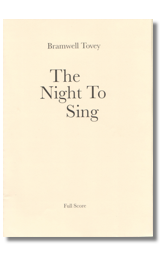
The Night To SIng (Score only) - Bramwell Tovey
The piece takes its inspiration from the VE Day celebrations of 1945. On 8 May 1945 the end of the war in Europe was celebrated in Great Britain. VE day (Victory in Europe day) gave rise to extraordinary public celebrations all over the country, from street parties to services of thanksgiving, to impromptu singing and community music-making. Contemporary reports mention Victorian ballads and Edwardian music hall songs, as well as the latest popular craze - the Conga. Festivities continued until dawn whereupon, finally surrendering to fatigue, the remnants of the crowd headed home on foot, long after the last bus. Some felt the celebrations to be inappropriate - much of Europe lay in ruins and war still raged in Asia. Almost everyone lamented the loss of somebody who had not survived. Duration: 16:50
Estimated dispatch 7-9 working days
-
 £74.00
The Night To SIng (Parts only) - Bramwell Tovey
The piece takes its inspiration from the VE Day celebrations of 1945. On 8 May 1945 the end of the war in Europe was celebrated in Great Britain. VE day (Victory in Europe day) gave rise to extraordinary public celebrations all over the country, from street parties to services of thanksgiving, to impromptu singing and community music-making. Contemporary reports mention Victorian ballads and Edwardian music hall songs, as well as the latest popular craze - the Conga. Festivities continued until dawn whereupon, finally surrendering to fatigue, the remnants of the crowd headed home on foot, long after the last bus. Some felt the celebrations to be inappropriate - much of Europe lay in ruins and war still raged in Asia. Almost everyone lamented the loss of somebody who had not survived. Duration: 16:50
Estimated dispatch 7-9 working days
-
 £42.00
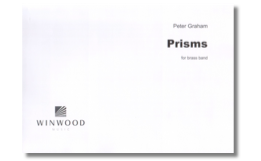
Prisms (Score only) - Peter Graham
Dating from 1986 Prisms (Symphonic Study No. 2 for Brass band) was extensively revised in 1988 to form the preent work. Though not programmatic as such, the work has its roots in traditional brass band music, being strongly melodic and adopting a broad ternary form. The main themes call all be traced to the fourth-based first subject, these offshoots drawing a parallel with light refraction - Prisms. As well as the lyrical sections, much of the music is highly rhythmic, with a busy percussion section, and accesible and enjoyable to all. Duration: 13:00
Estimated dispatch 7-9 working days
-
 £52.00
Prisms (Parts only) - Peter Graham
Dating from 1986 Prisms (Symphonic Study No. 2 for Brass band) was extensively revised in 1988 to form the preent work. Though not programmatic as such, the work has its roots in traditional brass band music, being strongly melodic and adopting a broad ternary form. The main themes call all be traced to the fourth-based first subject, these offshoots drawing a parallel with light refraction - Prisms. As well as the lyrical sections, much of the music is highly rhythmic, with a busy percussion section, and accesible and enjoyable to all. Duration: 13:00
Estimated dispatch 7-9 working days
-
 £29.95
Soliloquy II (Euphonium Solo with Brass Band - Score and Parts)
A few years ago, I wrote a Soliloquy based on a Salvation Army song by George Marshall called Soliloquy (In the Stillness), since published in the General Series. This solo follows up the form of that previous work, though it is quite different in emotional content, and was a commission during Covid lockdown from Euphonium player Micah Dominic Parsons.The main inspiration is the tune Cross of Jesus by John Stainer as well as a motif from some older Euphonium Studies from the Royal Military School of Music, Kneller Hall, that Micah had discovered. The tune is used in a chorale form and, after an introduction, the very first section is a reversal of the chorale that appears in the second half of the work. The Euphonium exclamations are all derived from the main tune and the study motif. The work begins in quite a dark reflective manner, representing those aspects of the song, without being too specific. The second half reflects the more positive characteristics and finds a triumphal nature in its conclusion. The soloist lines throughout have a very declamatory style and can have a freedom in performance.There is one new element in the coda, where the triplet motif (bars 87-89) is a direct quotation from Romans 8 - A brass celebration by Ray Steadman-Allen. RSA was a good friend, mentor and encourager to me. The glorious climax of Romans 8 is his presentation of the same tune (Cross of Jesus) used in this work. And so the piece ends with a final and personal reference to RSA!- Howard Evans
Estimated dispatch 7-14 working days
-
 £95.00
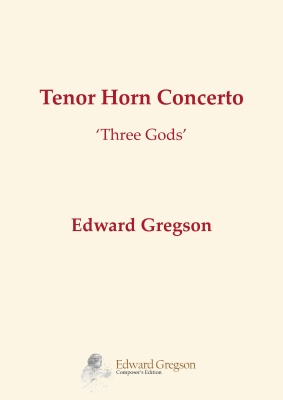
Tenor Horn Concerto 'Three Gods' (Tenor Horn Solo with Brass Band - Score and Parts)
Edward Gregson's Tenor Horn Concerto (Three Gods) was commissioned by the Belgian tenor horn soloist Tim de Maeseneer for a recording of commissioned works he made in 2024 with his own band, Brass Band Willebroek.The subtitle of 'Three Gods' refers to three mythological Greek Gods: Zeus, Hermes and Apollo. The idea for this came from Gregson's Viola Concerto, which he composed in 2023 and which was similarly subtitled 'Three Goddesses'. Indeed, the first movement of the horn concerto shares some common material with the viola concerto, although the other movements are newly composed.The concerto exploits the noble character of the horn, but the writing is also virtuosic in character as well as lyrical and melodic, demanding an extended playing range of nearly four octaves with a variety of colouration in its sonorities. The unifying motif of the whole concerto is the interval of a rising 5th, heard at the outset. The opening also has some other surprises (both seen and heard).The musical ideas, cast in three separate movements, take their starting point from the characters of the Three Gods in the title:Zeus, ruled as King of the Gods on Mount Olympus, and was the God of Thunder and Lightning and of War. His music is often threatening and violent, but also has a more tender side as portrayed in the lyrical second subject. However, the dominant mood is one of foreboding.Hermes was the great messenger to the Gods who could travel between realms on his winged sandals. Thus, his music is fast, fleet of foot, and mercurial - a dashing scherzo, but with lyrical and expressive moments.Apollo, the God of Music and Dance (and the Sun), symbolises virtue and beauty. This final movement, 'Hymn to Apollo', is mainly slow and hymn-like and cast in a continuous stream of melody passed between soloist and band. Brief fanfares herald a triumphant march, before the music returns to its quiet opening, gradually rising to a triumphant climax with glittering melodic percussion leading the way. The music ends in a blaze of glory!Duration: 17.00
Estimated dispatch 7-14 working days