
Results
-
 £38.95
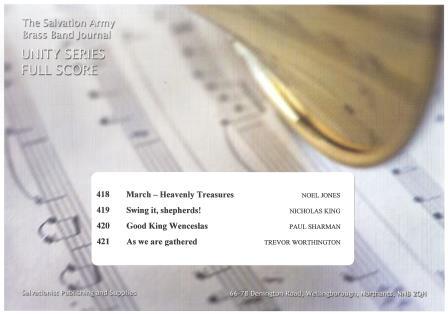
Unity Series Band Journal June 2014 Numbers 418-421
No.418 March - Heavenly Treasures (Noel Jones)Rich people cannot take money with them when they die but Christians have the joy of laying up treasure in Heaven. This march by Noel Jones incorporates two choruses 'Lay up treasure in Heaven' (TBCS 249)and 'Bright Crowns' (TB 78).No.419 Swing it, Shepherds! (Nicholas King)The traditional English Carol, 'While shepherds watched' and the spiritual carol 'Rise up, shepherd!' are combined in a bright swing arrangement by Deputy Songsters Leader Nicholas King, who is also a member of the Music Ministries Unit.No.420 Good King Wenceslas (Paul Sharman)The lyrics of the well-known carol 'Good King Wenceslas' were written by John Mason Neale in the 1850s and the tune used comes from a collection of medieval Latin songs, Piae Cantiones, published in 1582. It has been given a light-hearted treatment, which also features brief references to other carols.No.421 As we are gathered (Trevor Worthington)An arrangement of John Daniels' lovely song, the words of which say:As we are gathered, Jesus is here;One with each other, Jesus is here;Joined by the Spirit, washed in the blood,Part of the Body, the Church of God.As we are gathered, Jesus is here;One with each other, Jesus is here.
Estimated dispatch 7-14 working days
-
£35.00
These Mist Covered Mountains - Peter Meechan
These Mist Covered Mountains was commissioned by Keith Johnson (KMJ Recordings) for soprano cornetist, Mandy Crowther, to whom the piece is dedicated.In an age where we seem to be inundated with endless news cycles of various wars that we as a nation are involved in, and also those that we are not, it seems that war is now a constant, and we are in a never ending state.This short piece is intended to represent the cyclic nature of war, and the way that war never seems to have a true conclusion.
Estimated dispatch 12-14 working days
-
 £37.35
Fallen Souls (Brass Band) Andrew Wainwright
Fallen Souls was the winner of Grimethorpe Colliery Band's 1st Annual Composition Competition in 2023. This depictive and impactful work explores the theme of human fallibility. The piece begins with a slow, yearnful introduction that depicts a fall from grace, represented by a horn solo that reflects the innate goodness of humanity. However, the music soon becomes more agitated and dissonant as it represents the temptations that can lead us astray. The opening reaches a climax of chaos and despair, as we are shown the devastating consequences of our choices. The following section depicts the temptations of humanity. The music is chaotic and seductive in this section, with regular time changes and rhythmic instability, representing the many temptations that surround us. The section ends with a sense of uncertainty, as we are left wondering whether we will succumb to these temptations. There is a reprise of the opening horn solo, and a return to the notion of human fallibility, but this time in extended form. Again there is a build toward chaos, and the music becomes more complex and textured, reflecting the complexity of the human journey. The work ends somewhat abruptly with a blaze, leaving the listener with a sense of both hope and uncertainty. To view a rolling score video featuring Grimethorpe Colliery Band please visit www.youtube.com/watch?v=rM-p8CjnYo0 Duration: 5.00 minutes approx. Difficulty Level: 1st Section + PDF download includes parts and score. Sheet music available from www.brassband.co.uk/sheet-music/fallen-souls-brass-band-andrew-wainwright-brookwright Instrumentation: Soprano Cornet Eb Solo Cornet Bb Repiano Cornet Bb 2nd Cornet Bb 3rd Cornet Bb Flugel Horn Bb Solo Horn Eb 1st Horn Eb 2nd Horn Eb 1st Baritone Bb 2nd Baritone Bb 1st Trombone Bb 2nd Trombone Bb Bass Trombone Euphonium Bb Bass Eb Bass BbTimpani Percussion 1-3
In Stock: Estimated dispatch 1-3 working days
-
 £67.24
Pyrenean Carol Suite (Brass Band) David Taylor
This attractive suite for brass band by David Taylor features five traditional carols from the Pyrenees region of Spain, as follows: i. Nadal Tindaire (Jingling Christmas) - Occitan traditional This Occitan Christmas song tells of musical instruments used to celebrate the Nativity - 'fifes and trumpets, timpani and pipes, or you, clear little bells, along with the angels' choir.' ii. Gabriel's Message (Birjina Gaztetto Bat Zegoen) - Basque traditional The most widely-known of the chosen carols, honouring Jesus's mother Mary, this is often sung in its English version, but the melody came from the Basque country. The Basque words were adapted from the Mediaeval song Angelus ad Virginem. Here, we feature the flugel horn. This movement was originally written on its own, with organ accompaniment, for the composer's wife, Diane Scott. iii. El Noi de la Mare (The Child of the Mother) - Catalan traditional A beautiful Catalan carol celebrating the birth of Jesus, telling of the tasty gifts that the singer would bring - 'Raisins and figs and nuts and olives; Raisins and figs and honey and mato [a Catalan dessert cheese traditionally served with honey.]' Here we feature the euphonium. The tune was made famous by guitarist Andres Segovia, who used it as a favourite encore, and by John Rutter, who made a widely-used setting for choir. iv. Paure Satan (Poor Satan) - Occitan traditional This rather unusual carol tells of the pain that Satan is put to by the arrival of the infant Jesus. Its mocking and sarcastic tone is reflected here, where the tuba soloist (as Satan) is given musical trouble throughout by the other parts. At first they conflict with the soloist, then the soloist makes overtures of friendship, which are treated with suspicion followed by contempt. The soloist finally gives in to their accompaniment (or do they?). There are plenty of opportunities for little theatrical touches here, if the tuba player is so inclined! The tuba part in this movement is notably more difficult than the rest of the music, and a number of optional changes have been marked to make the part easier to play, if so desired. The player is also welcome to add suitable extra embellishments to taste if they wish, within the character of the music. v. Fum, Fum, Fum! - Catalan traditional A favourite Catalan Christmas song for centuries, this rousing melody provides a fitting way to round off the suite, with its repeated rhythmic refrain of the nonsense title phrase. It tells of the Nativity, and then it tells of the celebratory feasting and good times that the singers look forward to to honour it. Although the suite is intended to be performed whole, it is also intended for usage with a selection of movements on occasions where a shorter piece is wanted. Suggested formats include a single movement alone (2, 3, and 5 are likely most appropriate), a pair of movements (any of the first four, plus 5), and a suite of three or four movements (1 and 5, plus one or two of 2, 3, or 4 in the middle). It is suggested that a good way to design a 'pick-your-own-suite' from the movements is to think of the earlier movements as introductory to the final movement. To view a rolling score video featuring Kidlington Concert Brass please visit www.youtube.com/watch?v=QIGdul-yxxg PDF download includes score and parts. Sheet music available from: UK - www.brassband.co.uk USA - https://satradecentral.org Difficulty Level: 3rd Section + Length: 9.45 minutes Instrumentation: Soprano Cornet Eb Solo Cornet Bb Repiano Cornet Bb 2nd Cornet Bb 3rd Cornet Bb Flugel Horn Bb Solo Horn Eb 1st Horn Eb 2nd Horn Eb 1st Baritone Bb 2nd Baritone Bb 1st Trombone Bb 2nd Trombone Bb Bass Trombone Euphonium Bb Bass Eb Bass Bb Timpani Percussion 1-2
In Stock: Estimated dispatch 1-3 working days
-
 £55.00
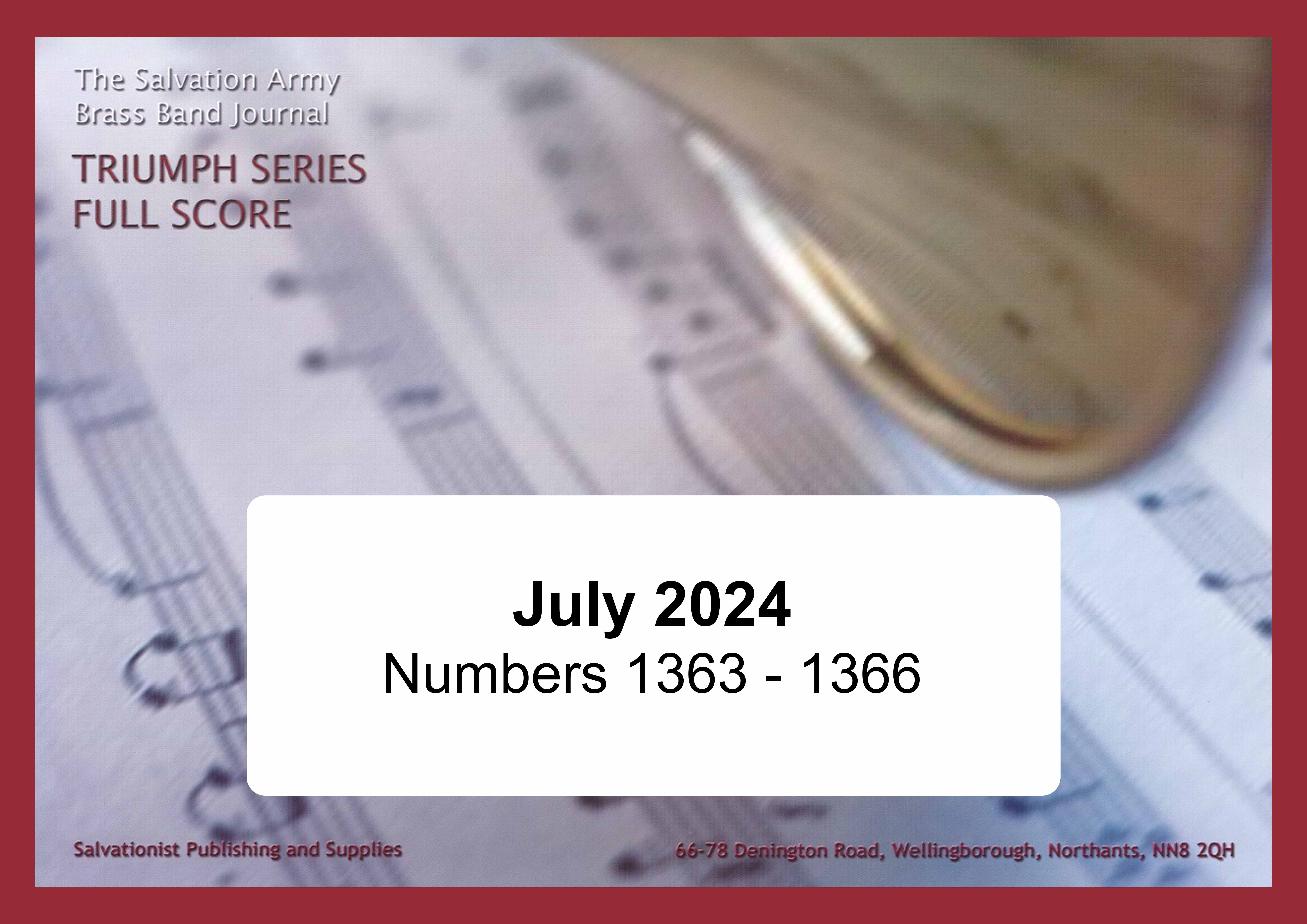
Triumph Series Brass Band Journal, Numbers 1363 - 1366, July 2024
1363: Festival March - Collect the harvest (Anders Beijer)This march is a call to tell others about the salvation we have received and bring people to Jesus. Jesus has bought us with his blood, and we now belong to him and stand under his protection, surrounded by his love and care. After brief references to the melody Bringing in the sheaves (S.A.S.B. 58) (also appearing later in the work in full) and an original melody, we hear the familiar tune Saviour, like a shepherd. This music should be performed with great joy and enthusiasm.1364: O come, Immanuel (Steve Kellner)The text of this beautiful Advent hymn (C.C. 62) dates to the 8th century and its chant-like tune to the 15th century. While the text alludes to Israel's captivity in Babylon and the coming Messiah, it in fact refers to the believer's anticipation of Jesus' second coming. The original chant melody was call and response, so the opening motif serves as the call, returning throughout the arrangement.1365: Our Consecration (Marcus Venables)This arrangement uses the tune St Margaret (T.B. 427) to the beloved hymn by George Matheson, O love that wilt not let me go (S.A.S.B. 616), which highlights the powerful and enduring nature of God's love. The use of the melodic fragment on the word 'go' serves as a subtle question mark, inviting the listener to reflect on the human qualities that may cause doubt in the steadfastness of God's love for us. However, as the piece ends, there is a sense of peace and assurance that we can truly rely on the never-ending love of God in our lives. This powerful and emotive arrangement will leave the listener feeling uplifted and encouraged by the knowledge that they are held securely in the arms of God's love.1366: March - The bell ringer (David Rowsell)The title of this march refers to someone who stands by the iconic Salvation Army Christmas kettle and receives donations from passers-by. They ring a bell to attract attention and subtly invite people to give a donation in support of The Salvation Army's work. This march was written as a tribute to the many volunteers worldwide who support this campaign each year. The music features the choruses from two Christmas carols, Sweet chiming Christmas bells (C.C. 83) and Sweet chiming bells (C.C. 82).
Estimated dispatch 7-14 working days
-
 £37.35
World War III (Brass Band) Joe Galuszka
This descriptive work for brass band by Joe Galuszka depicts the horrors of war. War is all around us. Every day, another life is lost. Myanmar, Sudan, Ethiopia, Ukraine, Colombia, Afghanistan, Somalia, Syria and Yemen. As time goes on, more and more countries are brought to the end of what is a diplomatic struggle - in where war seems to be the only option. 'War! Terror! Panic! captures the tumultuous and relentless nature of war. With driving rhythms, aggressive brass fanfares, and thundering percussion, the listener is immersed in the chaos of battle. Dissonance and clashing harmonies depict the discord that pervades war and takes us on a journey through the terror and panic that comes with the brutality of conflict. Remembrance (For Those That We Have Lost) provides a poignant and reflective interlude, allowing the audience to contemplate the human cost of war. Mournful melodies and expressive solos for trombone, euphonium and glockenspiel, convey the depth of sorrow and loss, serving as a powerful reminder of the toll war takes on individuals and communities. The final movement, Hymn for Peace and Hope is a testament to the enduring human spirit and the yearning for harmony - dissonance and conflict gradually give way to consonance and resolution. We celebrate the human capacity for unity and the triumph of peace over strife, as we imagine a world at piece. To listen to an audio demo of the work please visit https://on.soundcloud.com/Udt1AWRThgwuWnQv5 Duration: Approx. 5.00 mins Difficulty Level: 2nd Section + PDF download includes parts and score. Sheet music available from www.brassband.co.uk (UK) or https://satradecentral.org (USA) Instrumentation: Soprano Cornet Eb Solo Cornet Bb Repiano Cornet Bb 2nd Cornet Bb 3rd Cornet Bb Flugel Horn Bb Solo Horn Eb 1st Horn Eb 2nd Horn Eb 1st Baritone Bb 2nd Baritone Bb 1st Trombone Bb 2nd Trombone Bb Bass Trombone Euphonium Bb Bass Eb Bass Bb Timpani Percussion 1-3
In Stock: Estimated dispatch 1-3 working days
-
 £30.00
Junction 9 - Jock McKenzie
Junction 9 is my local access point to the nearby motorway. Indeed, Junction 9 is used by a significant number of musicians from my local area. From here we join the road network that gets us to our gigs and rehearsals. The approach roads to Junction 9 are elevated from the motorway itself, and as we draw near to the junction, we can see what lies in prospect - congestion or free-flowing traffic.
-
 £30.00
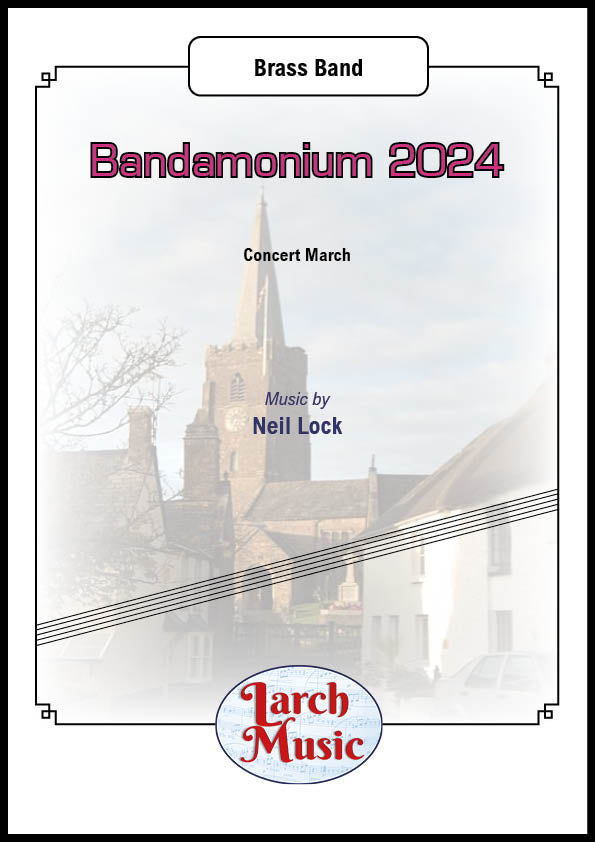
Bandamonium 2024 (Neil Lock) - Brass Band Sheet Music Full Score & Parts - LM541
COMPOSER: Neil LockThis march was submitted to the march composers' competition for "Bandamonium 3"in Hatherleigh, Devon in July 2024. The winning march was played by massed bands at the conclusion of the celebrations on Saturday 27th July 2024. Unfortunately, this march took second place in the competition, behind the march of Paul Pennicotte-Henrie, conductor of Okehampton Silver Band.The march can be played with or without the singing. (Even at the Whit Friday marches, begad!) I suggest that it should be introduced by 3-beat rolls.When played with singing, the "Bandamonium" lyrics (bars 10-13 and 56-57) are to be sung by all players, keeping to their own parts, with appropriate octave adjustment for their individual singing voices. Conductor and percussionists should sing with the main theme (Db and C at bars 10-13, F at 56-57). Listen to the 3rd cornet players!There is an additional part for Singers, in which the trio melody (bars 58 onwards) can be sung by Soprano and Tenor singers at a moderate choir standard. An octave-down option is also provided in the higher bars. This part can be given to "spare" singers within the band, or to singers external to the band if opportunity permits. The lyrics are:We are in Devon,We're in Hatherleigh,Whit Friday heaven,But we're marching free!Now it's past seven,Time to party,At BandamoniumIn Hatherleigh!LM541 - ISMN : 9790570005413
In Stock: Estimated dispatch 3-5 working days
-
£70.00
Macbeth - Peter Meechan
Commissioned by the Scottish Brass Band Association for the 2007 Scottish Open Championship, Macbeth takes itsa inspiration from the Shakespeare play of the same name. Character portraits (Of the three witches as well as Macbeth himself), abstractions (The lament), and scenes (Macbethas final battle with Macduff) make up the nine sections of the piece.i: WitchesThe prophecies of the three witches are an integral part of the play, and in this opening section, these mysterious characters are represented by three different sections of music that introduces the listener to the musical material of the piece.ii: DaggerMacbethas aIs this a dagger I see before theea speech, where an imaginary dagger leads him to contemplate the pending murder, builds in intensity before the bell tolls at itsa conclusion - a sign from Lady Macbeth that Duncan is now alone.iii: General MacbethA character portrait of Macbeth - a fearless General who has led his armies to defeat foes from all over Europe. His ambition and flair that make him such a great General are also the characteristics that lead to his eventual downfall.iv: Contemplations of Lady MacbethAlone and mad, Lady Macbeth ponders all that has gone, before taking her own life.v: LamentAlthough the play tells of Macbeth not feeling the pain of his wifeas death, this lament ponders not only her death, but the tale as a whole.vi: Tomorrow and tomorrow and tomorrowIt is in this final soliloquy that we see the ultimate tragedy of Macbeth - the realisation that his life is ultimately worthless.vii: A spell still castThis acts as an prologue to section eight, restating the original awitchesa music, before heading into Macbethas final battle.viii: Final BattleMacbethas final battle, where he locks swords with Macduff.ix: Not of woman bornMacbethas realisation that the witches have misled him comes all too late, as Macduff beheads Macbeth, fulfilling the last prophecy.
Estimated dispatch 12-14 working days
-
 £42.00
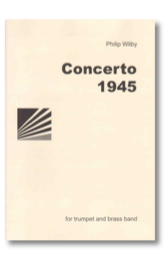
Concerto 1945 (Score only) - Philip WIlby
At a time when we are being encouraged to survey the recent past, its title aims to catch a flavour of that spirit of optimistic vision which coloured the British psyche at the end of the Second War, at once heroic, elegiac, and confident. The concerto's three movements are arranged in a circular pattern around a reflective slow movement. At the heart of that movement is a Cadenza, marked to be played off-stage, where the soloist is surrounded and supported by an additional group of fanfare players. By contrast, the outer movements are energetic and brisk, at times heroic, and at times virtuosic. Also available with piano accompaniment.
Estimated dispatch 7-9 working days
 View Music