
Results
-
 £39.95
Rhapsody on a Theme by Purcell - Contest Edition (Brass Band - Score only)
Contest VersionIn his relatively short lifetime, Henry Purcell (1659 -1695) achieved stellar musical success and was known and admired internationally by his contemporaries. He is justifiably considered one of England's greatest composers.I thought long and hard before using this magnificent theme as the basis for a band piece because I think that Benjamin Britten has said just about everything possible regarding it in his The Young Person's Guide to the Orchestra. Bearing this in mind, I tentatively set about working on this composition. Once started though, the job became fun because the theme still yielded possibilities - even after Britten!The piece is basically a set of linked variations, much like Rachmaninov's great Rhapsody on theme by Paginini. The music starts slowly and makes much use of crisply dotted rhythms - a Purcellian characteristic. The theme is heard twice before the music changes into a jaunty duple time variation based on the opening motif of Purcell's theme. After this, the mood changes to a waltz-like variation in which clear references to the original theme can be heard. The slow movement follows, and is based on rising and descending scalic figures. This variation is an 'A-B-A' movement with two similar passages framing a more vigorous middle section which features antiphonal fanfare-like figures. Without any preamble, the last variation launches itself - a rumbustious dance which has a distinctive feel to it.The theme eventually reappears as a counter-melody to this dance music before a final triumphant treatment of the melody featuring a somewhat athletic bass line. The music accelerates at the Coda and disappears in a 'puff of smoke'.- Kevin Norbury
Estimated dispatch 7-14 working days
-
 £44.95
Glorified (Brass Band - Score and Parts)
Glorified was composed for the Canadian Staff Band's 50th Anniversary celebrations. This work is based on two tunes, Lord, be glorified (T.B. 738), a significant song at Canada's Territorial Music School over the years, and Great is thy faithfulness (T.B. 641). This song celebrates and signifies God's faithfulness to all associated with the Canadian Staff Band, and the commitment shown by its members through the years.The first half of the work harkens back to those members of the band who tragically perished in the early days on RMS Empress of Ireland, which was en route to England for the 1914 International Congress when it was struck by another vessel and sank. The rhythmic ostinatos heard represent the passing of time over the years. After the somewhat dark introduction, the music settles into a reflective rendition of In my life, Lord, be glorified (S.A.S.B. 593), before bursting into a rhythmic and jagged mixed-metre section. A yearning elegy pays tribute to those who lost their lives.The second half of the piece is celebratory in nature and commemorates the reformation of the band and the rich history which has ensued in the subsequent years. The rhythmic energy found in this section builds to a majestic presentation of the tune Lord, be glorified, which leads into the return of Great is thy faithfulness but in an optimistic fashion.
Estimated dispatch 7-14 working days
-
 £29.95
Ben-Hur 1925 (Brass Band - A4 Study Score)
Lew Wallace's Ben-Hur: A Tale of the Christ has inspired numerous adaptations for film, television and radio, each distilling the vast eight-part novel while preserving its enduring themes of compassion and forgiveness.Using the 1925 silent film as a starting point, I have reimagined the story as Ben-Hur, late in life, looks back on its defining moments, his memories coming alive before him.Part I: Ben-Hur's life unfolds in epic flashes: from Rome's splendour and tyranny to the haunting strains of Veni, Veni Emmanuel hinting at Christ's coming; a family betrayed, the galleys, heroic battles, and a chariot triumph--yet even victory offers no peace.Part II: Ben-Hur is torn by inner turmoil as he discovers his suffering family. In desperation he turns to Christ whose message of compassion and forgiveness transforms him, his thirst for vengeance giving way to healing and reconciliation.The work also acknowledges the profound influence of Eric Ball, whose biblical tone poems -- including King of Kings (1931) and Exodus (1937) -- helped shape the brass band repertoire of their time.The hymn Veni, Veni Emmanuel, symbolising the parallel narrative of Christ within this story, was likewise central to Ball's epic The Kingdom Triumphant.The work concludes with the well-known Dresden Amen, also heard in the closing bars of The Kingdom Triumphant.Ben-Hur 1925 was commissioned by The Whitburn Band, MD Nicholas Childs, and is dedicated to the memory of Derek Smith.
Estimated dispatch 7-14 working days
-
£44.95
Ben-Hur 1925 (Brass Band - B4 Score only)
Lew Wallace's Ben-Hur: A Tale of the Christ has inspired numerous adaptations for film, television and radio, each distilling the vast eight-part novel while preserving its enduring themes of compassion and forgiveness.Using the 1925 silent film as a starting point, I have reimagined the story as Ben-Hur, late in life, looks back on its defining moments, his memories coming alive before him.Part I: Ben-Hur's life unfolds in epic flashes: from Rome's splendour and tyranny to the haunting strains of Veni, Veni Emmanuel hinting at Christ's coming; a family betrayed, the galleys, heroic battles, and a chariot triumph--yet even victory offers no peace.Part II: Ben-Hur is torn by inner turmoil as he discovers his suffering family. In desperation he turns to Christ whose message of compassion and forgiveness transforms him, his thirst for vengeance giving way to healing and reconciliation.The work also acknowledges the profound influence of Eric Ball, whose biblical tone poems -- including King of Kings (1931) and Exodus (1937) -- helped shape the brass band repertoire of their time.The hymn Veni, Veni Emmanuel, symbolising the parallel narrative of Christ within this story, was likewise central to Ball's epic The Kingdom Triumphant.The work concludes with the well-known Dresden Amen, also heard in the closing bars of The Kingdom Triumphant.Ben-Hur 1925 was commissioned by The Whitburn Band, MD Nicholas Childs, and is dedicated to the memory of Derek Smith.
Estimated dispatch 7-14 working days
-
£144.95
Ben-Hur 1925 (Brass Band - Score and Parts)
Lew Wallace's Ben-Hur: A Tale of the Christ has inspired numerous adaptations for film, television and radio, each distilling the vast eight-part novel while preserving its enduring themes of compassion and forgiveness.Using the 1925 silent film as a starting point, I have reimagined the story as Ben-Hur, late in life, looks back on its defining moments, his memories coming alive before him.Part I: Ben-Hur's life unfolds in epic flashes: from Rome's splendour and tyranny to the haunting strains of Veni, Veni Emmanuel hinting at Christ's coming; a family betrayed, the galleys, heroic battles, and a chariot triumph--yet even victory offers no peace.Part II: Ben-Hur is torn by inner turmoil as he discovers his suffering family. In desperation he turns to Christ whose message of compassion and forgiveness transforms him, his thirst for vengeance giving way to healing and reconciliation.The work also acknowledges the profound influence of Eric Ball, whose biblical tone poems -- including King of Kings (1931) and Exodus (1937) -- helped shape the brass band repertoire of their time.The hymn Veni, Veni Emmanuel, symbolising the parallel narrative of Christ within this story, was likewise central to Ball's epic The Kingdom Triumphant.The work concludes with the well-known Dresden Amen, also heard in the closing bars of The Kingdom Triumphant.Ben-Hur 1925 was commissioned by The Whitburn Band, MD Nicholas Childs, and is dedicated to the memory of Derek Smith.
Estimated dispatch 7-14 working days
-
 £91.99
A Bandsman's Overture (Brass Band - Score and Parts)
A Bandsman's Overture was commissioned by British Bandsman magazine to celebrate its 125th anniversary in 2012. It was premiered by Black Dyke Band, conducted by Dr Nicholas Childs, at a special anniversary concert held in Symphony Hall, Birmingham, on July 1st.British Bandsman was for a period known as British Bandsman and Contest Field, following an amalgamation of two magazines. The then owner, John Henry Iles, celebrated this new title by commissioning Ord Hume to write the famous march, BB & CF. As a salute to this heritage A Bandsman's Overture starts with the four notes, B(b)-B(b)-C-F, a motive which permeates an opening fanfare, which contrasts a busy opening with a more legato central section. This gives way to a bustling Vivo, based on repeated staccato notes. A change of key heralds a central cantabile melody, first on euphoniums and baritone and then played by the full band, which is followed by a short development section. This leads to a transformed reprise and a return of the opening fanfare, decorated this time by florid muted cornets.Duration: 6:00
Estimated dispatch 7-14 working days
-
 £89.95
Judd: Infinity
In the post-modern age in which we live, 'absolutes' are difficult for many to comprehend. Yet infinity, which means absolute, total, all-embracing, having no limits or boundaries in time, space, extent, or magnitude, has always been central to the Christian's concept of God.Through the ages, as human understanding has grown, particularly at a remarkable rate from the latter part of the twentienth century, Christianity has been continually challenged to interpret traditional beliefs in the light of new discoveries, but always within the reality of the infinite Being. In addition, scripture tells us that 'humanity was made in God's image'. Humankind is part of God's creation and as such, responsible for its upkeep. Such a commission has never been more relevant than in this present age. Psalm 8 creates a great picture of the majesty, eternal, infinte quality of God and yet reveals the desire of God to share in spirit with humankind. It recognises humankind as being, not a tool of the infinite, but as a creative contributing part of the ongoing movement and activity of the infinite.The music is deliberately melodic in context, creating a sense of unity with the infinite, in tandem with the varying expressions of individuality. It is not based on the Psalm but reflects some of the sentiments lying therein. The 'hymn-like' theme expresses the nature of the Divine using the Old Testament image of the infinite God coming to finite humankind, not in the 'wind', the 'earthquake', the 'fire', but in the 'still small voice' of quietness (1 Kings 19: 11-13). The ensuing musical development, in different styles and patterns, expresses this continual link between infinite and finite. Thus the conclusion, rather than being a symbol of might, power and magnificence, reflects the same sentiment as the opening.
Estimated dispatch 7-14 working days
-
 £29.95
Judd: Minneapolis IV
This march was the outcome of a request from Minneapolis IV Corps to write a march to celebrate its 60th anniversary. It is said that the composer received $25 for his efforts! At the time of its writing, Soderstrom had become a leading arranger for NBC Radio in Chicago and had mastered many contemporary American styles. His lush harmonies remind one of Gershwin, Porter, Berlin and Rodgers while even the scoring suggests an American big-band of the swing era! These and other novel touches make the march interesting to listen to, as well as to play, over 60 years on.
Estimated dispatch 7-14 working days
-
 £20.00
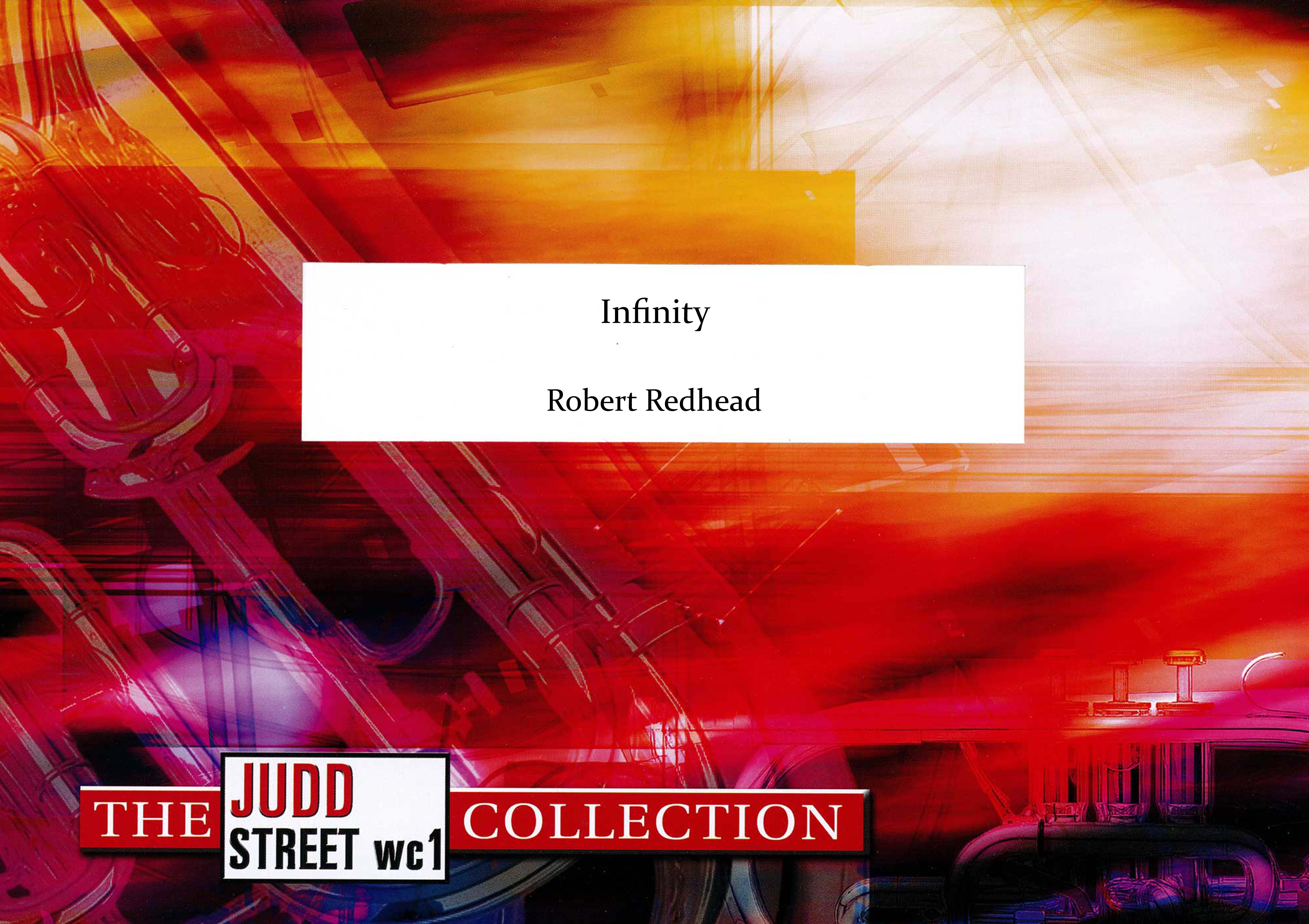
Infinity (Brass Band - Study Score)
In the post-modern age in which we live, 'absolutes' are difficult for many to comprehend. Yet infinity, which means absolute, total, all-embracing, having no limits or boundaries in time, space, extent, or magnitude, has always been central to the Christian's concept of God.Through the ages, as human understanding has grown, particularly at a remarkable rate from the latter part of the twentienth century, Christianity has been continually challenged to interpret traditional beliefs in the light of new discoveries, but always within the reality of the infinite Being. In addition, scripture tells us that 'humanity was made in God's image'. Humankind is part of God's creation and as such, responsible for its upkeep. Such a commission has never been more relevant than in this present age. Psalm 8 creates a great picture of the majesty, eternal, infinte quality of God and yet reveals the desire of God to share in spirit with humankind. It recognises humankind as being, not a tool of the infinite, but as a creative contributing part of the ongoing movement and activity of the infinite. The music is deliberately melodic in context, creating a sense of unity with the infinite, in tandem with the varying expressions of individuality. It is not based on the Psalm but reflects some of the sentiments lying therein. The 'hymn-like' theme expresses the nature of the Divine using the Old Testament image of the infinite God coming to finite humankind, not in the 'wind', the 'earthquake', the 'fire', but in the 'still small voice' of quietness (1 Kings 19: 11-13). The ensuing musical development, in different styles and patterns, expresses this continual link between infinite and finite. Thus the conclusion, rather than being a symbol of might, power and magnificence, reflects the same sentiment as the opening.
Estimated dispatch 7-14 working days
-
 £168.50
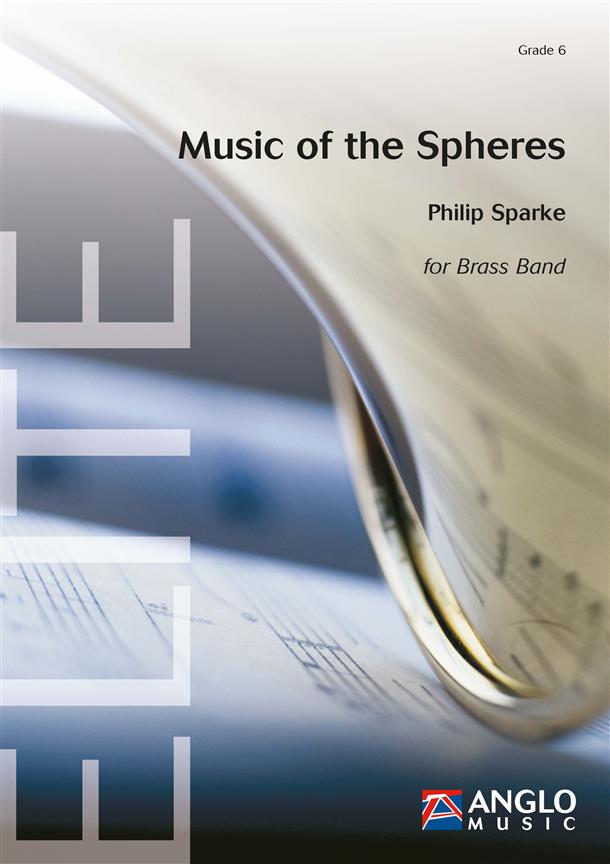
Music of the Spheres (Brass Band - Score and Parts)
Music of the Spheres was commissioned by the Yorkshire Building Society Band and first performed by them at the European Brass Band Championships in Glasgow, May 2004. The piece reflects the composers fascination with the origins of the universe and deep space in general. The title comes from a theory, formulated by Pythagoras, that the cosmos was ruled by the same laws he had discovered that govern the ratios of note frequencies of the musical scale. ('Harmonia' in Ancient Greek, which means scale or tuning rather than harmony - Greek music was monophonic). He also believed that these ratios corresponded to the distances of the six known planets from the sun and thatthe planets each produced a musical note which combined to weave a continuous heavenly melody (which, unfortunately, we humans cannot hear). In this work, these six notes form the basis of the sections Music of the Spheres and Harmonia. The pieces opens with a horn solo called t = 0, a name given by some scientists to the moment of the Big Bang when time and space were created, and this is followed by a depiction of the Big Bang itself, as the entire universe bursts out from a single point. A slower section follows called The Lonely Planet which is a meditation on the incredible and unlikely set of circumstances which led to the creation of the Earth as a planet that can support life, and the constant search for other civilisations elsewhere in the universe. Asteroids and Shooting Stars depicts both the benign and dangerous objects that are flying through space and which constantly threaten our planet, and the piece ends with The Unknown, leaving in question whether our continually expanding exploration of the universe will eventually lead to enlightenment or destruction.Duration: 18:00
Estimated dispatch 7-14 working days