
Results
-
 £129.99
Genetic Code (Brass Band - Score and Parts) - Doss, Thomas
The source of inspiration for this composition was the so-called 'genetic code'. Something which is universal, as almost all organisms on our planet use the same code for their genetic information and therefore speak the same 'language', as it were. The fact that plants, animals, and humans are all subject to the universality of this code fascinates the composer time and time again. Thus, he has chosen a musical motif for this phenomenon, which has been woven through the various musical passages of this work like a genetic thread.Genetic Code was commissioned by the Swiss Brass Band Association to celebrate the 50th anniversary of the Swiss Brass Band Championships, in 2025, and to be the compulsory piece in the Excellence Division that same year.Duration: 13.30
Estimated dispatch 7-14 working days
-
 £84.95
A Day in the Life of a Knight (Brass Band - Score and Parts) - Lawrence, Phil
Here we have a most descriptive piece of writing - a story through music. A fantastic 1st section test piece and championship concert work:The opening scene would depict standing on the battlements of a castle hearing the thundering hoofs of our brave Knight's horse miles in the distance. His arrival is expected, and his reputation is known across many lands. Today, he is to joust amongst mere mortal knights and compete for the hand of the fair (and local) Princess.He vanquishes all competitors and wins the day. The scene moves to evening and court where reception and dance is to be held for our winning knight. Both Knight and Princess become centre of attention during the dance. Their eyes only for each other.At last, the Knight has a chance to be a lone with his Princess as they steal away from the celebrations to a star lit rampart above the castle gardens, where the Knight declares his ever-lasting love and pledges his life and of honour to her. He asks her hand, meanwhile monks pray in the below chapel hoping for union. She say's yes. It is announced in court, then blown from the battlements.Day breaks; he is brought word of evil doings back in his own land. He leaves word to the Princess that he will be back soon to take her hand. The trouble back home was a rouse to get him away from the Princes so one of the vanquished, a dark knight in yesterdays joust, has summoned a dragon to kidnap the princess for his own.As the truth of the deception reaches our Knight he quickly returns to face the varlet that has taken his Lady. This time tis no joust, but a fight to the death with the dark knight and dragon. Our champion proves his best once again and wins the day and the hand of his Princess forever!- Phil LawrenceSuitable for 1st Section Bands and aboveDuration: 11.15
Estimated dispatch 7-14 working days
-
 £43.99
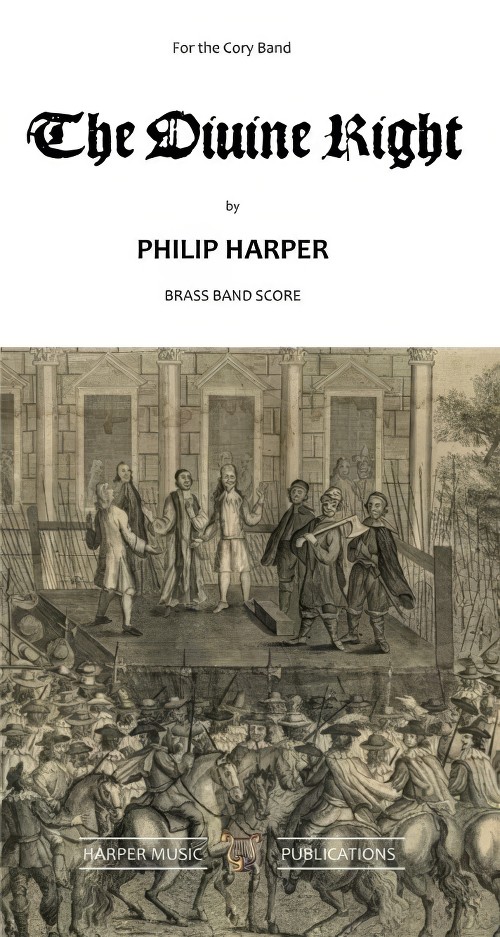
The Divine Right (Brass Band - Score only) - Harper, Philip
At the time of composing this piece, the Arab Spring was sweeping through the Middle East. It seemed that almost every week a new country's people had risen up against the regimes and dictatorships which had prevailed for generations, leaving many nations at a defining crossroads in their history. There were so many possible ways ahead: so many hopes, yet so many uncertainties.This music is a depiction of these revolutionary times, and several musical themes are in turn presented, discussed, considered, fought over, altered, rejected or accepted.Most nations have had, or probably will have, their own Arab Spring, including the United Kingdom. Events of 17th Century Britain provide the context for this piece, particularly those following the execution of the tyrant King Charles I on 30 January 1649. The regicide was in part due to Charless steadfast belief in the Divine Right of Kings, and led to a tumultuous interregnum, where England stood at its own defining crossroads. The music begins turbulently, before King Charles appears and is led to the gallows outside Banqueting House in central London where he is brutally decapitated. From the assembled crowd rose, according to one observer,a moan as I never heard before and desire I may never hear again.The music descends to emptiness.The musical argument which follows is not strictly programmatic, but a number of musical themes are all thrown into the melting pot, representing ideas such as: religion; military force; reasoned Parliamentary debate; and the chattering, irrepressible voice of the people. Additionally, there are some quotations from the music of royalist composer Thomas Tomkins (1572-1656), who was often in tune with the feeling of the times.This defining episode in England's history was brought to a close with the Restoration of the monarchy in 1660, and as the exiled King Charles II rode back into London the diarist John Evelyn wrote:Never was so joyful a day seen in this nation. I stood in the Strand and beheld it, and blessed God.At the end of the piece the bells ring out, and the musical appearance of the King has transformed from turbulent to triumphant.Duration: 17.00
Estimated dispatch 7-14 working days
-
£104.99
The Divine Right (Brass Band - Score and Parts) - Harper, Philip
At the time of composing this piece, the Arab Spring was sweeping through the Middle East. It seemed that almost every week a new country's people had risen up against the regimes and dictatorships which had prevailed for generations, leaving many nations at a defining crossroads in their history. There were so many possible ways ahead: so many hopes, yet so many uncertainties.This music is a depiction of these revolutionary times, and several musical themes are in turn presented, discussed, considered, fought over, altered, rejected or accepted.Most nations have had, or probably will have, their own Arab Spring, including the United Kingdom. Events of 17th Century Britain provide the context for this piece, particularly those following the execution of the tyrant King Charles I on 30 January 1649. The regicide was in part due to Charless steadfast belief in the Divine Right of Kings, and led to a tumultuous interregnum, where England stood at its own defining crossroads. The music begins turbulently, before King Charles appears and is led to the gallows outside Banqueting House in central London where he is brutally decapitated. From the assembled crowd rose, according to one observer,a moan as I never heard before and desire I may never hear again.The music descends to emptiness.The musical argument which follows is not strictly programmatic, but a number of musical themes are all thrown into the melting pot, representing ideas such as: religion; military force; reasoned Parliamentary debate; and the chattering, irrepressible voice of the people. Additionally, there are some quotations from the music of royalist composer Thomas Tomkins (1572-1656), who was often in tune with the feeling of the times.This defining episode in England's history was brought to a close with the Restoration of the monarchy in 1660, and as the exiled King Charles II rode back into London the diarist John Evelyn wrote:Never was so joyful a day seen in this nation. I stood in the Strand and beheld it, and blessed God.At the end of the piece the bells ring out, and the musical appearance of the King has transformed from turbulent to triumphant.Duration: 17.00
Estimated dispatch 7-14 working days
-
 £80.00
The Unfortunate Traveller (Brass Band - Score and Parts) - Holst, Imogen - Hindmarsh, Paul
Imogen Holst (1907-1984) submitted The Unfortunate Traveller (1929) as her final work as a student portfolio at the Royal College of Music, where her composition teacher was Gordon Jacob. The title was taken from Thomas Nashe's famous 1594 picaresque novel of the same title. The Suite was first performed on 12 February 1933 at her Majesty's Theatre, Carlisle, by the St. Stephen's Band, with the composer conducting. Te concert was given in memory of Holst's uncle, Dr. H.A. Lediard. Holst had been impressed with the band's performance of his A Moorside Suite at the 1928 National Brass Band Championships (The Crystal Palace, South London) and was keen to work with them. Writing in Imogen Holst, a life in music, Christopher Grogan indicates that it was Gustav Holst's suggestion to include his daughter's work in the programme, quoting Imogen Holst's remarks made in interview to The Daily Mail as follows: "....it is the first time, so far as I know, that a woman has conducted a brass band at a public concert....It has been a delight to rehearse the St. Stephen's Band. It was their performance at the Crystal Palace Festival that inspired me to write this Suite, which I have dedicated to them."Imogen Holst accompanied her father to the Crystal Palace in 1928 to hear the performances of A Moorside Suite, and was so excited by the played and, audibly, by her father's music that she decided to write a brass band piece for her final examination. Te result was The Unfortunate Traveller (1929). However, it was not possible for her to present a brass band work for examination. She arranged it for string orchestra so that it could be played before she left the RCM in July 1930. Following the premiere of the original in 1933, the manuscripts did not resurface until 1969 Imogen found them among her late mother's effects. Although she requested score and parts be destroyed, they ended up in the possession of Manchester composer John Golland, who marked up the score presumably with the intention of creating a new performing edition. The original scoring reveals a lack of experience with what can be a tricky medium.With the agreement of the Holst Foundation, a revised edition, with additional percussion, was prepared in 2011 since when the work has been fortunate to travel round the world as a concert and contest piece. The original includes drums in the March only. The title was taken from Tomas Nashe's famous 1594 picaresque novel of the same title. Several Morris Dance tunes are introduced during the course of the four short movements, including Bonnie Green Garters, Shepherd's Hey, The Rose and The Wind Blaws Cauld. Quirky twists and turns of harmony and spirited rhythms that remind us how much Imogen Holst loved tradition English dance music.In September 2025, I made a performing edition of the composer's arrangement for string orchestra. The manuscript lacks the final movement, which I arranged in a similar style, ie. without extending the upper ranges. Making this edition raised some issues regarding the accuracy of my band version and some of the solutions I used to smooth out the voicing. I have used the composer's second thoughts to refine my performing edition and to correct a textual errors.- Paul HindmarshDuration: 10.00
Estimated dispatch 7-14 working days
-
£40.00
The Unfortunate Traveller (Brass Band - Score only) - Holst, Imogen - Hindmarsh, Paul
Imogen Holst (1907-1984) submitted The Unfortunate Traveller (1929) as her final work as a student portfolio at the Royal College of Music, where her composition teacher was Gordon Jacob. The title was taken from Thomas Nashe's famous 1594 picaresque novel of the same title. The Suite was first performed on 12 February 1933 at her Majesty's Theatre, Carlisle, by the St. Stephen's Band, with the composer conducting. Te concert was given in memory of Holst's uncle, Dr. H.A. Lediard. Holst had been impressed with the band's performance of his A Moorside Suite at the 1928 National Brass Band Championships (The Crystal Palace, South London) and was keen to work with them. Writing in Imogen Holst, a life in music, Christopher Grogan indicates that it was Gustav Holst's suggestion to include his daughter's work in the programme, quoting Imogen Holst's remarks made in interview to The Daily Mail as follows: "....it is the first time, so far as I know, that a woman has conducted a brass band at a public concert....It has been a delight to rehearse the St. Stephen's Band. It was their performance at the Crystal Palace Festival that inspired me to write this Suite, which I have dedicated to them."Imogen Holst accompanied her father to the Crystal Palace in 1928 to hear the performances of A Moorside Suite, and was so excited by the played and, audibly, by her father's music that she decided to write a brass band piece for her final examination. Te result was The Unfortunate Traveller (1929). However, it was not possible for her to present a brass band work for examination. She arranged it for string orchestra so that it could be played before she left the RCM in July 1930. Following the premiere of the original in 1933, the manuscripts did not resurface until 1969 Imogen found them among her late mother's effects. Although she requested score and parts be destroyed, they ended up in the possession of Manchester composer John Golland, who marked up the score presumably with the intention of creating a new performing edition. The original scoring reveals a lack of experience with what can be a tricky medium.With the agreement of the Holst Foundation, a revised edition, with additional percussion, was prepared in 2011 since when the work has been fortunate to travel round the world as a concert and contest piece. The original includes drums in the March only. The title was taken from Tomas Nashe's famous 1594 picaresque novel of the same title. Several Morris Dance tunes are introduced during the course of the four short movements, including Bonnie Green Garters, Shepherd's Hey, The Rose and The Wind Blaws Cauld. Quirky twists and turns of harmony and spirited rhythms that remind us how much Imogen Holst loved tradition English dance music.In September 2025, I made a performing edition of the composer's arrangement for string orchestra. The manuscript lacks the final movement, which I arranged in a similar style, ie. without extending the upper ranges. Making this edition raised some issues regarding the accuracy of my band version and some of the solutions I used to smooth out the voicing. I have used the composer's second thoughts to refine my performing edition and to correct a textual errors.- Paul HindmarshDuration: 10.00
Estimated dispatch 7-14 working days
-
 £74.99
Willow Pattern (Brass Band - Score and Parts) - Harper, Philip
Composed in 2009 for Nicholas Childs and the Black Dyke BandThis piece tells the Willow Pattern legend through music. Several leitmotifs are used both for the different characters and also for some of the important emotions in the tale. Additionally, Knoon-se's part is mainly played by the flugel horn, Chang by the euphonium, the Mandarin by the Eb Bass and the Duke Ta-jin by the trombone.The Willow Pattern Legend:Once, in ancient China, there lived a wealthy and powerful Mandarin who had a beautiful daughter, Knoon-se. She had fallen in love with Chang, a humble accountant, which angered her father who imprisoned her in the Pavilion by the river with only the exotic birds for company. She learnt that the Mandarin planned to marry her to the pompous Duke Ta-jin and that the wedding would take place on the day the blossom fell from the willow tree, so she sent Chang a message: "Gather thy blossom, ere it be stolen". The Duke arrived by sea amid great fanfare when the tree was heavy with bud, and nights of magnificent banquets followed. After one such occasion when the Mandarin slept, Chang crept over the crooked fence and tiptoed into the Pavilion to rescue Knoon-se, but as they escaped the alarm was raised. They fled over the bridge with the Mandarin close on their heels brandishing his whip. They managed to escape by boat to a secluded island where they lived happily for a time. Meanwhile, the Mandarin learned of their refuge and, intent on revenge, he ordered his soldiers to kill them. As Knoon-se and Chang slept at night, the men set fire to the pagoda in which they lived and the lovers perished in the flames. However, the Gods, moved by the lovers' plight, transformed their souls into two turtle-doves which rose from the charred remains, soaring above the Earth, symbolising eternal happiness.Willow Pattern is dedicated to the memory of Jean Harper who passed away as I was completing the piece and who was a great collector of porcelain and china-ware.Duration: 12:00
Estimated dispatch 7-14 working days
-
 £38.00
Aviator (Brass Band - Score and Parts) - Anderson, Keiron
Aviator is a bright, lively piece, which attempts to show the fast moving and complex world of the stunt pilot who mixes simplicity and style with mad aerobatic prowess. The work shows the take off and landing but in the middle, a multiple time signature section mixes cut common and triple time signatures to take the Band on a white-knuckle ride before returning to the main theme for a safe landing. Duration: 4.00. Suitable for 1st Section Bands and above.
Estimated dispatch 7-14 working days
-
 £40.00
Take Five (Brass Band - Score and Parts) - Desmond, Paul - Sykes, Steve
The classic jazz number 'Take Five' was first recorded by the Dave Brubeck Quartet and released on its 1959 album Time Out. Composed by Paul Desmond, the group's saxophonist, it became famous for its distinctive, catchy melody and use of quintuple time, from which the piece got its name. This brass band arrangement, by Steve Sykes, captures the jaunty slant of the original.Suitable for Advanced Youth/3rd Section Bands and aboveDuration: 4.00
Estimated dispatch 7-14 working days
-
 £44.95
Powerhouse (Brass Band - Score and Parts) - Downie, Kenneth
Spirit divine, come as of old. So begins the song by Brindley Boon, and that phrase becomes the message of this piece, and an important motif in the music. It appears at the very beginning of the work and recurs at important points during the piece. The theme of the need for spiritual power is further underlined by the use of the hymns Show your power, Wonder-working power and the very old chorus Send a new touch of power on my soul, Lord.The composer first heard Boon's song Spirit Divine when it was sung by Parkhead Songsters in the Sunday morning meeting at his home Corps of Greenock Citadel. They were visiting for the weekend from Glasgow, and were conducted by Songster Leader Walter Chalmers, himself a beautiful lyric tenor soloist. They sang it in a moving fashion, unaccompanied, and such was the impact that, at the conclusion, many people went to the mercy seat. It made a huge impression on the young composer. It was the first time that Downie discovered the enormous power of music in worship. It also serves as a reminder to us all that young people of a tender age are very capable of grasping deeply significant events happening around them. This music was written for the 2020 UK Territorial Youth Band course.
Estimated dispatch 7-14 working days
 View Music