
Results
-
 £44.95
Triumphant (Brass Band - Score and Parts)
Triumphant was written as the opening work for the 2024 Future All-Stars final concert. Based on the well-known hymn Victory in Jesus (S.A.S.B. 464), the piece reimagines the familiar melody and words with energetic drumline-inspired rhythms and driving Bass groove.O victory in Jesus, my Saviour, for ever!He sought me and bought me with his redeeming blood;He loved me ere I knew him, and all my love is due him -He plunged me to victory beneath the cleansing flood.Musically speaking, the rhythmic pulse should remain confident and consistent throughout, with the percussion establishing the groove and the band locking in with precision. Take time to find a tempo that allows the Bass and Percussion parts to remain clear and accurate. A slightly steadier pace will produce a stronger, more convincing groove. However, a slower tempo can result in the band's playing becoming too heavy. Melodic lines should be played on the longer side, allowing phrases to sing over the rhythmic accompaniment that can be more defined and articulated. As the work builds, be patient and disciplined with dynamics, saving the band's fullest sound for the climactic moments, maximising their impact.
Estimated dispatch 7-14 working days
-
 £44.95
Powerhouse (Brass Band - Score and Parts)
Spirit divine, come as of old. So begins the song by Brindley Boon (S.A.S.B. 311), and that phrase becomes the message of this piece, and an important motif in the music. It appears at the very beginning of the work and recurs at important points during the piece. The theme of the need for spiritual power is further underlined by the use of the hymns Show your power (S.A.S.B. 365), Wonder-working power (S.A.S.B. 451) and the very old chorus Send a new touch of power on my soul, Lord (S.A.S.B. 785).The composer first heard Boon's song Spirit Divine when it was sung by Parkhead Songsters in the Sunday morning meeting at his home Corps of Greenock Citadel. They were visiting for the weekend from Glasgow, and were conducted by Songster Leader Walter Chalmers, himself a beautiful lyric tenor soloist. They sang it in a moving fashion, unaccompanied, and such was the impact that, at the conclusion, many people went to the mercy seat. It made a huge impression on the young composer. It was the first time that Downie discovered the enormous power of music in worship. It also serves as a reminder to us all that young people of a tender age are very capable of grasping deeply significant events happening around them. This music was written for the 2020 UK Territorial Youth Band course.
Estimated dispatch 7-14 working days
-
 £45.00
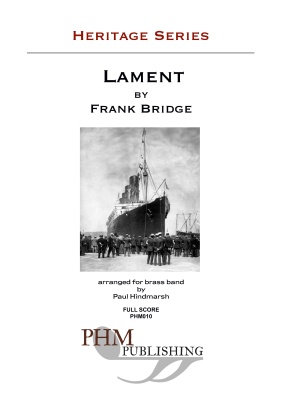
Lament (Brass Band - Score and Parts)
The English composer Frank Bridge (1879 - 1941) did not take an active part in the First World War. However, he was devastated by the slaughter on the western and the eastern fronts, especially the loss of so many of his musicians friends and colleagues. Writing in 1963, his former pupil Benjamin Britten confessed that 'a lot of my feelings about the First World War which people seemed to see in the War Requiem came from Bridge. He had written a piano sonata in memory of a friend killed in France and though he didn't encourage me to take a stand for the sake of a stand, he did make me argue and argue and argue. His own pacifism was not aggressive, but typically gentle'.Bridge composed this Lament for string orchestra on 14 June 1915, in memory of Catherine Crompton, who drowned when the Cunard liner Lusitania was torpedoed by a German submarine on 7 May, 1915. According to figures researched by Liverpool historian Kevin Roach (www.lusitania.net), 1201 men, women and children lost their lives out of the 1962 people aboard. Ninety-four children died, including Catherine, her twin brother Paul and four other siblings. Paul Crompton, Snr. (44), a British businessman working in Philadelphia, his wife Gladys (40) and the family nanny were also drowned. How Bridge's dedication came about is uncertain. The music critic Edwin Evans, who knew Bridge well, has written that the Catherine was a young friend. It is also possible that he came across the family photograph which was published in many newspapers in the wake of the tragedy. By that time, Bridge was greatly distressed by the war as a whole. It seems perfectly in keeping with his pacifist leanings and the strength of his reaction, that this poignant and deeply touching 'war memorial' should mourn a child who he did not know, rather than one of the thousands of young men who fell in battle.Through the musical tears of this melancholy lullaby, Bridge may have regarded the death of young Catherine Crompton as symbolic of the loss of so many innocent lives in wartime. His response to this personal tragedy was characteristically spontaneous and utterly sincere. It is one of his most effective miniatures, poignant yet restrained in its lyrical beauty, with a compelling directness and simplicity of construction.This brass band transcription is pitched one tone lower than the original for string orchestra.- Paul HindmarshDuration: 5.00
Estimated dispatch 7-14 working days
-
 £89.99
A Symphony of Colours (Brass Band - Score and Parts)
A Symphony Of Colours contains four movements, which merge seamlessly together; Joy; Chroma (a journey through the composers perception of synesthesia); Endless Time (where tuned percussion features alongside extended solos for the euphonium); and the final, climactic Ascent. This virtuoso score won a BASCA British Composer Award in the Brass & Wind Band category for its composer, Simon Dobson. Suitable for Championship Section Bands. Duration: 17.00
Estimated dispatch 7-14 working days
-
 £75.00
Iceni Autumn (Brass Band - Score and Parts)
The piece is in four movements; SPQR, Cockley Cley, Boudicca - Battles and Requiem and Venta Icenorum.S.P.Q.R. is an initialism of a Latin noun phrase, Senatus Populusque Romanus ("The Senate and the Roman People"). This movement attempts to portray the mood in England under Roman occupation and contains important themes developed throughout the suite.Cockley Cley is a reconstruction of the type of village occupied by the Iceni. For many years it was a popular tourist attraction in Norfolk.Boudicca (also known as Boadicea) was the wife of King Prasutagus of the Iceni, a British tribe that lived in East Anglia during the time of the Roman Emperor Nero. When Prasutagus, an ally of the Romans died, the local Roman government officials decided that they would seize her wealth and lands for themselves. When Boudicca protested, saying she was a Roman ally who was being treated no better than a slave, the Roman soldiers fogged her and raped her daughters. Boudicca called her tribe to arms and revolted against their Roman oppressors; this saw the complete devastation of Colchester, St Albans and London. In the final battle the Romans slaughtered about 80,000 Britons including women, children and old men, repaying atrocities in kind. Boudicca and her two daughters poisoned themselves rather than be captured and taken to Rome as prisoners of war.Venta Icenorum was the capital of the Iceni Tribe, who inhabited the flatlands and marshes of Norfolk and earned immortality for their revolt against Roman rule under their queen Boudicca in the winter of 61 AD. This triumphant march brings various themes together and ends with a final reference.
Estimated dispatch 7-14 working days
-
£30.00
Iceni Autumn (Brass Band - Score only)
The piece is in four movements; SPQR, Cockley Cley, Boudicca - Battles and Requiem and Venta Icenorum.S.P.Q.R. is an initialism of a Latin noun phrase, Senatus Populusque Romanus ("The Senate and the Roman People"). This movement attempts to portray the mood in England under Roman occupation and contains important themes developed throughout the suite.Cockley Cley is a reconstruction of the type of village occupied by the Iceni. For many years it was a popular tourist attraction in Norfolk.Boudicca (also known as Boadicea) was the wife of King Prasutagus of the Iceni, a British tribe that lived in East Anglia during the time of the Roman Emperor Nero. When Prasutagus, an ally of the Romans died, the local Roman government officials decided that they would seize her wealth and lands for themselves. When Boudicca protested, saying she was a Roman ally who was being treated no better than a slave, the Roman soldiers fogged her and raped her daughters. Boudicca called her tribe to arms and revolted against their Roman oppressors; this saw the complete devastation of Colchester, St Albans and London. In the final battle the Romans slaughtered about 80,000 Britons including women, children and old men, repaying atrocities in kind. Boudicca and her two daughters poisoned themselves rather than be captured and taken to Rome as prisoners of war.Venta Icenorum was the capital of the Iceni Tribe, who inhabited the flatlands and marshes of Norfolk and earned immortality for their revolt against Roman rule under their queen Boudicca in the winter of 61 AD. This triumphant march brings various themes together and ends with a final reference.
Estimated dispatch 7-14 working days
-
 £34.95
The High Council (Brass Band - Score and Parts)
This march was written at the request of the then Chief of the Staff, Commissioner Arnold Brown for the welcome meeting of the 1974 High Council, a gathering of The Salvation Army's top leaders from around the world who meet to elect a new General. The scintillating music is filled with many wonderful and surprising shifts of key, rhythm and instrumental colour. Evangeline Booth's song 'The world for God' provides the international reference while at the trio's peak, the composer joins three tunes in impressive counterpoint; 'We're the Army' (cornets), 'A Robe of White' (horns and baritones) and 'Bound for Canaan's Shore' (trombones). The march ends with a dazzling shift into triple time and an impressive molto allargando codetta.
Estimated dispatch 7-14 working days
-
 £39.00
King Cotton (Brass Band - Score and Parts)
This march was written in 1895 when the Sousa Band played for three weeks at the Cotton States And International Exposition. This was a time when in southern USA cotton production was vitally important - the phrase Cotton is King was appropriate and widely used.This arrangement was prepared for the 2010 Summer concerts of Brass Band of the Western Reserve, musical director Dr Keith M Wilkinson. The staging directions for back-row cornets in the last section will enhance the performance.
Estimated dispatch 7-14 working days
-
 £89.99
Torsion (Brass Band - Score and Parts)
Torsion was commissioned by the Leyland Band and first performed on 23 January 2010 at the Royal Northern College of Music Festival of Brass, Manchester, by Leyland Band conducted by Jason Katsikaris. This colourful and dynamic work is the most personal and ambitious that Simon Dobson composed during his residency with the Lancashire brass band. The dictionary defines torsion as the state of being twisted and the composer interprets this as the imagined dis-torsions and con-torsions of Time, Light and Sound in three contrasting movements. Simon Dobson fuses the traditional brass band sound with drive and energy of pop and funk jazz with optional digitally distorted 'echoes' providing added aural confusion at the points of climax. Although composed as a substantial concert work, Torsion would also make a challenging test-piece for contesting brass bands in the elite divisions. Suitable for Championship Section Bands. Duration: 15.00
Estimated dispatch 7-14 working days
-
 £60.00
From the Shores of the Mighty Pacific (Cornet Solo with Brass Band - Score and Parts)
Cornet Solo with Brass BandHerbert L. Clarke (1867 - 1945) is regarded by many as one of the finest cornet players of all time, noted not only for his amazing technique but also for his warm, lyrical tone. He has left a multitude of cornet solos as well as collections of studies which are still very widely used. He was a member of The Sousa Band briefly in 1893 and then from 1898 to 1917 where he was not only the distinguished cornet soloist but also became assistant director.From The Shores Of The Mighty Pacific is an all-time favourite rondo-caprice cornet solo and was first published in 1912. A brass band arrangement was requested by Chris Lichtler, principal cornet of Brass Band of the Western Reserve, musical director Dr. Keith M. Wilkinson. Chris has performed it many times with BBWR and it was recorded by them on the CD, Without Reserve!.
Estimated dispatch 7-14 working days