
Results
-
 £79.95
The Plantagenets (Brass Band - Score and Parts) - Gregson, Edward
A Symphonic Study for Brass BandThe Plantagenets was Gregson's first major test piece, written specially for the 1973 National Brass Band Championships.In this ambitious symphonic study he turned his attention to music which sets out to create a mood or atmosphere, in contrast to his earlier brass band works such as Essay and Partita where the underlying concerns are technical rather than expressive. However, Gregson is at pains to emphasise that The Plantagenets is not programme music. 'Symphonic' is the optimum word here. In its textural and harmonic complexity, its rhythmic and melodic variety, this was his most ambitious brass band piece so far. His language, with its roots in Hindemith and Bartok is further enriched here with the expressive language of Holst and Rachmaninov.As he says in his notes on the work: The Plantagenets attempts to portray the mood and feelings of an age - that of the House of Plantagenet which lasted from the middle of the twelfth century to the end of the fourteenth. To many it conjures up an age of chivalry and this is represented by fanfare motifs which occur throughout the work in varied form.Characteristically, the composer then goes on to describe not the atmosphere or mood he is trying to convey, but the means by which the music has been composed: the opening fanfares, based on the interval of the third, generating the musical material for the whole work; an exposition of two themes - one fanfare-like, one lyrical (on horns); a slow episode introducing a new melody on solo horn (answered by cornet and euphonium in canon); a little scherzo, fugal in character; and a recapitulation leading to a maestoso statement of the slow movement theme with a final reference to the fanfares as a triumphant conclusion.Duration: 11.30
Estimated dispatch 7-14 working days
-
£39.95
The Plantagenets (Brass Band - Score only) - Gregson, Edward
A Symphonic Study for Brass BandThe Plantagenets was Gregson's first major test piece, written specially for the 1973 National Brass Band Championships.In this ambitious symphonic study he turned his attention to music which sets out to create a mood or atmosphere, in contrast to his earlier brass band works such as Essay and Partita where the underlying concerns are technical rather than expressive. However, Gregson is at pains to emphasise that The Plantagenets is not programme music. 'Symphonic' is the optimum word here. In its textural and harmonic complexity, its rhythmic and melodic variety, this was his most ambitious brass band piece so far. His language, with its roots in Hindemith and Bartok is further enriched here with the expressive language of Holst and Rachmaninov.As he says in his notes on the work: The Plantagenets attempts to portray the mood and feelings of an age - that of the House of Plantagenet which lasted from the middle of the twelfth century to the end of the fourteenth. To many it conjures up an age of chivalry and this is represented by fanfare motifs which occur throughout the work in varied form.Characteristically, the composer then goes on to describe not the atmosphere or mood he is trying to convey, but the means by which the music has been composed: the opening fanfares, based on the interval of the third, generating the musical material for the whole work; an exposition of two themes - one fanfare-like, one lyrical (on horns); a slow episode introducing a new melody on solo horn (answered by cornet and euphonium in canon); a little scherzo, fugal in character; and a recapitulation leading to a maestoso statement of the slow movement theme with a final reference to the fanfares as a triumphant conclusion.Duration: 11.30
Estimated dispatch 7-14 working days
-
 £22.00
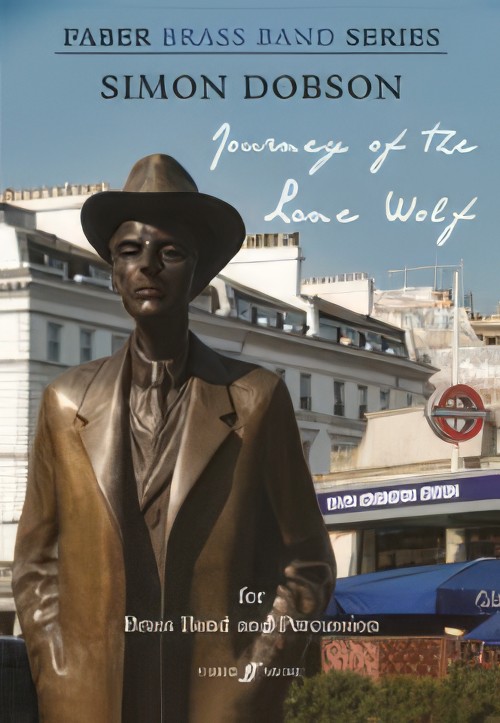
Journey of the Lone Wolf (Brass Band - Score only)
Championship Section Test Piece for the 2016 National Finals of the British Brass Band Championship.The Lone Wolf of the title is the great Hungarian composer and folklorist Bla Bartok. Bartok's journey took him from the hills of the Balkans to the heart of the new world. His singular vision may have meant a life out in the cold, a life without warmth and love, a life without true happiness, a death mourned by a few in a strange land.The first of the three linked movements is capturing the Peasants' Song and follows the young Bartok and fellow composer Zoltan Kolday as they embark on Summertime adventures through the Hungarian countryside to collect and catalogue the astonishing variety of Gypsy and folk music heard in the Balkan hills. The arrival of WW1 plunges Bartok's beloved Hungary into chaos.Bartok was at times a cold man, aloof and lonely. The occasional moments of tenderness he showed are portrayed in Night Music. His brief but intense affairs speak of a love he could only long for. Jazz is my night music and here there are hints of what Bartok may have heard in the USA later in his life.Having been forced by the world's evils to leave his homeland of Hungary for America Bartok, the anti-fascist, felt isolated and angry. In the finale, Flight and Fight, we hear his longing for a simpler time of Gypsy folk dances as well as his maturity and depth as a composer finally exploring deeper colours and darker themes.Duration: 15.00
Estimated dispatch 7-14 working days
-
 £76.99
Oregon (Brass Band - Score and Parts) - De Haan, Jacob
This fantasy tells the story of Oregon, one of America's north-western states. Traveling by train on the Northern Pacific Railroad, the listener is taken through the fascinating Oregon landscape. Indians, cowboys, golddiggers and hooded wagons will file past on this adventurous journey. The piece has some similarities with a soundtrack of a movie. Various melodies, which could be the main themes of a movie, pass the review.The piece begins in a slow movement, introducing the first theme in minor. Then we hear in the following fast movement the trombones imitate the train, whistling the steam-flute. We hear the characteristic minor theme again, but now in different variants (also in major). The rhythmic structure of "western" stile and rock succeed each other. This is leading to the slow movement, where the signals of horns and trumpets introduce a wonderful vocal melody. After this characteristic melody, the fast movement appears shortly again, the trombones whistling the steam-flute again (now in major). We hear also some musical elements, that plays a part in the following Presto. Barchanges, jazzy chords, interesting rhythmic patterns (with bongo) and an original theme are the characteristics of this Presto. After this, the horns announce the last section of the piece. Interesting is the fact that we hear in this Allegro section a variant of the vocal melody in the slow movement. Also the Presto theme returns shortly, followed by the Allargando, which is a grand characteristic end of a soundtrack. The movie of our travelling fantasy has come to an end.Duration: 9:10
Estimated dispatch 7-14 working days
-
 £60.99
Crazy Music in the Air (Brass Band - Score and Parts) - De Haan, Jacob
This composition in two parts is one of the first successful works Jacob de Haan published for brass band. Somewhat under the influence of Ted Huggen's Choral and Rock Out which was an overwhelming success at the time, the still very young Jacob de Haan wrote this composition. The first part (Air) exists of a choral melody with baroque grace notes, supported by a pop rhythm in the drums. The second part (Crazy Music) is a swinging bossa nova, in which various instrument groups present themselves in the continuously varying themes. The famous Black Dycke Mills Band contributed to the success of Crazy Music in the Air by regularly putting the piece on its tour programmes.Duration: 4:45
Estimated dispatch 7-14 working days
-
 £95.00
Journey of the Lone Wolf (Brass Band - Score and Parts) - Dobson, Simon
Championship Section Test Piece for the 2016 National Finals of the British Brass Band Championship.The Lone Wolf of the title is the great Hungarian composer and folklorist Bla Bartok. Bartok's journey took him from the hills of the Balkans to the heart of the new world. His singular vision may have meant a life out in the cold, a life without warmth and love, a life without true happiness, a death mourned by a few in a strange land.The first of the three linked movements is capturing the Peasants' Song and follows the young Bartok and fellow composer Zoltan Kolday as they embark on Summertime adventures through the Hungarian countryside to collect and catalogue the astonishing variety of Gypsy and folk music heard in the Balkan hills. The arrival of WW1 plunges Bartok's beloved Hungary into chaos.Bartok was at times a cold man, aloof and lonely. The occasional moments of tenderness he showed are portrayed in Night Music. His brief but intense affairs speak of a love he could only long for. Jazz is my night music and here there are hints of what Bartok may have heard in the USA later in his life.Having been forced by the world's evils to leave his homeland of Hungary for America Bartok, the anti-fascist, felt isolated and angry. In the finale, Flight and Fight, we hear his longing for a simpler time of Gypsy folk dances as well as his maturity and depth as a composer finally exploring deeper colours and darker themes.Duration: 15.00
Estimated dispatch 7-14 working days
-
 £44.95
Metropolis 1927 (Brass Band - Score only) - Graham, Peter
Fritz Lang's 1927 science fiction epic Metropolis is considered to be a masterpiece of cinematic vision and a high point of German Expressionist filmmaking. Set in a future dystopian world the film introduces the viewer to two contrasting communities living in the vast city of Metropolis. Those above ground live a life of privilege and pleasure serviced by the underground-dwelling drone workers whose role is to maintain and operate the banks of machines which provide the city's power.Lang's film, which can be considered a type of 20th century morality play, draws upon a range of themes and influences from Marxist ideals and social satire to overt religious symbolism.The music does not attempt to precis the plot, such as it is, but simply reflects my musical responses to Lang's noirish visual style and set designs - the brooding machine rooms, the decadent nightclubs, the gothic cathedral and so on - paradoxically a world of terrifying beauty.Metropolis 1927 was commissioned by Bramwell Tovey and The National Youth Brass Band of Great Britain with funds provided by The Arts Council of England. The first performances took place in the Winter Gardens, Weston-super-Mare on Saturday 19th April and in the Cheltenham Town Hall on Sunday 20th April 2014.This revised version was premiered by The Black Dyke Band, conductor Nicholas Childs, at the 38th European Brass Band Championships in the Konzerthaus Freiburg, Germany, on Saturday 2 May 2015.- Peter GrahamDuration: 15.00
Estimated dispatch 7-14 working days
-
£124.95
Metropolis 1927 (Brass Band Set - Score and Parts) - Graham, Peter
Fritz Lang's 1927 science fiction epic Metropolis is considered to be a masterpiece of cinematic vision and a high point of German Expressionist filmmaking. Set in a future dystopian world the film introduces the viewer to two contrasting communities living in the vast city of Metropolis. Those above ground live a life of privilege and pleasure serviced by the underground-dwelling drone workers whose role is to maintain and operate the banks of machines which provide the city's power.Lang's film, which can be considered a type of 20th century morality play, draws upon a range of themes and influences from Marxist ideals and social satire to overt religious symbolism.The music does not attempt to precis the plot, such as it is, but simply reflects my musical responses to Lang's noirish visual style and set designs - the brooding machine rooms, the decadent nightclubs, the gothic cathedral and so on - paradoxically a world of terrifying beauty.Metropolis 1927 was commissioned by Bramwell Tovey and The National Youth Brass Band of Great Britain with funds provided by The Arts Council of England. The first performances took place in the Winter Gardens, Weston-super-Mare on Saturday 19th April and in the Cheltenham Town Hall on Sunday 20th April 2014.This revised version was premiered by The Black Dyke Band, conductor Nicholas Childs, at the 38th European Brass Band Championships in the Konzerthaus Freiburg, Germany, on Saturday 2 May 2015.- Peter GrahamDuration: 15.00
Estimated dispatch 7-14 working days
-
 £37.95
Benvenuto Cellini (Brass Band - Score only) - Berlioz, Hector - Wright, Frank
Berlioz's opera Benvenuto Cellini was first produced in Paris in 1838 but was withdrawn as a failure, and it was not until the production in Dresden in 1888 that it was finally acclaimed by the Germans as a triumph. Adapted from certain episodes recorded in the memoirs of Benvenuto Cellini, Tuscan sculptor and goldsmith, the story, laid in Rome during the mid-sixteenth century, is not strictly historical. The short opening Allegro, marked deciso con impeto, is conceived in the most brilliant Berlioz manner, utilising full instrumentation. In the Larghetto we meet at once the first of the opera themes - the Cardinal's aria (from the last act) introduced in the bass, quasi pizzicato. A second melody leads to a resumption of the Allegro, the contrasting second subject in the tenor horns being an adaptation of Teresa's aria (Act I). Towards the end the Cardinal theme is re-introduced by trombones, fortissimo against an energetic cornet and euphonium passage (senza stringendo - without hurry, says the score). After a unison passage storming skywards, there is a sudden, dramatic three-bar silent pause broken by Eb basses alone, again stating the Cardinal theme. A simple molto crescendo on the dominant, begun piano, leads to the long, resounding chord.
Estimated dispatch 7-14 working days
-
 £82.95
Benvenuto Cellini (Brass Band - Score and Parts) - Berlioz, Hector - Wright, Frank
Berlioz's opera Benvenuto Cellini was first produced in Paris in 1838 but was withdrawn as a failure, and it was not until the production in Dresden in 1888 that it was finally acclaimed by the Germans as a triumph. Adapted from certain episodes recorded in the memoirs of Benvenuto Cellini, Tuscan sculptor and goldsmith, the story, laid in Rome during the mid-sixteenth century, is not strictly historical. The short opening Allegro, marked deciso con impeto, is conceived in the most brilliant Berlioz manner, utilising full instrumentation. In the Larghetto we meet at once the first of the opera themes - the Cardinal's aria (from the last act) introduced in the bass, quasi pizzicato. A second melody leads to a resumption of the Allegro, the contrasting second subject in the tenor horns being an adaptation of Teresa's aria (Act I). Towards the end the Cardinal theme is re-introduced by trombones, fortissimo against an energetic cornet and euphonium passage (senza stringendo - without hurry, says the score). After a unison passage storming skywards, there is a sudden, dramatic three-bar silent pause broken by Eb basses alone, again stating the Cardinal theme. A simple molto crescendo on the dominant, begun piano, leads to the long, resounding chord.
Estimated dispatch 7-14 working days
 View Music