
Results
-
 £29.95
Cafe 1719 - Jonathan Bates
DURATION: 2'30". DIFFICULTY: 1st Section+. 'Caf 1719' was composed for the Wantage Silver Band as part of their entertainment contest sets based on the music of Johann Sebastian Bach in 2019. This particular short, jazz-inspired work is composed in tribute to the great French Pianist Jacques Loussier (1934-2019) who received global acclaim for his jazz interpretations of Bach's music, along with many other classical composers. Despite being born in the same year and living in the same country, Bach and Handel never actually met, but what if they had? Cafe 1917 acts as a musical meeting point - in a fictional Jazz Cafe by the Rhine, with the tenor horn section performing a 'Loussier-esque' version of Bach's 'Prelude No.2 in C Minor' whilst on the other side of the cafe, the trombone section follow suit with their take on Handel's 'Bourree from Music for the Royal Fireworks'. Eventually the two meet, share ideas and incorporate them into each other's melodies. Amongst the 2 main featured works by Bach and Handel, the tutti interludes are constructed on music from Bach's 'Toccata and Fugue in D Minor'. .
In Stock: Estimated dispatch 1-3 working days
-
 £30.00
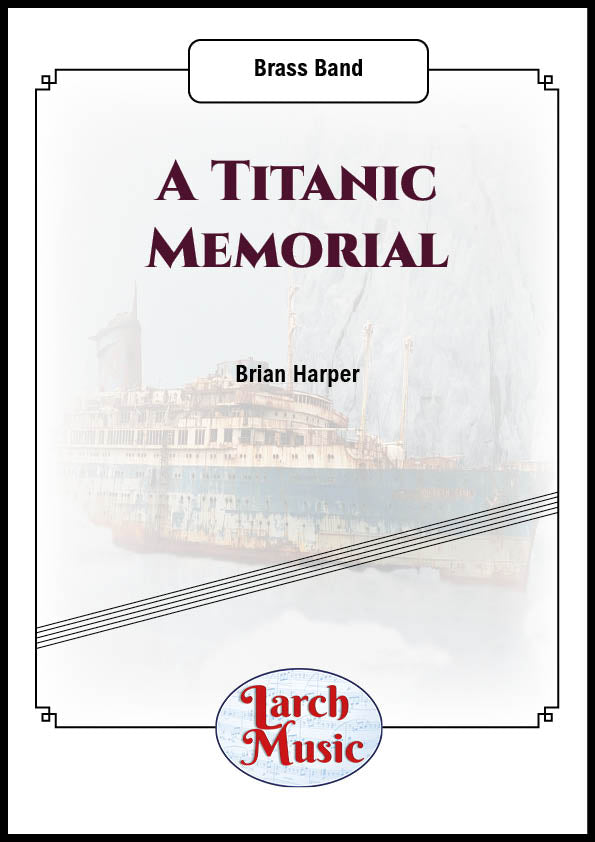
A Titanic Memorial - Brass Band Sheet Music Full Score & Parts - LM393
COMPOSER: Brian HarperRMSTitanicwas a British passengerliner, operated by theWhite Star Line, thatsank in the North Atlantic Oceanon 15 April 1912 after striking anicebergduring her maiden voyage fromSouthampton, England toNew York City, United States.Of theestimated 2,224 passengers and crewaboard, more than 1,500 died, making itthe deadliest sinking of a single shipup to that time.It remains the deadliest peacetime sinking of anocean linerorcruise ship.The disaster drew public attention, provided foundational material for thedisaster filmgenre, and has inspired many artistic works.LM393 - ISMN : 9790570003938
In Stock: Estimated dispatch 3-5 working days
-
 £25.00
Canzona XIII
DescriptionCanzona XIII, also known as Canzon Septimi Octavi Toni a 12, was first published in 1597 as part of a collection entitled 'Symphoniae Sacrae' - this collection was a mixture of instrumental and choral pieces, and also included the famous Sonata Pian'e Forte, probably his best known work.Gabrieli was born in Venice sometime between 1554 and 1557 and studied with the renowned Dutch composer Orlando di Lassus. He also studied with his uncle, Andrea Gabrieli, and eventually succeeded him as the organist and composer at St Mark's Basilica in Venice. Already renowned as a musical centre, Venice became a magnet for composers wishing to study with Gabrieli after 'Symphoniae Sacrae' was published.Like many of his works, this Canzona was written to take advantage of the unique layout of St Mark's, which had galleries on three sides where the musicians could be placed to create novel spatial effects - utterly new and exciting for sixteenth century listeners. Canzona XIII has three different antiphonal 'choirs' and in this arrangement the band is split into three groups to reflect Gabrieli's innovative idea. Ideally the three groups should be clearly separated so the the antiphonal effect comes across clearly, although this will of course depend on the performance space. On no account should the band remain in its normal seated formation!As Gabrieli didn't have any percussionists (and percussion was widely thought inappropriate for music performed in church anyway) there are no percussion parts in this music.This arrangement was first performed by the Coppull and Standish Band conducted by Andrew Baker in 2009.You can follow a preview of the score while listening to an audio export of the music below!
Estimated dispatch 7-14 working days
-
 £30.00
Finale from Tosca, Act 1 (Te Deum)
DescriptionPuccini's opera Tosca, one of his most successful and popular works is set in 1800 in Rome, as Napoleon's invading army is approaching. There are rebels in Rome who see Napoleon as a liberator from Neapolitan rule and are plotting secretly. One of those is the young firebrand artist Cavaradossi. He and his lover, the beautiful and tempestuous Tosca, are being pursued by the evil chief of the secret police, Scarpia. At the end of Act 1, Scarpia is revelling in his plot to capture Cavaradossi and trick Tosca into sleeping with him to buy her lover's freedom, all inside a church in Rome while a Te Deum service is being sung; in the background the bells are tolling and we hear distant cannonfire from the approaching army.In this arrangement the part of Scarpia is played mostly by the solo trombone. There is an optional organ part, although all of the organ part is covered in the band parts.This arrangement was first performed by the Harrogate Band conducted by Andrew Baker in 2022. Watch a video preview of the score below!
Estimated dispatch 7-14 working days
-
 £7.50
£7.50gemini
Descriptiongeminiis a virtuosicsolo for unaccompanied cornet or trumpet, inspired by the constellation of the same name and one of a small sequence of works inspired by the composer's love of astronomy.Gemini is a constellation visible in the night sky overhead in January and February, between Taurus, Cancer and Auriga. Gemini is latin for "twins", as the constellation's two brightest stars represent the mythological twins Castor and Pollux. Bizarrely, despite being twins, Castor and Pollux had two different fathers and hence two different fates and personalities. This work is dedicated to the composer's friend Lizzy Tonge. The opening melody takes its outline from the song 'Thank You' by Dido.Listen to an audio preview while following the music below:
Estimated dispatch 7-14 working days
-
 £30.00
Gull Dances - Terry Johns
The composer, who lives and works at the edge of the Forth estuary in Edinburgh has been inspired here by the intriguing "tap" dance that the gulls perform on the grass at certain times to encourage worms to break the surface. The middle movements describe the birds' "dancing" in flight, with a waltz and a slow soaring melody. The piece was written for the COOP Glasgow Brass Band on the occasion of their winning the Scottish brass band championship in 2009 and was broadcast on BBC Scotland's "Classics Unwrapped" in November of that year.
-
 £30.00
O.B.1. Fanfare - Tom Watson
Tom Watson was born into a musical family in Hertfordshire, England and showed a flare for playing the trumpet from the age of just 4. Taught by his father James Watson, the prolific international soloist, conductor, educator and session trumpeter, Tom studied at the Royal Academy of Music, where he gained a first class honours degree. Whilst still at college, Tom embarked on a varied professional freelance-playing career and was guest principal trumpet with the Mahler Chamber Orchestra performing under Claudio Abbado, Daniel Harding, and Sir Neville Marriner. Tom can be regularly found performing and recording with the London Symphony Orchestra, The BBC National Orchestra of Wales and many of the UK's finest orchestras. Commercially, Tom has played in sessions or concerts for artists such as Sir Elton John, Sir Paul McCartney, Sir Tom Jones, Dame Shirley Bassey, Ozzy Osbourne, Phil Collins, Eric Clapton, Joe Cocker, Jarvis Cocker, Pete Doherty, Nick Cave, Karl Jenkins and Victoria Wood. Some of his film session work has included recording the scores for Brave, Eragon and Stormbreaker. Tom also works as a musical director, arranging and conducting various projects such as Tony Christie's album Made in Sheffield and for renowned harpist Catrin Finch. Tom also runs his own independent recording and production company Pro Audio, part of Prozone Music, which Tom owns and runs alongside his brother William. The O.B.1. Fanfare was written for the Harper Ensemble, a brass ensemble comprising of Tom's contemporaries from his time at the Royal Academy of Music. It was written for the Leicester Square UK premiere of the film "Ali" starring Will Smith. Composed as a salute to Hollywood and the big screen, this fine pastiche of film scoring is an ideal fanfare and concert opener.
-
Duet For Two Cats - G. Rossini - Len Jenkins
"Duet For Two Cats" is often performed as an encore to vocal recitals and operatic galas. It may be sung by two sopranos, male-female pairs, or even as a tomcat duet and can be accompanied by a piano or a full orchestra. The lyrics are simple; the single word 'Miaow', repeated with various styles of inflexion and attitude throughout the piece. Our arrangement is for a cornet and trombone. The piece is generally ascribed to Rossini, though there is some doubt as to its actual origins and whether it is an authentic work by that composer. It is believed that an English composer, Robert Lucas Pearsall under the pseudonym G. Berthold may have assembled the various elements from Rossini and perhaps other composers into the piece as we now know it. In order to achieve the correct balance between band and soloists, there is a need to mute most of the band instruments. Recognising that not all bands will have the larger mutes which are expensive and sometimes unwieldy, we suggest a form of muting made famous by a jazz trumpeter and which works well on most instruments. It consists of a circle of heat resistant padded table covering or felt, slightly larger than the bell diameter, with an elasticated edge like a 'mop-hat'. With 3 holes in it to let the sound out, the mute is then simply stretched over the bell to achieve the desired effect and folded up when not required.
-
 £52.00
Stories for Saroyan - Elgar Howarth
Stories for Saroyan was written for Robert Childs and has also been performed to great acclaim by his son David Childs. A concerto of stature, graced with the composer's hallmark scoring, intense passion, and enigma! The Saroyan of the title is the American author William Saroyan whose tales inspired the composition. Saroyan, who one the Pulitzer Prize and turned it down, became known for loosly structured, impressionistic plays and stories stressing his belief in people's basic innocence. Elgar Howarth has set the standard of modern brass arranging, and his original works feature largely in the Winwood Music catalogue
Estimated dispatch 7-9 working days
-
 £64.00
Stories for Saroyan (Parts only) - Elgar Howarth
Stories for Saroyan was written for Robert Childs and has also been performed to great acclaim by his son David Childs. A concerto of stature, graced with the composer's hallmark scoring, intense passion, and enigma! The Saroyan of the title is the American author William Saroyan whose tales inspired the composition. Saroyan, who one the Pulitzer Prize and turned it down, became known for loosly structured, impressionistic plays and stories stressing his belief in people's basic innocence. Elgar Howarth has set the standard of modern brass arranging, and his original works feature largely in the Winwood Music catalogue
Estimated dispatch 7-9 working days
