
Results
-
£74.99
Brilliant Beatles - Peter Kleine Schaars
There have been many arrangements of Beatles' songs for various kinds of ensembles, so rather than just producing a further medley of Beatles' hits, Peter Kleine Schaars has added a new twist to them with this excellent new work. All You Need Is Love and With a Little Help from my Friends pass by in a swing march, Michelle sounds like a newly composed ballad and When I'm Sixty Four is played in Dixie swing style. A Hard Day's Night is transformed into a funk theme with a samba interlude, Let It Be into a slowmarch, and Ob-La-Di, Ob-La-Da in a rock beat. Experience The Beatles as you have never heard them before.
Estimated dispatch 5-14 working days
-
 £41.09
Verklarte Nacht (Brass Band) Arnold Schoenberg arr. Rob Bushnell
Composed in just three weeks in 1899, Verklarte Nacht (Transfigured Night) is a string sextet in one movement by Arnold Schoenberg. Whilst known better for tone rows, his dodecaphonic music and the Second Viennese School, Schoenberg was a master of harmony (writing a number of books on the subject) and, in his early life, was inspired by the music of Brahms and Wagner. This is his best-known tonal work. Its description as a tone poem is not surprising given it takes its inspiration from Richard Dehmel's poem of the same name, as well as Schoenberg's strong feelings towards his future wife, Mathilde Zemlinsky, sister of his teacher, Alexander von Zemlinsky. The work is said to have five sections, one for each of the stanzas in the poem. The poem, from 1896, describes a man and woman walking through a dark forest on a moonlit night. The woman shares a secret with him, that she is pregnant but not with his child. The man reflects upon this before warmly accepting (and forgiving) the news. The work premiered on 18 March 1902 in the Vienna Musikverein by the Rose Quartet. As was normal at the time, Schoenberg produced a string orchestra version that was premiered on 29 November 1916 in Prague, conducted by Zemlinsky, which was later revised in 1943 to better support the soloists, also adding more articulation and tempo markings. Whilst the piece was controversial at the time, both musically and due to the poem's "inappropriate" subject matter, Richard Dehmel himself was impressed, writing "I had intended to follow the motives of my text in your composition, but soon forgot to do so, I was so enthralled by the music." This arrangement is for the British-style brass band, with alternative parts for horns in F and bass-clef lower brass. To view a recording of the original composition please visit www.youtube.com/watch?v=vqODySSxYpc. Difficulty Level: 2nd Section + Duration: approx. 6.40 minutes Sheet music available from www.brassband.co.uk Instrumentation: Soprano Cornet Eb Solo Cornet Bb Repiano Cornet Bb 2nd Cornet Bb 3rd Cornet Bb Flugel Horn Bb Solo Horn Eb 1st Horn Eb 2nd Horn Eb 1st Baritone Bb 2nd Baritone Bb 1st Trombone Bb 2nd Trombone Bb Bass Trombone Euphonium Bb Bass Eb Bass BbTimpani Percussion 1-3
In Stock: Estimated dispatch 1-3 working days
-
£95.00
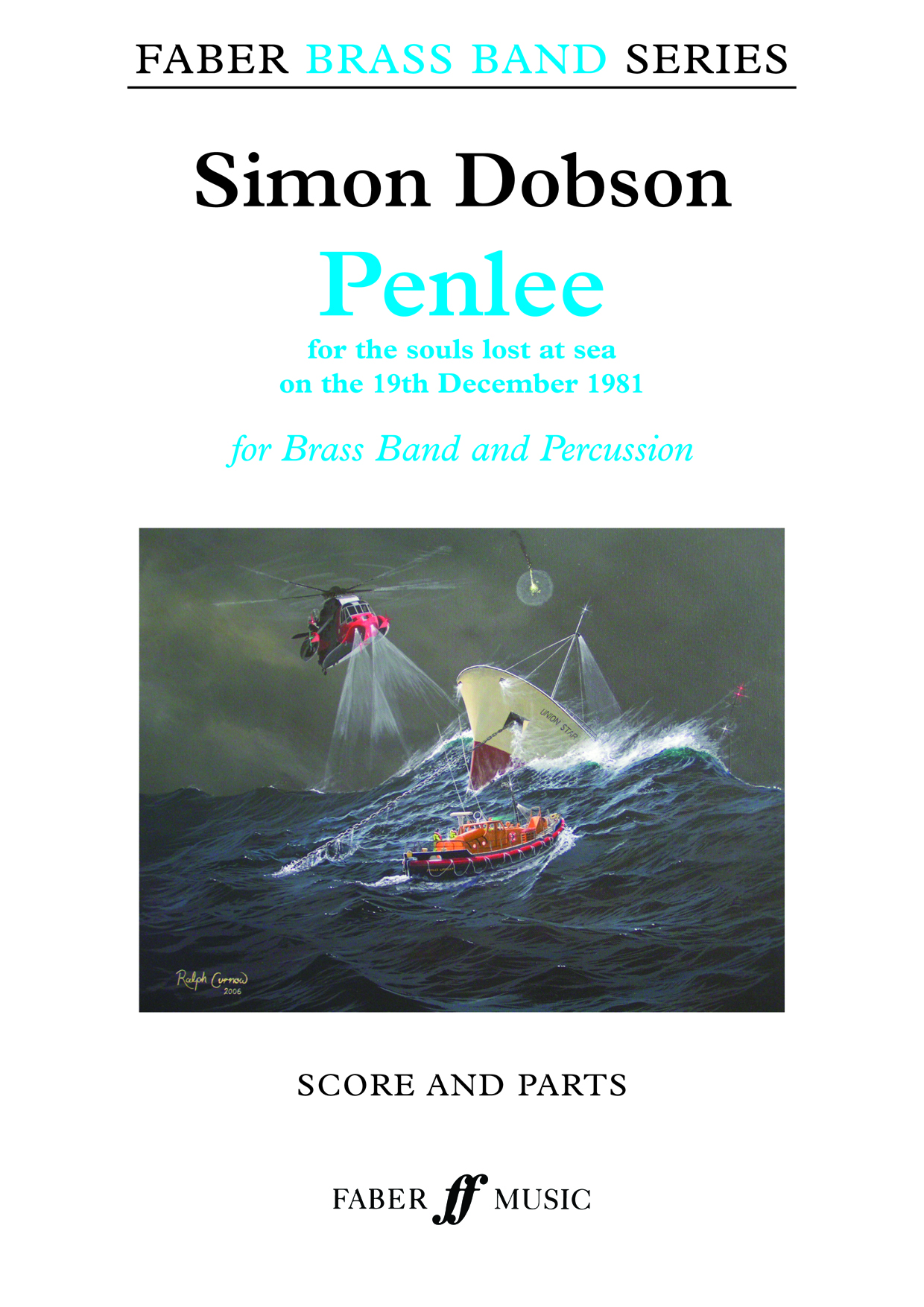
Penlee (Score & Parts) - Simon Dobson
To some, the tragic story of the Penlee lifeboat, Solomon Browne, would need no introduction, and to some the pain felt is still very much a reality. The composer, born just a few weeks before that fateful night on the 19th December 1981, has created this work as a musical homage to the bravery of the souls who lost their lives and has dedicated it to their memory.Penlee was commissioned by the Cornwall Youth Brass Band using funds bequeathed by Michael Pickett. The first performance was given by the Cornish Youth Brass Band, conducted by Ian Porthouse, at St. Michael's Church, Newquay, on 30th December 2008.Penlee has been voted into the Classic FM Hall of Fame 2011 at No.106. Not only is it the first time a brass work has been featured in the Hall of Fame, but it was also the highest new entry.The work has subsequently been recorded by the Leyland Band, conducted by Jason Katsikaris, on the CD entitled Penlee.Brass Band Grade 4: Advanced Youth and 3rd SectionDuration: 13 minutes
In Stock: Estimated dispatch 1-3 working days
-
 £35.00
strange geometry
Descriptionstrange geometrywas commissioned by Morgan Griffiths and the Hammonds Saltaire Band for their performance at the Brass in Concert Championships of 2015.As a bit of a space/sci-fi geek, as well as a musician, two events during the summer of 2015 had a particular effect on me. The first was the tragic early death in a plane crash of the famous film composer James Horner. Horner's music, particularly in films like 'Star Trek II: The Wrath of Khan', 'Avatar', 'Apollo 13' and even his debut in Roger Corman's 1980 budget film 'Battle Beyond the Stars', defined for a generation the sound of sci-fi at the cinema. Along with John Williams he created the vocabulary for those who wish to express other-worldly wonder in music and his inventive talent will be much missed in an industry where originality has become something of a dirty word in recent years.The second event was the epic flyby of Pluto by the NASA New Horizons spacecraft. There are many reasons to find this mission inspiring - for example, the scientists and engineers behind it created a craft that has travelled at 37,000 mph for nine years and three billion miles to arrive within seventy-two seconds of the predicted time for the flyby. That they achieved this with such accuracy is an outstanding tribute to humanity's ingenuity and insatiable curiosity. However, the most exciting aspect of the mission was the clear, high resolution pictures of this unthinkably remote and inhospitable world beamed back to mission control. The best previous image of Pluto was an indistinct fuzzy blob - suddenly we could see mountains made of ice, glaciers of methane and carbon monoxide and nitrogen fog - features previously unimagined on a world thought to be a slightly dull ball of cold rock. The BBC's venerable astronomy programme 'The Sky at Night' waxed lyrical about these newly discovered features, referring to "the surprising discoveries of mountains and strange geometry on the surface of this cold distant world".I like to think that Horner would have been as inspired as I have been by this real-life science story, and this piece uses some of the vocabulary of the sci-fi movie soundtrack in a tribute to the memory of a great musician and to the inspirational geeks at NASA who have boldly taken us where no-one has gone before.Note: This work comes with a B4 portrait score. Listen to a preview and follow the music below!
Estimated dispatch 7-14 working days
-
 £89.99
Penlee (Brass Band - Score and Parts)
2013 Finals of the National Brass Band Championships of Great Britain - 3rd SectioTo some, the tragic story of the Penlee lifeboat, Solomon Browne, would need no introduction, and to some the pain felt is still very much a reality. The composer, born just a few weeks before that fateful night on the 19th December 1981, has created this work as a musical homage to the bravery of the souls who lost their lives and has dedicated it to their memory.Penlee was commissioned by the Cornwall Youth Brass Band using funds bequeathed by Michael Pickett. The first performance was given by the Cornish Youth Brass Band, conducted by Ian Porthouse, at St. Michael's Church, Newquay, on 30th December 2008.Penlee has been voted into the Classic FM Hall of Fame 2011 at No.106. Not only is it the first time a brass work has been featured in the Hall of Fame, but it was also the highest new entry.The work has subsequently been recorded by the Leyland Band, conducted by Jason Katsikaris, on the CD entitled Penlee.Suitable for Advanced Youth/3rd Section Bands and aboveDuration: 13:30
Estimated dispatch 7-14 working days
-
 £45.00
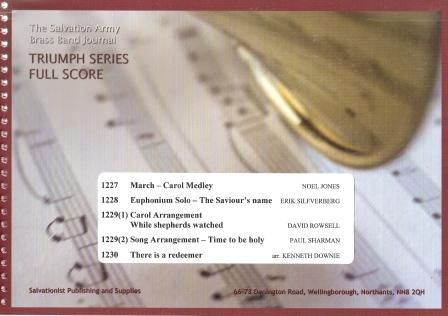
Triumph Series Band Journal July 2012 Numbers 1227 - 1230
No. 1227 March - Carol Medley (Noel Jones)This march features three carols, 'God rest ye merry, gentlemen', Hark! The herald angels sing' and 'Deck the Hall' together with brief references to others in a medley form. A couple of these references are somewhat camoflaged which provides further interest.No. 1228 Euphonium Solo - The Saviour's Name (Erik Silfverberg)A setting of Jane Clarke's lovely melody set to familiar words, 'There is a name I love to hear'.No. 1229 (1) Carol Arrangement - While shepherds watched (David Rowsell)A four-verse setting of the 16th Century tune, 'Winchester Old' commonly associated with the carol, 'While shepherds watched their flocks by night'.No. 1229 (2) Song Arrangement - Time to be holy (Paul Sharman)This arrangement of George Cole Stebbins' tune was originally made for the 2010 World Youth Convention in Sweden, the theme of which was 'Time to be holy'.No. 1230 There is a redeemer (Kenneth Downie)Melody Green-Sievright's popular song, 'There is a redeemer' was first published in 1982, 30 years before the appearance of this new setting.
Estimated dispatch 7-14 working days
-
 £27.00
Auld Lang Syne (Brass Band - Score and Parts)
It is a tradition in most English-speaking countries to sing this song at the stroke of midnight on New Year's Eve to usher in the New Year. The words are at least partially written by Robert Burns and the words "Auld Lang Syne" literally mean "old long ago" or "the good old days", providing a moment of reflection before moving forwards into the New Year.The tubular bells, although pitched, sound midnight when they enter at bar 10.This arrangement was prepared for Brass Band of the Western Reserve, musical director Keith M Wilkinson, to perform at First Night, Akron, Ohio, December 31st, 2007. The following choreography is suggested:Commence the performance with all the cornets scattered around the auditorium.At the end of bar 18 invite the audience to sing along with the band.At bar 27 the cornets move to stand in front of the other members of the band to lead to the stirring conclusion. Should auld acquaintance be forgot and never brought to mind?Should auld acquaintance be forgot and days of auld lang syne?For auld lang syne, my dear, for auld lang syne,We'll take a cup of kindness yet, for auld lang syne.
Estimated dispatch 7-14 working days
-
 £64.95
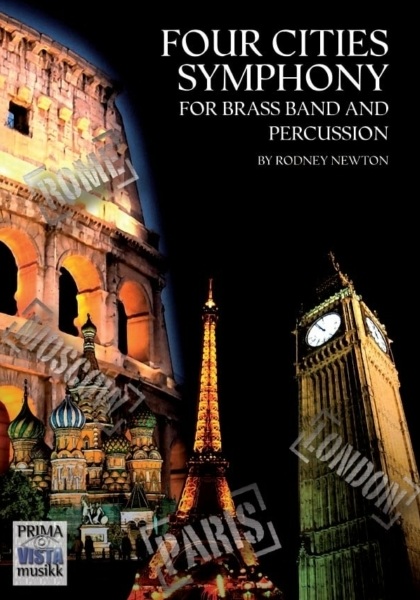
Four Cities Symphony (Brass Band - Score and Parts)
This piece was commissioned by the National Contesting Council as the 4th section test piece for the 2008 Regional Brass Band Championships of Great Britain.This symphony (the composer's 12th) has four movements played without a break. The first centres on two aspects of the city of London: its history and pageantry and its role as a busy modern metropolis.The second movement depicts Paris, its street cafes and boulevards and riverside walks, in the form of a romantic waltz.The third movement is constructed around the Gregorian chants of the Lord's Prayer (Pater noster, qui es in caelis) and the Creed (Credo in unum Deum) in an evocation of the city of Rome. After a powerful climax, mysterious tramping footsteps are heard as the ghosts or a Roman legion march through the city by night. The vision fades and the pater noster is heard once again before the movement is brought to a close with the ancient Ambrosian chant, Christus Vincit, Christus Regnet, Christus Imperat.The final movement is an evocation of the city of Moscow, with its great historic buildings, its turbulent history and its fiery traditional music. At the outset a rather dour folk-like melody is heard which is transformed into a lively Cossack dance.This work is dedicated to Howard Wilson, former principal euphonium of City of Coventry Band who, in 1972, introduced the composer to top section brass band contesting.Duration: 11.00
Estimated dispatch 7-14 working days
-
 £64.95
Music for Greenwich (Brass Band - Score and Parts) - Gregson, Edward
Music for Greenwich was commissioned in 1980 by the Greenwich Theatre, London, for a new production of Peter Buckman's play 'All Together Now'.In this play, about a down-at-heels brass band in the North of England brought to a new level of self-confidence and achievement by an incoming conductor, the whole cast performed a test piece on stage every night (i.e. Music for Greenwich), in readiness for a competition which they have entered and, of course, win. Although the play is as much a social commentary as anything to do with music-making, every member of the cast had to be able to play a brass instrument to a greater or lesser extent (a difficult challenge for the casting Director!).For obvious reasons, the music is not technically difficult. The work is structured as follows: a brief fanfare-like opening is followed by an allegro section, rhythmic and playful; a slow lyrical section is then introduced (a suitably nostalgic melody featuring solos for cornet and trombone), before a return to the fast music, a hint of the fanfare, and finally a climactic flourish to round things off. This is music to be enjoyed, as hopefully it was every night by the audience and actors alike.Duration: 5.00
Estimated dispatch 7-14 working days
-
£24.95
Music for Greenwich (Brass Band - Score only) - Gregson, Edward
Music for Greenwich was commissioned in 1980 by the Greenwich Theatre, London, for a new production of Peter Buckman's play 'All Together Now'.In this play, about a down-at-heels brass band in the North of England brought to a new level of self-confidence and achievement by an incoming conductor, the whole cast performed a test piece on stage every night (i.e. Music for Greenwich), in readiness for a competition which they have entered and, of course, win. Although the play is as much a social commentary as anything to do with music-making, every member of the cast had to be able to play a brass instrument to a greater or lesser extent (a difficult challenge for the casting Director!).For obvious reasons, the music is not technically difficult. The work is structured as follows: a brief fanfare-like opening is followed by an allegro section, rhythmic and playful; a slow lyrical section is then introduced (a suitably nostalgic melody featuring solos for cornet and trombone), before a return to the fast music, a hint of the fanfare, and finally a climactic flourish to round things off. This is music to be enjoyed, as hopefully it was every night by the audience and actors alike.Duration: 5.00
Estimated dispatch 7-14 working days
 View Music