
Results
-
 £54.95
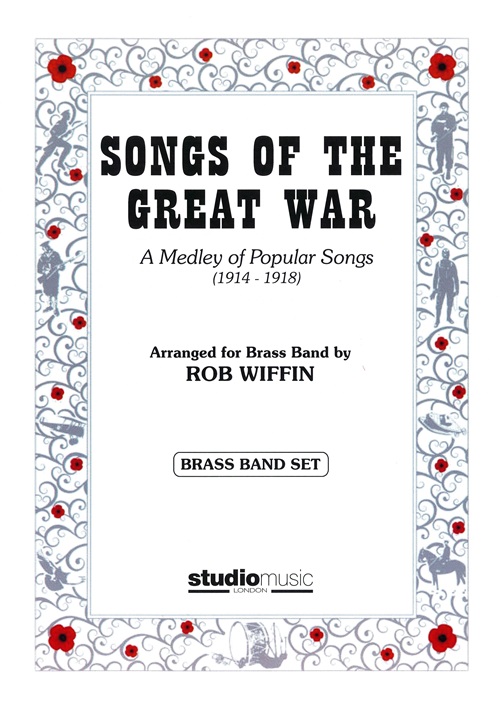
Songs of the Great War (Brass Band - Score and Parts) - Wiffin, Rob
A Medley of Popular Songs, 1914 - 1918Music of the Great War is a five year project to use music of the period to educate and engage schools, colleges, town bands, and the wider public across the UK and the world to learn in a positive way about the events, the experience of the troops involved from all sides, and how music played its part.This year, to commemorate the centenary of the Great War a specially arranged medley Songs of the Great War has been created. The medley has been arranged for bands to rehearse and eventually perform on the 11 November 2015. It brings together some of the most popular tunes played, sung and performed by the men and women of the time - in the trenches and on the various home fronts.With the support of many countries and organisations, on the 11 November the medley will be first played in New Zealand and Australia. It will ripple east across the world being performed in countries like India and Pakistan before hitting Europe and onwards to include performances in Canada and the Caribbean. This could become one of the most played pieces of music in a 24-hour period.In Britain, there will be performances across the country, including some at key events and sites involving a wide range of military and non-military personnel.The medley includes:It's a Long Way to TipperaryYour King and Country Want YouGood Bye-eeOh! It's a Lovely WarHello! Hello! Who's Your Lady FriendTake Me Back to Dear Old BlightyMademoiselle from ArmentieresThere's a Long, Long Trail A-windingIf You Were the Only Girl in the WorldPack Up Your Troubles (In Your Old Kit Bag)Old Soldiers Never Die/Last Post
Estimated dispatch 7-14 working days
-
 £55.00
The Dreaded Groove and Hook (Brass Band - Score and Parts) - Dobson, Simon
The Dreaded Groove and Hook is an up-tempo acid-jazz number that draws inspiration from bands like Jamiroquai and The Youngblood Brass Band. The groove in question is the main tune that is shared round the band, whilst the hook, in 'pop' terms, is the catchy bit of the song. The whole band joins in to play a huge 'riff' that acts as a chorus to the jazz-like verses.The piece was commissioned by Jason Katsikaris and The Leyland Band, who gave the first performance as part of their programme for the Brass in Concert Championships, held at The Sage, Gateshead on the 16th November 2008. It has been recorded by the same band and conductor on the CD entitled Penlee.Suitable for 1st Section Bands and aboveDuration: 4.00
Estimated dispatch 7-14 working days
-
 £45.00
For the Love of a Princess (Brass Band - Score and Parts) - Horner, James - Duncan, Andrew
A spectacular Brass Band arrangement of James Horner's love theme from Braveheart in full score and parts. Ideal for school concert bands, arranged by Andrew Duncan.Suitable for Advanced Youth/3rd Section Bands and aboveRecorded on Polyphonic QPRL220D Master Brass (Volume 16)Duraton: 4.00
Estimated dispatch 7-14 working days
-
 £69.99
The Green Hills of Tyrol (Euphonium Solo with Brass Band - Score and Parts) - Sparke, Philip
The Green Hills of Tyrol was commissioned by Jrena and Beat Knusel for their son, Swiss euphonium player Joel Knusel, to celebrate his 20th birthday in 2019. The request was for a piece suitable for use in a solo competition, possibly using a Scottish or Irish melody, and composer Philip Sparke suggested an old-fashioned air varie might be a suitable idea. The piece follows the well-established formula of a theme followed by four variations. The history of the original melody is fascinating and, although it is now well-known as a bagpipe tune, its background is Austrian or Italian, rather than Scottish. The tune appears as a chorus of Swiss soldiers in Rossini's 1829 opera William Tell but was possibly an existing Tyrolean folk tune. In 1854, during the Crimean War, Pipe Major John MacLeod of the 93rd Highlanders heard a band of the Sardinian contingent playing selections from the opera in camp before the Siege of Sebastopol. He was struck by the melody and arranged it for his pipers, calling it The Green Hills of Tyrol, referring to Tell's visit to that corner of Austria in the opera. It has since become universally popular among pipe bands who usually refer to it as A Scottish Soldier, following the addition of new lyrics in a 1961 hit by Andy Stewart.Duration: 5.45
Estimated dispatch 7-14 working days
-
 £125.00
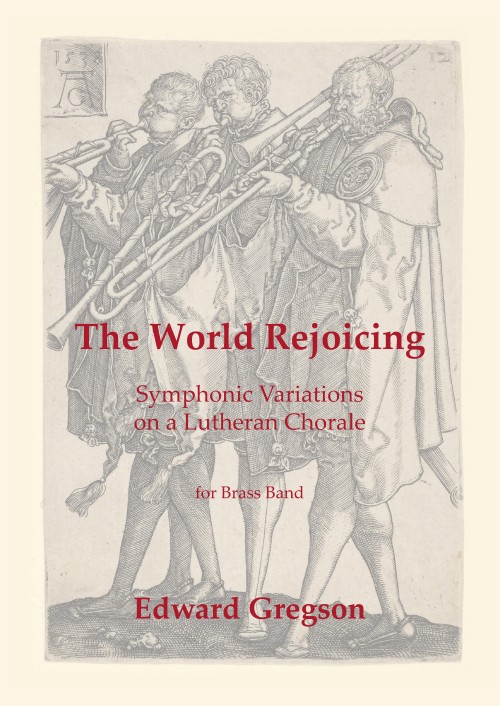
The World Rejoicing (Brass Band - Score and Parts) - Gregson, Edward
The World Rejoicing was commissioned by the National Brass Band Associations of Belgium, Netherlands, Norway, Switzerland, and the British Open, as the test piece for their competitions in 2020/21. Although the work was completed in 2019, the pandemic of 2020 meant that these competitions were postponed until 2021/22. The premiere took place in September 2021 at Symphony Hall, Birmingham, UK.In searching for a common link between the brass band traditions of the various European countries that commissioned this work, I considered the fact that hymns have always played an important role in the relationship that brass bands have with their particular communities; and thus I turned to a well- known Lutheran chorale, Nun danket alle Gott (Now thank we all our God), written around 1636 by Martin Rinkart, with the melody attributed to Johann Cruger. A number of composers have incorporated this chorale into their music, most famously J.S. Bach in his Cantatas no. 79 and 192, and Mendelssohn in the Lobsegang movement of his 2nd Symphony (the harmonisation of which is usually used when this hymn is sung).It seemed fitting therefore for me to return to a compositional form I have used many times before (Variations) and to write a work based on this hymn. I have used it in a similar way to that which I employed in my Variations on Laudate Dominum of 1976 - that is, rather than writing a set of variations using elaborations of the complete tune, I have taken various phrases from the chorale and used them within the context of other musical material, applying an overall symphonic process of continuous variation and development. The structure, or sub-divisions of the work, which is through composed and plays without a break, is as follows:Prelude, Capriccio, La Danza 1, Processional, La Danza 2, Arias and Duets, Fuga Burlesca, Chorale, and Postlude.The work, which is around 16 minutes in length, is also partly autobiographical - in the manner say of Strauss's Ein Heldenleben - in that I have incorporated into the score brief quotations from many of my other major works for brass band. In that respect, The World Rejoicing sums up a particular facet of my life as a composer, and reflects the admiration I have always had for what is surely one of the great amateur music-making traditions in the world.Duration: 16.00
Estimated dispatch 7-14 working days
-
£40.00
The World Rejoicing (Brass Band - Score only) - Gregson, Edward
The World Rejoicing was commissioned by the National Brass Band Associations of Belgium, Netherlands, Norway, Switzerland, and the British Open, as the test piece for their competitions in 2020/21. Although the work was completed in 2019, the pandemic of 2020 meant that these competitions were postponed until 2021/22. The premiere took place in September 2021 at Symphony Hall, Birmingham, UK.In searching for a common link between the brass band traditions of the various European countries that commissioned this work, I considered the fact that hymns have always played an important role in the relationship that brass bands have with their particular communities; and thus I turned to a well- known Lutheran chorale, Nun danket alle Gott (Now thank we all our God), written around 1636 by Martin Rinkart, with the melody attributed to Johann Cruger. A number of composers have incorporated this chorale into their music, most famously J.S. Bach in his Cantatas no. 79 and 192, and Mendelssohn in the Lobsegang movement of his 2nd Symphony (the harmonisation of which is usually used when this hymn is sung).It seemed fitting therefore for me to return to a compositional form I have used many times before (Variations) and to write a work based on this hymn. I have used it in a similar way to that which I employed in my Variations on Laudate Dominum of 1976 - that is, rather than writing a set of variations using elaborations of the complete tune, I have taken various phrases from the chorale and used them within the context of other musical material, applying an overall symphonic process of continuous variation and development. The structure, or sub-divisions of the work, which is through composed and plays without a break, is as follows:Prelude, Capriccio, La Danza 1, Processional, La Danza 2, Arias and Duets, Fuga Burlesca, Chorale, and Postlude.The work, which is around 16 minutes in length, is also partly autobiographical - in the manner say of Strauss's Ein Heldenleben - in that I have incorporated into the score brief quotations from many of my other major works for brass band. In that respect, The World Rejoicing sums up a particular facet of my life as a composer, and reflects the admiration I have always had for what is surely one of the great amateur music-making traditions in the world.Duration: 16.00
Estimated dispatch 7-14 working days
-
£15.00
The World Rejoicing (Brass Band - Study Score) - Gregson, Edward
The World Rejoicing was commissioned by the National Brass Band Associations of Belgium, Netherlands, Norway, Switzerland, and the British Open, as the test piece for their competitions in 2020/21. Although the work was completed in 2019, the pandemic of 2020 meant that these competitions were postponed until 2021/22. The premiere took place in September 2021 at Symphony Hall, Birmingham, UK.In searching for a common link between the brass band traditions of the various European countries that commissioned this work, I considered the fact that hymns have always played an important role in the relationship that brass bands have with their particular communities; and thus I turned to a well- known Lutheran chorale, Nun danket alle Gott (Now thank we all our God), written around 1636 by Martin Rinkart, with the melody attributed to Johann Cruger. A number of composers have incorporated this chorale into their music, most famously J.S. Bach in his Cantatas no. 79 and 192, and Mendelssohn in the Lobsegang movement of his 2nd Symphony (the harmonisation of which is usually used when this hymn is sung).It seemed fitting therefore for me to return to a compositional form I have used many times before (Variations) and to write a work based on this hymn. I have used it in a similar way to that which I employed in my Variations on Laudate Dominum of 1976 - that is, rather than writing a set of variations using elaborations of the complete tune, I have taken various phrases from the chorale and used them within the context of other musical material, applying an overall symphonic process of continuous variation and development. The structure, or sub-divisions of the work, which is through composed and plays without a break, is as follows:Prelude, Capriccio, La Danza 1, Processional, La Danza 2, Arias and Duets, Fuga Burlesca, Chorale, and Postlude.The work, which is around 16 minutes in length, is also partly autobiographical - in the manner say of Strauss's Ein Heldenleben - in that I have incorporated into the score brief quotations from many of my other major works for brass band. In that respect, The World Rejoicing sums up a particular facet of my life as a composer, and reflects the admiration I have always had for what is surely one of the great amateur music-making traditions in the world.Duration: 16.00
Estimated dispatch 7-14 working days
-
 £69.95
Heroes of the North (Brass Band - Score and Parts) - Graham, Peter
Heroes of the North was commissioned by Henning Annundsen for Skodvin Skulemusikk and pays tribute to the development of brass band activity in the Nordhordland region of Norway.The music is a set of character variations based upon personalities long associated with both the band and the region. The opening 5 note motif (C D E F G) might be considered the starting point for beginner brass students, and this mini-theme is developed throughout the work.Five variations follow: Mr Brevik's Galop (representing Tom Brevik, a key figure in Norwegian brass band music); Frode's Dance (with apologies to Edvard Grieg), portraying soprano cornet player Frode Rydland, one of Skodvin Skulemusikk's most famous "old boys"; Mr Bjrge's Walk representing Viggo Bjrge, "Mr Eikanger Bjrsvik Band"; Hymn for Knut-Harald, known as "Mr Skodvin Skulemusikk" having over many years played a central role in the teaching and training of the band, and finally Maestro Snell's Russian Adventure features music with more than a hint of Russian (Khachaturian to be precise) and calls to mind Howard Snell whose arrangements and presence have made such a huge contribution to Norwegian Brass Banding over many years.Heroes of the North is playable by 4th section bands.Duration: 10.00
Estimated dispatch 7-14 working days
-
 £29.95
Heroes of the North (Brass Band - Score only) - Graham, Peter
Heroes of the North was commissioned by Henning Annundsen for Skodvin Skulemusikk and pays tribute to the development of brass band activity in the Nordhordland region of Norway.The music is a set of character variations based upon personalities long associated with both the band and the region. The opening 5 note motif (C D E F G) might be considered the starting point for beginner brass students, and this mini-theme is developed throughout the work.Five variations follow: Mr Brevik's Galop (representing Tom Brevik, a key figure in Norwegian brass band music); Frode's Dance (with apologies to Edvard Grieg), portraying soprano cornet player Frode Rydland, one of Skodvin Skulemusikk's most famous "old boys"; Mr Bjrge's Walk representing Viggo Bjrge, "Mr Eikanger Bjrsvik Band"; Hymn for Knut-Harald, known as "Mr Skodvin Skulemusikk" having over many years played a central role in the teaching and training of the band, and finally Maestro Snell's Russian Adventure features music with more than a hint of Russian (Khachaturian to be precise) and calls to mind Howard Snell whose arrangements and presence have made such a huge contribution to Norwegian Brass Banding over many years.Heroes of the North is playable by 4th section bands.Duration: 10.00
Estimated dispatch 7-14 working days
-
£100.00
Handel in the Band (Brass Band - Score and Parts) - Downie, Kenneth
Handel in the Band is a virtuoso set of symphonic variations on one of Handel's best known keyboard dances, the Sarabande from his Suite in D minor, HWV 437, based on the Spanish traditional dance La Folia. Kenneth Downie's work was commissioned by Brass Band Treize Etoiles, for performance at the 2013 Swiss National Brass Band Championships, where it was conducted by James Gourlay. The title is a reference to Percy Grainger's popular Handel in the Strand, and is indicative of the witty and theatrical nature of the music, which is more playful than conventional competition pieces and as such offers different challenges to brass bands as well as being thoroughly entertaining for audiences.Kenneth Downie is one of the most respected and experienced brass band composers. His music has been widely performed and published throughout the brass band world since the 1960s.Handel in the Band was selected as the set work for the Championship Section final of the 2018 National Brass Band Championships of Great Britain, which took place at the Royal Albert Hall, London, on 6th October 2018.Duration: 15.00
Estimated dispatch 7-14 working days
 View Music