
Results
-
 £33.62
Rockingham (Brass Band) Edward Miller arr. Karl Whelan
This sublime arrangement of the much loved hymn tune Rockingham ('When I survey the wondrous cross'), was arranged by Karl Whelan in memory of Frank Naylor. Frank was a faithful member of North Ashton Band based in Wigan (UK), a renowned tenor horn player and an inspiration to his many pupils over the years. In reference to Frank's slow melody piece of choice, there is also a reference in the trombones to Star of Bethlehem by Stephen Adams, leading into the final verse. Sheet music available from: UK - www.brassband.co.uk USA - www.solidbrassmusic.com Difficulty Level: 4th Section + Instrumentation: Soprano Cornet Eb Solo Cornet Bb Repiano Cornet Bb 2nd Cornet Bb 3rd Cornet Bb Flugel Horn Bb Solo Horn Eb 1st Horn Eb 2nd Horn Eb 1st Baritone Bb 2nd Baritone Bb 1st Trombone Bb 2nd Trombone Bb Bass Trombone Euphonium Bb Bass Eb Bass Bb Timpani Percussion 1-3
In Stock: Estimated dispatch 1-3 working days
-
 £33.62
You're Always There (Brass Band) Lee Fisher arr. Andrew Wainwright
One of BrookWright's most popular titles, this piece is based on an original song by Lee Fisher which was written for Britain's Got Talent star Charlie Green. Originally arranged as a tenor horn solo with brass band, it is now available here as a standalone work for band. To view a follow-the-score video please visit www.youtube.com/watch?v=suzzgdxU_xU PDF download includes score and parts. Sheet music available from: UK - www.brassband.co.uk USA - https://satradecentral.org Difficulty Level: 4th Section + Length: 3.45 minutes Instrumentation: Soprano Cornet Eb Solo Cornet Bb Repiano Cornet Bb 2nd Cornet Bb 3rd Cornet Bb Flugel Horn Bb Solo Horn Eb 1st Horn Eb 2nd Horn Eb 1st Baritone Bb 2nd Baritone Bb 1st Trombone Bb 2nd Trombone Bb Bass Trombone Euphonium Bb Bass Eb Bass Bb Timpani Percussion 1-2
In Stock: Estimated dispatch 1-3 working days
-
 £33.62
Love Eternal (Trombone Solo with Brass Band) Jarrod Cooper arr. Gavin Lamplough
Love Eternal was arranged by Gavin Lamplough for trombone virtuoso Isobel Daws to perform in a special concert with the Melbourne Staff Band to honour its Bandmaster Ken Waterworth, on the occasion of his retirement after 30 years of leading the band. The arranger uses Jarod Cooper's popular contemporary worship song King of Kings, Majesty as the basis for the work and the piece seeks to provide a vehicle for the rich timbres of the trombone to be enjoyed by the listener. To view a rolling score video featuring Isobel Daws and the Melbourne Staff Band please visit www.youtube.com/watch?v=AEpbHNFPMxs This title is also available as a tenor horn solo with brass band here. PDF download includes score and parts. Sheet music available from: UK - www.brassband.co.uk USA - https://satradecentral.org Difficulty Level: 4th Section + Length: 5.00 minutes Instrumentation: Trombone Soloist Eb Soprano Cornet Eb 1st Cornet Bb 2nd Cornet Bb Flugel Horn Bb 1st Horn Eb 2nd Horn Eb 1st Baritone Bb 2nd Baritone Bb 1st Trombone Bb 2nd Trombone Bb Bass Trombone Euphonium Bb Bass Eb Bass Bb Percussion 1-3
In Stock: Estimated dispatch 1-3 working days
-
 £60.00
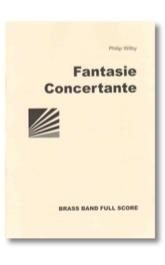
Fantasie Concertante (Score only) - Philip Wilby
This exciting new concerto is a welcome addition to the repertoire of french and tenor horn players alike. Like the 18th-Century Serenade form there are five movements, arranged symmetrically around a slow movement - Soliloquy - which separates movements entitled Burlesque (two) and Valse Caprice (three) respectively. The first and last movements share common material of a more symphonic stature, and the concerto ends with a brisk fugato. The solo horn is (in the band version) accompanied by a quintet of solo players (two cornets, euphonium, trombone, and tuba) who provide the lion's share of the counterpoint and contrast with the main body of musicians who provide musical punctuation in the more sonorous tutti sections. The first movement, Don Quixote's Dream, contains references to Cervantes' famous hero, the Spanish nature of his stories, and the ambling gait of his horseback adventures.
Estimated dispatch 7-9 working days
-
 £74.00
Fantasie Concertante (Parts only) - Philip Wilby
This exciting new concerto is a welcome addition to the repertoire of french and tenor horn players alike. Like the 18th-Century Serenade form there are five movements, arranged symmetrically around a slow movement - Soliloquy - which separates movements entitled Burlesque (two) and Valse Caprice (three) respectively. The first and last movements share common material of a more symphonic stature, and the concerto ends with a brisk fugato. The solo horn is (in the band version) accompanied by a quintet of solo players (two cornets, euphonium, trombone, and tuba) who provide the lion's share of the counterpoint and contrast with the main body of musicians who provide musical punctuation in the more sonorous tutti sections. The first movement, Don Quixote's Dream, contains references to Cervantes' famous hero, the Spanish nature of his stories, and the ambling gait of his horseback adventures.
Estimated dispatch 7-9 working days
-
 £29.95
Cafe 1719 - Jonathan Bates
DURATION: 2'30". DIFFICULTY: 1st Section+. 'Caf 1719' was composed for the Wantage Silver Band as part of their entertainment contest sets based on the music of Johann Sebastian Bach in 2019. This particular short, jazz-inspired work is composed in tribute to the great French Pianist Jacques Loussier (1934-2019) who received global acclaim for his jazz interpretations of Bach's music, along with many other classical composers. Despite being born in the same year and living in the same country, Bach and Handel never actually met, but what if they had? Cafe 1917 acts as a musical meeting point - in a fictional Jazz Cafe by the Rhine, with the tenor horn section performing a 'Loussier-esque' version of Bach's 'Prelude No.2 in C Minor' whilst on the other side of the cafe, the trombone section follow suit with their take on Handel's 'Bourree from Music for the Royal Fireworks'. Eventually the two meet, share ideas and incorporate them into each other's melodies. Amongst the 2 main featured works by Bach and Handel, the tutti interludes are constructed on music from Bach's 'Toccata and Fugue in D Minor'. .
In Stock: Estimated dispatch 1-3 working days
-
 £39.95
Agrabah Sunrise - Jonathan Bates
DIFFICULTY: 1st+. DURATION: 4'00". 'Agrabah Sunrise' was composed for the Foden's Band's Aladdin themed programme at the 2023 Brass in Concert Championships, held at The Glasshouse, Gateshead. The music uses a traditional Western Asian Raga called 'Bhairav' - traditionally practised in the early hours of the morning - as it's base and features extensive technical solos for Soprano, Cornet, Tenor Horn and Euphonium.
In Stock: Estimated dispatch 1-3 working days
-
 £34.95
Prelude on St. Clements - Jonathan Bates
DIFFICULTY: 3rd+. DURATION: 5'00". 'Prelude on St Clement's' was composed for the 2023 Royal Northern College of Music Brass Band Festival in memory of internationally renowned conductor and composer Bramwell Tovey. . Bramwell was the Artistic Director of the National Youth Brass Band of Great Britain throughout the composer's 7 years as a tenor horn player in the NYBBGB and the hymn tune 'St Clement's (no. 82 in the 120 Hymns for Brass Band book) was used by Bramwell to conclude every course. This setting of 3 verses of the hymn tune 'The Day Thou Gavest. was premiered by the RNCM Brass Band in January 2023.
In Stock: Estimated dispatch 1-3 working days
-
 £45.00
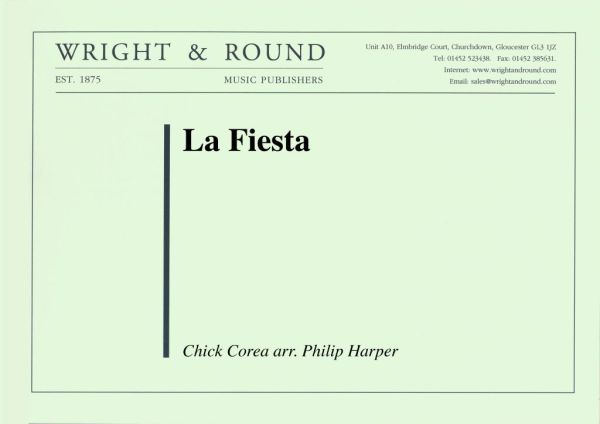
La Fiesta (Score and Parts)
Chick Corea is an American pianist and composer of Sicilian and Spanish descent, whose long career in jazz music continues to this day. A member of Miles Davis's band in the 1960s, he formed his own band Return to Forever in the 1970s before establishing himself as one of the greats of modern jazz.La Fiesta was composed in 1972 and included on Return to Forever's debut album. The music is in one-in-a-bar waltz time and switches between Latin carnival-style and jazz waltz, with stand-up solos for cornet, baritone and tenor horn. This arrangement was performed as part of the Cory Band's winning Brass in Concertprogramme in 2012.
Estimated dispatch 7-14 working days
-
£45.00
La Fiesta - Corea, C - Harper, P
Chick Corea is an American pianist and composer of Sicilian and Spanish descent, whose long career in jazz music continues to this day. A member of Miles Davis's band in the 1960s, he formed his own band Return to Forever in the 1970s before establishing himself as one of the greats of modern jazz.La Fiesta was composed in 1972 and included on Return to Forever's debut album. The music is in one-in-a-bar waltz time and switches between Latin carnival-style and jazz waltz, with stand-up solos for cornet, baritone and tenor horn. This arrangement was performed as part of the Cory Band's winning Brass in Concert programme in 2012.Listen to Cory BandCourtesy of World of Brass
In Stock: Estimated dispatch 1-3 working days
 Watch video
 View Music