
Results
-
 £31.95
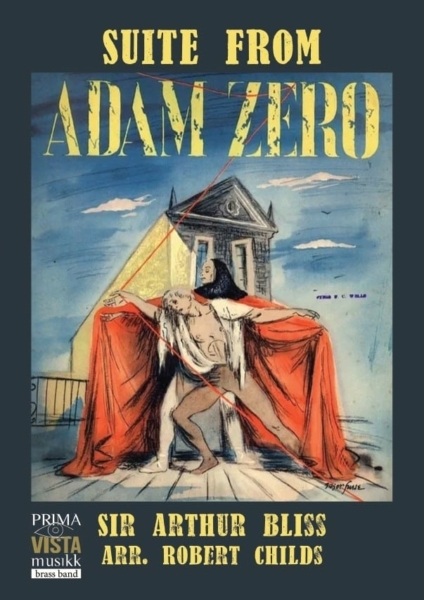
Adam Zero, Suite from (Brass Band - Score only) - Bliss, Arthur - Childs, Robert
Selected as the Section 2 test piece for the National Brass Band Championships of Great Britain 2025Following his ballet Checkmate, Bliss composed another score for the, by then, Sadler's Wells Ballet, Miracle in the Gorbals, which was choreographed by Robert Helpmann, to a scenario by Michael Benthall. Premired in 1944, the ballet made a considerable impact and was a box-office success. It was followed in turn by a further collaboration with Helpmann and Benthall, Adam Zero. This would serve Helpmann, in the eponymous role, as a vehicle in two respects: demonstrating his gifts as a dancer-actor and as a choreographer. First performed at the Royal Opera House, Covent Garden, on 8 April 1946, Adam Zero was conducted by Constant Lambert, the work's dedicatee. Bliss considered it 'his most varied and exciting ballet score'. Benthall provided a synopsis for the programme:There is a philosophy that life moves in an endless series of timeless cycles. As Nature passes through Spring, Summer, Autumn and Winter, so man is born, makes a success in his own particular sphere, loses his position to a younger generation, sees his world crumble before his eyes and only finds peace in death. This age-old story is told in terms of a Company creating a ballet and calling on the resources of the theatre to do so. Lighting, stage mechanism, dance conventions, musical forms and costumes and scenery of all periods are used to symbolize the world of 'Adam Zero'.Apart from Adam, as the Principal Dancer, other main roles included the Stage Director (representing Omnipotence), and Adam's Fates (Designer, Wardrobe Mistress, and Dresser). 'The Woman in this allegory', wrote Bliss, 'under the symbol of the Choreographer, was both the creator and destroyer of Adam: his first love, his wife, his mistress, and finally the figure of beneficent Death.' When the curtain rose, the 'audience saw the Covent Garden stage right back to the wall, completely empty except for the protagonists, 'the Company poised, still and expectant, as they await the birth of... Adam Zero.'Unfortunately, soon after the premire, Helpmann injured himself and had to withdraw from the remaining performances. Despite generally positive reviews, the ballet did not capture the imagination of audiences and, to Bliss's considerable disappointment, was not revived. Seventy years would elapse before its first major return to the stage, in 2016, performed by the ballet company of Stadttheater Bremerhaven with choreography by Sergei Vanaev.Bliss extracted a concert suite from the ballet, conducting its first performance with the City of Birmingham Symphony Orchestra on 28 October 1948. For his own suite, arranged for brass band in 2023, Dr Robert Childs chose three dances linked to the seasons, book-ending them with the ebullient 'Fanfare Overture' and 'Fanfare Coda'. After Adam has grown to manhood, his Fates clothe him in a costume synonymous with confident youth, appropriate for the virile, ardent 'Dance of Spring'. In the 'Approach of Autumn', Adam, now wearing a sombre costume, has grown older: his Fates have streaked grey in his hair and put lines on his face. But they had earlier raised Adam to the zenith of his power, and the 'Dance of Summer' depicts him in the prime of life, in music of sweeping grandeur. The 'Fanfare Coda' signals that the next cycle of life is about to begin.Duration: 10.30
Estimated dispatch 7-14 working days
-
£21.65
Adam Zero, Suite from (Brass Band - Study Score) - Bliss, Arthur - Childs, Robert
Selected as the Section 2 test piece for the National Brass Band Championships of Great Britain 2025Following his ballet Checkmate, Bliss composed another score for the, by then, Sadler's Wells Ballet, Miracle in the Gorbals, which was choreographed by Robert Helpmann, to a scenario by Michael Benthall. Premired in 1944, the ballet made a considerable impact and was a box-office success. It was followed in turn by a further collaboration with Helpmann and Benthall, Adam Zero. This would serve Helpmann, in the eponymous role, as a vehicle in two respects: demonstrating his gifts as a dancer-actor and as a choreographer. First performed at the Royal Opera House, Covent Garden, on 8 April 1946, Adam Zero was conducted by Constant Lambert, the work's dedicatee. Bliss considered it 'his most varied and exciting ballet score'. Benthall provided a synopsis for the programme:There is a philosophy that life moves in an endless series of timeless cycles. As Nature passes through Spring, Summer, Autumn and Winter, so man is born, makes a success in his own particular sphere, loses his position to a younger generation, sees his world crumble before his eyes and only finds peace in death. This age-old story is told in terms of a Company creating a ballet and calling on the resources of the theatre to do so. Lighting, stage mechanism, dance conventions, musical forms and costumes and scenery of all periods are used to symbolize the world of 'Adam Zero'.Apart from Adam, as the Principal Dancer, other main roles included the Stage Director (representing Omnipotence), and Adam's Fates (Designer, Wardrobe Mistress, and Dresser). 'The Woman in this allegory', wrote Bliss, 'under the symbol of the Choreographer, was both the creator and destroyer of Adam: his first love, his wife, his mistress, and finally the figure of beneficent Death.' When the curtain rose, the 'audience saw the Covent Garden stage right back to the wall, completely empty except for the protagonists, 'the Company poised, still and expectant, as they await the birth of... Adam Zero.'Unfortunately, soon after the premire, Helpmann injured himself and had to withdraw from the remaining performances. Despite generally positive reviews, the ballet did not capture the imagination of audiences and, to Bliss's considerable disappointment, was not revived. Seventy years would elapse before its first major return to the stage, in 2016, performed by the ballet company of Stadttheater Bremerhaven with choreography by Sergei Vanaev.Bliss extracted a concert suite from the ballet, conducting its first performance with the City of Birmingham Symphony Orchestra on 28 October 1948. For his own suite, arranged for brass band in 2023, Dr Robert Childs chose three dances linked to the seasons, book-ending them with the ebullient 'Fanfare Overture' and 'Fanfare Coda'. After Adam has grown to manhood, his Fates clothe him in a costume synonymous with confident youth, appropriate for the virile, ardent 'Dance of Spring'. In the 'Approach of Autumn', Adam, now wearing a sombre costume, has grown older: his Fates have streaked grey in his hair and put lines on his face. But they had earlier raised Adam to the zenith of his power, and the 'Dance of Summer' depicts him in the prime of life, in music of sweeping grandeur. The 'Fanfare Coda' signals that the next cycle of life is about to begin.Duration: 10.30
Estimated dispatch 7-14 working days
-
£74.95
Adam Zero, Suite from (Brass Band - Score and Parts) - Bliss, Arthur - Childs, Robert
Selected as the Section 2 test piece for the National Brass Band Championships of Great Britain 2025Following his ballet Checkmate, Bliss composed another score for the, by then, Sadler's Wells Ballet, Miracle in the Gorbals, which was choreographed by Robert Helpmann, to a scenario by Michael Benthall. Premired in 1944, the ballet made a considerable impact and was a box-office success. It was followed in turn by a further collaboration with Helpmann and Benthall, Adam Zero. This would serve Helpmann, in the eponymous role, as a vehicle in two respects: demonstrating his gifts as a dancer-actor and as a choreographer. First performed at the Royal Opera House, Covent Garden, on 8 April 1946, Adam Zero was conducted by Constant Lambert, the work's dedicatee. Bliss considered it 'his most varied and exciting ballet score'. Benthall provided a synopsis for the programme:There is a philosophy that life moves in an endless series of timeless cycles. As Nature passes through Spring, Summer, Autumn and Winter, so man is born, makes a success in his own particular sphere, loses his position to a younger generation, sees his world crumble before his eyes and only finds peace in death. This age-old story is told in terms of a Company creating a ballet and calling on the resources of the theatre to do so. Lighting, stage mechanism, dance conventions, musical forms and costumes and scenery of all periods are used to symbolize the world of 'Adam Zero'.Apart from Adam, as the Principal Dancer, other main roles included the Stage Director (representing Omnipotence), and Adam's Fates (Designer, Wardrobe Mistress, and Dresser). 'The Woman in this allegory', wrote Bliss, 'under the symbol of the Choreographer, was both the creator and destroyer of Adam: his first love, his wife, his mistress, and finally the figure of beneficent Death.' When the curtain rose, the 'audience saw the Covent Garden stage right back to the wall, completely empty except for the protagonists, 'the Company poised, still and expectant, as they await the birth of... Adam Zero.'Unfortunately, soon after the premire, Helpmann injured himself and had to withdraw from the remaining performances. Despite generally positive reviews, the ballet did not capture the imagination of audiences and, to Bliss's considerable disappointment, was not revived. Seventy years would elapse before its first major return to the stage, in 2016, performed by the ballet company of Stadttheater Bremerhaven with choreography by Sergei Vanaev.Bliss extracted a concert suite from the ballet, conducting its first performance with the City of Birmingham Symphony Orchestra on 28 October 1948. For his own suite, arranged for brass band in 2023, Dr Robert Childs chose three dances linked to the seasons, book-ending them with the ebullient 'Fanfare Overture' and 'Fanfare Coda'. After Adam has grown to manhood, his Fates clothe him in a costume synonymous with confident youth, appropriate for the virile, ardent 'Dance of Spring'. In the 'Approach of Autumn', Adam, now wearing a sombre costume, has grown older: his Fates have streaked grey in his hair and put lines on his face. But they had earlier raised Adam to the zenith of his power, and the 'Dance of Summer' depicts him in the prime of life, in music of sweeping grandeur. The 'Fanfare Coda' signals that the next cycle of life is about to begin.Duration: 10.30
Estimated dispatch 7-14 working days
-
 £88.00
Bass Trombone Concerto (Bass Trombone Solo with Brass Band - Score and Parts) - Brubeck, Christopher
"As a bass trombonist, I spent many years of my adolescence playing in youth orchestras, engaging in musical daydreams. I would visualize myself jumping up from the back of the orchestra to unleash improvisations much to the conductor's horror. The resultant three-movement, thirteen-minute work has enjoyed a robust life with performances by notable orchestras all around the world. Happily, the concerto works well as a recital piece, with many accomplished college players having won concerto competitions performing it. Jazz elements were inescapable, and realizing my old nightmare/dream, quite a bit of the trombone solo is meant to be improvised. I made a recording of the concerto with the London Symphony Orchestra, which was included on a CD called Bach to Brubeck released on Koch International Classics. Having already become popular as a bass trombone work with orchestra accompaniment, renowned British Bass Trombonist and publisher Roger Argente suggested he release a special Brass Band arrangement of my concerto. Roger knew the piece well because years ago he played the European premiere of the concerto with the Royal Philharmonic Orchestra at the Royal Albert Hall." - Chris Brubeck. Duration: 13.00. Suitable for 1st Section Bands and above.
Estimated dispatch 7-14 working days
-
 £69.99
Homage (Brass Band - Score and Parts) - Van der Roost, Jan
In the most literal sense: a piece for an occasion. The actual occasion was Jan de Haan's twentieth anniversary as a conductor of the top Dutch brass band, "Soli Deo Gloria" (Leeuwarden). To mark the occasion, the band commissioned the Belgian composer Jan Van der Roost to create a surprise piece: without knowledge of the person being celebrated, a suitable source of inspiration was sought for. After some thought the chorale-theme from Camille Saint-Sans organ symphony was chosen, a piece with which Jan de Haan has a special bond. Apart from this chorale, Homage is also based on the names of notes taken from 'Jan de Haan' and 'Soli Deo Gloria', resulting in the tone row: DEGAH. Both elements are combined together and form a grand climax towards the end of the piece when the whole band unites in the Saint Sans' theme.Duration: 5:30
Estimated dispatch 7-14 working days
-
 £40.00
Symphonic Dance No.3 (Brass Band - Score and Parts) - Rachmaninoff, Sergei - Littlemore, Phillip
Completed in 1940, the set of?Symphonic Dances?was Sergei Rachmaninov's last composition. The work is fully representative of the composer's late style with its curious, shifting harmonies, the almost Prokofiev-like grotesquerie of the outer movements and the focus on individual instrumental tone colours throughout.?Rachmaninov composed the Symphonic Dances four years after his Third Symphony, mostly at the Honeyman Estate, 'Orchard Point', in Centerport, New York, overlooking Long Island Sound. The three-movement work's original name was Fantastic Dances, with movement titles of 'Noon', 'Twilight' and 'Midnight'. When the composer wrote to the conductor Eugene Ormandy in late August, he said that the piece was finished and needed only to be orchestrated, but the manuscript for the full score actually bears completion dates of September and October 1940. It was premiered by Ormandy and the Philadelphia Orchestra, to whom it is dedicated, on 3rd January, 1941. This arrangement is of the last dance and is a kind of struggle between the?Dies Iraetheme, representing Death, and a quotation from Rachmaninov's own?Vespers?(also known as the All-night Vigil, 1915), representing Resurrection. The Resurrection theme proves victorious in the end as the composer actually wrote the word 'Hallelujah' at the relevant place the score (one bar after Fig. 16 in this arrangement).?Duration: 3:45
Estimated dispatch 7-14 working days
-
 £107.95
WHEN WORLDS COLLIDE (Brass Band - Score and Parts) - Clarke, Nigel
Subtitled: Little Green Men in Intergalactic Spaceships with Ray-Guns and Phasers, A Space Symphony for Brass band. Written for the free choice test piece for Brass Band Buizingen for the Flemish Open Brass Band Championships. When Worlds Collide seeks to recreate the atmosphere and sentiment of the American cult Sci-Fi movies of the 1950's such as Robert Wise's 1951 film 'The day the Earth Stood Still' and 'Invasion of the Body Snatches' directed by Don Siegel in 1956, as well as Rudolph Mate's 1951 film 'When Worlds Collide'. It is programmatic with subtitled sub-sections as follows: Crop Circles; Lights in the Sky; Strange Happenings; Sightings; "We Come in Peace"; Alien Abduction; Analysis of the Earthlings; Teleportation; New Understandings; Visions of Far Off Worlds; Colonisation. Duration: approx. 19 mins.
Estimated dispatch 7-14 working days
-
£49.95
WHEN WORLDS COLLIDE (Brass Band - Score only) - Clarke, Nigel
Subtitled: Little Green Men in Intergalactic Spaceships with Ray-Guns and Phasers, A Space Symphony for Brass band. Written for the free choice test piece for Brass Band Buizingen for the Flemish Open Brass Band Championships. When Worlds Collide seeks to recreate the atmosphere and sentiment of the American cult Sci-Fi movies of the 1950's such as Robert Wise's 1951 film 'The day the Earth Stood Still' and 'Invasion of the Body Snatches' directed by Don Siegel in 1956, as well as Rudolph Mate's 1951 film 'When Worlds Collide'. It is programmatic with subtitled sub-sections as follows: Crop Circles; Lights in the Sky; Strange Happenings; Sightings; "We Come in Peace"; Alien Abduction; Analysis of the Earthlings; Teleportation; New Understandings; Visions of Far Off Worlds; Colonisation. Duration: approx. 19 mins.
Estimated dispatch 7-14 working days
-
 £52.50
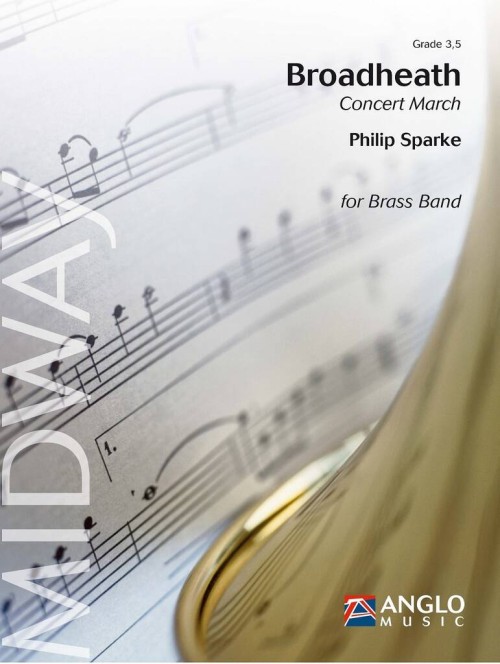
Broadheath (Brass Band - Score and Parts) - Sparke, Philip
Broadheath was commissioned by the Elgar International Brass Band Summer School for their 2024 course. The premiere took place in the Routh Hall at Bromsgrove School on Friday 26 July.It is in conventional march form, opening with a brief fanfare before the horns take up the main theme. This is then repeated by the full band before euphoniums and baritone announce the second subject. This builds to a stirring tutti passage utilising elements of the opening theme, which brings the opening section to a close.In honour of the summer school's tribute to Sir Edward Elgar (it is held in 'Elgar country'), the trio uses the opening melody of his 1st symphony as its main theme, decorating it with filigree work from the cornets. This is repeated on the full band and leads to a varied recapitulation of the opening material to bring the march full circle.Duration: 5.00
Estimated dispatch 7-14 working days
-
 £44.95
Trombone Concerto (Trombone Solo with Brass Band - Score only) - Wiffin, Rob
My Trombone Concerto was commissioned by Brett Baker following an earlier piece I had written for him called Shout! It was composed in Spain in the summer of 2010. Once I started writing I realised that this concerto was inevitably going to draw on my own experiences as a trombone player. The first movement was really a matter of getting the right thematic ideas and balancing the tutti and solo passages so, for formal structure, I studied the Gordon Jacob Trombone Concerto. There is a lyrical section preceding the first Allegro that owes much in spirit (but not in the actual music) to The Eternal Quest, Ray Steadman-Allen's Salvation Army solo. The slow movement seemed determined to come out in the vein of a Richard Strauss song. I wanted to write something ineluctably 'cantabile' as we trombone players rarely get a chance to play the melody. There is a brief allusion to that wonderful moment when the trombone gets to sing above the orchestra in Sibelius' seventh symphony. Arthur Wilson, that great exponent of the singing style in trombone-playing and my teacher at college died in the summer of 2010 so it seemed appropriate to dedicate this movement to him. The last movement is the lightest of the three in style and is slightly jazz-inflected, hopefully providing some fun for the soloist. While wanting to test the instrument I did not set out with the intention of making the concerto difficult but there are undoubtedly challenges of technique, range and style to be met by the soloist.- Rob Wiffin
Estimated dispatch 7-14 working days
 View Music