
Results
-
£24.50
Suo Gan - Traditional - Max Stannard
Suo Gan is a traditional Welsh lullaby which was written by an anonymous composer. The song features in Steven Spielberg's 1987 film, Empire of the Sun, where a young Christian Bale lip syncs to a performance by James Rainbird. The song has been recorded by great Welsh singers including Charlotte Church and Bryn Terfel. This solo gives a flexible option of any of your Bb instrumentalists in the band taking on the lead part of this beautiful tune.
In Stock: Estimated dispatch 1-3 working days
-
 £168.50
Music of the Spheres - Philip Sparke
Music of the Spheres was commissioned by the Yorkshire Building Society Band and first performed by them at the European Brass Band Championships in Glasgow, May 2004.The piece reflects the composers fascination with the origins of the universe and deep space in general. The title comes from a theory, formulated by Pythagoras, that the cosmos was ruled by the same laws he had discovered that govern the ratios of note frequencies of the musical scale. ('Harmonia' in Ancient Greek, which means scale or tuning rather than harmony - Greek music was monophonic). He also believed that these ratios corresponded to the distances of the sixknown planets from the sun and thatthe planets each produced a musical note which combined to weave a continuous heavenly melody (which, unfortunately, we humans cannot hear). In this work, these six notes form the basis of the sections Music of the Spheres and Harmonia.The pieces opens with a horn solo called t = 0, a name given by some scientists to the moment of the Big Bangwhen time and space were created, and this is followed by a depiction of the Big Bangitself, as the entire universe bursts out from a single point. A slower section follows called The Lonely Planet which is a meditation on the incredible and unlikely set of circumstances which led to the creation of the Earth as a planet that can support life, and the constant search for other civilizations elsewhere in the universe. Asteroids and Shooting Stars depicts both the benign and dangerous objects that are flying through space and which constantly threaten our planet, and the piece ends with The Unknown, leaving in question whether our continually expanding exploration of the universe will eventually lead to enlightenment or destruction.
Estimated dispatch 5-14 working days
-
 £59.29
Avifauna (Brass Band) Joshua Tyler Jameson
This highly descriptive work was commissioned by the National Youth Brass Band of America and will be a terrific concert or entertainment contest item. The music paints the picture of the lives of a variety of different birds. The composer writes: 'When I began thinking about this project I was sitting in my office in the early morning, the sun having just risen. There was a gentle breeze and the only thing that I could hear (aside from my hungry whining cats) was the gentle song of the birds outside my open window. As much of my work is programmatic, almost like symphonic poems, this immediately gave me the image of a majestic sunrise with all types of birds fluttering about, almost as if out of an episode of Planet Earth. When I was commissioned by the National Youth Brass Band of America, I knew the project had to be something the ensemble could grab onto. Something they could see. Something they could relate to. There being so many types of birds in North America, I selected a handful to help tell my story... The scene where I came up with this idea seemed to be the perfect starting point. Sunrise, tiny chirps of Morning Birds floating around the twilight of dawn, swiftly moving towards the majesty of the sun cresting the horizon. A new day, the beginning of a story. As the sun rises higher in the sky, animal activity stirs, becoming lively and wild. The flowers have opened up to drink in the sun's rays, leaving them open to nectar-seeking Hummingbirds. Whizzing by at lightning speed, the hummingbirds journey from flower to flower, drinking their fill until the sun begins to set back over the horizon. When daylight fades, the enigmatic Owl floats silently through the sky. The wonder of these creatures comes not just from their beauty, but also from their mystery and their ferocity. We see images in pop culture of majestic white owls and marvel in their beauty... but to a mouse roaming the forest floor in the dark of the night, the terror of suddenly being dropped upon by a silent predator is anything but peaceful. In the dead of night, soft rolling clouds thicken as a storm begins to brew. With the ensuing rain also emerges the grotesque scavenging Vulture; marching along from carcass to carcass, tearing into the rotting leftovers of another predator's kill, gorging themselves until over-full. However, from this nightmare fuel of a bird, a new day awaits... As the dawn of another day approaches, you begin to hear the same morning birds you heard the previous day. When the light finally breaks the horizon, the soaring majesty of the Eagle drives us to the end of our story; an exciting journey told through the eyes of the winged creatures that paint the skies of North America. This is Avifauna.' To view a follow-the-score video please visit: www.youtube.com/watch?v=J2bhBpx9KvM Sheet music available from: UK - www.brassband.co.uk USA - www.solidbrassmusic.com Difficulty Level: 2nd Section + Instrumentation: Soprano Cornet Eb Solo Cornet Bb Repiano Cornet Bb 2nd Cornet Bb 3rd Cornet Bb Flugel Horn Bb Solo Horn Eb 1st Horn Eb 2nd Horn Eb 1st Baritone Bb 2nd Baritone Bb 1st Trombone Bb 2nd Trombone Bb Bass Trombone Euphonium Bb Bass Eb Bass Bb Percussion 1-4
In Stock: Estimated dispatch 1-3 working days
-
 £74.95
Platform to the Heavens (Brass Band - Score and Parts)
The piece takes its inspiration from the mountain ranges from one of my favourite countries, Switzerland.I have visited the Swiss Alps on many occasions and I am still taken back by its sheer awesome beauty with every visit. This commission gave me the opportunity to pay homage to this wonderful landscape and paint my own musical picture of it.The piece opens with what I imagine daybreak would be like at one of its many peaks. With the sun growing behind the mountain range, the piece builds from a single note to a huge climatic chord revealing Mother Nature's creation.Then at rehearsal figure 'C' the tempo changes dramatically as we fly through the many slopes of the mountains as if on a manic skiing expedition, revealing the many dangers within the Swiss Alps.The twists, turns and climaxes begin to die away as we enter rehearsal figure 'M' - nightfall over the mountains. As the sun disappears, the sky darkens to reveal the beautiful starlit sky above the mountain range. This middle section starts with the various cadenzas that serve as echoes around the Alps. It then leads to a lyrical solo at rehearsal figure 'O' as the moonlight illuminates the icy mountain peaks. A final cadenza to conclude this section highlights the end of nightfall as the sun starts to rise again.This recapitulation from the opening, signals a new dawn as the sun rises above the snowy peaks once again. The music at this point in its slightly altered state highlights the dawn of a new day in the Alps. The fast manic ski ride follows which takes the piece to its grand finale conclusion.The idea behind the title of this piece is that the Swiss Alps are so beautiful and vast; I can only imagine that they could be a platform connecting the earth to the heavens above.Paul Lovatt-Cooper
Estimated dispatch 7-14 working days
-
 £33.35
An Irish Blessing (Brass Band) Craig Stevens
VIEW SCORE PDF Written during the Covid lockdown in 2020, An Irish Blessing is a beautiful original tune from the pen of Craig Stevens set to the following words: May the road rise to meet you. May the wind be at your back. May the sun shine warm upon your face. Though the rain falls on your fields And the flowers grow no more, May the Lord keep you safe in His hands Until we meet again. Traditional Irish Blessing (paraphrased) The composer writes: 'The hope, that despite the uncertainty of the times, that we would meet again.' To view a follow-the-score video featuring Ratby Cooperative Band please visit www.youtube.com/watch?v=9B6F7STXH9I Sheet music available from: UK - www.brassband.co.uk USA - www.solidbrassmusic.com Difficulty Level: Fourth Section + Instrumentation: Soprano Cornet Eb Solo Cornet Bb Repiano Cornet Bb 2nd Cornet Bb 3rd Cornet Bb Flugel Horn Bb Solo Horn Eb 1st Horn Eb 2nd Horn Eb 1st Baritone Bb 2nd Baritone Bb 1st Trombone Bb 2nd Trombone Bb Bass Trombone Euphonium Bb Bass Eb Bass Bb Timpani Percussion 1-2
In Stock: Estimated dispatch 1-3 working days
-
 £33.35
March - Helping Hands (Rob Bushnell) Brass Band
Helping Hands was written for the British Bandsman March Composition Contest, entered into category 2 (marches for 3rd/4th section bands). The piece is loosely programmatic in nature: The introductio is fanfare-like, announcing the date of the next Whit Friday Contests and the bands' anticipation of and preparation for the event. The first section is the march of the volunteers, as they descend upon the many venues, ready to run the contests. The second section (bars 35 to 52) sees the contests start. The bands strike up, march, finish and go from place to place, whilst the volunteers manage them, the audiences, and all manner of issues and problems thrown at them. The third section (bars 53 to 69) represents the bad weather which has, at times, presented itself on that particular Friday. But everyone carries on (possibly the sun comes out) and we enjoy the day. The trio uses the hymn St. Vincent by Sigismund Neukomm: St. Vincent de Paul is the patron saint of charities and volunteering, hence its use here. The piece is influenced by marches that are commonly heard during the Whit Friday March Contests, using motifs, rhythms and harmonic progressions (sparingly) throughout the piece. March-card sized parts included, with alternatives for horns in F and lower brass in bass clef. To view a rolling score video of the piece please visit www.youtube.com/watch?v=diqDoe0XpcA PDF download includes score and parts. Sheet music available from: UK - www.brassband.co.uk USA - www.cimarronmusic.com Difficulty Level: 3rd Section + Length: 3.50 minutes Instrumentation: Soprano Cornet Eb Solo Cornet Bb Repiano Cornet Bb 2nd Cornet Bb 3rd Cornet Bb Flugel Horn Bb Solo Horn Eb 1st Horn Eb 2nd Horn Eb 1st Baritone Bb 2nd Baritone Bb 1st Trombone Bb 2nd Trombone Bb Bass Trombone Euphonium Bb Bass Eb Bass Bb Drums
In Stock: Estimated dispatch 1-3 working days
-
 £34.95
Song of the Night Sky - Christopher Bond
Orpheus is known as the most talented music player of the ancient times. It is said that god Apollo was his father, from whom took his extreme talent in music, and the Muse Calliope was his mother. Tragedy struck when his wife, Eurydice stepped on a viper which in turn bit her, injecting its fatal venom. Nothing could stop his cries of anguish and sheer pain and sorrow upon realizing his beautiful Eurydice was dead. Orpheus decided to go into the Underworld to get his wife back. Apollo, his father, would talk to Hades, the god of the Underworld to accept him and hear his plea. And so Orpheus set off into the Underworld and was warned that for no reason must he look back while his wife was still in the dark, for that would undo everything he hoped for. As Orpheus was reaching the exit of the Underworld, he could hear the footfalls of his wife approaching him. As his was approaching the exit, his heart was beating faster and faster. The moment he stepped on the world of the living, he turned his head to hug his wife. Unfortunately, he got only a glimpse of Eurydice before she was once again drawn back into the underworld. When Orpheus turned his head, Eurydice was still in the dark, she hadn't seen the sun and, was drowned back to the dark world of the dead. Waves of anguish and despair swept over him and shuddering with grief he approached the Underworld again but this time, he was denied entry, the gates were standing shut and god Hermes, sent by Zeus, wouldn't let him in. His songs were no more joyful but extremely sad. His only comfort was to lay on a huge rock and feel the caress of the breeze, his only vision were the open skies. Song of the Night Sky was recorded by Tom Hutchinson and the Cory Band in June 2015, featuring on his debut solo album.
Estimated dispatch 10-14 working days
-
 £24.20
Caribbean Calypso - Steve Robson
Composed by Steve Robson specifically for the Flexi-Collection World Tour Series. Caribbean Calypso opens the doors to a memorable concert item, with the option of including a local steel drum group to join you. Lots of fun to be had with this unusual combination. But don't worry, there is an alternative solo version if a steel drum group isn't possible, so you can still bring the sea, sand and sun to your concert hall with the distinctive style of this music.Caribbean Calypso is part of the Flexi-Collection World Tour Series.Our Flexi-Collection Series:Flexible scoring tailored to your needs - a perfect solution for expanding the repertoire of Junior/Youth brass bands and ensembles. The Flexi-Collection currently offers two series and these will be regularly expanded to offer groups an even wider variation of music. Based on four-part harmony, these collections provide brass groups with the advantage of complete flexibility when may not be balanced.Added Extras:Each part of The World Tour Series also includes rudimentary theory reference sheet andLearn Together Moments(warm-up passages which relate to each of the styles of pieces included in the whole series). The score also includes background/programme notes andCheck It Outideas to encourage the players to find out more about the music style and/or inspiration behind the piece.If players or instruments are missing, the show can still go on! The thoughtful scoring and arranging by Steve Robson now means that groups of all abilities have access to a truly flexible set of music for their needs.Available for Brass Band (with world parts included), pieces included in our World Tour Series offer flexibility in every sense of the word.(Available individually or as part of the completeFlexi-Collection World Tour Series Album).
In Stock: Estimated dispatch 3-5 working days
-
 £164.99
Music of the Spheres (Brass Band - Score and Parts)
Music of the Spheres was commissioned by the Yorkshire Building Society Band and first performed by them at the European Brass Band Championships in Glasgow, May 2004. The piece reflects the composers fascination with the origins of the universe and deep space in general. The title comes from a theory, formulated by Pythagoras, that the cosmos was ruled by the same laws he had discovered that govern the ratios of note frequencies of the musical scale. ('Harmonia' in Ancient Greek, which means scale or tuning rather than harmony - Greek music was monophonic). He also believed that these ratios corresponded to the distances of the six known planets from the sun and thatthe planets each produced a musical note which combined to weave a continuous heavenly melody (which, unfortunately, we humans cannot hear). In this work, these six notes form the basis of the sections Music of the Spheres and Harmonia. The pieces opens with a horn solo called t = 0, a name given by some scientists to the moment of the Big Bang when time and space were created, and this is followed by a depiction of the Big Bang itself, as the entire universe bursts out from a single point. A slower section follows called The Lonely Planet which is a meditation on the incredible and unlikely set of circumstances which led to the creation of the Earth as a planet that can support life, and the constant search for other civilisations elsewhere in the universe. Asteroids and Shooting Stars depicts both the benign and dangerous objects that are flying through space and which constantly threaten our planet, and the piece ends with The Unknown, leaving in question whether our continually expanding exploration of the universe will eventually lead to enlightenment or destruction.Duration: 18:00
Estimated dispatch 7-14 working days
-
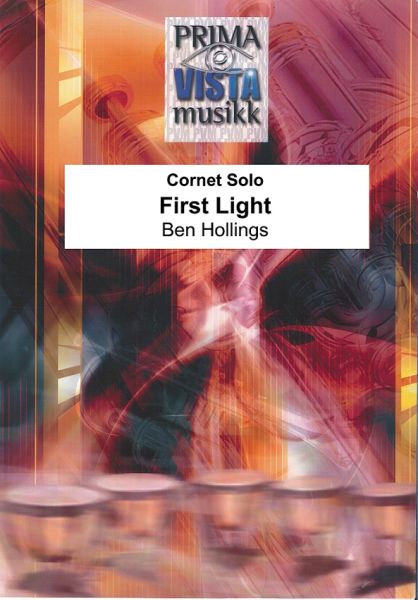 £24.95
First Light (Score and Parts)
First Light was written for Kirsty Abbotts and Carlton Main Frickley Colliery Band. A slow lilting melody is presented in the cornet solo and passed between the band and the soloist to create images of the tranquil night before the piece reaches a climactic moment which is meant to represent the beams of light emerging as the sun rises. The theme is then presented in a tutti forte section before arriving at a tranquil finish. First Light is featured on the Kirsty Abbotts and Carlton Main Frickley Colliery Bands CD, A Search for Peace.
Estimated dispatch 7-14 working days
 Listen to MP3
 View Music