
Results
-
 £125.00
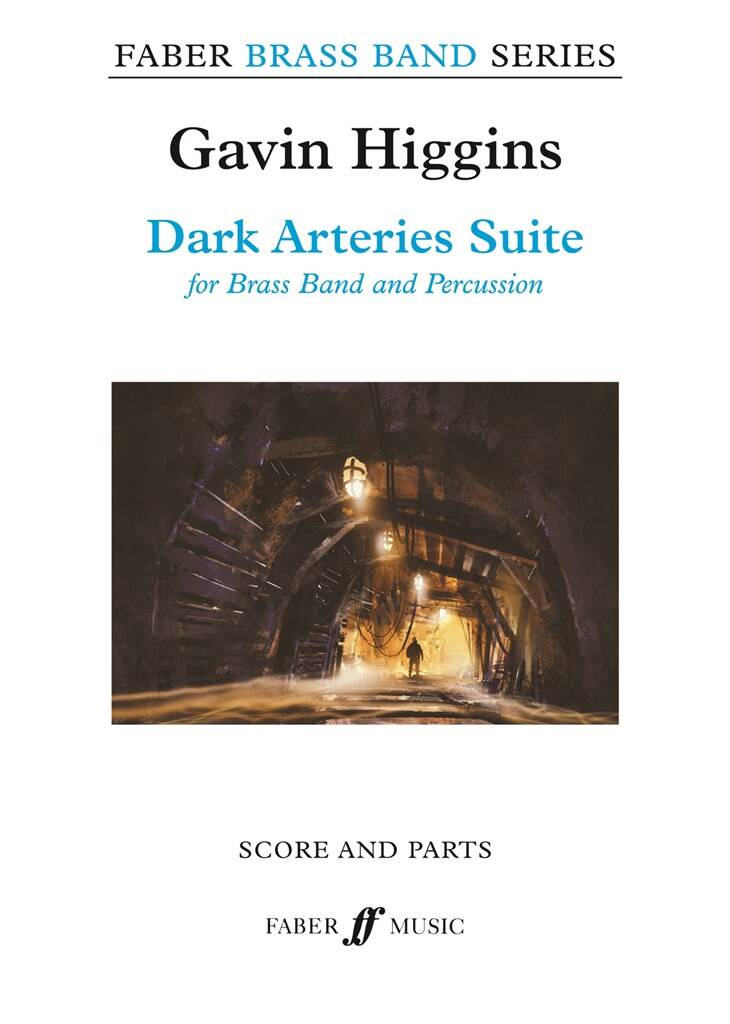
Dark Arteries - Gavin Higgins
Dark Arteries was commissioned by Rambert Dance Company and first performed in May 2015 with the Tredegar Town Band sharing the stage with Rambert dancers. Dark Arteries is a personal and at times highly wrought response to the Miners' Strike and its aftermath. It is in three movements, the first and last are expansive, with widely contrasting sound worlds, from dark, brooding melodies and the haunting sounds of solo flugel horn to wild syncopations on cornets, suggestive of an imposing, but often bleak mining landscape.In 2016 Higgins re-worked Dark Arteries into a virtuoso concert suite, which captures the essence of the work in three connected movements.Dark Arteries Suite was premiered by the National Youth Brass Band of Great Britain, conducted by Bramwell Tovey at the Barbican Centre, London, 22 April 2017.
Estimated dispatch 5-14 working days
-
 £59.99
A Festive Tribute - Johann Sebastian Bach - Philip Sparke
A Festive Tribute is an arrangement of a splendid chorus whichBach first used in the secular Cantata 207 of 1726, but is perhapsbetter known in its later version, which appears in Cantata 207a, thedescriptively titled Auf, schmetternde Tone der muntern Trompeten,which cannot be adequately translated but means something alongthe lines of 'let the trumpets sound'. While the lyrics are perhaps alittle obsequious, much of the music for this cantata is celebratoryand lushly scored for a large orchestra including trumpets, oboesd'amore and flutes, making it an ideal piece for a concert bandarrangement.
Estimated dispatch 5-14 working days
-
 £110.40
Three Inventions - Pi Scheffer
Dr. J (Pi) Scheffer was the leader of the famous Dutch AVRO Radio Big Band 'The Skymasters' in the 50's, as well as also being an English teacher. He also had a huge success with his composition for wind band 'Three Inventions', not only in Europe but also in the USA. At the time of publication (1971) there was no promotion with sound sample of this work, so for this reason now Molenaar Edition has a complete new score and parts available in their 'Creative Compositions' (c) series. The work is in the movements. 'Flippant', 'Whimsical' and 'Sorta Mixed Up'. A recent edition of the American magazine publication 'The School Musician' even compared Scheffer with Leonard Bernstein.
Estimated dispatch 5-14 working days
-
 £94.99
Dublin Pictures - Marc Jeanbourquin
Ireland is a multi-faceted country that has developed a popular and distinctive musical culture. The first movement of Dublin Pictures reflects Irish festivals where there is dancing and traditional beer flowing.More tranquil in its feel, the second movement illustrates the landscape that can be seen from the Ha'penny Bridge, a bridge that crosses the River Liffey in Dublin. This movement highlights the wide range of the orchestra's sound colours as the musicians' voices combine with the wind and percussion to accompany the soloist. The lively and joyful rhythms of the last movement take the listener to Temple Bar, the famoustourist quarter of the city, well known for its vibrant nightlife.The music's energy and virtuosic motifs are in contrast to the previous movement and provide a spirited and festive finale.Marc Jeanbourquin wrote this piece in three movements for Azimuts Brass in 2011. He then arranged it for Concert, Fanfare or Brass Band.
Estimated dispatch 5-14 working days
-
 £83.60
Los Hermanos de Bop - Mark Taylor - Sandy Smith
Los Hermanos De Bop is a composition by Mark Taylor (arr. Sandy Smith). In the Obrasso webshop are the Sheet Music for Brass Band with the article no. 16198 available. The sheet music is classified in Difficulty level C (medium). More Music for entertainment for Brass Band can be found using the flexible search function. Use the free trial score for Los Hermanos De Bop and get a musical impression from the audio samples and videos available for the Brass Band piece. With the user-friendly search function in the Obrasso webshop, you can find in just a few steps more sheet music from Mark Taylor for Brass Band. So that you can complete your concert program, show all music sheets can be displayed with one click on Music for entertainment in Difficulty level C (medium) . Los Hermanos De Bop is one of many brass music compositions that have been published by Musikverlag Obrasso. Next to Mark Taylor over 100 composers and arrangers work for the Swiss music publishing house. In addition to the notes for Brass Band you will also find literature in other formats such as Brass Band, Concert Band, Junior Band, Brass Ensemble, Woodwind Ensemble, Symphony Orchestra as well as CDs and Music Education. A large part of the publisher's own literature from top brass bands such as the Black Dyke Band, Cory Band, Brighouse & Rastrick Band or the Oberaargauer Brass Band was recorded on Obrasso Records. All sound carriers are also available digitally on the popular portals of Apple, Amazon, Google, Spotify and other providers worldwide. All Obrasso sheet music is produced on high quality paper. The slightly yellowish note paper offers a good contrast and is easy on the eyes in difficult lighting conditions. Delivery to private customers worldwide is free of shipping costs. Order your sheet music now directly from Obrasso Verlag.
Estimated dispatch 5-14 working days
-
 £66.00
Terminal - Gauthier Dupertuis
Terminalby Gauthier Dupertuis is an energetic, danceable work that captures the electric atmosphere of an airport terminal from morning to night. Repetitive rhythmic structures - symbolizing the constant hustle and bustle of an airport - form the connection between a majestic introduction and the central section, which explores a sound world tinged with 80s and 90s pop and funk music.The piece was commissioned by the Swiss National Youth Brass Band for the 2025 session of its B ensemble, also marking the Youth Brass Band 50th anniversary.
Estimated dispatch 5-14 working days
-
 £137.99
A Gabrieli Fantasy - Bert Appermont
In this five-movement work, Bert Appermont explores the possibilities that three choruses within a brass band have to offer. For this, he used the Canzon a 12 in echo by Giovanni Gabrieli, which he also used in 2018 for a double chorus trombone octet of the same name. There's a lot to be enjoyed in this fantasy, with its range of motifs, melodic cells and chords plus counterpoint techniques like the canon and imitations. An atmospheric piece of music that presents variation in sound and in stage arrangement as well!
Estimated dispatch 5-14 working days
-
 £115.60
Bekken (Fra Lyriske stykker opus 62) - Edvard Grieg - John Brakstad
Brooklet is one of the movements from Grieg's Lyric Pieces for Solo Piano opus 62. Information for the conductor: Brooklet is an technically advanced work for solo piano. In this arrangement, technical passages are simplified by overlapping and doubling some of the parts. To master the technical challenges and make it sound effortless, it is important to pay close attention to balance and precision. Some of the parts also have alternative parts added which can lower the technical challenges a bit.
Estimated dispatch 5-14 working days
-
 £59.99
Panis Angelicus - César Franck - Philip Sparke
Although Cesar Franck won many prizes during his student days his music was generally unrecognised by his contemporaries. His pieces were written in the romantic style whilst retaining a classical structure and his later compositions were referred to as 'cathedrals of sound'. Panis Angelicus is poetic and almost serene and this arrangement by Philip Sparke retains all of the beauty of the original.
Estimated dispatch 5-14 working days
-
£91.40
The Stars and Strips Forever - John Philip Sousa - Keith M. Wilkinson
The Stars And Stripes Forever is a composition by John Philip Sousa (arr. Keith M. Wilkinson). In the Obrasso webshop are the Sheet Music for Brass Band with the article no. 16535 available. The sheet music is classified in Difficulty level C (medium). More Marching music for Brass Band can be found using the flexible search function. Use the free trial score for The Stars And Stripes Forever and get a musical impression from the audio samples and videos available for the Brass Band piece. With the user-friendly search function in the Obrasso webshop, you can find in just a few steps more sheet music from John Philip Sousa for Brass Band. So that you can complete your concert program, show all music sheets can be displayed with one click on Marching music in Difficulty level C (medium) . The Stars And Stripes Forever is one of many brass music compositions that have been published by Musikverlag Obrasso. Next to John Philip Sousa over 100 composers and arrangers work for the Swiss music publishing house. In addition to the notes for Brass Band you will also find literature in other formats such as Brass Band, Concert Band, Junior Band, Brass Ensemble, Woodwind Ensemble, Symphony Orchestra as well as CDs and Music Education. A large part of the publisher's own literature from top brass bands such as the Black Dyke Band, Cory Band, Brighouse & Rastrick Band or the Oberaargauer Brass Band was recorded on Obrasso Records. All sound carriers are also available digitally on the popular portals of Apple, Amazon, Google, Spotify and other providers worldwide.
Estimated dispatch 5-14 working days
 View Music