
Results
-
Runaway - Max Crook & Del Shannon - Len Jenkins
"Runaway" was made famous by Del Shannon in 1961 when it was released in the February of that year and quickly became an international hit. At its height it was said to be selling at the rate of 80,000 singles per day and in the June made number one in the UK. It was written with Max Crook who had invented his own clavioline-based electric keyboard called a Musitron which features in the original recording. The song was originally recorded in A minor, but the producer sped up the finished recording to just below B-flat minor. The iconic synthesiser sound in this arrangement is reproduced as a solo on Soprano cornet, and should be within the capabilities of most players provided attention is paid to the breathing regime.
-
Paint It Black - Mick Jagger & Keith Richards - Len Jenkins
"Paint It Black" (originally released as "Paint It, Black") was written by Mick Jagger and Keith Richards, and first released as a single on 6 May 1966. It became the Rolling Stones' sixth number one in the UK and has remained influential as the first number one hit featuring a sitar. The song came at a pivotal period in The Rolling Stones' recording history, a time that saw the song-writing collaboration of Jagger and Richards assert itself as the principal composers of the band's original material. Its lyrics are for the most part meant to describe bleakness and depression and describe the extreme grief suffered by one stunned by the sudden and unexpected loss of wife, lover or partner. It famously plays during the end credits of the film Full Metal Jacket. Beginning in the style of an ironic minuet, which can be by-passed by starting at bar 54 where the heavy rock beat takes over, the piece is interesting and within the capabilities of 3rd or 4th section bands. For those bands with a drummer and one percussionist, an alternative percussion part is provided.
-
In Dreams - Roy Orbison - Len Jenkins
"In Dreams" is a song composed and sung by rock and roll performer Roy Orbison, and was released as a single on Monument Records in February 1963. Orbison later claimed that the origin for "In Dreams" came to him while he was sleeping, as many of his songs did. When he woke up the next morning, the entire composition was written in 20 minutes. Like many of Orbison's songs, but unlike the majority of rock and roll ballads, in under 3 minutes it goes through seven movements with distinct melodies and chord progressions without repeating itself. It was for that reason that I have always believed it was a suitable piece for brass where one does not have lyrics to distinguish changes between verses to avoid monotony. Graham Cooper
-
I Believe - Drake, Graham, Shirl & Stillman - Len Jenkins
"I Believe" is a popular song written by Ervin Drake, Irvin Graham, Jimmy Shirl and Al Stillman in 1953. It was commissioned with the intent of offering people hope and faith against the backdrop of the Korean War that followed so soon after World War 2. The number has been recorded by many artists and the edition by The Bachelors is perhaps the best well-known in Britain. This arrangement, which is very suitable for fetes and concerts, features the Flugel and Tenor Horns in a duet, with band accompaniment. It is dedicated to the twins Hazel and Heather who play these instruments in the Woburn Sands Band. Graham Cooper
-
I'm The Urban Spaceman - Neil Innes - Len Jenkins
Made famous by the Bonzo Dog Doo-Dah Band, "I'm the Urban Spaceman" was written by Neil Innes who won an Ivor Novello Award in 1968 for the song. The record which was released in the same year and went to No5 in the hit-parade, was produced by Sir Paul McCartney and Gus Dudgeon. It has been used to accompany various humorous sketches including one by Monty Python, and lends itself to anarchic behaviour by the band. A jolly piece which we leave to your imagination as to how you present it......
-
The Tricorn - Len Jenkins - Len Jenkins
The Tricorn is a style of three-cornered hat from Europe in the 18th century, generally referred to as a 'cocked hat' in Britain and popular in America at the time of the War of Independence. It may still be seen on ceremonial occasions as part of the town-cryer's dress in England and features in a popular German song for children 'Mein Hut, der hat drei Ecken'. However, in the case of this music, the reference is to the cornet section and the requirement for triple-tonguing on the Eb Soprano cornet. Whilst ostensibly a concert march in style, its jaunty rhythm makes you want to stride along and it may therefore be used as a 'road march' as well. Pressure on the Soprano cornetist as a soloist is reduced by adding the Solo Cornets to the melody line in the 'road march' version. With this in mind, we supply the music in both A4 (concert) and A5 (march-card) sizes as a package.
-
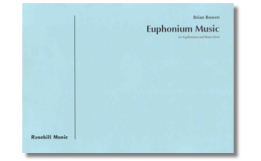 £42.00
Euphonium Music (Score only) - Brian Bowen
Written in 1978, the work is constructed in three movements and is virtually a concerto for euphonium and band. The first movement begins with an unaccompanied motto theme, which uses all twelve notes of the scale but with a tonal feel. The slow second movement is based on an original song melody by the composer - 'The Eyes of God' - and affords lyrical and richly expressive playing that is typically euphonium. Movement three follows without a break - a capricious movement which ends triumphantly. Now available in versions for piano, brass band, wind band, and orchestra, Euphonium Music can be seen as a major contribution to the literature for the instrument. Duration: 15 minutes An orchestral version is available on hire.
Estimated dispatch 7-9 working days
-
 £52.00
Euphonium Music (Parts only) - Brian Bowen
Written in 1978, the work is constructed in three movements and is virtually a concerto for euphonium and band. The first movement begins with an unaccompanied motto theme, which uses all twelve notes of the scale but with a tonal feel. The slow second movement is based on an original song melody by the composer - 'The Eyes of God' - and affords lyrical and richly expressive playing that is typically euphonium. Movement three follows without a break - a capricious movement which ends triumphantly. Now available in versions for piano, brass band, wind band, and orchestra, Euphonium Music can be seen as a major contribution to the literature for the instrument. Duration: 15 minutes An orchestral version is available on hire.
Estimated dispatch 7-9 working days
-
 £39.95
Return to Sorrento - E. de Curtis arr. Stephen Roberts
This arrangement of the ever-popular Italian song is playable by either E-flat or B-flat soloists.
Estimated dispatch 7-9 working days
-
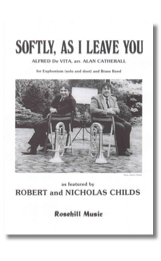 £39.95
Softly, As I Leave You - Alfred de Vita arr. Alan Catherall
Made popular by many singers over the years, this lovely song was first arranged for the Childs brothers as a solo, and later a duet, by Alan Catherall. It was first performed in the duet version at the Royal Albert Hall, London, in October 1985, conducted by their late father, John Childs. Also available with piano Brass Band Set comprises: Detailed condensed conductor score Solo B-flat Euphonium B-flat Euphonium Duet (2) E-flat Soprano Cornet Solo B-flat Cornet (4) 2nd B-flat Cornet (2) 3rd B-flat Cornet (2) B-flat Flugelhorn* Solo E-flat Horn* 1st E-flat Horn* 2nd E-flat Horn 1st B-flat Baritone 2nd B-flat Baritone 1st B-flat Trombone 2nd B-flat Trombone Bass Trombone B-flat Euphonium (2) E-flat Bass (2) B-flat Bass (2) 1st Percussion 2nd Percussion 3rd Percussion (Drum Kit) * Alternative parts for use as solo or duet provided. There is no Repiano Cornet part.
Estimated dispatch 7-9 working days