
Results
-
 £40.43
Saltarello from 'Italian Symphony' (Brass Band) Mendelssohn arr. Phil Lawrence
This tour de force will be ideal for bands looking for a barnstorming finale to their concert. The 'Italian' was really Mendelssohn's 3rd Symphony at the time it was completed in 1833. The 'Italian' is certainly a youthful work, not in its technique, since it shows a perfect mastery of symphonic composition, but in its spirit. He had begun it two years earlier on a visit to Italy, where the vivid sights and sounds had impressed him immensely, just as the visit to Scotland had the year before. The atmosphere of Italy impelled him to translate his impressions into another symphony. The dazzling finale, the Saltarello, conjures up a picture of Italian peasants dancing frantically in a wild and whirling fashion, not unlike the tarantella. The arranger writes: 'It was noted by some players of the day that the orchestral parts were somewhat virtuosic for the time, and this virtuosic style inspired me to arrange this for brass band.' To view a follow-the-score video of the work featuring the Fairey Band please visit https://www.youtube.com/watch?v=BvcuwwJQrR8 PDF download includes score and parts. Sheet music available from: UK - www.brassband.co.uk USA - www.solidbrassmusic.com Difficulty Level: 1st Section + Instrumentation: Soprano Cornet Eb Solo Cornet Bb Repiano Cornet Bb 2nd Cornet Bb 3rd Cornet Bb Flugel Horn Bb Solo Horn Eb 1st Horn Eb 2nd Horn Eb 1st Baritone Bb 2nd Baritone Bb 1st Trombone Bb 2nd Trombone Bb Bass Trombone Euphonium Bb Bass Eb Bass Bb Timpani
In Stock: Estimated dispatch 1-3 working days
-
 £34.95
Clouds - Anthony Ritchie
The starting point for this point was some dramatic cloud formations I experienced while in Morrinsville, New Zealand. It was a brilliantly sunny day, with occasional huge and interestingly shaped clouds floating past. They provided inspiration for the opening texture...
Estimated dispatch 5-7 working days
-
£90.00
Fragile Oasis - Peter Meechan
Fragile Oasis is the name of a collective who describe themselves as aaa grass-roots participatory initiative that connects the shared perspective of astronauts from different countries and cultures with people on Earth, encouraging all to work together so that our planet is not only visibly beautiful, but beautiful for alla.Many involved in the project are astronauts on the International Space Station (I.S.S.), who post, on their website (http://www.fragileoasis.org) many different details of their experiments, photos from space, and some incredible video footage of our Earth.One such time lapse video (a video made up many still images) was posted on their website by astronaut Ron Garan (http://www.fragileoasis.org/blog/2011/11/coming-back-down-to-our-fragile-oasis-2/) in 2011. It is made up of images taken from the I.S.S. of what Garan described as aaa couple of laps around our Fragile Oasis before coming back down [to Earth]a and features all kinds of amazing views from space.Each of the five sections of this work relate to an aspect of the video - either something literal or something more metaphorical. The opening section, i: The lights from Above, is a musical description of the view of the Aurora Australis from above the lights. The second section, ii: The Storm from Above (part i), is also a musical portrayal of portions of the video clip - in this case the many lightning storms we see from above. The storms that are so powerful on Earth appear as small bolts of electricity dancing through the clouds.The third section, iii: Freya, has its roots in personal family tragedy. The name Freya derives from a Norse goddess who was associated with both beauty and love, and in this central section I wanted to write music that not only acknowledged how fragile life itself is, but that every day of it counts and should be celebrated.iv: The Storm from Above (part ii) is a again a reference to the lightning storms, but also to the huge hurricanes we see in the video. It leads us to the final section, v: The Oasis from Above - a description of the size and grandeur of Earth, our Fragile Oasis.Fragile Oasis was commissioned by Leyland Brass Band and Michael Bach, and partly funded by The John Golland Trust, for their appearance at the 2013 European Brass Band Championships in Oslo, Norway. It is dedicated to Natalie Youson, in friendship
Estimated dispatch 12-14 working days
-
 £38.95
Unity Series Band Journal - Numbers 518 - 521, June 2023
518: March - A Christmas cavalcade (Morgan Juel Stavik)This march contains several Christmas carols and songs. Some are easy to recognise and are identified in the score, while other references are more subtle.519: Christmas bossa nova (Kevin Larsson)Using Jingle Bells, The First Nowell, It came upon the midnight clear and Ding dong! merrily on high, here is a great bossa nova to liven up your Christmas concert.520 (1): In te Domine speravi (Des Prez trs. Zachary Docter)This piece is a transcription of an early 16th century choral work by the Renaissance composer Josquin des Prez. Josquin was a well-known and highly regarded composer in his day. Like many composer of this period, Josquin wrote linearly, valuing independent free-flowing lines over vertical harmonies. As a result, the interlocking counterpoint in this work can be quite complex and the tied rhythms challenging.520 (2): Excerpt from 'Vespers' (Rachmaninoff trs. Andrew Poirier)Sergei Rachmaninoff's setting of the All-Night Vigil (Vespers) Op.37, of which this excerpt is taken, was composed in January and February 1915. The outbreak of World War I in August 1914 took many people by surprise, and to Rachmaninoff it was a severe shock. This compelled him to write a piece that reminded him of his childhood and the importance of the Russian Orthodox Church within the national identity of Russia. The excerpt transcribed here has a quality and enigmatic charm that never fails to move the souls of those that listen to it.521: March - Walk of faith (Stanley Makau)This march introduces Stanley Makau to the band journals. Stanley is currently the Deputy and Youth Bandmaster at Quarry Road Citadel Corps in Nairobi, Kenya. His inspiration for the march primarily came from Psalm 91: 11-12, and the march is in keeping with the traditional style that has been a staple for Salvation Army music-making.
Estimated dispatch 7-14 working days
-
 £34.95
Pyrotechnic Variations on 1812 (Brass Band - Score and Parts)
Pyrotechnic Variations on 1812 was composed for Brass Band Schoonhoven, and used as part of their programme for Brass in Concert in November 2016.'Pyrotechnic Variations' is a modern day twist on Tchaikovsky's famous '1812' Overture. A heraldic opening introduces some familiar themes, before leading into a frantic virtuosic passage (especially for euphonium!), where quotes can be heard all through the band. This subsides into the central 'slow' section (via the unusual route of a bass and drum kit feature). After a whisper quiet reintroduction of the main theme, we build to the 'canon' finale - ending in a glorious celebratory style!
Estimated dispatch 7-14 working days
-
 £14.95
Pyrotechnic Variations on 1812 (Score Only)
Pyrotechnic Variations on 1812 was composed for Brass Band Schoonhoven, and used as part of their programme for Brass in Concert in November 2016.'Pyrotechnic Variations' is a modern day twist on Tchaikovsky's famous '1812' Overture. A heraldic opening introduces some familiar themes, before leading into a frantic virtuosic passage (especially for euphonium!), where quotes can be heard all through the band. This subsides into the central 'slow' section (via the unusual route of a bass and drum kit feature). After a whisper quiet reintroduction of the main theme, we build to the 'canon' finale - ending in a glorious celebratory style!
Estimated dispatch 7-14 working days
-
 £38.95
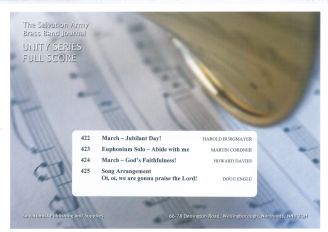
Unity Series Band Journal October 2014 Numbers 422 - 425
No. 422 March - Jubilant Day! (Harold Burgmayer)This accessible march was written for the small, but faithful, corps band in Lock Haven, Pannsylvania, USA, on the occasion of the corps' 125th anniversary.No. 423 Euphonium Solo - Abide with me (Martin Cordner)A sensitive three-verse setting of William H. Monk's well-known tune for Euphonium and band.No. 424 March - God's Faithfulness! (Howard Davies)This march was written to assist celebrations for a recent Salvation Army Congress held in the Indonesian Territory. The music is deliberately written in the style of a 'parade (or street) march' with a steady and unhurried tempo.No. 425 Song Arrangement - Oi, oi, we are gonna praise the Lord! (Doug Engle)This chorus by Doug Horley uses some 'invented' words, but it clearly communicates how our response should be to a God who loves us.
Estimated dispatch 7-14 working days
-
 £95.00
A Wartime Sketchbook (Brass Band - Score and Parts) - Walton, William - Hindmarsh, Paul
Early in 1941 William Walton, 39, received his call-up papers. He was by then one of the most eminent of British composers and was exempted from military service on condition that he provided music for films deemed to be of 'national importance'. Scoring Lawrence Olivier's Shakespeare epic Henry V in 1943 was the most substantial of these wartime projects. His role in patriotic films from 1941 and 42 like The Foreman went to France, Next of Kin, Went the day Well and The First of the Few was to provide appropriate title music and some underscoring at key moments. Walton extracted the most substantial portions of the latter as the popular Spitfire Prelude and Fugue for orchestra. The remaining music remained unpublished until 1990, when Christopher Palmer assembled the highlights into A Wartime Sketchbook. I was intrigued to hear these examples of Walton's wartime music and having discovered that they would fit naturally and idiomatically onto the brass band, I arranged six of the numbers into a suite for Besses o' th' Barn Band, which I was conducting at the time.In 1995 the brass band suite was recorded by the famous Black Dyke Mills Band as part of an all Walton album which I produced for the ASV label (ASV CD WHL 2093). This award- winning CD also included Walton's First Shoot, in the edition by Elgar Howarth, my transcription of movements from Music for Children and two substantial brass versions by Edward Watson of the suite from Henry V (with narrator) and the March and Siegfried Music from The Battle of Britain music.Prologue: This is the stirring title music from Went the day Well, a screen play by Graham Greene about a German airborne invasion of an English village. The main theme leads toBicycle Chase: Characteristic musical high-jinks for J.B.Priestley's The Foreman went to France.Refugees: From the same film, this is a poignant accompaniment to the long march of refugees. As Ernest Irving, the film's musical director, put it, "this really makes your feet sore and your knees sag."Young Siegfrieds: This lively movement comes from the music that Walton composed for The Battle of Britain in 1968, with the assistance of Malcolm Arnold, but which the film's producer rejected. It portrays first the Berliners, cheerfully ignoring the black-out and then, in the trio, the Young Siegfrieds of the Luftwaffe, courtesy of a parody of Siegfried's horn call from Wagner's opera.Romance: A soldier and a Dutch refugee snatch a few tender moments together in Next of Kin.Epilogue: At the end of The Foreman went to France, the French look forward with hope and optimism to eventual liberation.- Paul HindmarshDuration: 14.00
Estimated dispatch 7-14 working days
-
£40.00
A Wartime Sketchbook (Brass Band - Score only) - Walton, William - Hindmarsh, Paul
Early in 1941 William Walton, 39, received his call-up papers. He was by then one of the most eminent of British composers and was exempted from military service on condition that he provided music for films deemed to be of 'national importance'. Scoring Lawrence Olivier's Shakespeare epic Henry V in 1943 was the most substantial of these wartime projects. His role in patriotic films from 1941 and 42 like The Foreman went to France, Next of Kin, Went the day Well and The First of the Few was to provide appropriate title music and some underscoring at key moments. Walton extracted the most substantial portions of the latter as the popular Spitfire Prelude and Fugue for orchestra. The remaining music remained unpublished until 1990, when Christopher Palmer assembled the highlights into A Wartime Sketchbook. I was intrigued to hear these examples of Walton's wartime music and having discovered that they would fit naturally and idiomatically onto the brass band, I arranged six of the numbers into a suite for Besses o' th' Barn Band, which I was conducting at the time.In 1995 the brass band suite was recorded by the famous Black Dyke Mills Band as part of an all Walton album which I produced for the ASV label (ASV CD WHL 2093). This award- winning CD also included Walton's First Shoot, in the edition by Elgar Howarth, my transcription of movements from Music for Children and two substantial brass versions by Edward Watson of the suite from Henry V (with narrator) and the March and Siegfried Music from The Battle of Britain music.Prologue: This is the stirring title music from Went the day Well, a screen play by Graham Greene about a German airborne invasion of an English village. The main theme leads toBicycle Chase: Characteristic musical high-jinks for J.B.Priestley's The Foreman went to France.Refugees: From the same film, this is a poignant accompaniment to the long march of refugees. As Ernest Irving, the film's musical director, put it, "this really makes your feet sore and your knees sag."Young Siegfrieds: This lively movement comes from the music that Walton composed for The Battle of Britain in 1968, with the assistance of Malcolm Arnold, but which the film's producer rejected. It portrays first the Berliners, cheerfully ignoring the black-out and then, in the trio, the Young Siegfrieds of the Luftwaffe, courtesy of a parody of Siegfried's horn call from Wagner's opera.Romance: A soldier and a Dutch refugee snatch a few tender moments together in Next of Kin.Epilogue: At the end of The Foreman went to France, the French look forward with hope and optimism to eventual liberation.- Paul HindmarshDuration: 14.00
Estimated dispatch 7-14 working days
-
 £94.99
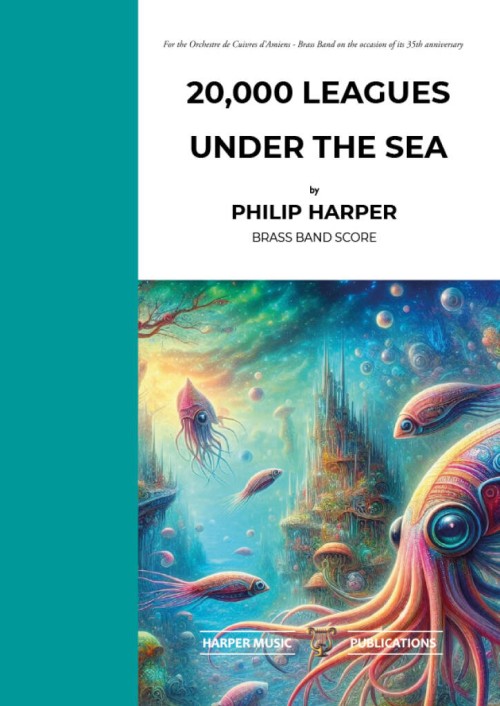
20,000 Leagues Under the Sea (Brass Band - Score and Parts) - Harper, Philip
Frenchman Jules Verne was a pioneer in science fiction during the late 19th Century, penning some classic stories such as Journey to the Centre of the Earth and Around the World in 80 Days - both of which have already been the subject of brass band test-pieces. It was therefore natural for me to choose Verne's 1869 watery magnum opus as the subject for this piece to which there are five sections, as well as an introduction and a finale.THE NAUTILUS. After a mysterious introduction we are introduced to The Nautilus - a fantastical submarine.THE CORAL KINGDOM. We visit awe-inspiring underwater coral formations.SQUID ATTACK. The Nautilus is attacked by a school of giant squid, or 'devilfish'.CAPTAIN NEMO. Captain Nemo is a loner and an eccentric. Some say he is a madman. Soloists of the band help to uncover the character of this enigmatic but powerful figure.MAELSTROM. The Nautilus is dragged into the ocean's deadliest whirlpool but Captain Nemo lives to fight another day.Duration: 12.30
Estimated dispatch 7-14 working days
 View Music