
Results
-
 £87.95
Trombone Concerto (Trombone Solo with Brass Band - Score and Parts) - Wiffin, Rob
My Trombone Concerto was commissioned by Brett Baker following an earlier piece I had written for him called Shout! It was composed in Spain in the summer of 2010. Once I started writing I realised that this concerto was inevitably going to draw on my own experiences as a trombone player.The first movement was really a matter of getting the right thematic ideas and balancing the tutti and solo passages so, for formal structure, I studied the Gordon Jacob Trombone Concerto. There is a lyrical section preceding the first Allegro that owes much in spirit (but not in the actual music) to The Eternal Quest, Ray Steadman-Allen's Salvation Army solo.The slow movement seemed determined to come out in the vein of a Richard Strauss song. I wanted to write something ineluctably 'cantabile' as we trombone players rarely get a chance to play the melody. There is a brief allusion to that wonderful moment when the trombone gets to sing above the orchestra in Sibelius' seventh symphony. Arthur Wilson, that great exponent of the singing style in trombone-playing and my teacher at college died in the summer of 2010 so it seemed appropriate to dedicate this movement to him.The last movement is the lightest of the three in style and is slightly jazz-inflected, hopefully providing some fun for the soloist.While wanting to test the instrument I did not set out with the intention of making the concerto difficult but there are undoubtedly challenges of technique, range and style to be met by the soloist.- Rob Wiffin
Estimated dispatch 7-14 working days
-
 £54.99
You Can't Stop the Beat (from Hairspray) (Brass Band - Score and Parts) - Shaiman & Wittman - Bond & Ricketts
This upbeat showstopper from the Broadway musical and hit movie Hairspray is a great way to infuse some added excitement into your next program. This is sure to sound impressive even with younger bands.Duration: 3.00
Estimated dispatch 7-14 working days
-
 £69.99
Tribute to Whitney Houston (Brass Band - Score and Parts) - Bond & Brown
It has been too many years since the American pop singer Whitney Houston passed away, but the world has not forgotten her beautiful voice. Her timeless hits, from ballads to wonderful dance tracks, are still heard on the radio. This attractive medley includes some of her greatest successes:How Will I KnowSaving All My Love for YouI Wanna Dance with SomebodyI Will Always Love YouDuration: 5.45
Estimated dispatch 7-14 working days
-
 £118.99
Albinus Variations (Brass Band - Score and Parts) - Crausaz, Etienne
based on Bach's Chorales 'Alle Menschen mussen sterben'Johann Georg Albinus wrote a number of Lutheran hymns set to music by various composers. Johann Sebastian Bach reworked and inserted some of these hymns into his cantatas, particularly the chorale 'Alle Menschen mussen sterben' in BWV 162. Albinus Variations opens with a solemn cadenza followed by five contrasted variations on this chorale. Both versions of the chorale, in major and minor keys, were used as a reference for this work.Duration: 12.45
Estimated dispatch 7-14 working days
-
£23.99
Albinus Variations (Brass Band - Score only) - Crausaz, Etienne
based on Bach's Chorales 'Alle Menschen mussen sterben'Johann Georg Albinus wrote a number of Lutheran hymns set to music by various composers. Johann Sebastian Bach reworked and inserted some of these hymns into his cantatas, particularly the chorale 'Alle Menschen mussen sterben' in BWV 162. Albinus Variations opens with a solemn cadenza followed by five contrasted variations on this chorale. Both versions of the chorale, in major and minor keys, were used as a reference for this work.Duration: 12.45
Estimated dispatch 7-14 working days
-
 £69.95
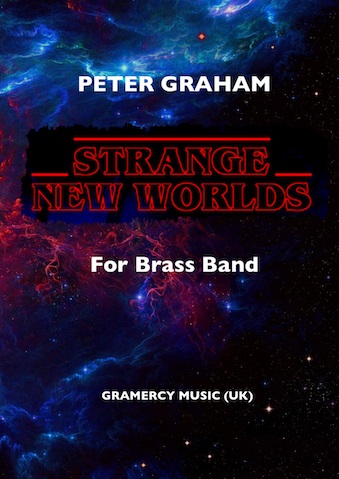
Strange New Worlds (Brass Band - Score and Parts) - Graham, Peter
Strange New Worlds was commissioned by Nicholas Childs for the National Children's Brass Band of Great Britain with funds provided by Arts Council England.The COVID-19 pandemic made it necessary for the 2020 course to transition from residential to virtual and the work was designed to accommodate this change. The participants individually filmed themselves to a click track and the videos were collated to create a "virtual" performance. The premiere was streamed live on YouTube on August 7, 2020.The work is in 5 movements with a narrative dictated by the individual movement titles. Although to me this narrative is clearly defined, multiple scenarios present themselves. Some may interpret the story as being one from the ancients while others might identify with the science-fiction of H.G. Wells. Others still will relate to the recent surge of interest in 1980s culture and the Netflix series Stranger Things (to which the title of my work pays homage). Nor would it be unreasonable to consider the piece an analogy reflecting events in 2020. Listeners will decide the story (or message) for themselves.The five movements are: I. Things to Come; II. Descent to Darkness (featuring Cornets, Trombones and Percussion); III. Resistance (featuring Horns, Baritones, Euphoniums, Basses and Percussion); IV/V. Aftermath/A New HopeDuration: 8.00
Estimated dispatch 7-14 working days
-
 £26.95
Do You Recall? (Trombone Solo with Brass Band - Score and Parts) - Wiffin, Rob
A slow, bluesy solo for trombone with band accompanimentLike many people, I took the opportunity offered by the COVID lockdown in Spring of 2020 to sort through old paperwork. I discovered a lot of songs that had not seen the light of day for many years and were mostly written with just the melody and chord symbols. Some offered the potential of becoming instrumental solos with a combination of heart-on-the-sleeve melodies the like of which I would not write now, together with maybe a greater sophistication in the instrumental writing. I had the notion in the back of my mind that Do you recall?; would work as a trombone solo but it seemed to fight me all the way. However, once finished it has proved to appeal to trombonists and has already been recorded by Brett Baker. It is not intrinsically difficult but needs a sense of the appropriate slow swing style and good control throughout the range.- Rob WiffinDuration: 4.15
Estimated dispatch 7-14 working days
-
 £104.99
The Baltic Way (Brass Band - Score and Parts) - De Haan, Jan
In 1989, the demonstration named the Baltic Way also known as the Baltic Chain-- was held in the Baltic states of Estonia, Latvia and Lithuania by its citizens in a call for independence from the Soviet Union. On 23rd August 1989, some two million participants formed a human chain, hand-in-hand all the way from the Estonian capital of Tallinn its Latvian counterpart, Riga, through to the Lithuanian capital of Vilnius - six hundred kilometres long. It became the longest human chain ever created and turned out to be the final push needed for much sought-after independence. This historic event became the source of inspiration for this composition. The introduction of thefirst movement, 'Struggle for Independence', is based on a nocturne for piano by the renowned Lithuanian composer and painter Mikalojus Konstantinas iurlionis (1875-1911), thematic material from which has been incorporated throughout the whole composition. The melancholic beginning is followed by a powerful theme which reflects the resolve of the Baltic people. The sudden aggressive, dissonant chords and a dominant and--in rhythmic terms--contrary bass drum announce that the resistance is not going smoothly. Just for a moment, we hear the anthem of the Soviet Union in the lower brass, but this is relentlessly pushed to the background by the rest of the band playing the Lithuanian national anthem, 'Tautika giesm ' (Lithuania, our homeland). The second movement, 'Decades of Suffering', echoes life under the Soviet Union's thumb. In the pursuit of independence, a peaceful protest is planned in which a human chain is formed across the Baltic states of Estonia, Latvia and Lithuania. This 'Chain of Freedom' is depicted in the final movement of the work. Duration: 10.30
Estimated dispatch 7-14 working days
-
 £35.00
Gaudete (Brass Band - Score and Parts) - McKenzie, Jock
Gaudete (meaning 'rejoice') is a sacred Christmas Carol of Latin text. As a single line melody to carry the words, is it thought to have been written in the late medieval period, with subsequent harmonies being added in the fifteenth century. The song was published in 1582 in the collection 'Piae Cantiones' - a collection of Finnish / Swedish sacred songs. This carol follows the typical structure for sacred songs at the time of its publication - a uniform series of four-line stanzas each preceded by a two-line refrain. The Latin text is a medieval song of praise about the Virgin Mary. My arrangement, whilst being something of an 'indulgence' seeks to use some musical language typical of the time of the original publication. Duration: 3.00
Estimated dispatch 7-14 working days
-
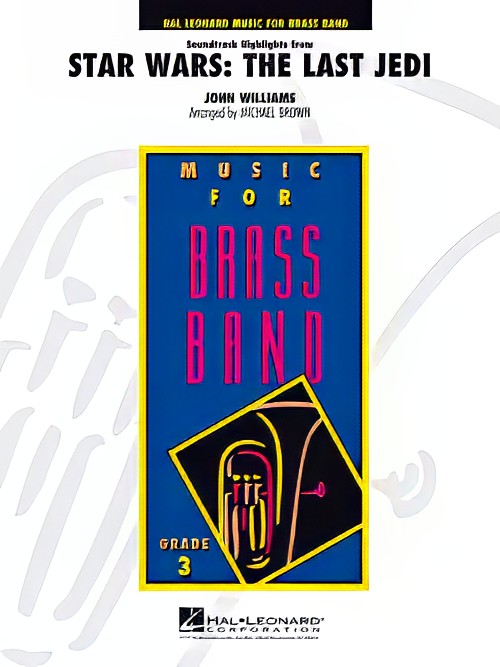 £74.99
Star Wars: The Last Jedi (Brass Band - Score and Parts) - Williams, John - Brown, Michael
From the blockbuster movie Star Wars: The Last Jedi, John Williams continues to display his mastery of music for film. This dynamic medley includes poignant new themes along with familiar older melodies as some of our favorite characters return for this episode. Duration: 4.45
Estimated dispatch 7-14 working days
 View Music