
Results
-
 £33.43
Menuet (Brass Band) Ravel arr. Rob Bushnell
Le Tombeau de Couperin (The Grave of Couperin) was written by Maurice Ravel between 1914 and 1917, originally a suite of piece for solo piano. Based on what was considered a traditional Baroque suite, Ravel wanted to pay homage to Baroque French keyboard music, whilst retaining his 20th-century chromaticism, making the work neoclassicist. Each movement is dedicated to the memory of a friend of the composer who died fighting in World War I. Ravel produced an orchestral version in 1919, omitting two of the original six movements.The Menuet was written in memory of Jean Dreyfus; Ravel had recuperated at his home.This arrangement is for the British-style brass band, with alternative parts for horns in F and bass-clef lower brass.A recording of the original composition can be found here: www.youtube.com/watch?v=jnNwEcBTSmk.Duration: Approx. 4 minutesDifficulty Level: 2nd Section +Duration: 4 minutes (depending on tempo and without any cuts)PDF download includes parts and score.Sheet music available at www.brassband.co.uk (UK) or https://satradecentral.org (USA)Instrumentation:Soprano Cornet EbSolo Cornet BbRepiano Cornet Bb2nd Cornet Bb3rd Cornet BbFlugel Horn BbSolo Horn Eb1st Horn Eb2nd Horn Eb1st Baritone Bb2nd Baritone Bb1st Trombone Bb2nd Trombone BbBass TromboneEuphonium BbBass EbBass BbTimpaniPercussion - Vibraphone & Glockenspiel
In Stock: Estimated dispatch 1-3 working days
-
 £33.43
Je te veux (Brass Band) Satie arr. Rob Bushnell
Je te veux, or I Want You, is a valse chantee (sung waltz) by the French composer Erik Satie, with lyrics by Henry Pacory. It was written for Paulette Darty, who first sang it in 1903 at La Scala, Paris, with Satie accompanying. There are various versions that Satie produced, the original for piano and voice, a version for brass 'orchestra', for full orchestra (where a trio section was added), and a version for solo piano (but including the new trio section).This arrangement is for the UK-style brass band, with alternative parts for horns in F and bass-clef lower brass, and is of the longer version (with the trio section). As a result, it lends itself to being performed in a various of ways, with the ensemble has the option of selecting the part of it compound ternary form to play: (A-B-A)(C-D-C)(A-B-A).A recording of the original composition can be found here: www.youtube.com/watch?v=FA3JJdmwJU8Difficulty Level: 4th Section +Duration: 4 or 5 minutes (depending on tempo and without any cuts)PDF download includes parts and score.Sheet music available at www.brassband.co.uk (UK) or https://satradecentral.org (USA)Instrumentation:Soprano Cornet EbSolo Cornet BbRepiano Cornet Bb2nd Cornet Bb3rd Cornet BbFlugel Horn BbSolo Horn Eb1st Horn Eb2nd Horn Eb1st Baritone Bb2nd Baritone Bb1st Trombone Bb2nd Trombone BbBass TromboneEuphonium BbBass EbBass BbTimpaniDrum KitAuxiliary Percussion (Glockenspiel, Cymbal & Triangle)
In Stock: Estimated dispatch 1-3 working days
-
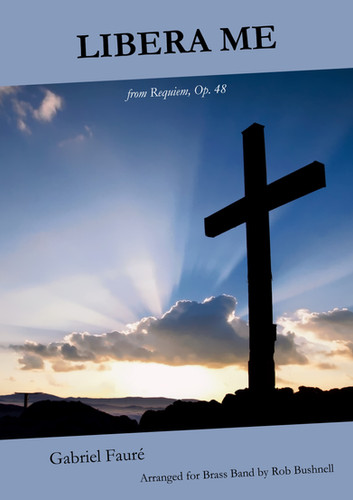 £33.43
Libera Me from 'Requiem' (Brass Band) Faure arr. Rob Bushnell
Composed between 1887 and 1890, Gabriel Faure's Requiem is not only one of his best-known works but one of the most popular piece of choral music in the Classical repertoire, coming 23rd in the Classic FM's Hall of Fame 2024. Believed to be a tribute to his father (who died in 1885), Faure himself said "My Requiem wasn't written for anything - for pleasure, if I may call it that!" It started life as a five-movement work but was later expanded to be the final seven-movement work we know today. The first version (which Faure called "un petit Requiem") was first performed on 16 January 1888, with Faure conducting, a second version premiered on 21 January 1893 before the final version (reworked for full orchestra) was played on 12 July 1900; the Requiem was performed at the composer's own funeral in 1924.The Libera Me, or Deliver Me, was actually written in 1877 and is the sixth part of the Requiem.Faure once said of the work, "Everything I managed to entertain by way of religious illusion I put into my Requiem, which moreover is dominated from beginning to end by a very human feeling of faith in eternal rest." Upon interview, he also said, "It has been said that my Requiem does not express the fear of death and someone has called it a lullaby of death. But it is thus that I see death: as a happy deliverance, an aspiration towards happiness above, rather than as a painful experience. The music of Gounod has been criticised for its inclination towards human tenderness. But his nature predisposed him to feel this way: religious emotion took this form inside him. Is it not necessary to accept the artist's nature? As to my Requiem, perhaps I have also instinctively sought to escape from what is thought right and proper, after all the years of accompanying burial services on the organ! I know it all by heart. I wanted to write something different."This arrangement is for the British-style brass band, with alternative parts for horns in F and bass-clef lower brass. The tenor solo is featured on the euphonium.A recording of the original composition can be found here: www.youtube.com/watch?v=fXwFNoBHCf0Duration: 4.20 minutes approx.Difficulty Level: 4th Section +PDF download includes parts and score.Sheet music available from www.brassband.co.ukInstrumentation:Soprano Cornet EbSolo Cornet BbRepiano Cornet Bb2nd Cornet Bb3rd Cornet BbFlugel Horn BbSolo Horn Eb1st Horn Eb2nd Horn Eb1st Baritone Bb2nd Baritone Bb1st Trombone Bb2nd Trombone BbBass TromboneEuphonium BbBass EbBass BbTimpani
In Stock: Estimated dispatch 1-3 working days
-
 £29.72
Beaufort Fanfare (Brass Band) Friedrich Gattermann
Beaufort Fanfare, by German composer Friedrich Gattermann, is a dynamic and vibrant musical work inspired by the Beaufort scale, a system for estimating wind speeds. Originally composed for brass ensemble and percussion, it was created to showcase Orchestral Tools' Beaufort Brass sample library, recorded at the iconic AIR Studios in London. Here it has been set for brass band.A central element of Beaufort Fanfare is its exploration of musical density. The piece begins with a single motif and gradually builds in complexity and richness, reflecting the increasing strength of the wind. As it progresses, the music intensifies, with the development of density playing a crucial role in conveying the evolving character of the elements.Through intricate brass harmonies and rhythmic drive, Beaufort Fanfare captures both the awe-inspiring beauty and raw power of nature. More than just an auditory experience, this composition takes the listener on a journey through the elements, celebrating the force of wind in all its forms.To view a rolling score video of the work please visit www.youtube.com/watch?v=vdiIIERMSDYDuration: 2.15 minutes approx.Difficulty Level: 1st Section +PDF download includes parts and score.Sheet music available from www.brassband.co.ukInstrumentation:Soprano Cornet EbSolo Cornet 1-3 BbSolo Cornet 2-4 BbRepiano Cornet Bb2nd Cornet Bb3rd Cornet BbFlugel Horn BbSolo Horn Eb1st Horn Eb2nd Horn Eb1st Baritone Bb2nd Baritone Bb1st Trombone Bb2nd Trombone BbBass TromboneEuphonium BbBass EbBass BbTimpaniPercussion 1-3
In Stock: Estimated dispatch 1-3 working days
-
 £48.30
Finale from Symphony No.3 (Organ Symphony) (Brass Band) Saint-Saens arr. Norbury
Saint-Saens' magnificent Finale from Symphony No.3 (widely known as the 'Organ Symphony') has here been arranged for brass band with optional organ by Kevin Norbury. It was recorded by The International Staff Band on its CD Manuscripts, although this version has been revised in places.Saint-Saens decided to add the organ and piano to his 3rd symphony as a pragmatic orchestration innovation. The composition of this symphony was probably started in 1885 and a first draft was completed in Prague in 1886.Saint-Saens later recalled its eventful genesis: 'The Symphony in C was three-quarters sketched out when I found it impossible to write the finale. I did not know how to resolve this situation, until one night I suddenly woke up and, in a sort of hallucination, I heard the whole finale, which I hastily wrote down in outline, knowing that if I went back to sleep without having put anything on paper, I would have forgotten it all the next day.'The symphony was first performed under the composer's direction at Saint James's Hall in London on May 19, 1886.This arrangement by Kevin Norbury can both function as a stand-alone brass band piece, and be performed with an organ by omitting the notes found in square brackets in the parts and score.To view a rolling score video please visit www.youtube.com/watch?v=OlUd_FppBY8PDF download includes score and parts. Additional parts (Horn in F and Baritone, Trombone, Euphonium & Tuba in Bass Clef) available here.Sheet music available from:UK - www.brassband.co.ukUSA - https://satradecentral.orgDifficulty Level: 1st Section +Length: 8.30 minutesInstrumentation:Soprano Cornet EbSolo Cornet BbRepiano Cornet Bb2nd Cornet Bb3rd Cornet BbFlugel Horn BbSolo Horn Eb1st Horn Eb2nd Horn Eb1st Baritone Bb2nd Baritone Bb1st Trombone Bb2nd Trombone BbBass TromboneEuphonium BbBass EbBass BbTimpaniGlockenspielPercussionOrgan (optional)
In Stock: Estimated dispatch 1-3 working days
-
 £33.43
Fanfare Prelude - Now thank we all our God (Brass Band & Organ) arr. Downie
This rousing fanfare prelude for Brass Band and optional Organ by Kenneth Downie is based on the monumental hymn Now thank we all our God, which dates from 17th century Germany. The arrangement is featured on the CD Classic Hymns for Orchestra - The Symphonic Music of Kenneth Downie (available here) as a symphonic brass setting.The arranger writes: 'The depth of the words is underpinned by the grandeur of the music, so I have tried to reflect the same regal approach in my setting for brass band.'This arrangement will be an ideal opener or prelude for concerts or church services.To view a rolling score video of the work please visit www.youtube.com/watch?v=olrdFskDfacPDF download includes score and parts. Additional parts for Horns in F, and Baritone, Trombone, Euphonium and Tuba in bass clef are available here.Sheet music available from:UK - www.brassband.co.ukUSA - https://satradecentral.orgDifficulty Level: 2nd Section +Length: 3.15 minutesInstrumentation:Soprano Cornet EbSolo Cornet Bb1st Cornet Bb2nd Cornet BbFlugel Horn BbSolo Horn Eb1st Horn Eb2nd Horn Eb1st Baritone Bb2nd Baritone Bb1st Trombone Bb2nd Trombone BbBass TromboneEuphonium BbBass EbBass BbTimpaniPercussion 1-3Organ (optional)
In Stock: Estimated dispatch 1-3 working days
-
 £81.74
'Odyssey' Variations (Brass Band) Kevin Norbury
'Odyssey' Variations was composed as a result of a commission in May 2020 from Five Lakes Silver Band and its musical director, Christopher Ward. This music is based on an original theme that I first used in an earlier composition, Odyssey, which was the test piece for the European Brass Band Championships, held at Munich, Germany, in April 1999. I distinctly remember getting into my hotel room and turning on the television to be greeted by news coverage of the Columbine High School shooting, so that piece has always held some significance for me, though because of a very sad coincidence.The melody was originally a cornet solo in the central slow section of Odyssey and pitched deliberately to test the soloist. I have, more recently attempted a straightforward choral setting of the melody, and the harmonies I use in the three chorale-style settings at the start of these variations are loosely based on that setting. The melody is a setting of the familiar words of Be Thou My Vision, an old Irish hymn, translated by Mary E. Byrne, and versified by Eleanor H. Hull.The form of the work is as follows:Theme - three presentationsVariation 1 - AllegroVariation 2 - Moderato (featuring the horns, baritones, euphoniums and basses)Variation 3 - Maestoso (featuring the cornets, flugel horn, and trombones)Variation 4 - AdagioVariation 5 - AllegrettoVariation 6 - Largo - ModeratoVariation 7 - Allegro moltoTheme - Maestoso e sostenutoFinale - Allegro vivace - Adagio e allargandoTo view a video of Five Lakes Silver Band performing the work please visit: www.youtube.com/watch?v=vfLnld3bCw8Sheet music available from:UK - www.brassband.co.ukUSA - www.solidbrassmusic.comDifficulty Level: 1st Section +Instrumentation:Soprano Cornet EbSolo Cornet BbRepiano Cornet Bb2nd Cornet Bb3rd Cornet BbFlugel Horn BbSolo Horn Eb1st Horn Eb2nd Horn Eb1st Baritone Bb2nd Baritone Bb1st Trombone Bb2nd Trombone BbBass TromboneEuphonium BbBass EbBass BbTimpaniPercussion 1-3
In Stock: Estimated dispatch 1-3 working days
-
 £33.43
Abide with me (Brass Band) William H. Monk arr. Greg Jasperse trs. Espen Haukas
VIEW SCORE PDFGreg Jasperse's choral setting of the much-loved hymn Abide with me has become very popular with choirs and has here been arranged for brass band by Norwegian composer Espen Haukas. The scoring is for standard brass band although the Repiano Cornet part is set as a second Flugel part. Optional cues are written for some upper register notes meaning the piece is playable by bands of all levels.To view a follow-the-score video with Bjorsvik Brass performing the work please visit:www.youtube.com/watch?v=lVHlQW_8PaoSheet music available from:UK - www.brassband.co.ukUSA - www.solidbrassmusic.comDifficulty Level: 4th Section +Instrumentation:Soprano Cornet EbSolo Cornet 1&2 BbSolo Cornet 3&4 Bb2nd Cornet Bb3rd Cornet BbFlugel Horn 1&2 BbSolo Horn Eb1st Horn Eb2nd Horn Eb1st Baritone Bb2nd Baritone Bb1st Trombone Bb2nd Trombone BbBass TromboneEuphonium 1&2 BbBass EbBass BbPercussion 1-3
In Stock: Estimated dispatch 1-3 working days
-
 £37.15
Nocturne for Brass Band & Percussion: The Lady with the Lamp - Andy Wareham
VIEW SCORE PDFNocturne for Brass Band & Percussion: The Lady with the Lamp was composed for the BrookWright International Brass Band Composer Competition 2020, the work later going on to be a finalist in the competition. The music celebrates the life and achievements of Florence Nightingale on the 200th anniversary of her birth.The work is structured in ternary form and is designed to be an engaging concert piece, accessible to both lower and upper section bands. Minimal percussion has been used and ossia passages have been added to accommodate all levels. The music imagines Miss Nightingale walking the wards at night with the contrasting sections representing her devotion to the care of others, the struggles and sacrifice of her service, and the lasting effect of her renowned achievements that are still felt to this day.Sheet music available from:UK - www.brassband.co.ukUSA - www.solidbrassmusic.comDifficulty Level: 2nd Section +Instrumentation:Soprano Cornet EbSolo Cornet 1&2 BbSolo Cornet 3&4 BbRepiano Cornet Bb2nd Cornet Bb3rd Cornet BbFlugel Horn BbSolo Horn Eb1st Horn Eb2nd Horn Eb1st Baritone Bb2nd Baritone Bb1st Trombone Bb2nd Trombone BbBass TromboneEuphonium 1&2 BbBass EbBass BbTimpaniPercussion 1-2
In Stock: Estimated dispatch 1-3 working days
-
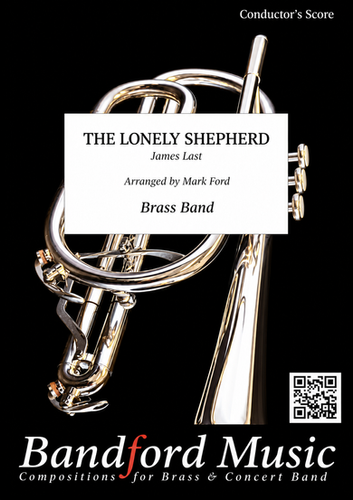 £33.43
The Lonely Shepherd (Brass Band) James Last arr. Mark Ford
Few melodies possess the haunting beauty and instant recognizability of The Lonely Shepherd. Originally composed by legendary bandleader James Last for a solo project titled Filmmusik Ohne Filme (Film Music Without Films), the track eventually found its home on the 1977 album Memories of Russia.It was this recording that catapulted pan flutist Gheorghe Zamfir to international superstardom, reaching the Top 25 on the German charts and becoming a permanent fixture in the global musical lexicon.While the original album title suggested "films without movies," the track didn't stay "homeless" for long. Its evocative, melancholic atmosphere has made it a favorite for directors across decades and continents.This brass band arrangement preserves the ethereal quality of the original, the soaring melodic lines and rhythmic intensity of the finale offering a brilliant showcase of phrasing and emotional depth.To view a rolling score video of the work please visit https://youtu.be/DgwjIij93OsDuration: Approx. 4.00 minutesDifficulty Level: 3rd Section +This PDF download includes the full score and parts.Sheet music available at www.brassband.co.uk (UK) or https://satradecentral.org (USA)Instrumentation:Soprano Cornet EbSolo Cornet BbRepiano Cornet Bb2nd Cornet Bb3rd Cornet BbFlugel Horn BbSolo Horn Eb1st Horn Eb2nd Horn Eb1st Baritone Bb2nd Baritone Bb1st Trombone Bb2nd Trombone BbBass TromboneEuphonium BbBass EbBass BbDrum KitPercussion 1-2
In Stock: Estimated dispatch 1-3 working days
 Watch video