
Results
-
 £30.00
My Little Welsh Home - Traditional
A beautiful arrangement by Tim Paton of a Welsh song by W S Gwynne Williams. Created in memory of his mother, Tim has produced a wonderful version for brass band and has also included an optional vocal solo or unison choir line.Comments from the arranger:I have arranged [My Little Welsh Home] in memory of my mother. [She] was born, Doreen Davies, on 27th November 1918, in Haverfordwest, Pembrokeshire, a small town in South West Wales. She had a beautiful voice, and met my father, Bill Paton, during World War II, whilst she was singing in a troop concert at the County Theatre in her home town, and my father was the MC.Throughout her life, my mother and father entertained, and she was singing right up until the final months of her life. She spent many years in Weston-super-Mare, Somerset, a seaside town in South West England, and it was here that she passed away on 20th September 2004. During the last several months of her life, she often referred to the song My Little Welsh Home:Here are the words.I am dreaming of the mountains of my homeOf the mountains where in childhood I would roamI have dwelt 'neath southern skiesWhere the summer never diesBut my heart is in the mountains of my homeI can see the little homestead on the hillI can hear the magic music of the RhyllThere is nothing to compareWith the love that once was thereIn the lonely little homestead on the hillI can see the quiet churchyard down belowWhere the mountain breezes wander to and froAnd when God my soul will keepIt is there I want to sleepWith those dear old folks that loved me long agoLooking at the words, I can see why it meant so much to her. Haverfordwest is at the foot of the Preseli Mountains, and her home and church were at the top of a hill. My mothers' ashes were taken back to her own little Welsh home, and laid to rest in the grounds of the church where she had been Christened, Confirmed and Married.Look and Listen (Score-reading digital sound-sample):
In Stock: Estimated dispatch 3-5 working days
-
 £30.00
She's Out of My Life - Tom Bahler
A lovely flugel solo arrangement of this well known song, made famous by the late Michael Jackson.It's arranger, Jon Bennett, has truly captured the beauty of the melody and through his scoring he has given the soloist and accompaniment the opportunity to bring the piece to life.A great new addition to your concert programme, not just because of its current relevance in the music world, but even moreso because of the way in which the music has been crafted for brass band.
In Stock: Estimated dispatch 3-5 working days
-
 £30.00
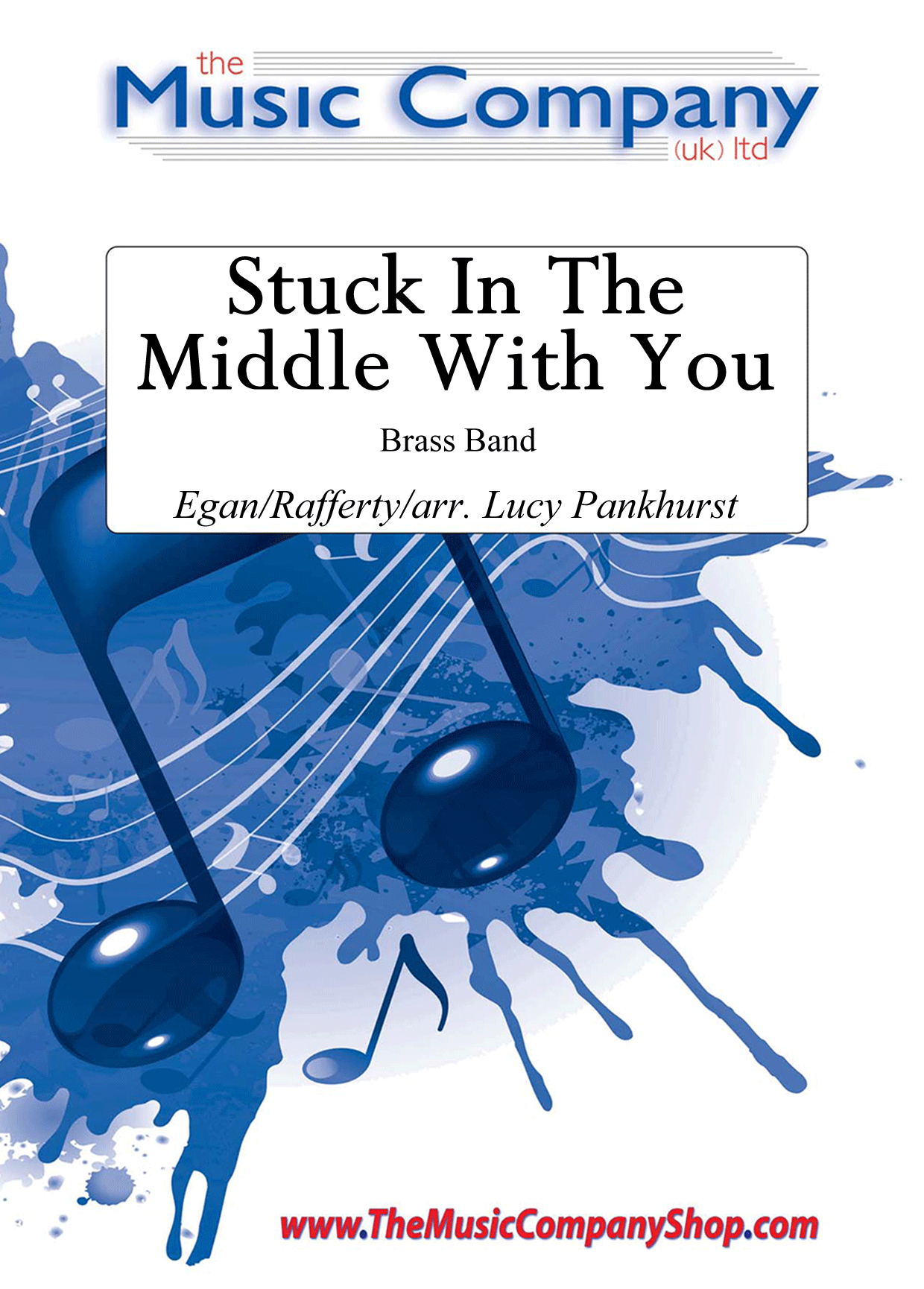
Stuck In The Middle With You - Egan/Rafferty
Arranged by Lucy Pankhurst, this is a refreshing remake of the original 70's hit song for Stealers Wheel, that combines nostalgia with some showy and innovative solo work.The melody travels around the band and the overall feel of the melody, rhythms and beat are brilliantly scored to recapture the original song, with the added benefit of soloists being to shine in riff spotlight moments. This classy makeover ensures thepiece can't help but get those toes tapping with its funky beat.A great concert feature which is bound to bring back fond memories for the audience and band members alike!
In Stock: Estimated dispatch 3-5 working days
-
 £40.00
Activate - Matthew Hall
ActivateTop to bottom in less than 2 minutes! Originally composed for Tredegar Town Band under the direction of Ian Porthouse, Activate is a fantastic way to start any programme in a concert or on the contest stage.The original conception of Activate occurred when Tredegar had 18 minutes of a 20 minute contest programme and couldn't find a piece to start the performance to fit in the time slot.With funky bass lines, percussion and melody lines as well as some devilish rhythmical elements in the inner parts, Activate is a sure fire way of getting the audience's feet tapping.The trombone solo in the middle section of the piece can be substituted on to any other Bb instrument should the need occur, and the piece can also be started with a drum kit rhythm rather than straight into the first bar.Activate
Estimated dispatch 5-7 working days
-
Mele Kalikimaka - Robert Alex Anderson - Len Jenkins
Mele Kalikimaka is an Hawaiian-themed Christmas song, written in 1949 by Robert Alex Anderson. The song takes its title from the Hawaiian phrase, "Mele Kalikimaka" meaning ''Merry Christmas'' Hawaiian has a different language system, and does not have the 'r'or 's' we have in English - thus our "Merry Christmas" becomes "Mele Kalikimaka". This arrangement offers a very different view of Christmas from the norm, which can be refreshing in a Concert of traditional carols, and allows for a solo feature section, if required, for Kazoos - great fun!
-
The Tricorn - Len Jenkins - Len Jenkins
The Tricorn is a style of three-cornered hat from Europe in the 18th century, generally referred to as a 'cocked hat' in Britain and popular in America at the time of the War of Independence. It may still be seen on ceremonial occasions as part of the town-cryer's dress in England and features in a popular German song for children 'Mein Hut, der hat drei Ecken'. However, in the case of this music, the reference is to the cornet section and the requirement for triple-tonguing on the Eb Soprano cornet. Whilst ostensibly a concert march in style, its jaunty rhythm makes you want to stride along and it may therefore be used as a 'road march' as well. Pressure on the Soprano cornetist as a soloist is reduced by adding the Solo Cornets to the melody line in the 'road march' version. With this in mind, we supply the music in both A4 (concert) and A5 (march-card) sizes as a package.
-
 £39.95
All I Ask of You (Score and Parts) - Andrew Lloyd Webber arr. Chris Mowat
The official authorized brass band arrangement one of the hit from Andrew Lloyd Webber's The Phantom of the Opera. A very sophisticated arrangement by Christopher Mowat for solo trombone and brass band. Lush!
Estimated dispatch 7-9 working days
-
 £39.95
As If We Never Said Goodbye (Score and Parts) - Andrew Lloyd Webber arr. Bill Geldard
The official authorized brass band arrangement one of the hits from Andrew Lloyd Webber's Sunset Boulevard. Expertly arranged as a solo for trombone and brass band by Bill Geldard.
Estimated dispatch 7-9 working days
-
 £39.95
Pie Jesu (Score and Parts) - Andrew Lloyd Webber arr. Ray Steadman-Allen
The official authorized brass band arrangement of the 'Pie Jesu' movement of Andrew Lloyd Webber's Requiem. Ray Steadman-Allen has expertly transcribed the piece for soprano cornet and solo cornet or flugelhorn and brass band. Ideal for concert or devotional use.
Estimated dispatch 7-9 working days
-
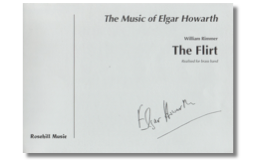 £39.95
The Flirt (Score and Parts) - William Rimmer arr. Elgar Howarth
Taken from William Rimmer's The Artistic Soloist - a volume of character melodies for solo cornet - Elgar Howarth has furnished four of the tunes with full accompaniment for brass band. The Flirt is dainty, inconstant, and capricious - the downcast eyes and the toss of the head are represented musically.
Estimated dispatch 7-9 working days