
Results
-
 £30.00
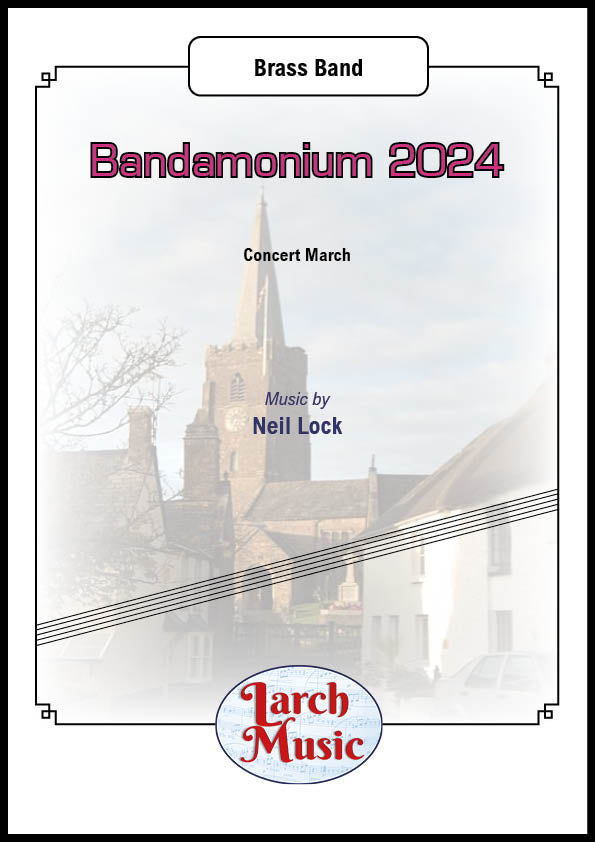
Bandamonium 2024 (Neil Lock) - Brass Band Sheet Music Full Score & Parts - LM541
COMPOSER: Neil LockThis march was submitted to the march composers' competition for "Bandamonium 3"in Hatherleigh, Devon in July 2024. The winning march was played by massed bands at the conclusion of the celebrations on Saturday 27th July 2024. Unfortunately, this march took second place in the competition, behind the march of Paul Pennicotte-Henrie, conductor of Okehampton Silver Band.The march can be played with or without the singing. (Even at the Whit Friday marches, begad!) I suggest that it should be introduced by 3-beat rolls.When played with singing, the "Bandamonium" lyrics (bars 10-13 and 56-57) are to be sung by all players, keeping to their own parts, with appropriate octave adjustment for their individual singing voices. Conductor and percussionists should sing with the main theme (Db and C at bars 10-13, F at 56-57). Listen to the 3rd cornet players!There is an additional part for Singers, in which the trio melody (bars 58 onwards) can be sung by Soprano and Tenor singers at a moderate choir standard. An octave-down option is also provided in the higher bars. This part can be given to "spare" singers within the band, or to singers external to the band if opportunity permits. The lyrics are:We are in Devon,We're in Hatherleigh,Whit Friday heaven,But we're marching free!Now it's past seven,Time to party,At BandamoniumIn Hatherleigh!LM541 - ISMN : 9790570005413
In Stock: Estimated dispatch 3-5 working days
-
 £49.95
Fantasia: Three Parts on a Ground (Score and Parts) - Henry Purcell arr. Philip WIlby
Composed by Henry Purcell for three solo instruments (violins or recorders) over a repeating bass line around the year 1680 this work shows English Contrapuntal skill at its most exhuberant. This free transcription for brass band stands alongside Philip Wilby's 1995 composition Revelation which uses it as a basis in tribute to Purcell's tercentenary.
Estimated dispatch 7-9 working days
-
 £32.00
The Beacons (Score only) - Ray Steadman-Allen
For centuries hilltop beacon fires blazed across the land signals of important happenings or warnings of invasion. This music tells no specific story but the titles of the four thematically related sections are a guide to the idea: The Beacons; Far Horizons; The Invaders; Celebration. The first movement has something of the character of the march and the fanfare; spirited and tightly driving, it promises most of the thematic material of the work. The second is largelt tranquil and is thinly scores with solo passages. The third has the most dramatic potential; its energy and conflict subsides to a lament and a tolling bell before a vigorous rounding off. Appropriately, the fourth movement is in a merry-making mood, and the jubilant music concludes with fragment statements of the main themes. The Beacons was first performed by IMI Yorkshire Imperial Band (James Scott) at the 'Concert of the Century', celebrating the Centenary of the British Bandsman, at the Free Trade Hall, Manchester, on 5 September 1987. Duration: 12:30
Estimated dispatch 7-9 working days
-
£33.00
Born Free - Barry, J - Catherall, A
Composed for the 1966 film starring Virginia McKenna and Bill Travers, this piece by John Barry is one of his most critaically acclaimed scores winning the Academy Award for Best Original Score.
In Stock: Estimated dispatch 1-3 working days
-
£26.50
Brave and Free - Greenwood, JA
Includes a full band set (no score)
In Stock: Estimated dispatch 1-3 working days
-
£26.50
Free and Easy - Gilbourne, J
Includes a full band set (no score)
In Stock: Estimated dispatch 1-3 working days
-
 £34.95
Escape Velocity (Brass Band - Score and Parts)
Escape Velocity is the scientific term for the speed at which a body overcomes the gravitational pull of another body. Thematically, the music seeks to capture the busyness and 'gravitational pull' of the fallen world and the struggle of the believer to overcome and escape into the restful presence of God. Eventually, the believer breaks free from the world, the work culminating in a presentation of the popular Hillsong anthem, 'I will run to you'.
Estimated dispatch 7-14 working days
-
 £89.95
Diversions for Brass Band, Op.97 (Brass Band - Score and Parts)
This work was commissioned in1985 by Skellerup, Christchurch, New ZealandMovements:Allegro VivaceAndante Con Moto Molto ExpressivoAllegro VivaceDerek Bourgeois wrote Diversions in the summer of 1985 to a commissioned from the Skellerup Brass Band.Bourgeois previous test piece, Blitz, was aggressive and forceful, therefore the composer decided to write a work of a completely different character, which although technically very demanding, is light-hearted in style, and easy on the ear, as the title suggests.The first and third movements share the same tempo, but are rather different in character. The first movement is a sonata allegro contrasting two main themes. The first is bold and jaunty and is heavily scored, the second announced by the solo horn is more lyrical in character. The development section and recapitulation are merged into a continuous interplay of the two themes.The second movement is an expressive andante in free rondo form. It is lightly scored for the most part with a lot of solo passages that make demands on the musicianship of the players and conductor alike. The very simplicity of its textures and the breadth of its melodic writing demand firm control of vibrato, phrasing and rubato.The brief finale is nothing short of a romp. Its ternary structure is highly rhythmic in character and only rarely do the performers enjoy the luxury of two consecutive bars in the same time signature!Duration: 11.00
Estimated dispatch 7-14 working days
-
 £87.95
Masquerade (Score and Parts)
The first performance took place on the 4th. September 1993 at the Free Trade Hall in Manchester during the British Open Brass Band Championships.Note by Philip Wilby:Masquerade is a centenary tribute to Verdi's last opera Falstaff and takes its final scene as the basis for my own piece. Thus I have used some of Verdi's music, and some of Shalespeare's plot, and woven them into a fabric with highly demanding music of my own to produce a work in the great tradition of operatically-based brass band pieces. Such scores date from the very beginnings of band repertory and are often not direct arrangements in the established sense but new compositions produced in homage to a past master. They may still offer performers and audience alike something familiar interwoven with something new. My own piece reuses some elements from the original story: . .Falstaff has been caught in a web of his own lies by the ladies of the town, who propose to teach him a lesson. The story opens at night in Windsor Great Park. The plotters, variously disguised in Hallowe'en fashion (as fairies,elves hobgoblins etc!) assemble in the park to await Falstaff's arrival (musicologists will, perhaps, note a rare use of 'large bottle in F' being used during this scene of suppressed alcoholic revelry!). Falstaff's companions, Bardolph,Piston and Robin, enter (represented here by the three trombones!), and are variously abused by the masqueraders. At the height of the Tout an alarm sounds and Falstaff (euphonium cadenza) enters as Midnight strikes. From a safe hiding place he watches as the disguised Nanetta (principal comet) sings a serene solo as the moon appcars above the trees. With sudden force the others seize him and drag him from his hiding place. As in the traditional game 'Blind Man's Buff', he is roughly turned seven times (a sequence of solo accelerandi) until, at last, he recognizes his assailants as his sometime friends. Far from complaining, Verdi's character concludes the opera with a good-humoured fugue on the words.... 'All the World's a Joke... Every mortal laughs at the others, But he laughs best who has the final laugh. Philip Wilby.
Estimated dispatch 7-14 working days
-
 £44.95
Masquerade (Score Only)
The first performance took place on the 4th. September 1993 at the Free Trade Hall in Manchester during the British Open Brass Band Championships.Note by Philip Wilby:Masquerade is a centenary tribute to Verdi's last opera Falstaff and takes its final scene as the basis for my own piece. Thus I have used some of Verdi's music, and some of Shalespeare's plot, and woven them into a fabric with highly demanding music of my own to produce a work in the great tradition of operatically-based brass band pieces. Such scores date from the very beginnings of band repertory and are often not direct arrangements in the established sense but new compositions produced in homage to a past master. They may still offer performers and audience alike something familiar interwoven with something new. My own piece reuses some elements from the original story: . .Falstaff has been caught in a web of his own lies by the ladies of the town, who propose to teach him a lesson. The story opens at night in Windsor Great Park. The plotters, variously disguised in Hallowe'en fashion (as fairies,elves hobgoblins etc!) assemble in the park to await Falstaff's arrival (musicologists will, perhaps, note a rare use of 'large bottle in F' being used during this scene of suppressed alcoholic revelry!). Falstaff's companions, Bardolph,Piston and Robin, enter (represented here by the three trombones!), and are variously abused by the masqueraders. At the height of the Tout an alarm sounds and Falstaff (euphonium cadenza) enters as Midnight strikes. From a safe hiding place he watches as the disguised Nanetta (principal comet) sings a serene solo as the moon appcars above the trees. With sudden force the others seize him and drag him from his hiding place. As in the traditional game 'Blind Man's Buff', he is roughly turned seven times (a sequence of solo accelerandi) until, at last, he recognizes his assailants as his sometime friends. Far from complaining, Verdi's character concludes the opera with a good-humoured fugue on the words.... 'All the World's a Joke... Every mortal laughs at the others, But he laughs best who has the final laugh. Philip Wilby.
Estimated dispatch 7-14 working days
 View Music