
Results
-
£86.00
Saturday in the Park - Robert Lamm - Lars Erik Gudim
This is on of the group Chicago's most popular ballads, still doing great after beeing recorded in 1972 on their fifth album. Chicago's main songsriter, Robert lamm, wrote this after a particulary exhilarating 4th of July spen in New York's Central Park, where there were steel drum players, singers, dancers and jugglers. This was originally used as a soundtrack to an unreleased home video. It became the group's first gold single.
Estimated dispatch 7-14 working days
-
£90.00
Fragile Oasis - Peter Meechan
Fragile Oasis is the name of a collective who describe themselves as aaa grass-roots participatory initiative that connects the shared perspective of astronauts from different countries and cultures with people on Earth, encouraging all to work together so that our planet is not only visibly beautiful, but beautiful for alla.Many involved in the project are astronauts on the International Space Station (I.S.S.), who post, on their website (http://www.fragileoasis.org) many different details of their experiments, photos from space, and some incredible video footage of our Earth.One such time lapse video (a video made up many still images) was posted on their website by astronaut Ron Garan (http://www.fragileoasis.org/blog/2011/11/coming-back-down-to-our-fragile-oasis-2/) in 2011. It is made up of images taken from the I.S.S. of what Garan described as aaa couple of laps around our Fragile Oasis before coming back down [to Earth]a and features all kinds of amazing views from space.Each of the five sections of this work relate to an aspect of the video - either something literal or something more metaphorical. The opening section, i: The lights from Above, is a musical description of the view of the Aurora Australis from above the lights. The second section, ii: The Storm from Above (part i), is also a musical portrayal of portions of the video clip - in this case the many lightning storms we see from above. The storms that are so powerful on Earth appear as small bolts of electricity dancing through the clouds.The third section, iii: Freya, has its roots in personal family tragedy. The name Freya derives from a Norse goddess who was associated with both beauty and love, and in this central section I wanted to write music that not only acknowledged how fragile life itself is, but that every day of it counts and should be celebrated.iv: The Storm from Above (part ii) is a again a reference to the lightning storms, but also to the huge hurricanes we see in the video. It leads us to the final section, v: The Oasis from Above - a description of the size and grandeur of Earth, our Fragile Oasis.Fragile Oasis was commissioned by Leyland Brass Band and Michael Bach, and partly funded by The John Golland Trust, for their appearance at the 2013 European Brass Band Championships in Oslo, Norway. It is dedicated to Natalie Youson, in friendship
Estimated dispatch 12-14 working days
-
 £30.00
Fantastic Polka - Arthur Pryor
A graduate of London's Guildhall School of Music, he studied with Denis Wick, Eric Crees and Peter Gane, and was awarded the Principal's Prize. As a former Head of Brass at the Royal Birmingham Conservatoire and Manchester's Royal Northern College of Music he is currently Professor of Trombone and Brass Ensemble at the Folkwang University of Arts, Essen, Germany and Visiting Tutor at London's Guildhall School of Music & Drama. Voted 2014 Teacher of the Year by the British Trombone Society he is a regular Low Brass Professor with the European Union Youth Orchestra, Gustav Mahler Jugendorchester and Schleswig Holstein Festival Orchestra.
-
 £30.00
Heraldic Spirit - Chris Houlding
A graduate of London's Guildhall School of Music, he studied with Denis Wick, Eric Crees and Peter Gane, and was awarded the Principal's Prize. As a former Head of Brass at the Royal Birmingham Conservatoire and Manchester's Royal Northern College of Music he is currently Professor of Trombone and Brass Ensemble at the Folkwang University of Arts, Essen, Germany and Visiting Tutor at London's Guildhall School of Music & Drama. Voted 2014 Teacher of the Year by the British Trombone Society he is a regular Low Brass Professor with the European Union Youth Orchestra, Gustav Mahler Jugendorchester and Schleswig Holstein Festival Orchestra.
-
£40.00
Kiwi Dragon - Matthew Hall
'Kiwi Dragon' was commissioned by Byron 'Buzz' Newton for his Master's final performance recital at The Royal Welsh College of Music & Drama in 2012, a recital in which he was awarded an unprecedented 100%. Buzz travelled to Cardiff, Wales for his Master's degree course and became a member of Tredegar Town Band during his studies. 'Kiwi Dragon's' inception came from an initial conversation with the soloist where the thought of combining traditional Welsh folk music with that of Buzz's native New Zealand folk songs to create a virtuosic finishing piece for the recital was conceived. Originally scored for solo euphonium, 10-piece brass and percussion, 'Kiwi Dragon' includes the traditional New Zealand folk melodies Pokare Ana and Tarakihi and the Welsh folk melody Myfanwy, combined with the national anthems of both New Zealand and Wales in the pieces' culmination.
Estimated dispatch 5-7 working days
-
Left Bank Two - Wayne Hill - Len Jenkins
In the 1960's, a group of session musicians had some studio time left over and asked if anyone had something they wanted to try. The young vibes player, Wayne Hill came up with this tune, which they recorded on the spot, almost as a 'throwaway' piece. To viewers in the UK, it is best known as the music used in "The Gallery" sequence of 'Vision On', which was a British children's television programme, shown on BBC1 from 1964 to 1976. Tony Hart, artist and co-presenter of the programme, made pictures in a variety of sizes and media, and encouraged children to submit their own paintings to "The Gallery" for display on TV. They did so in their thousands. The piece has been used in a number of adverts including those for Volkswagen, Castrol Oil and Waitrose, and TV programmes such as NBC's America's Got Talent, The X Factor (U.S) and the BBC panel show QI. Left Bank Two features a Vibraphone solo with Brass Band accompaniment. For those bands that do not have a Vibraphone, an alternative solo for a B flat instrument is included.
-
 £94.95
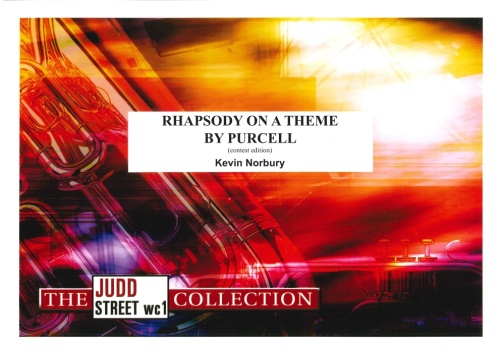
Rhapsody on a Theme by Purcell (Brass Band - Score and Parts)
Contest VersionIn his relatively short lifetime, Henry Purcell (1659 -1695) achieved stellar musical success and was known and admired internationally by his contemporaries. He is justifiably considered one of England's greatest composers.I thought long and hard before using this magnificent theme as the basis for a band piece because I think that Benjamin Britten has said just about everything possible regarding it in his The Young Person's Guide to the Orchestra. Bearing this in mind, I tentatively set about working on this composition. Once started though, the job became fun because the theme still yielded possibilities - even after Britten!The piece is basically a set of linked variations, much like Rachmaninov's great Rhapsody on theme by Paginini. The music starts slowly and makes much use of crisply dotted rhythms - a Purcellian characteristic. The theme is heard twice before the music changes into a jaunty duple time variation based on the opening motif of Purcell's theme. After this, the mood changes to a waltz-like variation in which clear references to the original theme can be heard. The slow movement follows, and is based on rising and descending scalic figures. This variation is an 'A-B-A' movement with two similar passages framing a more vigorous middle section which features antiphonal fanfare-like figures. Without any preamble, the last variation launches itself - a rumbustious dance which has a distinctive feel to it.The theme eventually reappears as a counter-melody to this dance music before a final triumphant treatment of the melody featuring a somewhat athletic bass line. The music accelerates at the Coda and disappears in a 'puff of smoke'.- Kevin Norbury
Estimated dispatch 7-14 working days
-
£39.95
Rhapsody on a Theme by Purcell (Brass Band - Score only)
Contest VersionIn his relatively short lifetime, Henry Purcell (1659 -1695) achieved stellar musical success and was known and admired internationally by his contemporaries. He is justifiably considered one of England's greatest composers.I thought long and hard before using this magnificent theme as the basis for a band piece because I think that Benjamin Britten has said just about everything possible regarding it in his The Young Person's Guide to the Orchestra. Bearing this in mind, I tentatively set about working on this composition. Once started though, the job became fun because the theme still yielded possibilities - even after Britten!The piece is basically a set of linked variations, much like Rachmaninov's great Rhapsody on theme by Paginini. The music starts slowly and makes much use of crisply dotted rhythms - a Purcellian characteristic. The theme is heard twice before the music changes into a jaunty duple time variation based on the opening motif of Purcell's theme. After this, the mood changes to a waltz-like variation in which clear references to the original theme can be heard. The slow movement follows, and is based on rising and descending scalic figures. This variation is an 'A-B-A' movement with two similar passages framing a more vigorous middle section which features antiphonal fanfare-like figures. Without any preamble, the last variation launches itself - a rumbustious dance which has a distinctive feel to it.The theme eventually reappears as a counter-melody to this dance music before a final triumphant treatment of the melody featuring a somewhat athletic bass line. The music accelerates at the Coda and disappears in a 'puff of smoke'.- Kevin Norbury
Estimated dispatch 7-14 working days
-
 £44.95
Triumphant (Brass Band - Score and Parts)
Triumphant was written as the opening work for the 2024 Future All-Stars final concert. Based on the well-known hymn Victory in Jesus (S.A.S.B. 464), the piece reimagines the familiar melody and words with energetic drumline-inspired rhythms and driving Bass groove.O victory in Jesus, my Saviour, for ever!He sought me and bought me with his redeeming blood;He loved me ere I knew him, and all my love is due him -He plunged me to victory beneath the cleansing flood.Musically speaking, the rhythmic pulse should remain confident and consistent throughout, with the percussion establishing the groove and the band locking in with precision. Take time to find a tempo that allows the Bass and Percussion parts to remain clear and accurate. A slightly steadier pace will produce a stronger, more convincing groove. However, a slower tempo can result in the band's playing becoming too heavy. Melodic lines should be played on the longer side, allowing phrases to sing over the rhythmic accompaniment that can be more defined and articulated. As the work builds, be patient and disciplined with dynamics, saving the band's fullest sound for the climactic moments, maximising their impact.
Estimated dispatch 7-14 working days
-
 £74.95
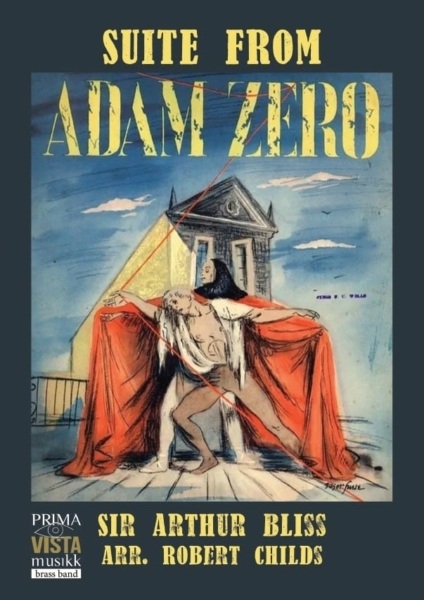
Adam Zero, Suite from (Brass Band - Score and Parts)
Selected as the Section 2 test piece for the National Brass Band Championships of Great Britain 2025Following his ballet Checkmate, Bliss composed another score for the, by then, Sadler's Wells Ballet, Miracle in the Gorbals, which was choreographed by Robert Helpmann, to a scenario by Michael Benthall. Premired in 1944, the ballet made a considerable impact and was a box-office success. It was followed in turn by a further collaboration with Helpmann and Benthall, Adam Zero. This would serve Helpmann, in the eponymous role, as a vehicle in two respects: demonstrating his gifts as a dancer-actor and as a choreographer. First performed at the Royal Opera House, Covent Garden, on 8 April 1946, Adam Zero was conducted by Constant Lambert, the work's dedicatee. Bliss considered it 'his most varied and exciting ballet score'. Benthall provided a synopsis for the programme:There is a philosophy that life moves in an endless series of timeless cycles. As Nature passes through Spring, Summer, Autumn and Winter, so man is born, makes a success in his own particular sphere, loses his position to a younger generation, sees his world crumble before his eyes and only finds peace in death. This age-old story is told in terms of a Company creating a ballet and calling on the resources of the theatre to do so. Lighting, stage mechanism, dance conventions, musical forms and costumes and scenery of all periods are used to symbolize the world of 'Adam Zero'.Apart from Adam, as the Principal Dancer, other main roles included the Stage Director (representing Omnipotence), and Adam's Fates (Designer, Wardrobe Mistress, and Dresser). 'The Woman in this allegory', wrote Bliss, 'under the symbol of the Choreographer, was both the creator and destroyer of Adam: his first love, his wife, his mistress, and finally the figure of beneficent Death.' When the curtain rose, the 'audience saw the Covent Garden stage right back to the wall, completely empty except for the protagonists, 'the Company poised, still and expectant, as they await the birth of... Adam Zero.'Unfortunately, soon after the premire, Helpmann injured himself and had to withdraw from the remaining performances. Despite generally positive reviews, the ballet did not capture the imagination of audiences and, to Bliss's considerable disappointment, was not revived. Seventy years would elapse before its first major return to the stage, in 2016, performed by the ballet company of Stadttheater Bremerhaven with choreography by Sergei Vanaev.Bliss extracted a concert suite from the ballet, conducting its first performance with the City of Birmingham Symphony Orchestra on 28 October 1948. For his own suite, arranged for brass band in 2023, Dr Robert Childs chose three dances linked to the seasons, book-ending them with the ebullient 'Fanfare Overture' and 'Fanfare Coda'. After Adam has grown to manhood, his Fates clothe him in a costume synonymous with confident youth, appropriate for the virile, ardent 'Dance of Spring'. In the 'Approach of Autumn', Adam, now wearing a sombre costume, has grown older: his Fates have streaked grey in his hair and put lines on his face. But they had earlier raised Adam to the zenith of his power, and the 'Dance of Summer' depicts him in the prime of life, in music of sweeping grandeur. The 'Fanfare Coda' signals that the next cycle of life is about to begin.Duration: 10.30
Estimated dispatch 7-14 working days
 View Music