
Results
-
 £22.50
Petite Suite de Ballet (Score Only)
This composition consists of four 'miniatures', simple in construction, yet not without technical demands upon the players.The music is for a ballet which so far exists only in the imagination! Like most ballet, it has a touch of the fantastic, and must be interpreted with a light, deft touch.The first movement, Parade, brings many characteristics on to the stage, marching perkily, leggily, with almost puppet-like movements.In the next movement, Pas Seul (Solo Dance), one lone figure holds the stage, with a mixture of grace and sauciness. At the end he (or she) runs off with a snap of the fingers.The third movement is a Minuet. A chosen few, richly garbed, perform this stately, courtly dance, while the rest of the company look on at some ritual in which they are not allowed to join.The final Ensemble commencing with the return of the lone figure, gradually brings the whole company to the stage. Various groups come forward for a few moments, and then rejoin the general pattern of the dancing. Towards the end a stately procession is formed, but this finally breaks up in a sudden flurry of leaping and capering, and in a moment, as though at some magic call, the dances have disappeared, whilst the sonorous tones of the final bars of music follow them with a rather disapproving air.Our little fantasy in over.
Estimated dispatch 7-14 working days
-
£33.00
Lux Aeterna - Harper, P
The title Lux Aeterna (Eternal Light) can be interpreted on a number of levels. Musically it has a rather mystical feel to it, and the single note with which the piece begins continues uninterrupted throughout, like an inextinguishable flame, or a constant source of hope. There are lyrical and song-like solo lines for cornet, flugel and euphonium. In a recent review Paul Hindmarsh described the piece as a touching new work by Philip Harper that would have got my vote for best new work for its technical ingenuity if not its 'wow factor'.Listen to Cory BandCourtesy of World of Brass
In Stock: Estimated dispatch 1-3 working days
-
 £24.95
The Pilgrim's Prayer (Brass Band - Score and Parts) - Rouse, Sydney - Ball, Eric
Introduction - This could hardly be more simple. Inexperienced players may have some little difficulty in intonation, especially as they are starting 'cold', but a useful lesson can be learned in this connection when rehearsing these two bars. Section A - The music is hymn tune-like in character, but it should not become stilted. Close intonation is still a point to study, especially in view of the chromatic nature of some of the harmony. Section B - Aim to secure just balance in the accompanying parts, especially in the second phrase, where the 1st comets may be inclined to treat their moving part as an independent melody rather than part of the 'colour' background. Section C -This is a reprise of the first theme, with a different arrangement. The same comments apply, however. Section D - Here the music becomes more song-like in style, and provides an interesting contrast. The scoring, too, is more varied, and there are a number of points that call for attention. Note that the 1st and 2nd comets and 2nd trombone work as a team throughout; see that the pulsating, syncopated background adds to the movement of the music without giving a jerky effect; the new entries in the fourth and twelfth bars are to be made quite smoothly; and do not allow the texture of the music, especially in the last eight bars of the section, to overshadow the simplicity of the main tune. Section E - Here the first subject appears again. In the arrangement the colour contrasts are quite clear-cut. In order to secure true balance in the fifth and sixth bars, it may be necessary to adjust the amount of tone given by the bass trombone, as this part is not doubled as are the other parts. Section F -This section forms a simple but expressive coda.
Estimated dispatch 7-14 working days
-
£12.50
The Pilgrim's Prayer (Brass Band - Score only) - Rouse, Sydney - Ball, Eric
Introduction - This could hardly be more simple. Inexperienced players may have some little difficulty in intonation, especially as they are starting 'cold', but a useful lesson can be learned in this connection when rehearsing these two bars. Section A - The music is hymn tune-like in character, but it should not become stilted. Close intonation is still a point to study, especially in view of the chromatic nature of some of the harmony. Section B - Aim to secure just balance in the accompanying parts, especially in the second phrase, where the 1st comets may be inclined to treat their moving part as an independent melody rather than part of the 'colour' background. Section C -This is a reprise of the first theme, with a different arrangement. The same comments apply, however. Section D - Here the music becomes more song-like in style, and provides an interesting contrast. The scoring, too, is more varied, and there are a number of points that call for attention. Note that the 1st and 2nd comets and 2nd trombone work as a team throughout; see that the pulsating, syncopated background adds to the movement of the music without giving a jerky effect; the new entries in the fourth and twelfth bars are to be made quite smoothly; and do not allow the texture of the music, especially in the last eight bars of the section, to overshadow the simplicity of the main tune. Section E - Here the first subject appears again. In the arrangement the colour contrasts are quite clear-cut. In order to secure true balance in the fifth and sixth bars, it may be necessary to adjust the amount of tone given by the bass trombone, as this part is not doubled as are the other parts. Section F -This section forms a simple but expressive coda.
Estimated dispatch 7-14 working days
-
 £91.99
Time Remembered (Brass Band - Score and Parts) - Sparke, Philip
The initial idea was for a millennium piece, which it is, but rather than add to the many celebratory pieces that have understandably been written to salute the 3rd millennium, Philip Sparke thought it would perhaps be appropriate to think about the aspects of life that are constantly with us (such as faith and philosophy) rather than the exciting changes that the year 2000 has undeniably wrought. This calm meditative work will bring a moment of serenity and reflection to any concert.Duration: 8.30
Estimated dispatch 7-14 working days
-
 £28.95
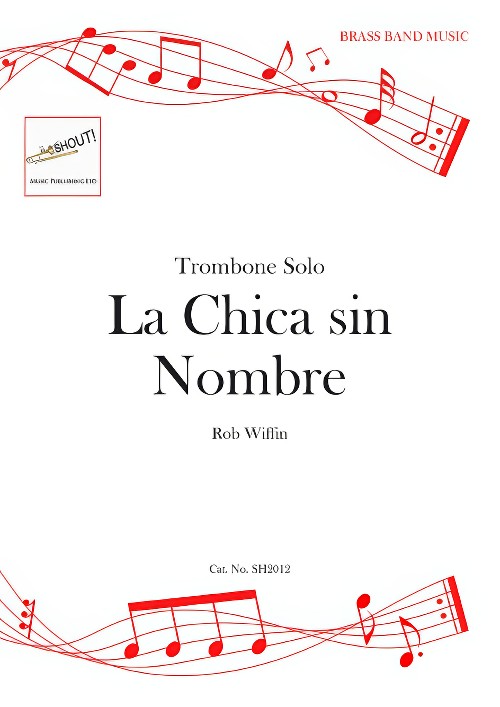
La Chica sin Nombre (Trombone Solo with Brass Band - Score and Parts) - Wiffin, Rob
A vibrant, rhythmic solo for trombone and bandLa Chica sin Nombre was written in March 2020 at the request of Brett Baker. He wanted something in Latin style so I chose to go for a Mambo-type dance piece. In obtaining the right percussion sound I would always ask for Conga drums and Mambo Bell/Timbales rather than drum kit. The piece needs to be played with an appropriate feel for Latin music. It should sound light and easy to play but has a few tricky moments- especially the cadenza-like sections from F to H. The virtuosic section at letter G can be cut if required.- Rob WiffinDuration: 4.15
Estimated dispatch 7-14 working days
-
 £85.00
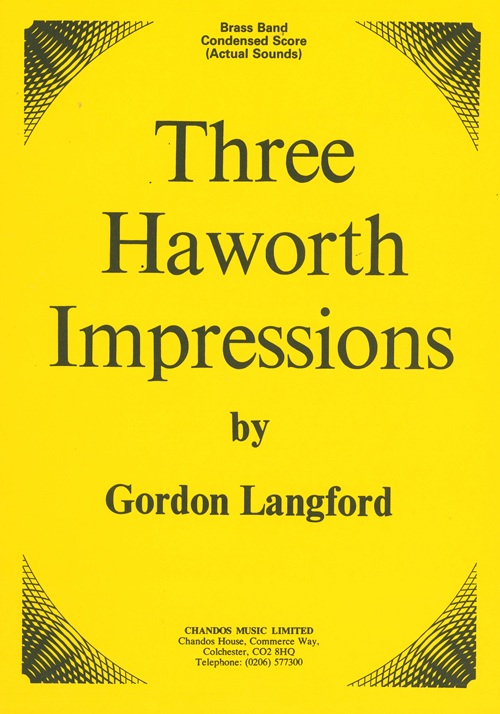
Three Haworth Impressions (Brass Band - Score and Parts) - Langford, Gordon
A wonderful three movement suite which conjures up fabulous musical imagery of the lands of northern England. Well worth including as a concert item in your next programme, but this great original composition should really should be set again as a test-piece soon - rewarding musically for audience and bandsmen alike.Includes:TOP WITHENS - A GENERAL EVOCATION OF THE ATMOSPHERE OF WUTHERING HEIGHTS The sinister opening motif symbolises the influence of the evil Heathcliffe, Soon this motif experiences several changes of character in order to portray emotions other than those of hatred and jealousy. The overall mood is, however, one of gloom and foreboding.THE THREE BELLS This is a reference to the pseudonyms adopted by Ann, Charlotte and Emily Bronte. The music begins with three "bell"-notes; Ab for Acton Bell, Cb for Currer Bell and Eb for Ellis Bell, and these three notes form the basis of a wistful waltz tune. Again the mood is rather sombre -- save for a brighter middle section -- and the opening motif from "Top Withens" is to be heard, again symbolising the frustrations and ill-fortune by which their lives were plagued.THE WORTH VALLEY RAILWAY The Brontes were not the only people in Haworth and not all is desperation and gloom. The third impression is a celebration of the victory of the people of Haworth in their fight to retain their railway. The nine-eight rhythm of a slow train is prominent, and our once-sombre motif is transformed into a triumphant fanfare.Duration: 12.00Please note that there are only 3 solo cornet parts included in this set
Estimated dispatch 7-14 working days
-
£16.00
Three Haworth Impressions (Brass Band - Score only) - Langford, Gordon
A wonderful three movement suite which conjures up fabulous musical imagery of the lands of northern England. Well worth including as a concert item in your next programme, but this great original composition should really should be set again as a test-piece soon - rewarding musically for audience and bandsmen alike.Includes:TOP WITHENS - A GENERAL EVOCATION OF THE ATMOSPHERE OF WUTHERING HEIGHTS The sinister opening motif symbolises the influence of the evil Heathcliffe, Soon this motif experiences several changes of character in order to portray emotions other than those of hatred and jealousy. The overall mood is, however, one of gloom and foreboding.THE THREE BELLS This is a reference to the pseudonyms adopted by Ann, Charlotte and Emily Bronte. The music begins with three "bell"-notes; Ab for Acton Bell, Cb for Currer Bell and Eb for Ellis Bell, and these three notes form the basis of a wistful waltz tune. Again the mood is rather sombre -- save for a brighter middle section -- and the opening motif from "Top Withens" is to be heard, again symbolising the frustrations and ill-fortune by which their lives were plagued.THE WORTH VALLEY RAILWAY The Brontes were not the only people in Haworth and not all is desperation and gloom. The third impression is a celebration of the victory of the people of Haworth in their fight to retain their railway. The nine-eight rhythm of a slow train is prominent, and our once-sombre motif is transformed into a triumphant fanfare.Duration: 12.00Please note that there are only 3 solo cornet parts included in this set
Estimated dispatch 7-14 working days
-
 £15.99
A Road Less Travelled By (Brass Band - Study Score) - Sparke, Philip
A Road Less Travelled By was commissioned by Palangos Orkestras for the Championship Section of the 2020 European Brass Band Championships held in Palanga, Lithuania.The following was written by the composer, Philip Sparke:The title alludes to a poem by American author, Robert Frost, which appeared in his 1916 collection, Mountain Intervals: The Road Not Taken.In common with most of my larger works, this piece in not programmatic, but purely abstract; there is no extrinsic musical story. The choice of title shares my view of how composers can often develop. There can be no 'destination' in a composer's career, but rather a continuing journey to an unknown place. From piece to piece a composer needs to decide his or her next steps, never really knowing where they might lead. As Frost so eloquently describes, these sorts of instinctive decisions guide all our lives.Set in three movements, which play without a break, A Road Less Travelled By opens with a Moto Perpetuo firmly rooted in classical language, form and syntax. A continuous river of semiquavers, veering from melody to accompaniment and back again, adds drive, every and motion. The second movement, Nocturne, is in the form of a free fantasia; solos for vibraphone, flugel horn and euphonium set the stage for a central cornet solo, quietly echoed by the full band. A triumphal climax is reached before the movement dissolves into a Scherzo Finale. Mercurial and quixotic in nature, this third movement starts jovially until trios for trombones and horns darken the atmosphere. A change of mood and meter leads to a reprise of the opening and a return of the cornet melody, this time accompanied by figures derived from the scherzo theme. A brief coda based on earlier material drives the piece to a close.Duration: 15.30
Estimated dispatch 7-14 working days
-
 £69.99
The Green Hills of Tyrol (Euphonium Solo with Brass Band - Score and Parts) - Sparke, Philip
The Green Hills of Tyrol was commissioned by Jrena and Beat Knusel for their son, Swiss euphonium player Joel Knusel, to celebrate his 20th birthday in 2019. The request was for a piece suitable for use in a solo competition, possibly using a Scottish or Irish melody, and composer Philip Sparke suggested an old-fashioned air varie might be a suitable idea. The piece follows the well-established formula of a theme followed by four variations. The history of the original melody is fascinating and, although it is now well-known as a bagpipe tune, its background is Austrian or Italian, rather than Scottish. The tune appears as a chorus of Swiss soldiers in Rossini's 1829 opera William Tell but was possibly an existing Tyrolean folk tune. In 1854, during the Crimean War, Pipe Major John MacLeod of the 93rd Highlanders heard a band of the Sardinian contingent playing selections from the opera in camp before the Siege of Sebastopol. He was struck by the melody and arranged it for his pipers, calling it The Green Hills of Tyrol, referring to Tell's visit to that corner of Austria in the opera. It has since become universally popular among pipe bands who usually refer to it as A Scottish Soldier, following the addition of new lyrics in a 1961 hit by Andy Stewart.Duration: 5.45
Estimated dispatch 7-14 working days
 View Music