
Results
-
 £59.95
LAND OF THE LONG WHITE CLOUD, The - Aotearoa (Brass Band Set - Score and Parts) - Sparke, Philip
Score & Parts. First Section - National Brass Band Championships of Great Britian Area Test Piece 2017. Recorded on Polyphonic QPRL069D Un Vie de Matelot, Polyphonic QPRL065D Double Champions
Estimated dispatch 7-14 working days
-
£59.95
Moorside Suite (Brass Band - Score and Parts) - Holst, Gustav
Score and Parts. 2010 National Championships Area Qualitying Contest - 1st Section. This work was first heard at the Crystal Palace Brass Band Contest in 1928 for which it had been specially written.
Estimated dispatch 7-14 working days
-
£59.95
PAGEANTRY (Suite) (Brass Band Set - Score and Parts) - Howells, Herbert
Score & Parts. National Championships of Great Britain Area Test piece 2017 - Championship Section. Recorded on Polyphonic QPRL040D Pageantry
Estimated dispatch 7-14 working days
-
 £59.95
PSALMS AND ALLELUIAS (Brass Band Set - Score and Parts) - Wilby, Philip
Score and Parts. National Brass Band Championships of Great Britain Section 2 Finals 2010 .
Estimated dispatch 7-14 working days
-
£55.00
ROYAL MILE SUITE, A (Brass Band Set - Score and Parts) - Fernie, Alan
Score and Parts. National Brass Band Championships of Great Britain Section 4 Finals 2010 .
Estimated dispatch 7-14 working days
-
 £45.00
Symphony No.1, Finale from (Brass Band - Score and Parts) - Rachmaninoff, Sergei - Littlemore, Phillip
Rachmaninov composed his First Symphony in 1895, at the age of just 22 years. It received its first performance on March 27, 1897, at a Russian Symphony Society concert in St. Petersburg with Alexander Glazunov conducting. The premiere was not well-received, and Rachmaninov himself blamed Glazunov for a lacklustre approach for beating time rather than finding the music. Some contemporary reports even suggested that Glazunov was inebriated when he took to the stage! Despite the disappointment of the premiere performance, Rachmaninov never destroyed the score but left it behind when he left Russia to settle in the West, eventually it was given up for lost. After the composer's death, a two-piano transcription of the symphony surfaced in Moscow, followed by a set of orchestral parts at the conservatory in Saint Petersburg. In March 1945, the symphony was performed in Moscow for the first time since its 1897 premiere. It was a grand success, and this led to a new and more enthusiastic evaluation of the symphony. In March 1948 it received a similarly successful American premiere and the work proceeded to establish itself in the general repertory. The final movement (Allegro con fuoco) is colourful and grand but not without its darkly contrasting, menacing episodes that intensifies its malevolence. It is a work overflowing with ideas demonstrating a strong, highly individual, and self-assured young talent. Duration: 5:40
Estimated dispatch 7-14 working days
-
 £40.00
Zadok the Priest (SAATBB Chorus with Brass Band - Score and Parts) - Handel, George Frideric - Littlemore, Phillip
Handel's coronation anthem?Zadok the Priest?was composed for the coronation of George II in 1727, and has been sung at every subsequent British coronation. Handel used texts from the King James Bible, which are derived from the biblical account of the anointing of Solomon. There are no choral parts included with the set, however it works with all the major editions of vocal score. Duration: 6:00
Estimated dispatch 7-14 working days
-
 £55.00
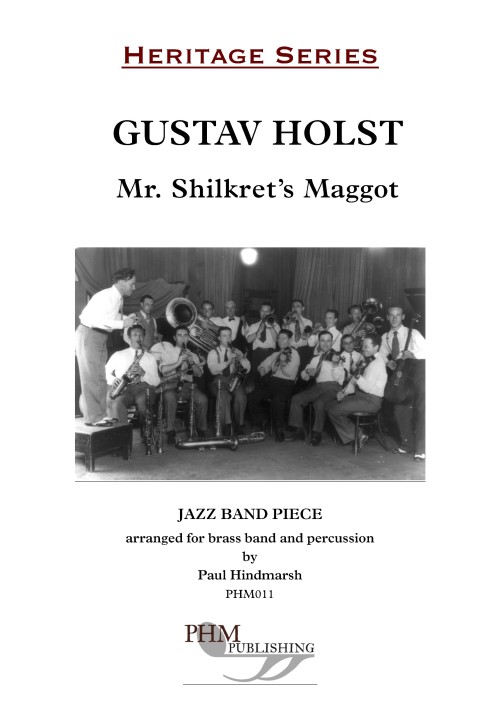
Mr Shilkret's Maggot (Brass Band - Score and Parts) - Holst, Gustav - Hindmarsh, Paul
This short piece was composed in 1932 during a visit Gustav Holst was making to the USA. He was invited by the band leader Nathaniel Shilkret to contribute to a series of piece for concert jazz band based on a folk song. Rather than using a traditional tune, Holst invented one of his own in folk song style and therefore the piece was not performed. Holst considered various titles for the piece including Mr. Shilkret's Dump, Folly and Maggot. On the manuscript he described it as a Jazz Band Piece. When the composer's daughter Imogen re-scored the piece for the English Chamber Orchestra to record under her direction in 1967, she changed decided to use the title Capriccio.Her re-orchestration involved removing the saxophone quartet, adding cor anglais and a second bassoon and changing cornet parts to trumpets. She retained the harp, extensive percussion, piano and celesta. My brass band version is based on the composer's manuscript, held at the British Library. It retains the composer's cornet parts, re-voices the woodwinds and strings, and places keyboards and harp onto glockenspiel, marimba, vibraphone and xylophone.I have selected the title Mr. Shilkret's Maggot for my scoring of Jazz Band Piece, which was first performed by The Cory Band, conducted by Philip Harper, at the Royal Northern College of Music Brass Band Festival, 29 January 2017.- Paul HindmarshDuration: 5.30
Estimated dispatch 7-14 working days
-
 £144.99
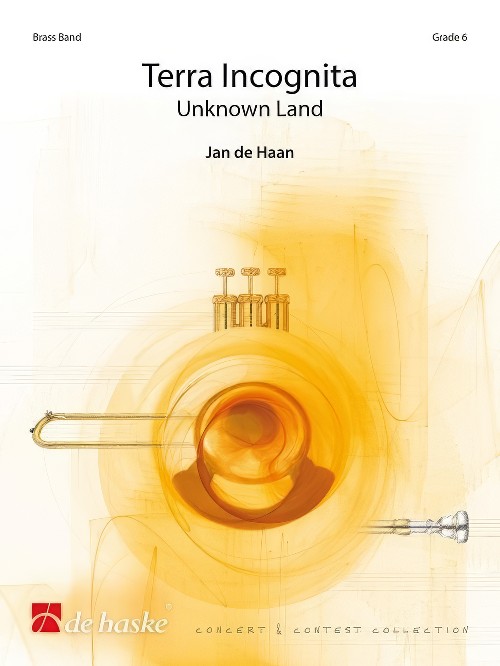
Terra Incognita (Unknown Land) (Brass Band - Score and Parts) - De Haan, Jan
In five musically and thematically continuous parts, this composition transports us to foreign, fascinating places - stepping into the shoes of the explorers who set off to discover unknown lands centuries ago. The test piece for the Dutch Brass Band Championships 2015 (Challenge Section) holds interesting solo parts for flugelhorn and trombone. An exciting musical journey!Duration: 14:30
Estimated dispatch 7-14 working days
-
£24.95
The Pilgrim's Prayer (Brass Band - Score and Parts) - Rouse, Sydney - Ball, Eric
Introduction - This could hardly be more simple. Inexperienced players may have some little difficulty in intonation, especially as they are starting 'cold', but a useful lesson can be learned in this connection when rehearsing these two bars. Section A - The music is hymn tune-like in character, but it should not become stilted. Close intonation is still a point to study, especially in view of the chromatic nature of some of the harmony. Section B - Aim to secure just balance in the accompanying parts, especially in the second phrase, where the 1st comets may be inclined to treat their moving part as an independent melody rather than part of the 'colour' background. Section C -This is a reprise of the first theme, with a different arrangement. The same comments apply, however. Section D - Here the music becomes more song-like in style, and provides an interesting contrast. The scoring, too, is more varied, and there are a number of points that call for attention. Note that the 1st and 2nd comets and 2nd trombone work as a team throughout; see that the pulsating, syncopated background adds to the movement of the music without giving a jerky effect; the new entries in the fourth and twelfth bars are to be made quite smoothly; and do not allow the texture of the music, especially in the last eight bars of the section, to overshadow the simplicity of the main tune. Section E - Here the first subject appears again. In the arrangement the colour contrasts are quite clear-cut. In order to secure true balance in the fifth and sixth bars, it may be necessary to adjust the amount of tone given by the bass trombone, as this part is not doubled as are the other parts. Section F -This section forms a simple but expressive coda.
Estimated dispatch 7-14 working days
 View Music