
Results
-
 £144.99
No Man's Land - Thierry Deleruyelle
No Man's Land was commissioned by the 'Noordlimburgse Brass Band'. Thierry Deleruyelle has written this work in 2018, 100 years after the end of World War 1. This work is related to his first work written for brass band, Fraternity, which tells the story about the mining accident in Courieres, France. Countries such as Belgium and Germany helped France. Eight years later World War 1 broke out. Instead of helping each other, no man's land arose.
Estimated dispatch 5-14 working days
-
 £39.95
Good Old Songs No.2
Includes: The Man Who Broke the Bank at Monte Carol; Let Him Go, Let Him Tarry; If Those Lips Could Only Speak; While Strolling in the Park; Ta-Ra-Ra-Boom-De-Ay.
Estimated dispatch 7-14 working days
-
 £69.99
Theme from "Star Trek(R)" - Alexander Courage - Thomas Doss
Who doesn't know the famous introduction 'To boldly go where no man has gone before' at the beginning of each Star Trek sequel? Many generations grew up with Star Trek - one of the most iconic Sci-Fi series ever written.The original theme is as iconic as the opening line. A great warm up for the next Star Trek series in 2017, arranged by Thomas Doss.
Estimated dispatch 5-14 working days
-
 £34.95
Descent, The - Christopher Bond
The Descent takes its inspiration from Victorian author Jules Verne; specifically, his work Twenty Thousand Leagues Under the Sea. In Twenty Thousand Leagues Under the Sea, Professor Arronax finds himself a prisoner of the mysterious Captain Nemo, on a remarkable submarine called the Nautilus. Nemo is one of Verne's most memorable characters. He's a man who has turned his back on the world, and his name - Nemo - means 'No Man.' He has vowed never to set foot on dry land ever again. Verne gives his hero's brilliance and benevolence a dark underside - the man's obsessive hate for Empires and Imperialism. Captain Nemo is a genius, an engineer, an artist, an athlete, sometimes a pacifist, sometimes a righter of wrongs, sometimes an out and out villain, and he invented the Nautilus. The Descent is based on the idea of a descent to the depths of the ocean in the Nautilus with Captain Nemo, with the cornet soloist expressing both the anguish and reflective sides of the character. On one hand, a troubled and agitated figure, juxtaposed with the reflective memories of his homeland, children, mother and father. The work was written for and commissioned by Flowers Band as part of their programme of music at Brass in Concert 2019.
Estimated dispatch 10-14 working days
-
 £20.00
King Lear Fanfare - Claude Debussy
King Lear is a tragedy by William Shakespeare. Lear descends into madness bringing tragic consequences for all. Based on a mythological pre-Roman Celtic king, the play has been widely adapted for the stage and motion pictures, with the title role coveted by many of the world's most accomplished actors. Its first known performance was in 1607, George Bernard Shaw wrote, "No man will ever write a better tragedy than Lear". Originally orchestrated for 2 flutes, 4 horns, 3 trumpets, timpani, side drum, 2 harps, and strings, Debussy wrote five minutes of incidental music for a production of King Lear, produced at the Theatre Mogador Paris in 1904.
-
 £69.99
Star Trek, Theme from (Brass Band - Score and Parts) - Courage, Alexander - Doss, Thomas
Who doesn't know the famous introduction "To boldly go where no man has gone before" at the beginning of each Star Trek sequel? Many generations grew up with Star Trek - one of the most iconic Sci-Fi series ever written. The original theme is as iconic as the opening line. A great warm up for the next Star Trek series in 2017, arranged by Thomas Doss.Duration: 3:15
Estimated dispatch 7-14 working days
-
 £23.00
King Lear Fanfare (Brass Band - Score and Parts) - Debussy, Claude - Wilson, Duncan
King Lear is a tragedy by William Shakespeare. Lear descends into madness bringing tragic consequences for all. Based on a mythological pre-Roman Celtic king, the play has been widely adapted for the stage and motion pictures, with the title role coveted by many of the world's most accomplished actors. Its first known performance was in 1607, George Bernard Shaw wrote, "No man will ever write a better tragedy than Lear". Originally orchestrated for 2 flutes, 4 horns, 3 trumpets, timpani, side drum, 2 harps, and strings, Debussy wrote five minutes of incidental music for a production of King Lear, produced at the Theatre Mogador Paris in 1904. Duration: 1.30. Suitable for 4th Section Bands and above.
Estimated dispatch 7-14 working days
-
 £159.99
Time Machine - Thomas Doss
Time Machine is a journey through time that begins in the Stone Age. Evolution and the coming of man take place. The journey takes us into the present, in which disorientation and chaos abound. We travel further into the future. An unfamiliar, quiet and surreal landscape lies before us and we wander through it, bewildered as we become aware of the destruction of the environment. Suddenly, and for no reason, memories from our childhood are awoken. Cultures have become completely mixed into one and the evolution of man has run its course. We realise that there is no "afterwards" as before us lies the Stone Age once again... The wheel of time spins blindly on and all isrepeated.
Estimated dispatch 5-14 working days
-
 £59.99
Jesu, Joy of Man's Desiring - Johann Sebastian Bach - Philip Sparke
Bach's appointment as the Cantor at Leipzig's Thomaskirche in 1723 required him to produce a new cantata for every Sunday service. Jesu, Joy of Man's Desiring is taken from his Cantata No.147 and is unusually elaborate, treated more like an aria than a chorale. It is perhaps the best-loved cantata movement from Bach's entire output and is a certain crowd pleaser for your concert programme.
Estimated dispatch 5-14 working days
-
 £38.95
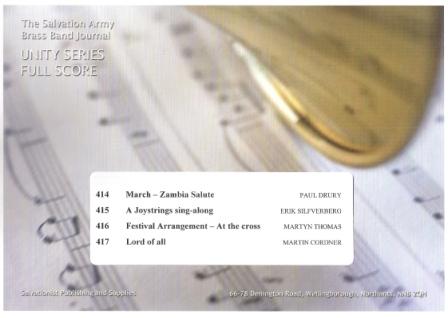
Unity Series Band Journal February 2014 Numbers 414-417
No.414 March - Zambia Salute (Paul Drury)In April 2009, a group from Chelmsford Citadel Corps visited Zambia. The purpose of the visit was to assist in the leadership of the Zambian Territorial Music School, held at Chikankata. This march was written to commemorate the event and received its premiere performance at the final festival. The melody featured is the chorus of the song, I know not why Dod's wondrous grace (S.A.S.B. 730).No.415 A Joystrings sing-along (Erik Silfverberg O.F.)This piece represents the first published work since the sudden Promotion to Glory of Bandmaster Erik Silfverberg O.F. The Joystrings made Salvation Army history about fifty years ago, introducing rock music on the Christian music scene. Many of their songs have become classics and have been used as thematic material in our brass music. Here is a selection of three of their songs, to be used either as a band piece or as accompaniment to a sing-along. The three songs are:- 'I want to sing it', 'It's an open secret' and 'Have faith in God'.No.416 Festival Arrangement - At the cross (Martyn Thomas)The well-known song, 'At the cross' (T.B. 580), is given a lively new setting by Martyn Thomas. The rock and swing treatment of this old melody should appeal to many!No.417 Lord of all (Martin Cordner)This piece was written for the 120th Anniversary of Balham corps (London Central Division) in 2011. In terms of a theme, the anniversary occasion prompted the primary thought that the piece should first be a praise-offering to God, acknowledging him for who he is. Therefore songs referenced in the piece are praide songs: 'Lord, reign in me', 'He is Lord', 'All hail the Lamb', along with a song of testimony, 'I'm a soldier bound for Glory' (T.B. 382),which speaks of the Christian hope in Heaven and challenges Salvationists to influence others by living out that hope. There is also a brief reference to the National Anthem of the Democratic Republic of Congo (4 bars before D)- man acknowledgement to the faithfulness of corps soldiers who in recent years have arrived from that country.
Estimated dispatch 7-14 working days
 View Music