Results
-
£30.00Repton (Sir Hubert Parry arr. by David Grace) - Brass Band Sheet Music Full Score & Parts - LM557
COMPOSER: Sir Hubert ParryARRANGER: David Grace"Dear Lord and Father of Mankind" is ahymnwith words taken from a longer poem, "The Brewing of Soma" by AmericanQuakerpoetJohn Greenleaf Whittier. The adaptation was made byGarrett Horderin his 1884Congregational Hymns.In many countries the hymn is most usually sung to thetune"Repton" byHubert Parry; however, in the United States, the prevalent tune is "Rest" byFrederick Charles Maker.The text set appears below. Some hymnal editors omit the fourth stanza or resequence the stanza so that the fifth stanza as printed here comes last.If sung to Parry's tune, "Repton", the last line of each stanza is repeated.It is often customary, when singing the final stanza as printed here, to gradually sing louder from "Let sense be dumb...", reaching a crescendo on "...the earthquake, wind and fire", before then singing the last line "O still, small voice of calm" much more softly.Dear Lord and Father of mankind,Forgive our foolish ways!Reclothe us in our rightful mind,In purer lives Thy service find,In deeper reverence, praise.In simple trust like theirs who heardBeside the Syrian seaThe gracious calling of the Lord,Let us, like them, without a wordRise up and follow Thee.O Sabbath rest by Galilee!O calm of hills above,Where Jesus knelt to share with TheeThe silence of eternityInterpreted by love!With that deep hush subduing allOur words and works that drownThe tender whisper of Thy call,As noiseless let Thy blessing fallAs fell Thy manna down.Drop Thy still dews of quietness,Till all our strivings cease;Take from our souls the strain and stress,And let our ordered lives confessThe beauty of Thy peace.Breathe through the heats of our desireThy coolness and Thy balm;Let sense be dumb, let flesh retire;Speak through the earthquake, wind, and fire,O still, small voice of calm.
In Stock: Estimated dispatch 3-5 working days
-
£70.00
Fire in the Sky - Peter Meechan
Fire in the Sky takes its inspiration from the stunning town of Montreux in Switzerland. I was commissioned to write the work 5 days before I visited this Montreux and was at work forming ideas for the piece as I arrived on the shore of Lake Geneva and its amazing views of the Alps.Whilst the scenery is without doubt some of the most incredible views I have ever witnessed, it was the history of the town that set Fire in the Sky in motion. Whilst there, it occurred to me that many of my musical heroes had lived or performed there, and three of them in particular had a strong connection with the town. Miles Davis, Igor Stravinsky and Freddie Mercury graced Montreux - the large convention centre, where the famous summer jazz festival is held, named its two halls after Davis and Stravinsky, and there is a quite breathtaking statue of Mercury in the town too.Each musician also commemorates an anniversary in 2011, the year of the premiere of Fire in the Sky; it is 40 years since the death of Stravinsky and both Miles Davis and Freddie Mercury died in 1991, making it 20 years since their deaths. So it seemed fitting to write a piece that in some way acknowledges them, and is a kind of personal athanksa for all they have given, and continue to give, me.The title comes from the famous Deep Purple song, Smoke on the Water - whose second line is aFire in the Skya and is a reference to the night the townas casino was set alight by a Frank Zappa fan. The piece tries to recreate the atmosphere of that night, paint a picture of fire in the sky (and smoke on the water) and also uses small anuggetsa of the music of my three greatest musical heroes, Miles Davis, Freddie Mercury and Igor Stravinsky.Fire in the Sky was commissioned by the Tomra Brass Band, Norway, and is dedicated to Stijn BerbeA and Nick Ost - both of whom are connected with the band (teaching and conducting), and both have been close friends - personally and musicaly - for many years. I am indebted to them for the opportunity to write this piece.
Estimated dispatch 12-14 working days
-
£119.99The Patriots - Jan de Haan
The Dutch patriottentijd (literally 'Time of the Patriots') was a period of political instability in the 1780s. The country was led by regents who were occupied with their own personal interests rather than dedicating themselves to the needs of the people. In this revolutionary period, the devoted republican Patriots were in conflict with the Orangists. A civil war followed, in which the Patriots were beaten and driven away by a Prussian army. This composition is an abstract piece inspired by the Patriots. The thematic material is based on the Dutch war song 'Merck toch hoe sterck'. Its powerful minor melody, which has its origins in the Eighty Years' War, is recognizablethroughout the work, presented in variations of constantly shifting character.
Estimated dispatch 5-14 working days
-
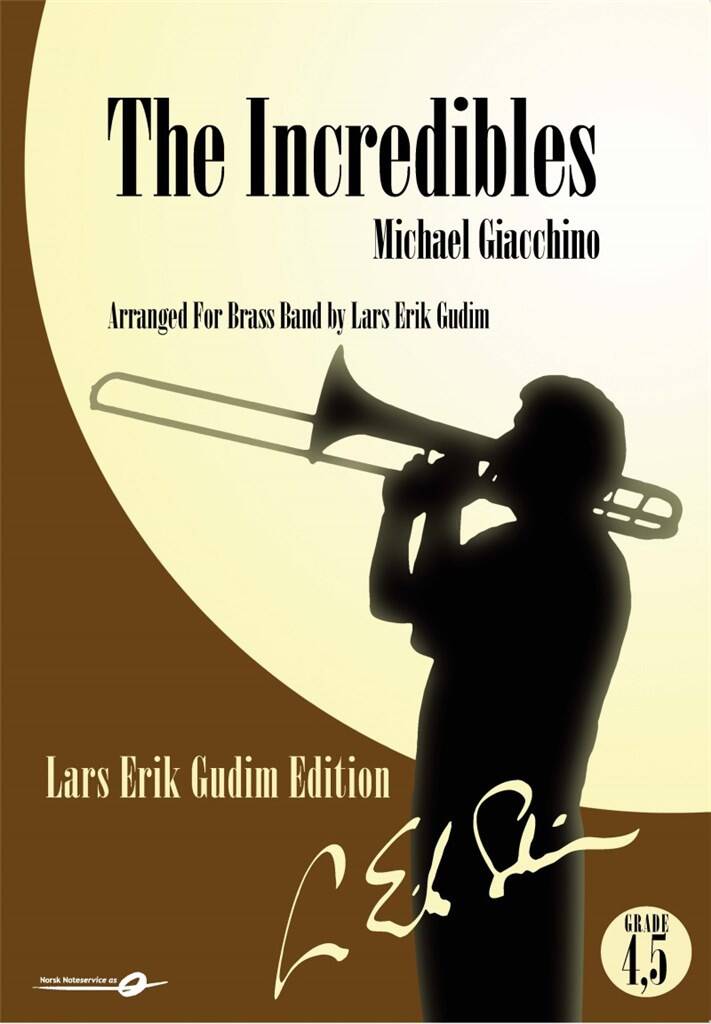
£64.95South Loop on the CTA - Tom Davoren
Tom Davoren composed South Loop in 2015 following an annual visit to the city of Chicago, in the Midwest region of the United States of America. It takes its name from a section of the "L", the famous elevated railway which is the lifeblood of thecity and its suburbs. The piece tries to capture some of the bustling energy of this Chicago landmark and the 750,000 commuters who use it each day.
Estimated dispatch 5-14 working days
-
£69.99Symphonic Suite from Star Wars: The Force Awakens - John Williams - Stephen Bulla
Utilizing the distinctive Jedi Steps theme featured at the end of the film, combined with the rousing Finale from the end credits, Stephen Bulla authentically recreates the beauty and power of this amazing film score. Courtesy of Mr. Williams himself, an alternate "concert ending" is provided in addition to the quiet ending as heard at the end of the film.
Estimated dispatch 5-14 working days
-
£94.99
The Devil's Bridge - Bertrand Moren
The "Teufelsbrucke" (devil's bridge) is a very old bridge connecting the Goschenen and Andermatt valleys in the canton of Uri, central Switzerland. Legend has it that in the 13th century the people of Uri made a pact with the devil to build a bridge across the canyon. When the people only delivered a goat in payment of the soul demanded by the devil he was angry and decided to knock down the bridge. An old woman painted the sign of a cross on the rock the devil was intending to destroy the bridge with and the devil, unable to lift it, disappeared forever. The rock remains to this day at the northern entry of the Gotthard tunnel.
Estimated dispatch 5-14 working days
-
£60.99The Craftsmen - Christian Bouthier
The energetic activities of three craftsmen at a local crafts market inspired the composer Christian Bouthier to write this work in three movements. The clockmaker gets many curious visitors at his stand. He patiently and proudly shows the precision work of his beautiful clocks and lets all of them tick - the small ones and large ones. The cooper (barrel-maker) skillfully puts together fine-looking, sturdy barrels of the best types of wood. From afar, you can hear the cooper hammering. In the final movement things are hectic at the blacksmith because the local horse-riding society has just arrived. Many horses are provided with new shoes. The experienced blacksmith hits thehorseshoes into the proper shape on his anvil; now the horses can spiritedly trot and gallop on the way back. A fascinating new addition to the concert band repertoire.
Estimated dispatch 5-14 working days
-
£60.99Hymn of Faith - Louis Bourgeois - John Blanken
The French composer Louis Bourgeois lived from c.1510 to 1560. Bourgeois was cantor in Geneva and, commissioned by John Calvin, he composed melodies for metrical (rhyming) versions of the psalms. After completing about a hundred one-part psalms, he made some four-part arrangements, which were denounced and even resulted in his imprisonment for a day. Later, Bourgeois published a number of psalm collections, and judging from his book Le droict chemin de musique he was also an excellent educator. The melodies Bourgeois composed, are (contrary to Gregorian chants) particularly suitable for community singing. This applies to his hymn tune Saint Michael, which is why this melody hasbeen used for various texts, written for many occasions. John Blanken made this arrangement for a wedding ceremony: an occasion in which faith and trust play a large - if not the largest - role. Hence the title Hymn of Faith. The arrangement contains four verses of the hymn. After a majestic opening the hymn follows twice, the second verse being embellished in the tenor register. After a short interlude verse three follows, played by a quartet. The majestic opening is then repeated as a modulation into the fourth verse, which concludes the work in a brilliant tutti.
Estimated dispatch 5-14 working days
-
£22.00The Catskills - Nigel Hess
In upstate New York lie the Catskill Mountains - an extraordinary combination of tranquillity and power, peace and majesty. Once seen they call you back again and again. This brass band transcription has been made by PhillipLittlemore and explores the sonorous and warm sounds of the brass band. The Catskills is the second movement of East Coast Pictures, originally written for wind band, and was commissioned in 1985 by the British Youth WindOrchestra with funds from National Westminster Bank plc. These three short 'pictures' were inspired by several visits by the composer to a small part of the USA's East Coast, an area that provides greatextremesin the geography and the people.
Estimated dispatch 5-14 working days
-
£76.99On the Movieset - John Emerson Blackstone
Glitter and glamour, good-looking people, a lot of Bling Bling and fast cars images like these will cross our minds when we think of the movie world. However, reality proves to be different : as a rule, a tremendous amount of work will have been done on the set before a film is ready to be shown on the big screen. A visit to an actual movie set inspired John Emerson Blackstone to write a composition bearing the same name. He had both seen a number of characteristic attributes and heard the typical phrases used in film making, and he incorporated them into 'On the Movie Set' . In the first part, 'The Clapboard', a 'director's assistant' is supposed to shout "Quieton the set'" and "Action!", as is done before a real scene is shot. Subsequently, in order to create the right atmosphere, the clacking of a 'Clapboard' should be heard. During a romantic scene we should be transported to another world by means of sweet sounds in the background, so romantic music is of course heard in the next part, 'Love Scene'. At the end of a long working day 'It's a wrap' is called on the set to inform everyone that the filming on that day is completed. Now there is only one more thing left to dream of : an Oscar..... Perf. Note: The use of the right props will add to the performance and appreciation of 'On the Movie Set'. A red carpet and a glamorous reception should give your audience the feeling they are attending a real 'opening night'!
Estimated dispatch 5-14 working days