
Results
-
 £122.10
Himlen i min famn - Carola Häggkvist - Reid Gilje
"Heaven in My Arms" is a beautiful melody by Carola Haggkvist with lyrics by Erik Hillestad.This version is without vocal soloist so the melody is spread into many parts throughout the arrangement.To the conductor:Strive for good flow and phrasing. Feel free to be a bit creative with the phrasing. It invites for two-bar phrases in the melody, but perhaps 2/2/4 could also work nicely.Balance is very important. Often there is both melody and obligato/countermelody in addition to harmonic elements. Let each of them have their own layer in the balance.Staccato effects in cornets and marimba are intended as pizzicato effects and must be phrased. Not too static.The tutti section at 72 can be energetic with intense lines. Maybe a little piu mosso as well. Think big and orchestral with good resonance and timbre.- Reid Gilje -
Estimated dispatch 5-14 working days
-
 £115.60
Knask for aspiranter - Suite in Three Movements - Idar Torskangerpoll
Candy for Beginners is a suite of three songs used by the composer with the youngest beginners throughout several years. The method is to sing the melodies before learning it on the instruments. Lyrics about candy has proven to be very popular among the youngsters.... In English it can goes like this: "Candy floss, candy floss, candy floss, candy floss, oh yeah". And: "Soda for me, give me soda for free". And: "Lefse, it is good, lefse, now you should, Lefse, give me one, lefse, sure is fun." The composer urges the band to find their own lyrics to the melodies, making it their own with a local twist. This is a good rhythmic exercise for the young players
Estimated dispatch 5-14 working days
-
 £59.99
Old Hundredth - Louis Bourgeois - Philip Sparke
The tune Old Hundredth is one of the best-known melodies in all Christian musical traditions and first appeared in the 1551 psalter "Pseaumes Octante Trois de David", where it is used as a setting for a version of Psalm 134; it is usually attributed to the French composer Louis Bourgeois (c.1510 - c.1560). The melody was then used in 1561 by the Scots clergyman, William Kethe in Sternhold and Hopkins' Psalter for his paraphrase of Psalm 100 - All People that on Earth do Dwell, which is still the most familiar hymn sung to this noble tune. When Tate and Brady's "New Version of the Psalms" was published in 1696, the melody became know as the 'old' version - henceits current title. This arrangement presents three contrasting verses and is effective as a concert piece as well as an instrumental interlude as part of a church service or wedding.
Estimated dispatch 5-14 working days
-
 £54.99
Rockin' Juniors - Christian Bouthier
Young people have their whole future in front of them. Such a message is reflected in this fresh and sparkling short work by Christian Bouthier. It is composed for a flexible line-up, with each part plays a significant role meaning there is something of interest for all players. The lively rock tempo is maintained throughout, providing an easy work which is full of energy!
Estimated dispatch 5-14 working days
-
 £85.00
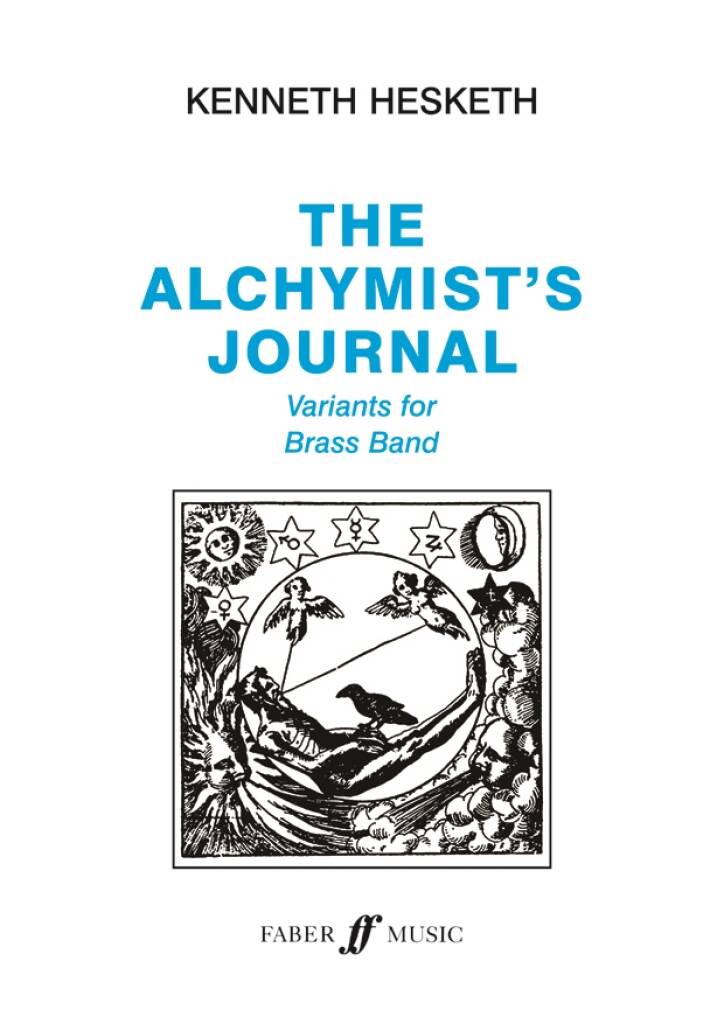
Alchymist's Journal. - Kenneth Hesketh
'The Alchymist's Journal' gets its title from the book of the same name by American author Evan S. Connell. The book fictionalises a number of famous Alchemist's writings, each one developing another's thoughts thuscontinuing one idea but changing it subtly to provide a new view point or way of thinking. This process is, in fact, alchemical as one idea transmutes into another. This idea is parallel to the processes at work within thesevariants. The whole work is constructed from 6 notes (C, A, B flat, E flat, F sharp, E) and is presented in nine different sections, each individual in mood but still based upon the original pitches. This is not a thematic setofvariations, as the themes are developed one at a time from small segments of the six notes. For example, the opening theme is the complete number of pitches, the second theme uses three notes transposed then repeated at theoriginal level, and so on. Harmonically, the six notes can be divided into two triads, A minor and E flat minor - each key beginning and ending the piece respectively. Whilst this is essentially abstract music with noprogramme there is an introduction, menacing scherzo, slow reflective section followed by a recap of the scherzo and final coda. 'The Alchymist's Journal' was commissioned by the Brass Band Heritage Trust at the suggestionof Paul Hindmarsh, to whom the work is dedicated.
Estimated dispatch 5-14 working days
-
 £76.99
Variations on Shalom Chaverim - Andreas Ludwig Schulte
Shalom Chaverim is an ancient Hebrew (farewell)song, which was originally sung at the end of a celebration or meeting. It was and is mostly sung as a round. Freely translated the words mean "Goodbye, friends, goodbye and see you again!". The varying moods at a parting have been captured very well by Andreas Schulte in his arrangement 'Variations on Shalom Chaverim'. The composer himself says about the song, 'Although the melody is in a minor key, the overall atmosphere in the song is positive. one wishes each other all the best. Saying goodbye, however, also hurts. When you slow down the pace of the melody and add 'blue notes' in the harmonies, this can be sensed immediately.'Schulte refers here to the first variation. The second variation is very intense with possibly even deeper-felt emotions. 'Variations on Shalom Chaverim' ends on a cheerful and positive note, in fast tempo, and with oriental elements in the melody: 'L'hitra'ot, Shalom' (See you again, and farewell!).
Estimated dispatch 5-14 working days
-
 £137.99
La Viuda Negra - Carl Wittrock
Carl Wittrock composed La Viuda Negra (The Black Widow) for the Dutch Brass Band Championships (2010). A Spanish tinged composition filled with drama and emotion. La Viuda Negra is a Spanish widow, dressed in black clothes. Her face is marked by traces of sorrow, but her speaking eyes and sanguineous appearance attracts the attention of everyone. Many man's heart should beat faster! What is the story of this mysterious woman? The black widow (Latrodectus Mactan) is also the nickname of a spider. This spider is well known for the distinctive black and red coloring of the female of the species and for the fact that she will occasionally eat her mateafter reproduction.
Estimated dispatch 5-14 working days
-
 £52.70
Far Eastern Dream - Paul Voet
The longest trip we make is to the Far East. Japan, China, Tibet,... all countries with an enormous cultural background and history. Percussion is very important here to give a rich dimension to this Japanese 'Black Bamboo' theme. Tam-tam, Chinese cymbals, Tibetan gong and a kododrum (if not possible, large floor tom) together with marimba and glockenspiel are used all the time in a carefulway. A solo cornet presents the main theme that is answered by the whole lower brass section. While this theme develops now and then the sounds of the impressive 'dung' is heard. (dung is the Tibetan very large trumpet-like instrument with loud and very deep sounds) In a quicker tempo Eb bass, euphonium and solo cornet start with the theme and even the counter theme. The whole group joins the party but everything ends very silently with mute.
Estimated dispatch 5-14 working days
-
 £52.70
The Goodbye - Paul Voet
We sail the ocean with stubborn, hardworking but weak hearted Flemish fishermen to the Northern parts of the Atlantic. A sailor is leaving his wife or girlfriend not knowing if he is going to come back soon. Leaving for good fishing grounds around Iceland. This sad song(the first line of the text says; The wind that blows from the east, my love, is not going to blow for ever) is a solo for flugelhorn accompanied by the whole lower brass section. In a certain way of counterpoint tenorhorns, baritones and euphoniums are woven around thesoloist. The warmth from these saxhorn section is coloured by some chords from trombones and a quite virtuosi marimba line.
Estimated dispatch 5-14 working days
-
 £228.70
Abstractions - Torstein Aagaard-Nilsen
1. Aurora Borealis (Lento espressivo) The first movement is inspired by the northern lights. It constantly changes in colour and shape. 2. Rocks (Moderato ben ritmico) The title of the second movement is a play with the word "rock" is a well-known word describing a musical genre. But it is also a giant stone or a part of a mountain. 3. Seascape (Allegro) The third movement is inspired by different aspects of the sea. It also sums up different ideas that occurs in the two previous movements to round off the whole piece. Third Edition - 2015
Estimated dispatch 5-14 working days
 View Music