
Results
-
 £154.99
A Brussels Requiem (Brass Band - Score and Parts) - Appermont, Bert
The attacks in Brussels on 22 March 2016 created a shockwave throughout Belgium and the rest of the world. Equally, the attacks in Paris and Nice led to great public indignation, fear and disbelief. What has happened to the western world? Have our cultures grown apart to such an extent that we do not understand each other anymore? Bert Appermont's intention was to voice certain emotions that these acts of terror have caused: particularly fear, grief, anger, and helplessness. He uses the French children's song Au Claire de la Lune as a connecting thread throughout the work. This piece is also about hope and faith in another world, and is meant to pay homage to all victims, resulting in a dignified remembrance. The musical development is presented in four through-composed parts, titled Innocence, In Cold Blood, In Memoriam - We Shall Rise Again and A New Day. This work was commissioned by the Brassband Oberosterreich (Brass Band Upper Austria) to be played at the European Brass Band Championships 2017.Duration: 16.30
Estimated dispatch 7-14 working days
-
 £82.95
The Flowers of the Forest (Brass Band - Score and Parts) - Bennett, Richard Rodney - Hindmarsh, Paul
In a preface to the score, the composer explains that 'the folk song The Flowers of the Forest is believed to date from 1513, the time if the battle of Flodden, in the course of which the archers of the Forest (a part of Scotland) were killed almost to a man'. Bennett had already used the same tune in his Six Scottish Folksongs (1972) for soprano, tenor and piano, and it is the arrangement he made then that forms the starting-point for the brass-band piece. A slow introduction (Poco Adagio) presents the folk song theme three times in succession - on solo cornet, on solo cornets and tenor horns, and on muted ripieno cornets in close harmony - after which the work unfolds through five sections and a coda. Although played without a break, each of these five sections has its own identity, developing elements of the tune somewhat in the manner of variations, but with each arising from and evolving into the next. The first of these sections (Con moto, tranquillo) is marked by an abrupt shift of tonality, and makes much of the slow rises and falls characteristic of the tune itself. The tempo gradually increases, to arrive at a scherzando section (Vivo) which includes the first appearance of the theme in its inverted form. A waltz-like trio is followed by a brief return of the scherzando, leading directly to a second, more extended, scherzo (con brio) based on a lilting figure no longer directly related to the theme. As this fades, a single side drum introduces an element of more overtly martial tension (Alla Marcia) and Bennett says that, from this point on, he was thinking of Debussy's tribute to the memory of an unknown soldier (in the second movement of En Blanc et noir, for two pianos). Bennett's march gradually gathers momentum, eventually culminating in a short-lived elegiac climax (Maestoso) before the music returns full-circle to the subdued melancholy of the opening. The work ends with a haunting pianissimo statement of the original tune.
Estimated dispatch 7-14 working days
-
£44.95
The Flowers of the Forest (Brass Band - Score only) - Bennett, Richard Rodney - Hindmarsh, Paul
In a preface to the score, the composer explains that 'the folk song The Flowers of the Forest is believed to date from 1513, the time if the battle of Flodden, in the course of which the archers of the Forest (a part of Scotland) were killed almost to a man'. Bennett had already used the same tune in his Six Scottish Folksongs (1972) for soprano, tenor and piano, and it is the arrangement he made then that forms the starting-point for the brass-band piece. A slow introduction (Poco Adagio) presents the folk song theme three times in succession - on solo cornet, on solo cornets and tenor horns, and on muted ripieno cornets in close harmony - after which the work unfolds through five sections and a coda. Although played without a break, each of these five sections has its own identity, developing elements of the tune somewhat in the manner of variations, but with each arising from and evolving into the next. The first of these sections (Con moto, tranquillo) is marked by an abrupt shift of tonality, and makes much of the slow rises and falls characteristic of the tune itself. The tempo gradually increases, to arrive at a scherzando section (Vivo) which includes the first appearance of the theme in its inverted form. A waltz-like trio is followed by a brief return of the scherzando, leading directly to a second, more extended, scherzo (con brio) based on a lilting figure no longer directly related to the theme. As this fades, a single side drum introduces an element of more overtly martial tension (Alla Marcia) and Bennett says that, from this point on, he was thinking of Debussy's tribute to the memory of an unknown soldier (in the second movement of En Blanc et noir, for two pianos). Bennett's march gradually gathers momentum, eventually culminating in a short-lived elegiac climax (Maestoso) before the music returns full-circle to the subdued melancholy of the opening. The work ends with a haunting pianissimo statement of the original tune.
Estimated dispatch 7-14 working days
-
 £159.99
Omaggio (Euphonium Concerto No.4) (Euphonium Solo with Brass Band - Score and Parts) - Sparke, Philip
Omaggio was commissioned by Steven Mead in celebration of his 60th birthday and in memory of his father, Rex. He gave the premiere of the brass band version in Rome in March 2022, accompanied by the Italian Brass Band conducted by Filippo Cangiamilla. The concert band premiere took place on 6th July that year as part of the 2022 Spanish International Tuba Euphonium Conference, accompanied by the Banda municipal de msica de Malaga.The concerto is set in 3 continuous movements, which are united by a recurring syncopated interval of a fifth. The first movement, Fantasia, opens with this motive accompanying an extended monologue for the soloist. This is followed by a lengthy bridge passage by the band, which is eventually joined by the soloist, who guides the music back to the opening soliloquy, leading to an energetic central section. This develops until the opening material again returns to introduce the second movement, Ballad, which revolves around an expressive melody for the soloist, interspersed by accompanied cadenzas. The third movement, The King Triumphant, pays homage to Steven's late father, Rex, and its title alludes both to Rex's name (Rex being Latin for king) as well as his love of Eric Ball's Salvationist masterpiece, The Kingdom Triumphant. The finale is an energetic tour-de-force featuring an acrobatic 6/8 melody, which is interrupted twice by the magnificent hymn tune, Helmsley, which Ball uses so effectively in The Kingdom Triumphant. A galloping coda brings the work to a close.
Estimated dispatch 7-14 working days
-
 £24.95
The Great Parade (Brass Band - Score and Parts) - Downie, Kenneth
This piece is intended to be a bright, sparkling concert march and features the spiritual 'I got a robe'. The quick tempo is to encourage a performance of sparkle and wit and, at the same time, to reflect the mood of celebration in the spiritual. The song was sung by slaves to encourage them to remember that, although they might be deprived of even basic items like robes in their present plight, one day, when they get to heaven, 'all God's children got a robe'.
Estimated dispatch 7-14 working days
-
£12.50
The Great Parade (Brass Band - Score Only) - Downie, Kenneth
This piece is intended to be a bright, sparkling concert march and features the spiritual 'I got a robe'. The quick tempo is to encourage a performance of sparkle and wit and, at the same time, to reflect the mood of celebration in the spiritual. The song was sung by slaves to encourage them to remember that, although they might be deprived of even basic items like robes in their present plight, one day, when they get to heaven, 'all God's children got a robe'.
Estimated dispatch 7-14 working days
-
 £54.99
Hymnus Antverpiae (Brass Band - Score and Parts) - Van der Roost, Jan
This hymn was commissioned by "Antwerpen 93". And this city, on the banks of the river Schelde has been nominated "Cultural Capital of Europe" for 1993. The work-group "animatie" took the initiative and commissioned a hymn, which -as the finale to a grand open-air event on 27th March- was premired by hundreds of musicians from all over Europe. Philippe Langlet (France) was the conductor at this majestic occasion. Musically speaking the piece can no doubt be labelled easy. Indeed it is meant to represent a hymn, playable by all in different instrumental combinations. Consequently a variable instrumentation was chosen and a type of music, which by native is easily accessible and uncomplicated. The conductor is free -in the instrumentation- to score this piece according to his own taste. It is perhaps advisable to use the sharp brass in the forte parts, in order to make the range in the sound of the orchestra as colourful as possible. The percussion parts are not absolutely essential, so that the hymn can also be performed without percussion.Duration: 4:00
Estimated dispatch 7-14 working days
-
 £95.00
Tenor Horn Concerto 'Three Gods' (Tenor Horn Solo with Brass Band - Score and Parts) - Gregson, Edward
Edward Gregson's Tenor Horn Concerto (Three Gods) was commissioned by the Belgian tenor horn soloist Tim de Maeseneer for a recording of commissioned works he made in 2024 with his own band, Brass Band Willebroek.The subtitle of 'Three Gods' refers to three mythological Greek Gods: Zeus, Hermes and Apollo. The idea for this came from Gregson's Viola Concerto, which he composed in 2023 and which was similarly subtitled 'Three Goddesses'. Indeed, the first movement of the horn concerto shares some common material with the viola concerto, although the other movements are newly composed.The concerto exploits the noble character of the horn, but the writing is also virtuosic in character as well as lyrical and melodic, demanding an extended playing range of nearly four octaves with a variety of colouration in its sonorities. The unifying motif of the whole concerto is the interval of a rising 5th, heard at the outset. The opening also has some other surprises (both seen and heard).The musical ideas, cast in three separate movements, take their starting point from the characters of the Three Gods in the title:Zeus, ruled as King of the Gods on Mount Olympus, and was the God of Thunder and Lightning and of War. His music is often threatening and violent, but also has a more tender side as portrayed in the lyrical second subject. However, the dominant mood is one of foreboding.Hermes was the great messenger to the Gods who could travel between realms on his winged sandals. Thus, his music is fast, fleet of foot, and mercurial - a dashing scherzo, but with lyrical and expressive moments.Apollo, the God of Music and Dance (and the Sun), symbolises virtue and beauty. This final movement, 'Hymn to Apollo', is mainly slow and hymn-like and cast in a continuous stream of melody passed between soloist and band. Brief fanfares herald a triumphant march, before the music returns to its quiet opening, gradually rising to a triumphant climax with glittering melodic percussion leading the way. The music ends in a blaze of glory!Duration: 17.00
Estimated dispatch 7-14 working days
-
£40.00
Tenor Horn Concerto 'Three Gods' (Tenor Horn Solo with Brass Band - Score only) - Gregson, Edward
Edward Gregson's Tenor Horn Concerto (Three Gods) was commissioned by the Belgian tenor horn soloist Tim de Maeseneer for a recording of commissioned works he made in 2024 with his own band, Brass Band Willebroek.The subtitle of 'Three Gods' refers to three mythological Greek Gods: Zeus, Hermes and Apollo. The idea for this came from Gregson's Viola Concerto, which he composed in 2023 and which was similarly subtitled 'Three Goddesses'. Indeed, the first movement of the horn concerto shares some common material with the viola concerto, although the other movements are newly composed.The concerto exploits the noble character of the horn, but the writing is also virtuosic in character as well as lyrical and melodic, demanding an extended playing range of nearly four octaves with a variety of colouration in its sonorities. The unifying motif of the whole concerto is the interval of a rising 5th, heard at the outset. The opening also has some other surprises (both seen and heard).The musical ideas, cast in three separate movements, take their starting point from the characters of the Three Gods in the title:Zeus, ruled as King of the Gods on Mount Olympus, and was the God of Thunder and Lightning and of War. His music is often threatening and violent, but also has a more tender side as portrayed in the lyrical second subject. However, the dominant mood is one of foreboding.Hermes was the great messenger to the Gods who could travel between realms on his winged sandals. Thus, his music is fast, fleet of foot, and mercurial - a dashing scherzo, but with lyrical and expressive moments.Apollo, the God of Music and Dance (and the Sun), symbolises virtue and beauty. This final movement, 'Hymn to Apollo', is mainly slow and hymn-like and cast in a continuous stream of melody passed between soloist and band. Brief fanfares herald a triumphant march, before the music returns to its quiet opening, gradually rising to a triumphant climax with glittering melodic percussion leading the way. The music ends in a blaze of glory!Duration: 17.00
Estimated dispatch 7-14 working days
-
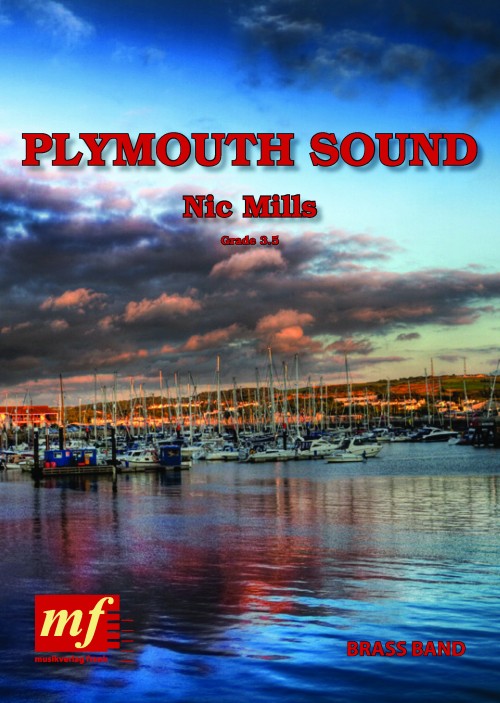 £49.60
Plymouth Sound (Brass Band - Score and Parts) - Mills, Nic
The concept of the work was to capture the beauty of the natural bay protecting the harbour at Plymouth. The work is based on two themes. The first being a lyrical melody to represent the beauty of the Sound and a march-like theme showing the military heritage the city has, through the armed forces based there. The opening fanfare immediately grabs the attention of the audience, and settles into a lyrical melody with the flutes and clarinets emulating the sea and the rolling of the waves. This jubilant piece turns to emulate a storm at sea. Then it moves into the march theme, which takes the main form for the second half of the piece, moving into a fanfare-like statement (recapitulation of the opening fanfare) to complete the piece. Overall, this is a fun work to play, with all sections of the band being tested and would be a great opener or finisher piece.Duration: 5.15
Estimated dispatch 7-14 working days
 View Music