
Results
-
 £38.95
Unity Series Band Journal - Numbers 530 - 533, June 2024
530: Carol Arrangement - God rest you merry, gentlemen (Noel Jones)This swing arrangement of the traditional English carol also features references to O come, all ye faithful (C.C. 61) and Jingle Bells (C.C. 121). Play with imagination and a sense of style!531: Go, tell it on the mountain! (Nathanael Watchorn)Historically, the passion of enslaved people in America for singing about the Gospel of Jesus is well documented, but it was men of three generations, each named John Wesley Work, who enabled spirituals to become more widely known. John Wesley Work Sr, a church choir director in Nashville, Tennessee, wrote and arranged music for the pioneering Fisk Jubilee Singers whose early repertoire consisted largely of spirituals. This passion and knowledge of spirituals was passed down through the generations. John Work III travelled hundreds of miles to collect songs by attending church services in remote areas. In 1940, he published a collection of 230 songs which included a setting of Go, tell it on the mountain! that is still performed today.Nathanael Watchorn, a Bandsman at Regent Hall Corps in London, is a new contributor to the journals. He originally wrote this as a vocal arrangement for the group FourHymn, subsequently transcribing it for the corps' Young People's Band, while he was Band Leader.532: Carol Arrangement - They all were looking for a king (Stephen Hull)At the North American Composers Forum, Major Len Ballantine challenged participants to find an unfamiliar song in the Salvation Army Song Book and try to write an arrangement of the listed tune. Stephen Hull happened across They all were looking for a king (S.A.S.B. 128) and the tune Childhood (T.B. 421) which lead to this arrangement.533: March - Washed and healed (Eiliv Herikstad)The Christian experience of many people will have been positively impacted by the life of the late Bandmaster Eiliv Herikstad, either personally or through his musical leadership and compositions. This march is the second publication from this well-known Salvation Army composer since his Promotion to Glory last year. This march is more traditional in style that many of his compositions but contains a strong Christian message and demonstrates his compositional expertise.
Estimated dispatch 7-14 working days
-
 £50.00
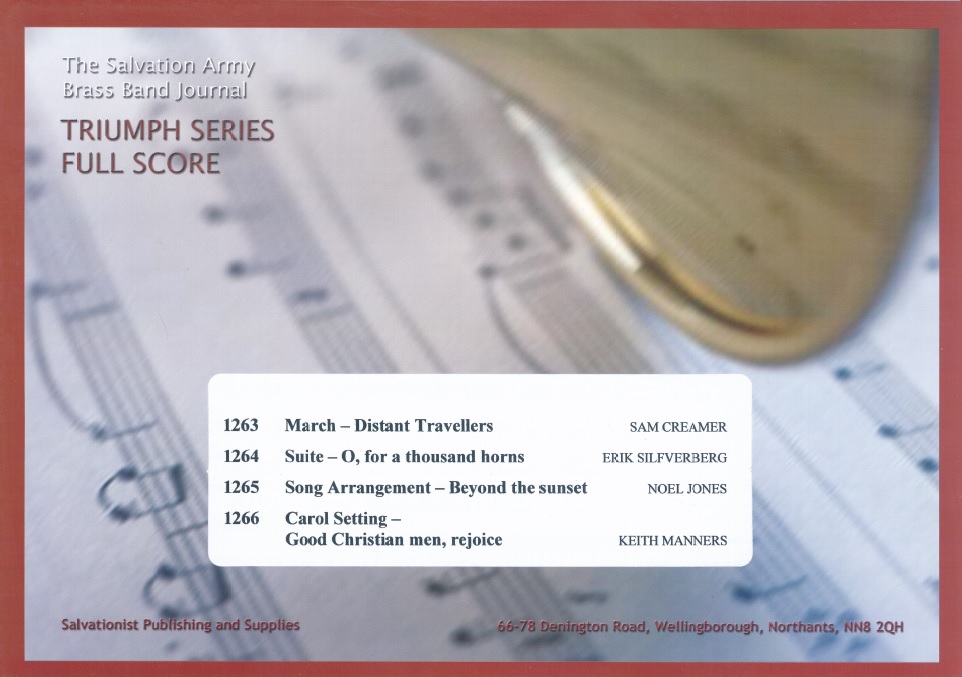
Triumph Series Band Journal July 2015 Numbers 1263 - 1266
No. 1263 March - Distant Travellers (Sam Creamer)With this Christmas march, we introduce a new contributor to our journals. Sam Creamer is a bandsman and songster at the Carindale Corps in Brisbane, Australia Eastern Territory. This march should prove a useful addition to the Christmas repertoire of many groups, as it features the well-known Christmas carols; When wise men come seeking (NCP 92) and While shepherds watched (NCP 93), as well as brief references to others.No. 1264 Suite - O, for a thousand horns (Erik Silfverberg)Bandmaster Erik Silfverberg OF has taken the song O for a thousand tongues by Charles Wesley, and has composed a suite in three movements with each of the movements exploring the sentiments of one of the verses. The tune Grimsby is heard in part throughout, but the majority of the musical material used is original.No. 1265 Song Arrangement - Beyond the sunset (Noel Jones)A three-verse setting of the song Beyond the sunset which speaks of the Christian's eternal home in Heaven.No. 1266 Carol Setting - Good Christian men, rejoice (Keith Manners)A bright setting of the well-known Christmas carol.
Estimated dispatch 7-14 working days
-
 £19.95
Mythical Tales (Brass Quintet)
Mythical Tales (2012) is a ten minute work in three movements which represents three of the most popular folk stories or indeed in the case of the first movement, true stories, in Welsh culture.I. Owain GlyndwrOwain Glyn Dwr was born around the 1350s into an Anglo-Welsh gentry family. His estates provided him with a modest power base in north-east Wales. After a number of disputes, he proclaimed himself prince of Wales in September 1400.Glyn Dwr led several battles with the English, although he was never captured. Over the next few years punitive measures were enacted to keep control of Wales, but these were matched by many acts of Welsh rebellion - among them the capture of Conwy Castle in April 1401. In June 1402, at the Battle of Pilleth on Bryn Glas Hill, Glyn Dwr led his troops to victory over an English army. By now Glyn Dwr was leading a national revolt. In 1404, he led a march towards Wocester, but failed, with the English capturing parts of Wales. He died defending his country.II. MyfanwyMyfanwy was the most beautiful woman in Powys, but she was vain and liked nothing better than to be told how beautiful she was. Many handsome men would court her, but she would not show interest because they couldn't sing and play to her, reflecting her true beauty.Luckily, a penniless bard, Hywel ap Einion was in love with Myfanwy, and one day plucked up the courage to climb up the hill to the castle with his harp, to sing and play to her. He's allowed in to play for her, and while he's playing and complimenting her on her beauty she can neither listen nor look at any other man. Because of this Hywel believes that she has fallen in love with him. But his hopes are dashed when a richer, more handsome and more eloquent lover comes along. The music of the second movement portrays the despair and upset that Hywel must have felt.III. Battle of the DragonsMany centuries ago when dragons roamed the land, a white ice dragon descended on a small village and decided to live there, not knowing that a red fire dragon was already living nearby.Six months later the red dragon awoke to find a huge white dragon wrapped around his village that he cared for. He could tell that his people were ill from the cold. The Land was bare; nothing was able to grow not even the pesky dandelions. The people were starving. The people longed for the red dragon to free them from the icy misery, so that their life and land could return to the sunny and warm climate that it was once before.The red fire dragon challenged the white ice dragon to a single combat fight at the top of the cliff the next day. The people of the village watched in terror awaiting their fate. The red dragon beat the white dragon, and the crowd cheered with joy as the red dragon roared with triumph. The mayor of the village declared that the land should always fly a flag with the symbol of a Red dragon on it. The flag's background should be half green and half white; the green to represent the lush green grass of the land and the white to represent the ice. This way no one would ever forget what happened.
Estimated dispatch 7-14 working days
-
 £29.95
Judd: Christmas Presence
Written for Birmingham Citadel Band to play at their annual carol concert at Symphony Hall, Birmingham, this piece tells the story of the Nativity using the carols 'Who is he?' and 'Calypso Carol' (Christmas Collection 16). Brief appearances are made by the shepherds ('While shepherds watched'), the angels ('Ding dong! merrily on high') and the wise men ('Three kings' march' and 'We three kings of Orient are'). The music finishes with a majestic setting of the chorus of 'Who is he?', reminding us who the baby Jesus is:'Tis the Lord! O wondrous story,'Tis the Lord, the king of Glory!At his feet we humbly fall,Crown him, crown him Lord of all!
Estimated dispatch 7-14 working days
-
 £110.00
Diversions After Benjamin Britten (Brass Band - Score and Parts)
Suite by Lucy Pankhurst, Simon Dobson, Paul McGhee and Gavin HigginsHaving devised a collective centenary tribute for Michael Tippett at the 2006 RNCM Festival of Brass (Variations on a Theme of Michael Tippett by five eminent composers of brass band music, PHM002), I commissioned this companion piece as a Benjamin Britten tribute for the 2013 festival. In the late 1970s, while researching a book about the English composer, and Britten's first teacher, Frank Bridge (1879 - 1941), I came across a copy of the printed score of Benjamin Britten's Variations on a Theme of Frank Bridge (Op.10) for string orchestra, in which Britten had written descriptive titles for each of the variations suggesting appropriate character traits of his much loved mentor and guide. The character variations are cast in march, song and dance forms.Taking inspiration from Britten's youthful tribute, I invited four award-winning composers, who have all made significant contributions to the brass band medium, to create their own personal reflections on four aspects of Britten's character and music, designed to form a suite of Diversions after Benjamin Britten, but which can also be played separately.Lucy Pankhurst's hauntingly lyrical Prelude: His Depth refers to the emotional and symbolic subtexts that underpin Britten's operas, taking its musical cue from Britten's many arrangements of folk songs. The flugel horn takes a prominent role throughout.Simon Dobson's breathless Scherzo: His Vitality reminds us with its rapid passage work and leaping bass 'groove' that Britten loved tennis and fast cars in his younger days.Paul McGhee's evocative interpretation of the March: His Sympathy represents Benjamin Britten's pacifism, as the composer writes: 'We view the music through the eyes of a pacifist. Whilst war and violence surround us, we do not engage in it and though it continues to happen around us. With the use of muted effects in most of the band throughout the piece, the flugel horn is the lone voice of reason, standing firm against the mechanical and destructive society in which it is forced to live. As the machine of war continues around the lone voice, the voice is gradually dismissed and mocked as the war machine rumbles on into the distance.'In an extended finale, entitled Toccata: His Skill, Gavin Higgins celebrates Benjamin Britten's consummate creativity. For the RNCM Festival of Brass premiere, the four contrasting movements were framed and connected by Britten's Fanfare for St. Edmundsbury for three trumpets, with the trumpet soloists spaced round the hall. I am grateful to the Britten Estate and publishers Boosey & Hawkes for giving permission for the elements of Britten's fanfare to be incorporated in the collective work.- Paul HindmarshDuration: 19.30
Estimated dispatch 7-14 working days
-
£45.00
Diversions After Benjamin Britten (Brass Band - Score only)
Suite by Lucy Pankhurst, Simon Dobson, Paul McGhee and Gavin HigginsHaving devised a collective centenary tribute for Michael Tippett at the 2006 RNCM Festival of Brass (Variations on a Theme of Michael Tippett by five eminent composers of brass band music, PHM002), I commissioned this companion piece as a Benjamin Britten tribute for the 2013 festival. In the late 1970s, while researching a book about the English composer, and Britten's first teacher, Frank Bridge (1879 - 1941), I came across a copy of the printed score of Benjamin Britten's Variations on a Theme of Frank Bridge (Op.10) for string orchestra, in which Britten had written descriptive titles for each of the variations suggesting appropriate character traits of his much loved mentor and guide. The character variations are cast in march, song and dance forms.Taking inspiration from Britten's youthful tribute, I invited four award-winning composers, who have all made significant contributions to the brass band medium, to create their own personal reflections on four aspects of Britten's character and music, designed to form a suite of Diversions after Benjamin Britten, but which can also be played separately.Lucy Pankhurst's hauntingly lyrical Prelude: His Depth refers to the emotional and symbolic subtexts that underpin Britten's operas, taking its musical cue from Britten's many arrangements of folk songs. The flugel horn takes a prominent role throughout.Simon Dobson's breathless Scherzo: His Vitality reminds us with its rapid passage work and leaping bass 'groove' that Britten loved tennis and fast cars in his younger days.Paul McGhee's evocative interpretation of the March: His Sympathy represents Benjamin Britten's pacifism, as the composer writes: 'We view the music through the eyes of a pacifist. Whilst war and violence surround us, we do not engage in it and though it continues to happen around us. With the use of muted effects in most of the band throughout the piece, the flugel horn is the lone voice of reason, standing firm against the mechanical and destructive society in which it is forced to live. As the machine of war continues around the lone voice, the voice is gradually dismissed and mocked as the war machine rumbles on into the distance.'In an extended finale, entitled Toccata: His Skill, Gavin Higgins celebrates Benjamin Britten's consummate creativity. For the RNCM Festival of Brass premiere, the four contrasting movements were framed and connected by Britten's Fanfare for St. Edmundsbury for three trumpets, with the trumpet soloists spaced round the hall. I am grateful to the Britten Estate and publishers Boosey & Hawkes for giving permission for the elements of Britten's fanfare to be incorporated in the collective work.- Paul HindmarshDuration: 19.30
Estimated dispatch 7-14 working days
-
 £30.00
Pioneers (Brass Band) - Steve Robson
The 19th Century was a time of great pioneering spirit, where developments in industry, and transport were to begin a process, which was to transform societies around the world beyond recognition.In the vast, so-called "New World" of America these changes were exemplified as the railways spread out to reach hitherto remote and largely unexplored expanses.Steve Robson has composed Pioneers as a three movement piece for brass band, written in the spirit of John Philip Sousa (1854 - 1932), Stephen Foster (1826 - 1864) and Scott Joplin (1868 - 1917).The three movements consist of:March - The US Marine Band (1880)Spiritual - I'm Lookin' Up To HeavenRagtime - Canonball RagAlso available for brass and percussion ensemble.
In Stock: Estimated dispatch 3-5 working days
-
 £20.00
Pioneers (Ensemble) - Steve Robson
The 19th Century was a time of great pioneering spirit, where developments in industry, and transport were to begin a process, which was to transform societies around the world beyond recognition.In the vast, so-called "New World" of America these changes were exemplified as the railways spread out to reach hitherto remote and largely unexplored expanses.Steve Robson has written Pioneers as a three movement piece for brass and percussion ensemble (and also now available as a full brass band version), written in the spirit of John Philip Sousa (1854 - 1932), Stephen Foster (1826 - 1864) and Scott Joplin (1868 - 1917).The three movements have been written for the following instrumentation:2 x Bb cornet1 x flugelhorn1 x Eb Tenor Horn1 x tenor trombone1 x euphonium1 x Eb Bassdrumkit and percussionand consist of:March - The US Marine Band (1880)Spiritual - I'm Lookin' Up To HeavenRagtime - Canonball RagAlso available for brass band.
In Stock: Estimated dispatch 3-5 working days
-
 £77.00
General Series Brass Band Journal, Numbers 2250 - 2253, December 2024
2250: Prelude on 'Rhosymedre' (Ralph Vaughan Williams trs. Douglas Engle)The English composer Ralph Vaughan Williams' work Three Preludes (founded on Welsh Hymn Tunes) was published for the organ in 1920. This is a transcription of the second movement of that work. The words associated with the hymn tune are by Samuel Crossman, My song is love unknown (S.A.S.B. 149), and vividly depict the events of Holy Week. The music is gentle and solemn and would be appropriate for a Good Friday service or as a moment of repose in a concert. 2251: Hosanna Shuffle (Sam Creamer)The half-time shuffle groove is a popular feel developed by alternative rock/pop bands of the 1980s. It marries elements of rock and swing styles together to form a new and infectious feel - Hosannah Shuffle being written as a tribute to this fusion of musical styles. Contrary to a swing style, shuffle brings the pulse back onto the beat while maintaining the swung quaver rhythms to create a rock-type rhythmic drive. 2252: Everlasting Love (Keith Manners)This piece was written for the London North East Music School in 2004. The theme of the week was 'Making a stand for Christ', reminding the school that it only takes one person to make such a stand before others follow. The music starts with a lone Solo Cornet playing the melody of Graham Kendrick's song Such Love (S.A.S.B. 199). One by one, other parts join in with the theme.2253: Festival March (Michael Cooper)This piece represents the first published brass composition of Bandmaster Michael Cooper, who is the Bandmaster at Brisbane City Temple Corps. This imposing festival march features the tunes I want to be a soldier (T.B. 683), Lift up the banner (T.B. 90) and My Jesus, I love thee (T.B. 506). These tunes depict the idea that spiritual warfare is an essential component of one's faith, success of which is articulated in the final verse of My Jesus, I love thee (S.A.S.B. 878).
Estimated dispatch 7-14 working days
-
 £38.95
Unity Series Band Journal February 2017 Numbers 450 - 453
Prelude - A promise (Ruben Schmidt)This bright energetic opener by a young German Salvationist composer features the tune 'Standing on the promises'.My Saviour (Graham Robinson)This is a lively setting of the contemporary song 'When I was lost' and the more traditional 'The Saviour sought and found me' which will give a helpful addition for bands looking for a bright number for their repertoire.Meditation - Boundless Grace (Andrew Blyth)The song 'Lord, I hear of showers of blessing' is the basis of this more traditional style meditation based around the tune 'Even Me'.March - Fired Up! (Martin Cordner)Written for the 130th anniversary of the Woodbridge Corps, this simple yet engaging march brings the tune 'Whitechapel' associated with the song 'Near the cross assembled, Master' with verse three being its focus for the work - "Fire that turns men into heroes".
Estimated dispatch 7-14 working days