
Results
-
 £24.95
Ave Verum from Stabat Mater - Karl Jenkins - Andrew Wainwright / Robert Childs
The World premiere performance of Karl Jenkins' Stabat Mater took place on March 15th 2008 in Liverpool's Anglican Cathedral performed by the Royal Liverpool Philharmonic Orchestra and Choir conducted by the composer. Stabat Mater is a 13th-century Roman Catholic poem...
Estimated dispatch 5-7 working days
-
 £49.95
Marche Slave - Pyotr Ilyich Tchaikovsky - Robert Childs
Marche Slave is not a march at all but an elaborate concert piece; a symphonic tone poem on the subject of the military alliance between Russia and Serbia. The work includes folk songs from both countries. Serbian folk tunes constitute...
Estimated dispatch 5-7 working days
-
 £64.95
Suite from Stabat Mater - Karl Jenkins - Andrew Wainwright / Robert Childs
The world premiere performance of Karl Jenkins' Stabat Mater took place on March 15th 2008 in Liverpool's Anglican Cathedral, performed by the Royal Liverpool Philharmonic Orchestra and Choir conducted by the composer. Stabat Mater is a 13th-century Roman Catholic poem...
Estimated dispatch 5-7 working days
-
£29.95
WAR CRY (Brass Band Set) - Dorothy Gates
This work was written as the opener for the New York Staff Band's 125th anniversary concert in Carnegie Hall in March 2012. Based on the song, 'Ever is the war cry'. the music is quite militant in nature which is a direct reflection of the text. While the composer pays homage to the past in this fitting salute, the overall musical style is decidedly that of the 21st century.
Estimated dispatch 7-14 working days
-
£29.95
MOTONDO (Brass Band Set) - Donald Osgood
This march commemorated the International Scouts 'Motondo' held in Holland in 1952. Motondo is an African word meaning 'a gathering for giving thanks'. A favourite chorus from the event is used in the trio section, 'Travel along in the sunshine, on the King's highway'. Unusually for 'general use' marches, Motondo has an alternative 'concert' ending which can be used if the Da Capo is not employed.
Estimated dispatch 7-14 working days
-
£29.95
MIGHTY TO SAVE (Brass Band Set) - George Marshall
Mighty to Save is the quintessential Salvation Army march; catchy tunes, well scored, useful on parade or in concert, fun to play and unequivocal in message; Jesus is Mighty to Save!...From the uttermost to the uttermost, Mighty to Save!
Estimated dispatch 7-14 working days
-
£29.95
TORCHBEARERS! (Brass Band Set) - Eric Ball
This march was written for the Musical Troopers of 1933 to feature as a signature tune on their campaigns. This band was part of the Torchbearers session at the Salvation Army Training College (or School for Officer Training) and their sessional song can be heard sounding majestically in the third strain, the composer giving special emphasis to the first two words; Out there! Out there! Where the darkness reigns out there! Torchbearers are going...
Estimated dispatch 7-14 working days
-
 £30.00
Gallipoli - James Stretton
My interest in the disastrous Dardanelles campaign of WW1 was first stimulated when I saw Peter Weir's 1981 film "Gallipoli" starring a very youthful Mel Gibson. The campaign ran from February 19th 1915 to January 9th 1916. The Turkish victory ultimately stemmed from the British foolhardy underestimation of the military potential of the declining Ottoman Empire. Significant numbers of British and French troops were involved against the Turkish & German forces. However, it is the heroic involvement of the ANZAC forces comprising of 50,000 Australians and 15,000 New Zealanders that is now at the forefront of our memories. The ANZACS were at the spearhead of the amphibious assault of April 25th 1915 and sustained appalling losses in dreadful conditions. Indeed, many historians consider the bravery and fortitude displayed by the ANZACS at Gallipoli to be an important component in the national consciousness of Australia and New Zealand. A century on from the end of "The Great War", the war to end all wars it is to the brave ANZAC soldiers that this concert march is humbly dedicated. James Stretton - Blenheim, New Zealand.
-
 £35.00
Music Through The Ages - Steve Robson
A fun and educational collection of 7 pieces created by Steve Robson, with optional narration, providing a time-travelling journey through the history of 2000 years of music to the present time.Originally written for Stanhope Youth Band, the piece has now been well received by other youth bands far and wide. The complete work offers great flexibility too, as te movements can be used as stand-alone items or as a full concert performance, offering players and audiences an insight to the evolving styles of Music Through The Ages.Movements include:FanfareThe Passing of the VIth Legion A Patrol - Imagining the sound of the Roman Legion at Vindolanda (AD84)The Journey of St Cuthbert - A Plainchant (995)The Honorable Robert Shafto MP - Late Baroque Style (1749)The Very Capable Mr Mozart Classical Style - Rondo (1786)Sans Pareil March - Tribute to Timothy Hackworth and George Allan (1913)The Angel of the North - Contemporary composition (Present day)Watch a full performance below of the pieces, including narration. This was a collaborative performance project, presented by members of different youth bands from across the North East on Saturday 13 November 2018 in the Theatre at Ushaw College, Durham.(NB: The piece Galliard, performed at 12mins 22secs into the video, was specially written for the concert and is not included in this collection.)Look and Listen (with thanks to all participating youth bands and supporting players):Set includes score (with narration), separately bound narration (enable a choice of either compere/conductor presentation) and parts including:Cornet 1Cornet 2Corent 3FlugelhornEb Tenor Horn 1Eb Tenor Horn 2Baritone 1Baritone 2Trombone 1Trombone 2Bass TromboneEuphoniumEb BassBb BassTimpaniPercussionAdditional world parts also provided include F Horn 1, F Horn 2, Trombone 1 in Bass Clef, Trombone 2 in Bass Clef.
In Stock: Estimated dispatch 3-5 working days
-
 £32.00
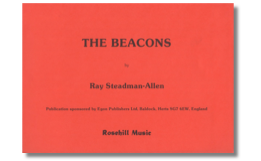
The Beacons (Score only) - Ray Steadman-Allen
For centuries hilltop beacon fires blazed across the land signals of important happenings or warnings of invasion. This music tells no specific story but the titles of the four thematically related sections are a guide to the idea: The Beacons; Far Horizons; The Invaders; Celebration. The first movement has something of the character of the march and the fanfare; spirited and tightly driving, it promises most of the thematic material of the work. The second is largelt tranquil and is thinly scores with solo passages. The third has the most dramatic potential; its energy and conflict subsides to a lament and a tolling bell before a vigorous rounding off. Appropriately, the fourth movement is in a merry-making mood, and the jubilant music concludes with fragment statements of the main themes. The Beacons was first performed by IMI Yorkshire Imperial Band (James Scott) at the 'Concert of the Century', celebrating the Centenary of the British Bandsman, at the Free Trade Hall, Manchester, on 5 September 1987. Duration: 12:30
Estimated dispatch 7-9 working days