
Results
-
 £80.00
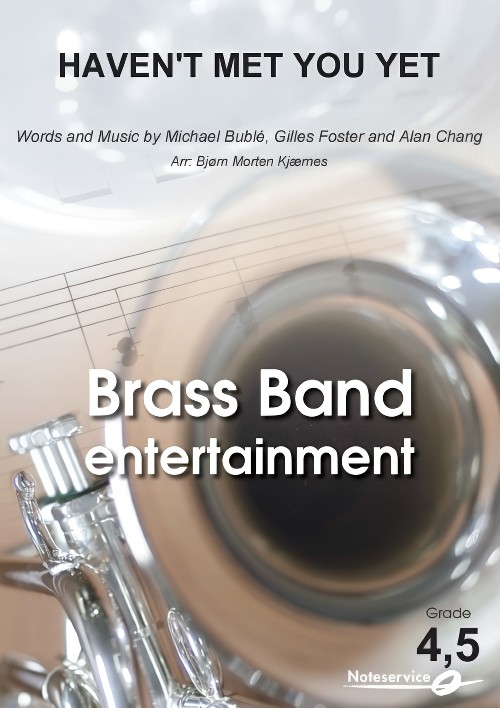
Haven't Met You Yet (Optional Vocal Solo with Brass Band - Score and Parts) - Kjaernes, Bjorn Morten
Haven't Met You Yet is the first single from Canadian singer Michael Buble's sixth album, Crazy Love, released on August 31, 2009. According to Buble, the single and its official music video are about everyone's dream of finding a relationship and love. Buble co-wrote Haven't Met You Yet with Alan Chang and Amy Foster-Gillies, and dedicated it to his then fiancee and now wife, Luisana Lopilato (who appears as his love interest in the music video).In 2012, Nick Jonas covered the song in the TV series Smash, so this music can also be used in a TV/Movie theme concert.
Estimated dispatch 7-14 working days
-
 £54.95
A Christmas Finale (Brass Band - Score and Parts) - Lovatt-Cooper, Paul
As the title suggests, A Christmas Finale provides an ideal close to any Christmas concert. Paul Lovatt-Cooper has taken a collection of popular works associated with Christmas and expertly crafted this wonderful piece to provide both the listener and performer with an exciting Christmas musical experience.? A note from the composer: I love the magic of Christmas. I find the whole experience exciting, from the handing out of presents to the movies shown on television. However, it is the music I love the most, from Christmas carols to Christmas number ones, it all adds to the unique atmosphere and sense of joviality associated with this wonderful time of year. A Christmas Finale captures my yuletide emotions and will hopefully provide enjoyment for you too! Merry Christmas. Duration: 7.30
Estimated dispatch 7-14 working days
-
 £89.99
Ross Roy (Brass Band - Score and Parts) - De Haan, Jacob
In this composition, Jacob de Haan sees the "Ross Roy" as a metaphor for the years spent at school (a monument in time), where one's personality is formed. So, the opening theme the artist calls the Ross Roy theme initially has monumental characteristics.The rhythmic motion, which strides along in the lower register and percussion at the beginning of the next section is typical of "Tempo di Marcia". This movement, accompanied by repetitions of sound, is a metaphor for the structure and discipline in school. This is the introduction to a march theme, symbolic of "passing through" the classes up to the final examinations.Then, the Ross Roy theme is dealt with again, now in a playful, humorous variation. As if the composer is saying there should also be time for a smile in school. The same theme can be heard in major key and a slower tempo in the following section, expressing pride and self-confidence. This is also the introduction to the expressive middle section that represents love, friendship and understanding.We then return to the march theme in a slightly altered construction. The oriental sounds, constituting the modulation to the final theme, are symbols of the diversity of cultures in the school. The characteristic final theme first sounds solemn, but turns into a festive apotheosis. It is no coincidence that the final cadence is reminiscent of the close to a traditional overture, for the school years can be considered the "overture" to the rest of one's life.Duration: 9:20
Estimated dispatch 7-14 working days
-
 £94.95
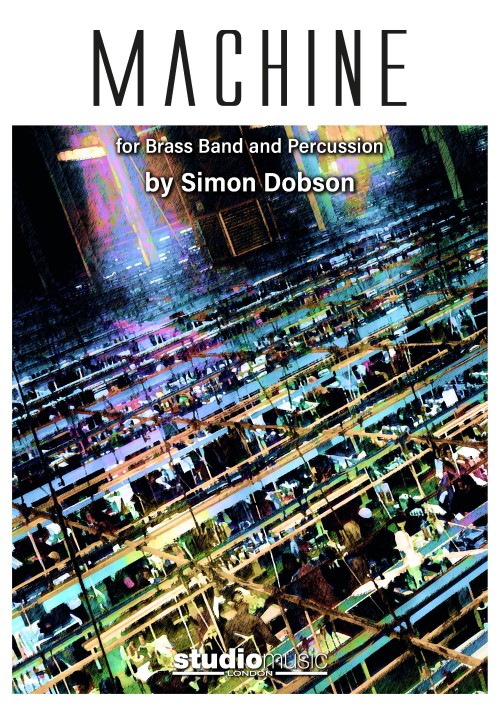
Machine (Brass Band - Score and Parts) - Dobson, Simon
Machine, was commissioned by the Salvation Army Trading Company for the National Youth Brass Band of Great Britain.The work speaks of the perils of the fast fashion industry, the part it plays in our current understanding of late-stage capitalism and it's complicity in the destruction wrought on our one home planet. It also seeks to portray the incredible efforts of the Salvation Army in their quest to slow the fast fashion industry and recycle clothing in the most innovative and progressive ways.The work is through composed and comprises five movements.Movement 1: The great Machine. The band is placed into 8 groups of three (expect tubas, in their normal position as a 4), who stand in specific places on the stage. This will create machine like antiphonal movement in the written music. The great Machine in question is the fast fashion industry, in all its chaos, seeming grandeur and relentless momentum.Movement 2: Mode phmre is fast, angular and quirky, a nod to the perilous speed and waste of the fast fashion industry (the movement title is the French for fast fashion).Movement 3: A planet to treasure (for DA) is a love letter to our home planet and its finite resources and as well as the beauty of the natural world, which unfortunately, we are destroying (hence the dedication to David Attenborough on his 100th year).Movement 4: The wheels keep turning, returns to the fast, angular, almost unstoppable grasp of capitalism and the damaging structures it promotes.Movement 5: Recycle, re-use, mirrors the opening (though without stage directions) in reference to the cyclic nature of fast fashion and the wonderful work that The Salvation Army do in trying to halt this system.
Estimated dispatch 7-14 working days
-
 £44.95
Machine (Brass Band - Score only) - Dobson, Simon
Machine, was commissioned by the Salvation Army Trading Company for the National Youth Brass Band of Great Britain.The work speaks of the perils of the fast fashion industry, the part it plays in our current understanding of late-stage capitalism and it's complicity in the destruction wrought on our one home planet. It also seeks to portray the incredible efforts of the Salvation Army in their quest to slow the fast fashion industry and recycle clothing in the most innovative and progressive ways.The work is through composed and comprises five movements.Movement 1: The great Machine. The band is placed into 8 groups of three (expect tubas, in their normal position as a 4), who stand in specific places on the stage. This will create machine like antiphonal movement in the written music. The great Machine in question is the fast fashion industry, in all its chaos, seeming grandeur and relentless momentum.Movement 2: Mode phmre is fast, angular and quirky, a nod to the perilous speed and waste of the fast fashion industry (the movement title is the French for fast fashion).Movement 3: A planet to treasure (for DA) is a love letter to our home planet and its finite resources and as well as the beauty of the natural world, which unfortunately, we are destroying (hence the dedication to David Attenborough on his 100th year).Movement 4: The wheels keep turning, returns to the fast, angular, almost unstoppable grasp of capitalism and the damaging structures it promotes.Movement 5: Recycle, re-use, mirrors the opening (though without stage directions) in reference to the cyclic nature of fast fashion and the wonderful work that The Salvation Army do in trying to halt this system.
Estimated dispatch 7-14 working days
-
£69.95
Transformation (Brass Band - Score and Parts) - Downie, Kenneth
I believe in transformation, God can change the hearts of men, And refine the evil nature, till it glows with grace again'. So wrote John Gowans in the second verse of his great hymn, 'I believe that God the Father, can be seen in God the Son', written specifically to affirm Salvationists' beliefs. It is sung to the tune Bethany and in seeking to explore this great subject at the heart of the Christian gospel in musical terms, the composer has used this fine tune as the basis. Although it never appears in its entirety, it is seldom out of the picture and much of the work is derived from it. The other main source of material is the lovely, simple chorus, 'Some day I shall be like him, changed to heavenly beauty, when his face I see'. This chorus is especially prominent in the middle section but there are important references to it throughout. There are also brief references to Charles Wesley's hymn, 'Love Divine' and, in particular, the telling lines, 'Changed from glory into glory, till in Heaven we take our place'. The work suggests that, at times, the process of being transformed is a struggle, portrayed with many passages of fraught and demanding music. Considerable reserves of stamina and technique are required while, in contrast, the chorus, 'Some day I shall be like him' provides the warm, gentle centre of the work. The premiere of the work was given by The International Staff Band of The Salvation Army in Cadogan Hall on Friday 3rd June 2011, as part of the band's 120th anniversary celebrations.
Estimated dispatch 7-14 working days
-
£34.95
Transformation (Brass Band - Score only) - Downie, Kenneth
I believe in transformation, God can change the hearts of men, And refine the evil nature, till it glows with grace again'. So wrote John Gowans in the second verse of his great hymn, 'I believe that God the Father, can be seen in God the Son', written specifically to affirm Salvationists' beliefs. It is sung to the tune Bethany and in seeking to explore this great subject at the heart of the Christian gospel in musical terms, the composer has used this fine tune as the basis. Although it never appears in its entirety, it is seldom out of the picture and much of the work is derived from it. The other main source of material is the lovely, simple chorus, 'Some day I shall be like him, changed to heavenly beauty, when his face I see'. This chorus is especially prominent in the middle section but there are important references to it throughout. There are also brief references to Charles Wesley's hymn, 'Love Divine' and, in particular, the telling lines, 'Changed from glory into glory, till in Heaven we take our place'. The work suggests that, at times, the process of being transformed is a struggle, portrayed with many passages of fraught and demanding music. Considerable reserves of stamina and technique are required while, in contrast, the chorus, 'Some day I shall be like him' provides the warm, gentle centre of the work. The premiere of the work was given by The International Staff Band of The Salvation Army in Cadogan Hall on Friday 3rd June 2011, as part of the band's 120th anniversary celebrations.
Estimated dispatch 7-14 working days
-
£59.95
My Strength, My Tower - Rhapsodic Variations (Brass Band - Score and Parts) - Goffin, Dean
This music consists of a theme followed by five extensive variations. The theme is the composer's own tune set to the words, 'Thee will I love, my strength, my tower', a hymn by Johann Scheffler translated by John Wesley. A strong modal flavour is characteristic of the theme. Variation 1: This is a light and graceful variation with a good deal of imitative writing. It leads, without a break, into the next variation. Variation 2: Fire and ferocity are asked for in the course of this variation. Variation 3: This variation demonstrates the original approach of the composer. Solo lines for cornet and euphonium are included with their arabesques and arpeggii. Variation 4: Taking the form of a passacaglia, the 'ground' is given out at once by the basses. Fragments of the 'ground', plain or decorated, are combined and used in a number of ways, revealing the composer's mastery of counterpoint. Variation 5: The briskly moving and scintillating final variation abounds in sudden variations of dynamic. The tempo remains constant until an increase is called for in the coda. This 'contest' version has been prepared by Brian Bowen who was asked to re-work the percussion part and introduce a repiano cornet part (Salvation Army band publications do not, in general, have a part for repiano cornet).
Estimated dispatch 7-14 working days
-
£29.95
My Strength, My Tower - Rhapsodic Variations (Brass Band - Score only) - Goffin, Dean
This music consists of a theme followed by five extensive variations. The theme is the composer's own tune set to the words, 'Thee will I love, my strength, my tower', a hymn by Johann Scheffler translated by John Wesley. A strong modal flavour is characteristic of the theme. Variation 1: This is a light and graceful variation with a good deal of imitative writing. It leads, without a break, into the next variation. Variation 2: Fire and ferocity are asked for in the course of this variation. Variation 3: This variation demonstrates the original approach of the composer. Solo lines for cornet and euphonium are included with their arabesques and arpeggii. Variation 4: Taking the form of a passacaglia, the 'ground' is given out at once by the basses. Fragments of the 'ground', plain or decorated, are combined and used in a number of ways, revealing the composer's mastery of counterpoint. Variation 5: The briskly moving and scintillating final variation abounds in sudden variations of dynamic. The tempo remains constant until an increase is called for in the coda. This 'contest' version has been prepared by Brian Bowen who was asked to re-work the percussion part and introduce a repiano cornet part (Salvation Army band publications do not, in general, have a part for repiano cornet).
Estimated dispatch 7-14 working days
-
 £60.99
Lentini's Ballad (Optional Vocal Solo with Brass Band - Score and Parts) - De Haan, Jacob
Giacomo da Lentini was a 13th century Italian poet who was a notary at the court of the Holy Roman Emperor Frederick II and is said to have invented the sonnet. Lentini's Ballad is based on the famous poem 'Amor e un desio che ven da core' (Love is a desire that comes from the heart). It sounds great as an instrumental work, but there is also an option for a vocal version using the Italian lyrics of the poem, making the arrangement even more special!Duration: 3:30
Estimated dispatch 7-14 working days
 View Music