
Results
-
 £40.00
Abide With Me (Euphonium Solo with Brass Band - Score and Parts) - McGhee, Paul
My arrangement of William H. Monk's tune of 1861, uses the euphonium soloist as the central figure for the melodic line in the three verses. Surrounding the solo line is an irregular pulsed figure in the percussion to give the music an unsettled feel whilst the muted ensemble lightly colour the melodic contour of the soloist. From the low beginnings of the piece, where no high instrumentation is used, we are led through the darkened texture to a bright finale, although the sense of the forbidding is always present.Abide With Me has always been a favourite hymn of mine and it was when watching the film 28 Days Later that I believed it would make a rather striking arrangement for brass band. This was confirmed further when the hymn was used at the 2012 opening ceremony of the London Olympics. The juxtaposition between the static, slow moving melody and the rhythmic effects of the dancers was something that I thought could be captured in an arrangement.- Paul McGheeDuration: 5.00
Estimated dispatch 7-14 working days
-
 £79.99
Freaks! (Trombone Solo with Brass Band - Score and Parts) - Higgins, Gavin
Freaks! was written for Lisa Sarasini in 2006 and first performed by her with Zone One Brass at the Royal College of Music, London. This tuneful and flamboyant showpiece was inspired by the Tod Browning film of the same name. The 1932 black and white cult classic was banned for many years due to its controversial morality issues and lead characters - real life side show 'freaks'. It is one of the most bizarre things to have ever come out of Hollywood. Gavin Higgins' virtuoso trombone solo is programmatic in style, full of humour with a sinister undercurrent, and is broken into seven short scenes: Introduction; Roll up... See the Freaks; The Amazing Cleopatra - Queen of the Air; Gooble Gobble one of us - The Wedding Party; The Fall of Cleopatra; The Freaks Take Revenge; Cleopatra - The Duck Lady. Suitable for 1st Section Bands and above. Duration: 12.00
Estimated dispatch 7-14 working days
-
 £24.95
Abide With Me - Trombone Solo (Brass Band - Score and Parts) - Downie, Kenneth
The very evocative tune to this hymn is called 'Eventide' and was written by William Henry Monk. He was an important figure in 19th century English church music and became organist and choirmaster at a variety of London churches in the course of his lifetime. In 1857, he was appointed the first editor of Hymns, Ancient and Modern, a publication that would eventually sell sixty million copies! It was for this hymnbook that he wrote the tune 'Eventide' to the words, 'Abide with Me' by Henry Francis Lyte. This version, for trombone solo and brass band, was commissioned by Brett Baker.
Estimated dispatch 7-14 working days
-
£12.50
Abide With Me - Trombone Solo (Brass Band - Score Only) - Downie, Kenneth
The very evocative tune to this hymn is called 'Eventide' and was written by William Henry Monk. He was an important figure in 19th century English church music and became organist and choirmaster at a variety of London churches in the course of his lifetime. In 1857, he was appointed the first editor of Hymns, Ancient and Modern, a publication that would eventually sell sixty million copies! It was for this hymnbook that he wrote the tune 'Eventide' to the words, 'Abide with Me' by Henry Francis Lyte. This version, for trombone solo and brass band, was commissioned by Brett Baker.
Estimated dispatch 7-14 working days
-
 £29.95
Before The Cross (Cornet Solo with Brass Band - Score and Parts) - Gregson, Edward
Written at the request of David Daws for his solo album The Sound of David Daws, this meditation for cornet and brass band uses the composer's own song Before the cross (originally published in The Musical Salvationist, April 1965), the first lines of which are Before the cross I stand in fear and wonder, and see that all my sirs on Thee are laid. The song was written at an early stage of the composer's career, just before commencing study at The Royal Academy of Music, London. After a brief introduction the melody is heard twice, first played by the soloist, then on Euphonium and Flugel Horn with the soloist adding ornate counterpoint before taking up the melody once again, this time leading to a quiet and reflective conclusion.
Estimated dispatch 7-14 working days
-
 £64.95
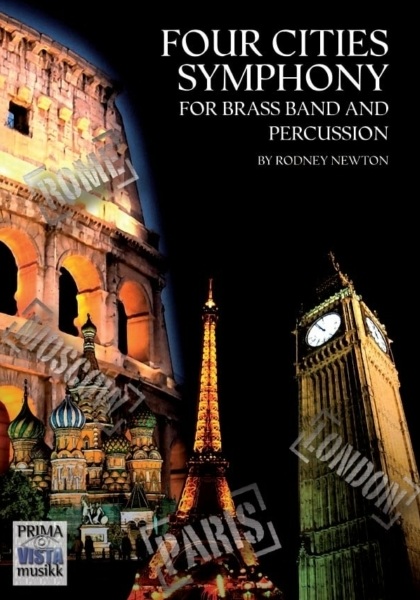
Four Cities Symphony (Brass Band - Score and Parts) - Newton, Rodney
This piece was commissioned by the National Contesting Council as the 4th section test piece for the 2008 Regional Brass Band Championships of Great Britain.This symphony (the composer's 12th) has four movements played without a break. The first centres on two aspects of the city of London: its history and pageantry and its role as a busy modern metropolis.The second movement depicts Paris, its street cafes and boulevards and riverside walks, in the form of a romantic waltz.The third movement is constructed around the Gregorian chants of the Lord's Prayer (Pater noster, qui es in caelis) and the Creed (Credo in unum Deum) in an evocation of the city of Rome. After a powerful climax, mysterious tramping footsteps are heard as the ghosts or a Roman legion march through the city by night. The vision fades and the pater noster is heard once again before the movement is brought to a close with the ancient Ambrosian chant, Christus Vincit, Christus Regnet, Christus Imperat.The final movement is an evocation of the city of Moscow, with its great historic buildings, its turbulent history and its fiery traditional music. At the outset a rather dour folk-like melody is heard which is transformed into a lively Cossack dance.This work is dedicated to Howard Wilson, former principal euphonium of City of Coventry Band who, in 1972, introduced the composer to top section brass band contesting.Duration: 11.00
Estimated dispatch 7-14 working days
-
 £105.00
Tuba Concerto (Tuba Solo with Brass Band - Score and Parts) - Vaughan Williams, Ralph - Littlemore, Phillip
Ralph Vaughan Williams' Tuba Concerto was written in 1953/4 in response to an invitation to compose a work for the Golden Jubilee of the London Symphony Orchestra. Vaughan Williams was by then in his eighty-second year. The lively, outer movements both conclude with extended cadenzas, while the beautifully lyrical Romanza is Vaughan Williams at his best. Phillip Littlemore's brass band arrangement is a welcome addition to the brass band repertoire. Suitable for Championship Section Bands. Duration: 15.00
Estimated dispatch 7-14 working days
-
 £82.95
Occasion (Brass Band - Score and Parts) - Gregson, Edward
Occasion was published especially for the National Youth Brass Band Championship of Great Britain, held at the Royal Albert Hall, London, on 4th October, 1986.Occasion for Brass Band is in four movements: Fanfare, Festivities, Elegy and Dance. The opening Fanfare was originally written as a Wedding Fanfare for Paul and Hazel Patterson in 1981, while the Elegy and Dance were commissioned as a test-piece for the first Westsound/Ayrshire Invitation Contest in 1982 for the leading bands in Scotland. Festivities was therefore written last, to complete the work and give it its essentially 'festive' character. Except for the Elegy, which is contemplative, the music throughout is extrovert and joyful. The opening Fanfare may be performed separately - of the Fanfare may be left out entirely, making the work a three movement Suite.Duration: 11 minutes
Estimated dispatch 7-14 working days
-
£37.95
Occasion (Brass Band - Score only) - Gregson, Edward
Occasion was published especially for the National Youth Brass Band Championship of Great Britain, held at the Royal Albert Hall, London, on 4th October, 1986.Occasion for Brass Band is in four movements: Fanfare, Festivities, Elegy and Dance. The opening Fanfare was originally written as a Wedding Fanfare for Paul and Hazel Patterson in 1981, while the Elegy and Dance were commissioned as a test-piece for the first Westsound/Ayrshire Invitation Contest in 1982 for the leading bands in Scotland. Festivities was therefore written last, to complete the work and give it its essentially 'festive' character. Except for the Elegy, which is contemplative, the music throughout is extrovert and joyful. The opening Fanfare may be performed separately - of the Fanfare may be left out entirely, making the work a three movement Suite.Duration: 11 minutes
Estimated dispatch 7-14 working days
-
 £32.95
Saddleworth Festival Overture (Brass Band - Score only) - Richards, Goff
Commissioned by the Saddleworth Arts Festival and specially published for the Fourth Section Finals of the National Brass Band Championships of Great Britain, held at the Royal Albert Hall, London, October 1985.2013 Butlins Fourth SectionDuration: 9.15
Estimated dispatch 7-14 working days
 View Music