
Results
-
 £99.95
Euphonium Concerto (Euphonium Solo with Brass Band - Score and Parts) - Ellerby, Martin
This Euphonium Concerto was written between late 1994 and early 1995 in response to a commission from Steven Mead to whom the work is dedicated. It is cast in four movements and lasts a little over 22 minutes.Includes: FantasyCapriccioRhapsody (for Luis)DiversionsDuration: 22.30
Estimated dispatch 7-14 working days
-
 £60.99
Brazilian Bay Dance (Brass Band - Score and Parts) - Evers, Harm
This piece, by the Dutch composer Harm Evers, takes you and your musicians to the hot atmosphere of a Brazilian beach party. Everyone celebrates until late at night and dances to the cheerful sounds of Latin American music.Duration: 4:00
Estimated dispatch 7-14 working days
-
 £54.99
A Spanish Christmas Carol (Brass Band - Score and Parts) - Millstone, Patrick
Rondeau of the Shepherds is the historical title associated with the well'known Dutch Christmas carol "Midden in de winternacht." The modern Dutch text was written in 1948 by the poet and writer Harry Prenen. The melody, however, has a much older heritage. It appears in the works of 17th' and 18th'century French organ composers such as Louis-Claude Daquin, Claude Balbastre, and Jean-Franois Dandrieu, who often included it in their Christmas suites and nols.The tune itself is believed to originate from a late'medieval Spanish (likely Catalan) Christmas song, traditionally identified as "El Desembre Congelat." Its imagery--shepherds, flutes, and drums--reflects a deep familiarity with biblical narratives while offering a vivid glimpse into the festive, folk-influenced Christmas celebrations of the Middle Ages.Energetic and joyful, this carol works beautifully as an uplifting, up-tempo intermezzo within a church service or seasonal concert program.Duration: 3.00
Estimated dispatch 7-14 working days
-
 £60.99
Bandstand Boogie (Brass Band - Score and Parts) - Albertine, Charles - Wain, Peter
Charles Albertine played tenor saxophone with the Sammy Kaye band in the late 1940s, and was the lead arranger for the new Las Elgart band. He arranged most of the Three Suns later music. Most of his later career was spent in television.Bandstand Boogie was adopted by Dick Clark as the theme song for his long-running series, American Bandstand.Duration: 3.15
Estimated dispatch 7-14 working days
-
 £55.00
EPISODES FOR BRASS (Brass Band - Score and Parts) - Churcher, Gareth
Despite the title's inference, the work's form is not episodic, but more a depiction of various episodes in the life of the composer, who penned it for his wedding to capture the excitement and majesty of the day. The piece is in three movements: Fanfare and Bells of Celebration, Solenne (dedicated to the late Shaun Thomas), and Finale, which starts with a wake-up call, followed by a fanfare for cornets and trombones.
Estimated dispatch 7-14 working days
-
£25.00
EPISODES FOR BRASS (Brass Band - Score only) - Churcher, Gareth
Despite the title's inference, the work's form is not episodic, but more a depiction of various episodes in the life of the composer, who penned it for his wedding to capture the excitement and majesty of the day. The piece is in three movements: Fanfare and Bells of Celebration, Solenne (dedicated to the late Shaun Thomas), and Finale, which starts with a wake-up call, followed by a fanfare for cornets and trombones.
Estimated dispatch 7-14 working days
-
 £42.95
In Memoriam R.K (Brass Band Set - Score and Parts) - Howarth, Elgar
All England National Brass Band Championship 2007. Recored on Polyphonic QPRL226D Master Brass Volume 18, QPRL056D National Brass Band Championship 1992 played by Black Dyke.Composer's NoteRudolph Kempe, the German conductor, was much admired for this interpretations of late romantic music, particularly Mahler and Strauss. No such music exists in the brass band repertoire and this piece, deliberately written in pastiche style, serves both to fill the gap and as my own small tribute to one of the greatest musicians I have known.
Estimated dispatch 7-14 working days
-
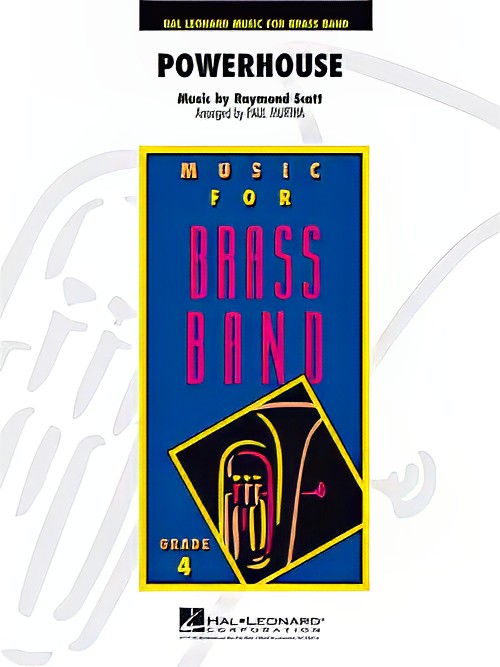 £67.50
Powerhouse (Brass Band - Score and Parts) - Scott, Raymond - Murtha, Paul
The zany music of the Raymond Scott Quintette, originally recorded in the late 1930s, was a popular resource for the early Warner Bros. cartoons scored by Carl Stalling. Filled with surprise and humour, any fan of Bugs Bunny will recognise these unforgettable themes!Duration: 2:45
Estimated dispatch 7-14 working days
-
£34.95
SLOW RIDE IN A STATIC MACHINE, A (Brass Band) - Lawrence, Phil
A Slow Ride in a Static Machine was inspired some time ago when my (late) Father came to visit me "down in London" as he put it. It was based not on one of his circular mishaps, but on several! He was always directed carefully, but refused to carry a map in the car! At one time when I lived in North London I would meet him outside the capital, and he would then follow be back to my place, but after I moved to East London I made him bite the navigational bullet and transverse the 'M25 Orbital'. His main problem seemed to be getting off this mesmerising circular cark park. He would often phone (in a weary tone) from the Dartford Tunnel (which is 5 junctions past the one he needed to get off at), asking me to, "bring him in" so to speak. I would always refuse. And then, he would do the opposite (especially when travelling at night), he would phone me up from near Cambridge (he'd gone the wrong way up the M11 away from London by 45 miles), and would ask where he was!The title is obviously a play on John Adams' composition, A Short Ride In A Fast Machine. This quirky tone poem starts as a wind-up by using those unwanted intervals of augmented 4th's and minor 9th's & 7th's in the main tune, before hearing the road works, the juggernauts multi horns, fender-benders, ambulance and police sirens! This then all works to a back beat on kit. The wind-up start gets to an almost Go-Go 1960's Disco middle section (the nostalgic hay-days of the open road), where our wind-up tune falls into place and we all relax as we can now drive at 42.1 mph! We DC, and then get into a right car mess in the Coda!Phil Lawrence.Duration:4:00
Estimated dispatch 7-14 working days
 View Music