
Results
-
 £50.00
Dragon Dances
DescriptionDragon Dances was commissioned by Owen Farr, who is also the work's dedicatee, gave the first performance with the Cornwall Youth Band conducted by Richard Evans on 5 April 2010 and has recorded it on his solo CD "A New Dawn" accompanied by the Cory Band conducted by Philip Harper.Being a Welsh composer, writing music for a Welsh soloist, I was naturally keen to reflect this in the music, and I drew inspiration from two particularly Welsh concepts - "hiraeth" and "hwyl". "Hiraeth" is a word that has no direct translation into English, but an approximation would be 'yearning for home'. Like the other celtic nations, Wales has a widespread diaspora of people who left to seek new lives out in the empire and "hiraeth" is a way of summing up the homesickness felt by these exiles, some of whom return each year for a special ceremony at the Royal National Eisteddfod. "Hwyl" is an even more complicated word, variously meaning ecstatic joy, fervour, equable temperament and even the characteristic sing-song oration style of the great Welsh Methodist preachers.I have attempted to make the music reflect both of these, with the melancholy first part of the work inspired by the hymns and solo songs for which Wales is famous, and the second part having a much more dance-like, joyful quality.Performance Notes:2 solo cornets, 2nd and 3rd cornets require cup mutes. 2 solo cornets require harmon mutes with tubes removed (marked 'TR' in the score).1st horn and 1st baritone require straight mutes, preferably fibre. 1st trombone requires a straight mute, 2nd and bass require cup mutes.Percussion instruments required are vibraphone, glockenspiel, timpani, snare drum, suspended cymbal and tam tamWatch/Listen to the score below:
Estimated dispatch 7-14 working days
-
 £35.00
Edward Gregson: Fanfare for a New Era (for Brass Band)
DescriptionComposer's NoteThe Fanfare has been designed to be partly antiphonal, with four separate brass 'choirs' initially playing their own music, and so some spatial separation is desirable. Soprano and solo cornets should be placed centrally, standing behind the rest of the band - or in some venues could even be placed off-stage in a side balcony, but still close to the band. If the Fanfare is played by a contesting size band, one of the solo cornets should play the 1st cornet part together with the usual player ie the number of players on the 1st, 2nd, and 3rd cornet parts should be equal. Otherwise the number of players in each of the two cornet 'choirs' is at the discretion of the conductor. The Tubular Bells accompanying the cornets 1-3 group should be placed close to that group. See inside back cover for suggested band formation.The style of playing should replicate that of symphonic brass, with a minimum of vibrato and with long notes being sustained without decaying.Programme NoteCommissioned in 2020 by Youth Brass 2000, Fanfare for a New Era was designed to be partly antiphonal - thus the separation of the band into four brass 'choirs', each with their own percussion accompaniment. First, soprano and solo cornets, rather like heraldic trumpeters, announce the main idea, majestic in character. Then horns, baritones, and euphoniums, with timpani, enter with stately figurations. Next, the heraldic trumpeters usher in trombones and tubas, to the accompaniment of tom-toms and snare drum, presenting a faster and rhythmic dance-like theme. Finally, the remaining cornets amplify the pealing of bells. All four elements then come together, surrounding the audience with a 'joyful noise' of festive brass and percussion.The original symphonic brass version of this fanfare can be purchased as part of a set of Three Fanfares HERE.For more information on Edward Gregson's music please visit the composer's website: www.edwardgregson.com
Estimated dispatch 7-14 working days
-
£58.00
Marsj i mai - Hans Offerdal
March in May is a fun and joyful march with challenges in all instrumental groups!Composed for Haugen skolekorps and their 40 years anniversary in 2017.Playing time: approx. 2:10 min
Estimated dispatch 7-14 working days
-
£29.95
PSALM OF THANKS (Brass Band Set) - Paul Sharman
The composer is a former member of Birmingham Citadel Band and was asked to compose this piece for the band's 115th anniversary reunion weekend. It is a joyful expression of thanks using the well-known tune, 'Now thank we all our God'.
Estimated dispatch 7-14 working days
-
£59.95
ROMANS 8 Brass Celebration (Brass Band Set) - Ray Steadman-Allen
Based on the eighth chapter of Romans, this music was composed as a companion to a series of bible studies at the 1985 British National School of Music. The tunes of four songs are presented, each supporting the ideas of the chapter; 'This joyful Eastertide' 'We are born of the Spirit' 'Lord of all hopefulness' and 'In the Cross of Christ I glory'.
Estimated dispatch 7-14 working days
-
 £30.00
Joy to the World - George Frideric Handel
"Joy to the World" is a popular Christmas Carol with words by Isaac Watts. As of the late 20th century, "Joy to the World" was the most published Christmas hymn in North America. The words of the hymn are by the English writer Watts are based on Psalm 98, 96:11-12 and Genesis 3: 17-18. The version of this carol usually heard today is from an edition by Lowell Mason and is named "Antioch" and attributed as "arranged by Handel". This tune has the first four notes in common with the chorus "Lift up your heads" from the Messiah and the third line recalls "Comfort ye" from the same work. But this resemblance is often dismissed as a chance resemblance by Handel scholars today. Another theory is its similarity to a tune called "Comfort" and associated with Charles Wesley's hymn "O Joyful Sound", which was written some three years earlier than Lowell Mason's "Antioch" in 1833. This carol has been recorded by many artists such as Andy Williams, The Supremes, Bing Crosby, Ella Fitzgerald, Johnny Cash, Nat King Cole, Perry Como, Vic Damone and Mariah Carey.
-
 £40.00
Fanfare for a New Era (Brass Band - Score and Parts)
Fanfare for a New Era is the most substantial of Edward Gregson's fanfares and was the result of a private commission by Lady Sheila Stoller to celebrate the opening in April 2017 of the Stoller Hall at Chetham's School of Music, Manchester. Gregson dedicated it to Sir Norman Stoller, who donated the funding for the new concert hall. The Fanfare was designed to fill the whole space, with separate brass choirs - trumpets, horns, trombones and tuba - playing their own music. A solo trumpeter playing 'on high' announces first the four horns and timpani, who enter with a stately measure. Next the herald trumpeter ushers in trombones, tuba and drums, with a faster dance. Finally, the remaining three trumpets amplify the peeling of bells. All four elements then come together, surrounding the audience with a 'joyful noise' of festive brass and percussion.Duration: 3.00
Estimated dispatch 7-14 working days
-
 £70.00
General Series Band Journal August 2017 Numbers 2170-2173
Praise to the Lord! (Andreas Holmund)A joyful and exuberant setting of the tune 'Lobe den Herren' which will be popular amongst many groups looking for an exciting programme item.Carol of the bells (Warren Brookes)The 'Carol of the bells' is an extremely popular and much used carol. This setting will bring a useful addition to the Christmas repertoire and is arranged by a Salvationist from Australia.Breathe on me (Paul Drury)This work is based on the 'Sing to the Lord' setting by Mark Porter which has proved popular amongst many vocal groups. It is hoped that this developed setting will enhance its popularity.March Cedarlights (Norman Bearcroft)Lt. Colonel Norman Bearcroft provides a march with all his hallmarks of energy and rhythmic and melodic interest. The march was written as a tribute to the International College for Officers and features the tunes 'Joy, joy, joy there is joy in The Salvation Army', 'They shall come from the East' and 'The World for God' reflecting the internationalism of the College.
Estimated dispatch 7-14 working days
-
 £77.00
General Series Brass Band Journal, Numbers 2265 - 2268, April 2026
2265: Holy God, we praise your name (Micael Dikantsa)This bolero introduces composer Micael Dikantsa of the Amriswil Corps, Switzerland, and is based on the hymn Holy God, We Praise Your Name (Grosser Gott, wir loben dich). Set in the traditional slow, dramatic bolero style, the work builds steadily from a distinctive percussion figure as the melody passes through different instrumental groups. With its growing intensity and rich scoring, this piece offers an engaging and atmospheric addition to concert programmes.2266: Tell the story (Barrie Gott)This work continues the Swing series that began nearly 40 years ago with Light'Walk. After a bold introduction, the melody unfolds through unison and close'harmony writing, leading to a Flugel Horn solo with scope for improvisation. The well'known hymn I Love to Tell the Story is heard in a New Orleans style before a modulation launches an energetic shout chorus and lively coda. Smooth, relaxed swing style is key throughout.2267: The old rugged cross (Erik Leidzn)This arrangement by Erik Leidzn is an early and lesser'known setting of a well'loved hymn, rediscovered during research into his work. Edited from a rare score found in the USA East Music Department archives, it demonstrates Leidzn's economical and effective style, creating a practical and expressive arrangement at a time when concise, serviceable hymn settings were greatly needed.2268: Heaven came down! (Michael Cooper)Inspired by William Booth's famous challenge to use contemporary styles for sacred purpose, this piece blends high'energy jazz'fusion big'band writing with a joyful gospel hymn. Driven by rhythm, syncopation and precision, the music proclaims its message of transformation and spiritual joy with vitality, clarity and infectious swing.
Estimated dispatch 7-14 working days
-
 £14.95
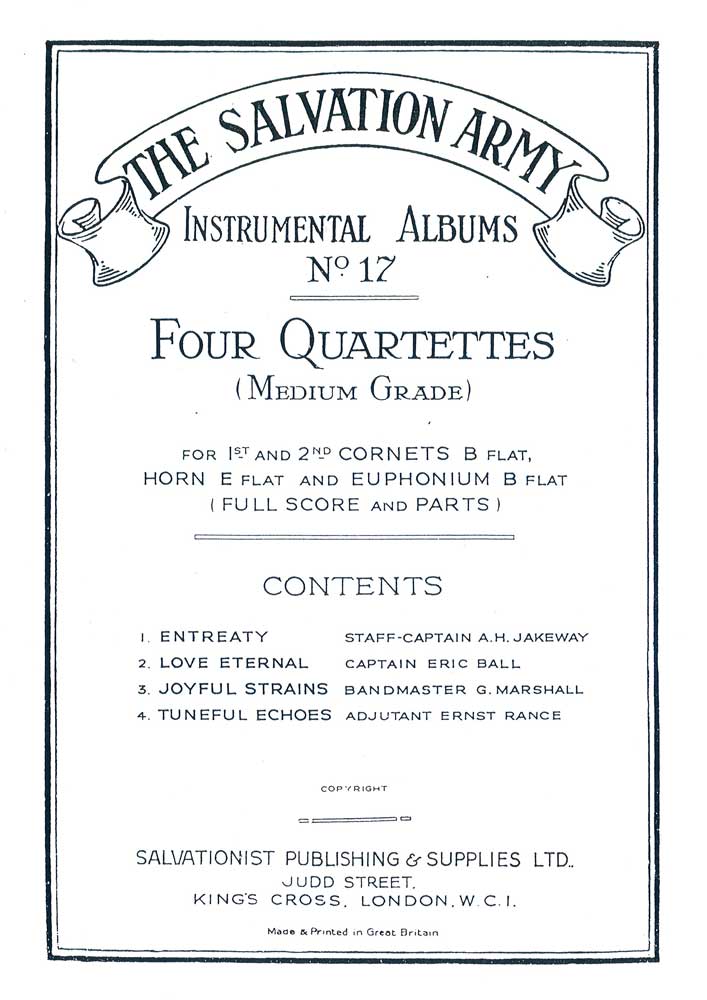
Instrumental Album No.17 - Four Quartettes
Includes: Entreaty; Love Eternal; Joyful Strains; Tuneful EchoesInstrumentation: 2 Cornets, Eb Horn & Euphonium (Bb)
Estimated dispatch 7-14 working days