
Results
-
£83.00
A Bournemouth Suite - Benjamin Tubb
Bournemouth Suite was written by Benjamin Tubb in 2005, when the composer was just 17 years of age. After spending many school holiday weeks with his grandparents in the coastal town of Bournmouth, it was obvious that these experiences would make a great basis for a composition.This testpiece is split into three separate movements: Balloon Ride, The Pier at Night and The BIC. Each movement has its own unique character, although there are ideas shared by all three throughout, one of which is the opening syncopation.Balloon RideThe First movement, Balloon Ride, describes a journey on "The Bournemouth Eye", a tethered hot air balloon that takes you up 500 feet. It's located in the middle of the town centre, which enables you to see surrounding countryside for up to 20 miles! The movement begins rather ominously as the balloon raises from the ground which leads into a more lively section caharacteresed by the repeating quavers in the lower brass and woodblock. The movement ends in much the same way as it started - signalling the return to terra firma.The Pier At NightDuring the summer there are several large firework displays in the town centre. The second movement, The Pier At Night descirbes an evening spent on the beach in deckchairs watching the montage of colours in the night-time sky. With demanding solos for horn and cornet, as well as exposed playing spread throughout the band, this slow movement will really test a band's expressive and lyrical playing.The 'BIC'The Bournemouth INternational Centre, also known as "The BIC" is one of Bournemouth's most visited attractions, and regularly hosts shows such as 'Riverdance' and pantomimes. Inside is a world of entertainment and the centre itself is just a stone's throw from both "The Bournemouth Eye" and the Pier. The 3rd movement has been written to describe the buzz of activity surrounding the BIC, and the entire works ends with the same syncopated motif from the beginning.A Bournemouth Suite was set as the 'set-test' at the Pontins Brass Band Championships 2009.
Estimated dispatch 7-14 working days
-
 £48.56
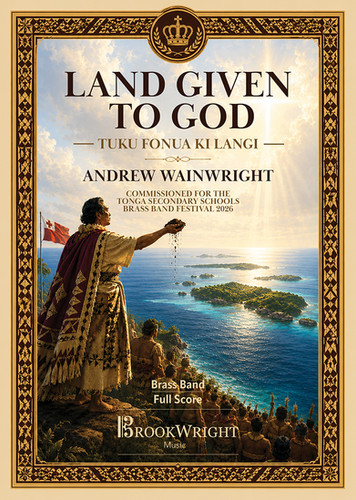
Land Given to God (Tuku Fonua ki Langi) (Brass Band) Andrew Wainwright
Land given to God (Tuku Fonua ki Langi) is a landmark major test-piece for brass band celebrating Tongan faith, history, and cultural identity. Commissioned by Sione Malekamu Manu Jr for the Tonga Secondary School Music Festival, Land given to God marks a monumental achievement in Pacific music literature as the first major brass band test-piece written specifically for the Kingdom of Tonga. Commemorating two centuries of Christianity, this compelling four-movement work traces Tonga's journey from ancient traditions to its historic 1839 dedication to divine protection. The piece draws its principal thematic material from the beloved Tongan hymn Oku 'iai ha ki'i fonua 'oku tu'u 'i 'oseni. The work is divided into four through-composed movements: I. Koe Lotu Mu'a (The Old Religion): Grounded and ritualistic, this movement paints the ancient spiritual order of pre-Christian Tonga - a nation anchored in sacred ancestral tradition on the threshold of change. II. Koe Lotu Fo'ou (The New Religion): Captures a nation in transition, depicting the arrival of Wesleyan missionaries, the conversion of Taufa'ahau (King Siaosi Tupou I), and the powerful 1834 spiritual revival (To 'a e 'Ofa). III. Koe Sivi Fakaosi (The Final Test): A dramatic musical confrontation between doubt and conviction. It recounts the story of Christian teacher Pita Vi being cast into shark-infested waters as a test of faith, surviving unharmed to seal the King's devotion. IV. Koe Tuku Fonua ki Langi (Land Given to God): A solemn, declarative finale recounting the historic 1839 act at Pouono, where King Siaosi Tupou I offered the land and people of Tonga to the divine protection of Heaven. Duration: approx. 8.45 minutes Difficulty Level: 4th Section + This PDF download includes the full score and parts. Sheet music available at www.brassband.co.uk (UK) or https://satradecentral.org (USA) Instrumentation: Soprano Cornet Eb Solo Cornet Bb Repiano Cornet Bb 2nd Cornet Bb 3rd Cornet Bb Flugel Horn Bb Solo Horn Eb 1st Horn Eb 2nd Horn Eb 1st Baritone Bb 2nd Baritone Bb 1st Trombone Bb 2nd Trombone Bb Bass Trombone Euphonium Bb Bass Eb Bass Bb Percussion 1-3
In Stock: Estimated dispatch 1-3 working days
-
 £79.95
Amundsen - Jonathan Bates
DURATION: 14'00". DIFFICULTY: 1st+. 'Amundsen' was commissioned by rskog Brass, Norway for their winning performance at the 2020 Norwegian National Championships held at the Grieghallen in Bergen. In December 1911, Norwegian Roald Amundsen gained global fame by becoming the first explorer to lead a team to the geographic South Pole. Amundsen and 4 other members of his team arrived 5 weeks ahead of a rival team from the UK led by Robert Falcon Scott, all of which perished on their attempted return from the pole. Initially when Amundsen's team set out in 1910, they were under the impression that they would be making the far shorter journey to the arctic drift to attempt to reach the North Pole, but Amundsen had received news that American explorers Peary and Cook had beaten them to this goal, and so Amundsen's focus changed southward. 'Fram, Forward' - 'Fram' (translating to English as "forward") was the name of the ship Amundsen used for this particular polar expedition. Amundsen had only informed 2 people of his real intentions of conquering the South Pole when the ship first left port in Kristiansand before heading south to the Portuguese island of Madeira in the Atlantic Ocean. After weeks at sea - causing the uninformed members of the crew to raise a number of questions and produce a general feel of uncertainty and low spirits - it was here that Amundsen announced his true plans to the rest of his crew. They were asked whether they wished to continue with their expedition, to which all - some begrudgingly - agreed to sail on to the South Pole, through the great Ice Barrier before docking in the Bay of Whales on the Ross Ice Shelf. 'Ross Ice Shelf' - Upon Amundsen's arrival in the Bay of Whales, the team were greeted by the sight of the enormous ice plateau's and glaciers, towering into the Antarctic sky. In 1907, Ernest Shackleton had attempted - and failed - to reach the South Pole, but his route and mapping was by now well documented. Scott and the UK team were to follow this route, whereas Amundsen and his men forged their own way to the pole through unchartered territory and deadly terrain littered with deep crevasses and canyons. The music here though, is a picture of tranquility. The eerie silence of total emptiness with only the heavy snow falling around Amundsen as Fram and the Bay of Whales disappears into the distance, faced by the maginute of the expedition ahead. 'Advance to Polheim' - The first new challenge Amundsen discovered on this route was a rough, sharp and extremely steep glacier (which was later named the Axel heiberg Glacier after the Norwegian monarch who funded much of the expedition), which would take his team up from sea level to an altitude of over 9,000ft in just 20 miles, with most of this over just 7 miles. Once scaled, only the vast Antarctic Plateau stood between Amundsen and the pole. Here the race began, with only one aim - victory for himself, his team, and for the whole of Norway. .
In Stock: Estimated dispatch 1-3 working days
-
 £29.88
Breathe on me, breath of God (Brass Band) Robert Jackson arr. Andrew Wainwright
Andrew Wainwright's sensitive setting of Breathe on Me, Breath of God was commissioned by Sione Malekamu Manu Jr for the 2026 Tonga Secondary School Music Festival, in memory of the late Sione Malekamu Manu. The piece offers a reflective yet powerful treatment of Edwin Hatch's beloved 1878 hymn. Set across two contrasting verses, the arrangement traces a spiritual journey from quiet contemplation to triumphant exaltation. The first verse opens with delicate textures and warm, blended tone, allowing the familiar melody - traditionally set to Robert Jackson's tune Trentham - to emerge with serene simplicity. Building seamlessly through a transitional passage, the setting broadens into a majestic second verse, celebrating the transformative power and majesty of the divine spirit. Concise yet profoundly moving, this arrangement showcases both the lyrical sensitivity and majestic power inherent to the traditional brass band. To view a rolling score video of this piece please visit www.youtube.com/watch?v=Oh7WRTwhpqM Duration: approx. 2.40 minutes Difficulty Level: 4th Section + This PDF download includes the full score and parts. Sheet music available at www.brassband.co.uk (UK) or https://satradecentral.org (USA) Instrumentation: Soprano Cornet Eb Solo Cornet Bb Repiano Cornet Bb 2nd Cornet Bb 3rd Cornet Bb Flugel Horn Bb Solo Horn Eb 1st Horn Eb 2nd Horn Eb 1st Baritone Bb 2nd Baritone Bb 1st Trombone Bb 2nd Trombone Bb Bass Trombone Euphonium Bb Bass Eb Bass Bb Timpani Percussion 1-2
In Stock: Estimated dispatch 1-3 working days
-
 £33.62
He will hold me fast (Trombone Feature with Band) Matt Merker arr. Noel Brooks
Originally conceived as a trombone duet for the graduation recital of Andy Brooks at Western University, this setting of Matt Merker's popular choral work has been adapted by Noel Brooks as a featured work for trombone trio with brass band. The arrangement follows the emotional arc of the hymn's lyrics, utilising the brass band's colours to reflect the themes of each verse. The journey begins with a sense of vulnerability; the accompaniment is kept sparse and cold to echo the text's plea regarding a failing faith. In the second verse, the music transitions into a more encouraging and uplifted atmosphere, reflecting the assurance of being "precious in His Holy sight." A shift occurs in the third verse, which takes on a darker, more reflective character to support the gravity of the lyrics. This contemplative section builds steadily toward the final chorus, where a sense of confidence returns. The work culminates in a strong musical statement of the hymn's central promise: "He will hold me fast." To view a performance of the work by the Canadian Staff Band please visit www.youtube.com/watch?v=lArvB6HP3pI Duration: Approx. 5.00 minutes Difficulty Level: 4th Section + This PDF download includes the full score and parts. Sheet music available at www.brassband.co.uk (UK) or https://satradecentral.org (USA) Instrumentation: 1st Trombone Soloist Bb 2nd Trombone Soloist Bb Bass Trombone Soloist Soprano Cornet Eb 1st Cornet Bb 2nd Cornet Bb Flugel Horn Bb 1st Horn Eb 2nd Horn Eb 1st Baritone Bb 2nd Baritone Bb Euphonium Bb Bass Eb Bass Bb Percussion Glockenspiel
In Stock: Estimated dispatch 1-3 working days
-
 £79.95
Corineus - Christopher Bond
Corineus, in medieval British legend, was a prodigious warrior, a fighter of giants, and the eponymous founder of Cornwall. The first of the legendary rulers of Cornwall, he is described as a character of strength and power. It is on the medieval ruler that this new work, Corineus, is based, presented in three contrasting sections. The work opens with heraldic fanfares and a sense of jubilance before presenting musical material which changes and develops organically, portraying the journey taken by Corineus, Brutus, and the Trojans from modern-day mainland Europe to Britain. The central section of the work is slower, creating a feeling of longing. Brutus' son, Locrinus, had agreed to marry Corineus' daughter, Gwendolen, but instead fell in love with a German princess. In writing this part of the work, the composer portrays the longing of Gwendolen for her husband, knowing he is in love with somebody else. After Corineus died, Locrinus divorced Gwendolen, who responded by raising an army in Cornwall and making war against her ex-husband. Locrinus was killed in battle, and legend suggests that Gwendolen threw Locrinus' lover into the River Severn. This dramatic battle provides the inspiration for the final part of the work. In writing this work, the composer hopes to flare the imagination of young brass players around the country, in an engaging new take on a firm fixture in British folklore.
Estimated dispatch 10-14 working days
-
 £34.50
The Wanderer - Hymn Tune Arrangement
ABOUT THIS PIECE: Written for the Haydock Band in memory of their late president, Stan Gardner, this is a beautifully simple take on the hymn tune: Stella. The title comes from the words of often sung to this hymn, written by John Lingard: 'Pray for the wanderer, pray for me'. Before the whole hymn is heard, the band play a repeated melody that evokes feelings of movement. There is an interplay between new and old melody, before a rousing rendition of the hymn by forte band. The arrangement concludes with the opening melody disappearing into the distance - a musical representation of the arranger's sentiments written at the top of the score: 'May God bless your onward journey, dear friend'. ENSEMBLE: Standard British Brass Band WHEN YOU BUY THIS PRODUCT, YOU GET: High-quality printed score and parts LEVEL: 1 LISTEN: DURATION: 5-minutesEXAMPLE SCORE: Click here LEVEL GUIDE: Level 1- Accessible to all Level 2 - c. UK third section and higher Level 3 - c. UK second section and higher Level 4 - c. UK first section and higher Level 5 - c. UK championship section level
Estimated dispatch 5-7 working days
-
 £25.00
...and the winter moon rises
Description...and the winter moon riseswas inspired by a winter's evening car journey across the Pennines from Manchester to Huddersfield, through the brass band heartland of Saddleworth. There was recent snow on the ground, and the sun had just set. A bright clear moon was rising into a sky coloured with orange from the setting sun, and the moonlight made all the snow and ice sparkle.The work is the fourth movement of a larger 5 movement suite entitled "North!", but can be (and has been) performed in isolation. This work was a finalist in the 2012 Ohio Brass Arts Festival composition competition.Performance NotesThe percussion parts should be playable by three players; the "arco" parts of the vibraphone parts should be played by drawing a cello or double bass bow up the side of the bar. Motors should be left off throughout.Three of the brass players are asked to double on triangles for the first part of the piece; ideally these should be of different sizes giving clearly different sounds. The easiest solution is to tie a triangle to the music stand, rather than try to hold it and then swap instruments later in the piece.Click below to watch a playback preview of the score!
Estimated dispatch 7-14 working days
-
 £44.95
Prelude and Fanfare - Dan Price
Prelude and Fanfare takes its inspiration from a piece of NASA Video footage, where a camera is attached to a piece of debris and jettisoned into space from the space shuttle. The work is a musical reflection of this journey,...
Estimated dispatch 5-7 working days
-
 £48.00
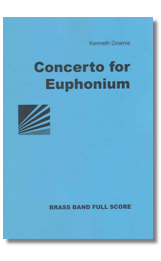
Concerto for Euphonium - Kenneth Downie
An accessible and enjoyable showpiece for soloists of all ages. The concerto's three movements are in a tuneful, melodic style and bravura passages are mixed with others designed to exploit the singing qualities of the instrument. The first movement is a vigorous allegro in which the short, pithy motifs of the opening theme contrast with the broad sweep of the second subject. A short cadenza-like passage yields to a high-spirited episode before a reprise of the opening ends the movement quietly. The second movement opens with a warm, romantic melody which is soon taken up by the soloist. A short animated section gives way to the earlier tutti theme, this time with passionate decoration from the soloist before the music gently unwinds in a tranquil coda. The finale has a bouncy, festive feel. After the first subject runs its course there is a brief journey through a more contrapuntal style, before a spirited presto moves into a compound episode before returning to the opening idea. A jubilant coda brings the work to a conclusion.
Estimated dispatch 7-9 working days