
Results
-
 £14.95
Comfort And Joy (Brass Band - Score only) - Thomas, Martyn
A pure, unadulterated 'big band' style jazz arrangement for brass band of 'God rest ye merry gentlemen'.
Estimated dispatch 7-14 working days
-
 £69.99
Trumpeter's Lullaby (Cornet Trio with Brass Band - Score and Parts) - Anderson, Leroy - Iwai, Naohiro
Leroy Anderson is part of American cultural heritage and he is often compared to such masters as Gershwin and Copland. Trumpeter's Lullaby was written for The Boston Pops Orchestra of which he was the conductor. This new arrangement for brass band gives your three cornet soloists a chance to 'take to the fore' in a variety of up-tempo jazz styles. Once performed this item will become a favourite that you will use time and time again.Duration: 3:45
Estimated dispatch 7-14 working days
-
 £59.70
Down Bourbon Street (Brass Band - Score and Parts) - Fernie, Alan
Jazz Medley (New Orleans Style)Slightly reduced Brass Band instrumentation (no rep cornet, no 2nd horn, no 2nd trombone part)
Estimated dispatch 7-14 working days
-
 £95.00
Journey of the Lone Wolf (Brass Band - Score and Parts) - Dobson, Simon
Championship Section Test Piece for the 2016 National Finals of the British Brass Band Championship.The Lone Wolf of the title is the great Hungarian composer and folklorist Bla Bartok. Bartok's journey took him from the hills of the Balkans to the heart of the new world. His singular vision may have meant a life out in the cold, a life without warmth and love, a life without true happiness, a death mourned by a few in a strange land.The first of the three linked movements is capturing the Peasants' Song and follows the young Bartok and fellow composer Zoltan Kolday as they embark on Summertime adventures through the Hungarian countryside to collect and catalogue the astonishing variety of Gypsy and folk music heard in the Balkan hills. The arrival of WW1 plunges Bartok's beloved Hungary into chaos.Bartok was at times a cold man, aloof and lonely. The occasional moments of tenderness he showed are portrayed in Night Music. His brief but intense affairs speak of a love he could only long for. Jazz is my night music and here there are hints of what Bartok may have heard in the USA later in his life.Having been forced by the world's evils to leave his homeland of Hungary for America Bartok, the anti-fascist, felt isolated and angry. In the finale, Flight and Fight, we hear his longing for a simpler time of Gypsy folk dances as well as his maturity and depth as a composer finally exploring deeper colours and darker themes.Duration: 15.00
Estimated dispatch 7-14 working days
-
 £45.00
Rhapsody in Blue (Brass Band - Score and Parts) - Gershwin, George - Sykes, Steve
Steve Sykes has taken the main themes from George Gershwin's classic 1924 Rhapsody in Blue for piano and concert jazz orchestra to form a tuneful selection for brass band.Suitable for Advanced Youth/3rd Section Bands and aboveDuration: 8:00
Estimated dispatch 7-14 working days
-
 £24.95
ROAR! (Brass Band Parts) - Scott, Andy - Fieldhouse, Jim
Brass Band parts only. Roar! is a short punchy piece, with minimalist tendencies combined with jazz influenced harmonies. A bold opening statement gives way to a theme that develops with added layers of texture. These two ideas form the basis of the structure of Roar!. Dur: 4:00
Estimated dispatch 7-14 working days
-
£15.00
ROAR! (Brass Band Score) - Scott, Andy - Fieldhouse, Jim
Brass Band score only. Roar! is a short punchy piece, with minimalist tendencies combined with jazz influenced harmonies. A bold opening statement gives way to a theme that develops with added layers of texture. These two ideas form the basis of the structure of Roar!. Dur: 4:00
Estimated dispatch 7-14 working days
-
£40.00
Take Five (Brass Band - Score and Parts) - Desmond, Paul - Sykes, Steve
The classic jazz number 'Take Five' was first recorded by the Dave Brubeck Quartet and released on its 1959 album Time Out. Composed by Paul Desmond, the group's saxophonist, it became famous for its distinctive, catchy melody and use of quintuple time, from which the piece got its name. This brass band arrangement, by Steve Sykes, captures the jaunty slant of the original.Suitable for Advanced Youth/3rd Section Bands and aboveDuration: 4.00
Estimated dispatch 7-14 working days
-
 £54.99
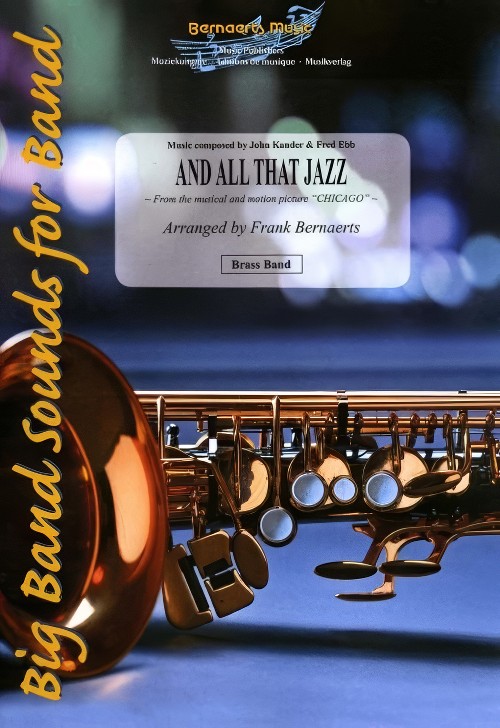
And All That Jazz (Brass Band - Score and Parts) - Ebb & Kander - Bernaerts, Frank
Theme frrom the musical and motion picture Chicago. Duration: 3.15
Estimated dispatch 7-14 working days
-
 £54.20
AND ALL THAT JAZZ (Brass Band) - Morrison, Alan
from the musical Chicago. Grade: medium Duration: 3:06
Estimated dispatch 7-14 working days
 View Music