
Results
-
 £63.00
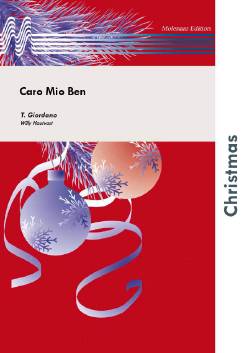
Caro Mio Ben - T. Giordano/Willy Hautvast
Here we have one of the most famous 'Arie antiche' (ancient aria's) from the 18th century, written in the style of Handel. For many years it has been attributed to Giuseppe Giordani, opera and sacred music composer of the Neapolitan school. However, recent investigations clearly established that this song had actually been composed by his son Tommaso (1733-1806). This delicate wind band arrangement by Willy Hautvast can also be performed with a vocal soloist or a mixed choir.
Estimated dispatch 10-14 working days
-
£79.00
Sovnlaus - Haug en, Haugen & Aadland - Idar Torskangerpoll
Hellbillies is a Norwegian rock band founded in 1990 in the small village of Al, Hallingdal. They are now among the most popular bands in Norway with 16 CD-releases. They are awarded the Norwegian "Spellemannsprisen" (an equivalent to Grammy) several times."Sovnlaus" ("Sleepless") is the title track from their last record album released in 2016. It's a typical powerful rock song and should be played with power and precision.
Estimated dispatch 7-14 working days
-
£67.00
Sovnlaus - Haugen-Haugen-Aadland - Idar Torskangerpoll
Hellbillies is a Norwegian rock band founded in 1990 in the small village of Al, Hallingdal. They are now among the most popular bands in Norway with 16 CD-releases. They are awarded the Norwegian "Spellemannsprisen" (an equivalent to Grammy) several times."Sovnlaus" ("Sleepless") is the title track from their last record album released in 2016. It's a typical powerful rock song and should be played with power and precision.
Estimated dispatch 7-14 working days
-
£44.00
Hva var vel livet uten deg? - Ernfrid Ahlin og Gunnar Kaspersen - Jan Utbult
"Hva var vel livet uten deg" ("What was the life without you") is a song composed by Swedish composer Ernfrid Ahlin with lyrics by the Norwegian Gunnar Kaspersen.It has been features in both movies and TV-series from 1951 and onward. The most well-known version is from the TV-series "Fredrikssons Fabrikk" which was produced between 1990 and 1993.
Estimated dispatch 7-14 working days
-
 £29.95
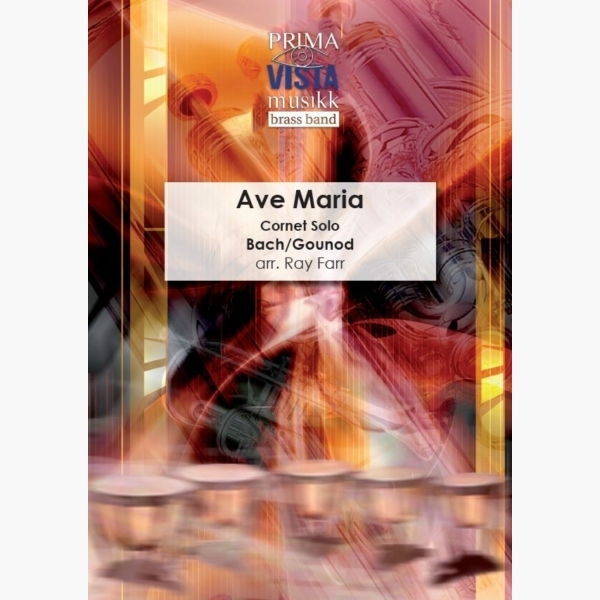
Ave Maria - Johann Sebastian Bach, Charles Gounod - Ray Farr
There have been several settings of this Roman Catholic prayer to music, with the Bach/Gounod version being the most famous. It consists of the first prelude of Bach's The Well-Tempered Clavier plus a melody that Gounod wrote over this. Gounod...
Estimated dispatch 5-7 working days
-
 £29.95
Cleopatra - Eugene Damare - R John Childs
This popular cornet solo was arranged by the late R John Childs whilst he was conductor of the Tredegar Town Band. It is one of the most famous of all triple-tonguing polkas and remains a favourite amongst cornet soloists and...
Estimated dispatch 5-7 working days
-
£44.95
FINALE FROM SYMPHONY No.4, Excerpts from (Brass Band Set) - Tchaikovsky - William Gordon
Peter Ilyich Tchaikovsky wrote his fourth symphony in 1877 and 1878. It was first performed in the latter year conducted by Nikolai Rubenstein. Despite initial critical reaction, the symphony has become a staple of the orchestral repertoire and is one of the most frequently performed late 19th century symphonies. In the exciting finale, Tchaikovsky incorporates a famous Russian folk song, 'In the field stood a birch tree' as one of its themes.
Estimated dispatch 7-14 working days
-
 £51.95
Arioso and Allegro - Joseph Hector Fiocco arr. Philip Wilby and Robert Childs
Joseph Hector Fiocco (1703-41) was the most famous member of a family of Belgian musicians. As well as being a church musician, Joseph was a violin maker, professor of Latin and Greek, and a distinguished harpsichord player. His famous allegro, originally written for harpsichord, lies well for the euphonium. It requires a steady tempo throughout its compass and dynamic range, and is ideal for improving technique and stamina. The lyrical arioso demands well-shaped phrases and ne breath control.
Estimated dispatch 7-9 working days
-
 £37.95
O Sole Mio - E. Di Capua
One of the most famous melodies the world has known! This arrangement can be played by any B-flat soloist so it makes a great addition to the repertory.
Estimated dispatch 7-9 working days
-
 £29.88
March - St. Julien (Brass Band) Arthur W. Hughes arr. Keith M. Wilkinson
St Julien is a town near the French/Belgian border which witnessed several battles during WW1. The composer Arthur W. Hughes (1870-1950) was born in Kingston, Ontario, and left home when he was quite young to perform with circus bands in US. He wrote several marches and a few other compositions but this one, dating from 1918, is the most well-known. The march also works as a fast circus march. Here it has been expertly arranged for brass band by Dr. Keith M. Wilkinson. Difficulty Level: 4th Section + Sheet music available from: UK - www.brassband.co.uk USA - www.solidbrassmusic.com Instrumentation: Soprano Cornet Eb Solo Cornet Bb Repiano Cornet Bb 2nd Cornet Bb 3rd Cornet Bb Flugel Horn Bb Solo Horn Eb 1st Horn Eb 2nd Horn Eb 1st Baritone Bb 2nd Baritone Bb 1st Trombone Bb 2nd Trombone Bb Bass Trombone Euphonium Bb Bass Eb Bass Bb Percussion 1-3
In Stock: Estimated dispatch 1-3 working days
 View Music
 Watch video