
Results
-
 £108.00
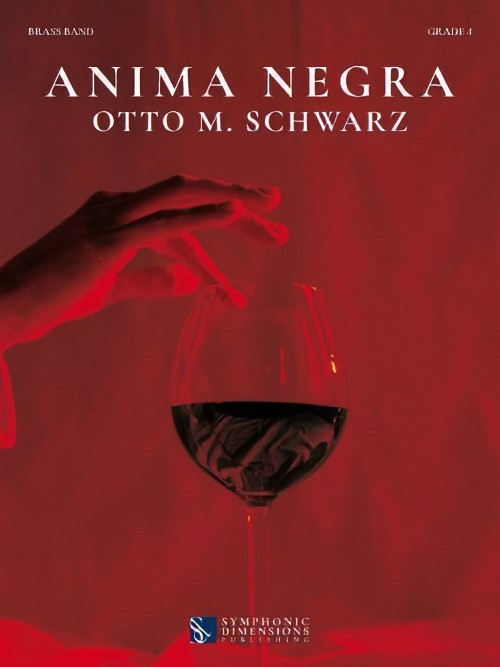
Anima Negra (Brass Band - Score and Parts) - Schwarz, Otto M.
Two boys from Felanitx: Pere Obrador and Miquel Angel Cerda. Having finished school, one stayed in Mallorca, while the other one left to study in Madrid. Some years later, homesickness and a yearning for the sea brought Miquel back. The turning point in their lives came in 1994. They realised their dream and produced their first wine. Their vision was to produce a real "Balearic Wine" from native grapes such as Callet, Mantonegro and Fogoneu. Anima Negra captures the stunning landscape of Mallorca in a single glass of wine. It reflects the sun, salinity and energy of the island and has conquered the world.Duration: 9.15
Estimated dispatch 7-14 working days
-
 £38.00
Inchcolm (Horn Solo with Brass Band - Score and Parts) - Johns, Terry
Inchcolm is an island in the Forth estuary first visited by St Columba in 567 and mentioned in Shakespeare's Macbeth. The ruins of Columba's abbey are regularly shrouded in mist and bring with it a flavour of mystery and legend. Composer and distinguished French horn player Terry Johns (Drac to his friends) was commissioned to write this work for Superbrass and their water influenced 2nd album, Brass Taps. Drac requested that he be allowed to write a solo feature with a proper tune for horn. Kingdom Brass in Scotland premiered Inchcolm in its new brass band form and the solo part is playable by either a tenor or french horn player. Duration: 5.00. Suitable for 2nd Section Bands and above.
Estimated dispatch 7-14 working days
-
 £60.99
Washington Grays (Brass Band - Score and Parts) - Grafulla, Claudio S. - Curnow, James
Claudio S Grafulla was born on the Spanish island of Minorca in 1818 and emigrated to the United States in 1838. Although he was a composer of many original works, the one that is still regarded as one of the finest marches ever written is his Washington Grays March. This arrangement strives to recreate the original lost version written for an American Civil War brass band.
Estimated dispatch 7-14 working days
-
 £40.00
Symphonic Dance No.3 (Brass Band - Score and Parts) - Rachmaninoff, Sergei - Littlemore, Phillip
Completed in 1940, the set of?Symphonic Dances?was Sergei Rachmaninov's last composition. The work is fully representative of the composer's late style with its curious, shifting harmonies, the almost Prokofiev-like grotesquerie of the outer movements and the focus on individual instrumental tone colours throughout.?Rachmaninov composed the Symphonic Dances four years after his Third Symphony, mostly at the Honeyman Estate, 'Orchard Point', in Centerport, New York, overlooking Long Island Sound. The three-movement work's original name was Fantastic Dances, with movement titles of 'Noon', 'Twilight' and 'Midnight'. When the composer wrote to the conductor Eugene Ormandy in late August, he said that the piece was finished and needed only to be orchestrated, but the manuscript for the full score actually bears completion dates of September and October 1940. It was premiered by Ormandy and the Philadelphia Orchestra, to whom it is dedicated, on 3rd January, 1941. This arrangement is of the last dance and is a kind of struggle between the?Dies Iraetheme, representing Death, and a quotation from Rachmaninov's own?Vespers?(also known as the All-night Vigil, 1915), representing Resurrection. The Resurrection theme proves victorious in the end as the composer actually wrote the word 'Hallelujah' at the relevant place the score (one bar after Fig. 16 in this arrangement).?Duration: 3:45
Estimated dispatch 7-14 working days
-
 £74.99
Willow Pattern (Brass Band - Score and Parts) - Harper, Philip
Composed in 2009 for Nicholas Childs and the Black Dyke BandThis piece tells the Willow Pattern legend through music. Several leitmotifs are used both for the different characters and also for some of the important emotions in the tale. Additionally, Knoon-se's part is mainly played by the flugel horn, Chang by the euphonium, the Mandarin by the Eb Bass and the Duke Ta-jin by the trombone.The Willow Pattern Legend:Once, in ancient China, there lived a wealthy and powerful Mandarin who had a beautiful daughter, Knoon-se. She had fallen in love with Chang, a humble accountant, which angered her father who imprisoned her in the Pavilion by the river with only the exotic birds for company. She learnt that the Mandarin planned to marry her to the pompous Duke Ta-jin and that the wedding would take place on the day the blossom fell from the willow tree, so she sent Chang a message: "Gather thy blossom, ere it be stolen". The Duke arrived by sea amid great fanfare when the tree was heavy with bud, and nights of magnificent banquets followed. After one such occasion when the Mandarin slept, Chang crept over the crooked fence and tiptoed into the Pavilion to rescue Knoon-se, but as they escaped the alarm was raised. They fled over the bridge with the Mandarin close on their heels brandishing his whip. They managed to escape by boat to a secluded island where they lived happily for a time. Meanwhile, the Mandarin learned of their refuge and, intent on revenge, he ordered his soldiers to kill them. As Knoon-se and Chang slept at night, the men set fire to the pagoda in which they lived and the lovers perished in the flames. However, the Gods, moved by the lovers' plight, transformed their souls into two turtle-doves which rose from the charred remains, soaring above the Earth, symbolising eternal happiness.Willow Pattern is dedicated to the memory of Jean Harper who passed away as I was completing the piece and who was a great collector of porcelain and china-ware.Duration: 12:00
Estimated dispatch 7-14 working days
-
 £34.95
Rhapsody On The Isle Of Mull (Brass Band - Score and Parts) - Downie, Kenneth
Mull is an island off the west coast of Scotland and it gives its name to the lovely tune which forms the basis of this music. It is very scenic, with some beautiful mountains and the composer has tried to suggest something of the atmosphere of grandeur in his score. The largely pentatonic nature of the tune heavily colours the musical texture.
Estimated dispatch 7-14 working days
-
£17.50
Rhapsody On The Isle Of Mull (Brass Band - Score Only) - Downie, Kenneth
Mull is an island off the west coast of Scotland and it gives its name to the lovely tune which forms the basis of this music. It is very scenic, with some beautiful mountains and the composer has tried to suggest something of the atmosphere of grandeur in his score. The largely pentatonic nature of the tune heavily colours the musical texture.
Estimated dispatch 7-14 working days
-
 £84.99
Pacific Dreams (Brass Band - Score and Parts) - De Haan, Jacob
Pacific Dreams describes the experience of Miguel, a travelling composer from Spain who, feeling somewhat alienated from his homeland, is wandering through an area of Sydney known as The Rocks. At a small outdoor market in a typical street of this old colonial neighbourhood, he discovers a print of William DeShazos painting "Pacific Dreams" Portrayed in the painting is the surf of one of the exotic islands in the Pacific. Next, with the impressive Sydney Harbour Bridge looming over the narrow streets of The Rocks, he envisions sultry Pacific beaches. Suddenly a theme he once composed about the lakes in Japan comes to him. Is it the Asian influences present in cosmopolitan Sydney that bring this theme to mind? Or perhaps the waters around Sydney, over which he could sail to Tahiti? He is uncertain. Could this same theme be used to create a new composition about his feelings for the metropolis Sydney? How then to work his Pacific Dreams into the mix? Miguel is certainly no fan of Hawaiian music. Maybe he could use the vocabularies of islands like Hawaii and Tahiti, their beautiful vowel combinations being sung ad libitum by a mixed choir.With these ideas and his newly purchased print of "Pacific Dreams", he boards the Metro at Circular Quay. He has a final glimpse of the harbour and the Sydney Opera House as the train races into the ground. On to the hotel! To work! He must compose! Maestoso : Miguel is impressed as he gazes upon the Sydney Harbour Bridge. And yet, he wants to go away from this city. Away, to an exotic island in the Pacific.Steady Rock : In the Rocks, musicians are playing at a square. Miguel basks in the atmosphere but at the same time he is fantasising about Hawaii and Tahiti. Andante Lamentoso : In his hotel room, Miguel is feeling sad and lonely in this big city. He takes comfort in his "Pacific Dreams". Allegro : Miguel boards the boat that takes him from Darling Harbour to Circular Quay. In his mind he is travelling on to Hawaii. Or is it home, where the bolero is playing? He is pulled back to reality by the skyline of Sydney.Duration: 9.15
Estimated dispatch 7-14 working days
-
 £84.99
Utopia (Brass Band - Score and Parts) - De Haan, Jacob
Utopia is the name of a book written by the English author Thomas More and was published in 1516. The title is a word thought up by More himself, after the Greek language, meaning Nowhereland and leading to the invention of the words utopian scheme and utopian. Utopia pictured an ideal state on an island far from the inhabited world. This idea was the basis of the composition. It makes one think of Oregon in variety of themes and style. Utopia also exists of a combination of styles that breathe the atmosphere of film music. However, Utopia sounds less American. The slow and stirring middle part for example is closer to the European romanticism: the chord signals in the brass section remind of Wagner's music.Duration: 11.30
Estimated dispatch 7-14 working days
-
 £28.95
Caribbean Calypso (Brass Band - Score and Parts) - Wiffin, Rob
This vivacious calypso seeks to capture the vital rhythm and spirit of Caribbean dance music. It was written just after a visit to the Caribbean island of St. Lucia. Calypso music was everywhere and its beat was highly infectious. The composer catches the essence of calypso in the music and the sense of fun comes through to both the players and listeners.Duration: 3.00
Estimated dispatch 7-14 working days
 View Music