
Results
-
 £79.95
Corineus - Christopher Bond
Corineus, in medieval British legend, was a prodigious warrior, a fighter of giants, and the eponymous founder of Cornwall. The first of the legendary rulers of Cornwall, he is described as a character of strength and power. It is on the medieval ruler that this new work, Corineus, is based, presented in three contrasting sections. The work opens with heraldic fanfares and a sense of jubilance before presenting musical material which changes and develops organically, portraying the journey taken by Corineus, Brutus, and the Trojans from modern-day mainland Europe to Britain. The central section of the work is slower, creating a feeling of longing. Brutus' son, Locrinus, had agreed to marry Corineus' daughter, Gwendolen, but instead fell in love with a German princess. In writing this part of the work, the composer portrays the longing of Gwendolen for her husband, knowing he is in love with somebody else. After Corineus died, Locrinus divorced Gwendolen, who responded by raising an army in Cornwall and making war against her ex-husband. Locrinus was killed in battle, and legend suggests that Gwendolen threw Locrinus' lover into the River Severn. This dramatic battle provides the inspiration for the final part of the work. In writing this work, the composer hopes to flare the imagination of young brass players around the country, in an engaging new take on a firm fixture in British folklore.
Estimated dispatch 10-14 working days
-
£95.00
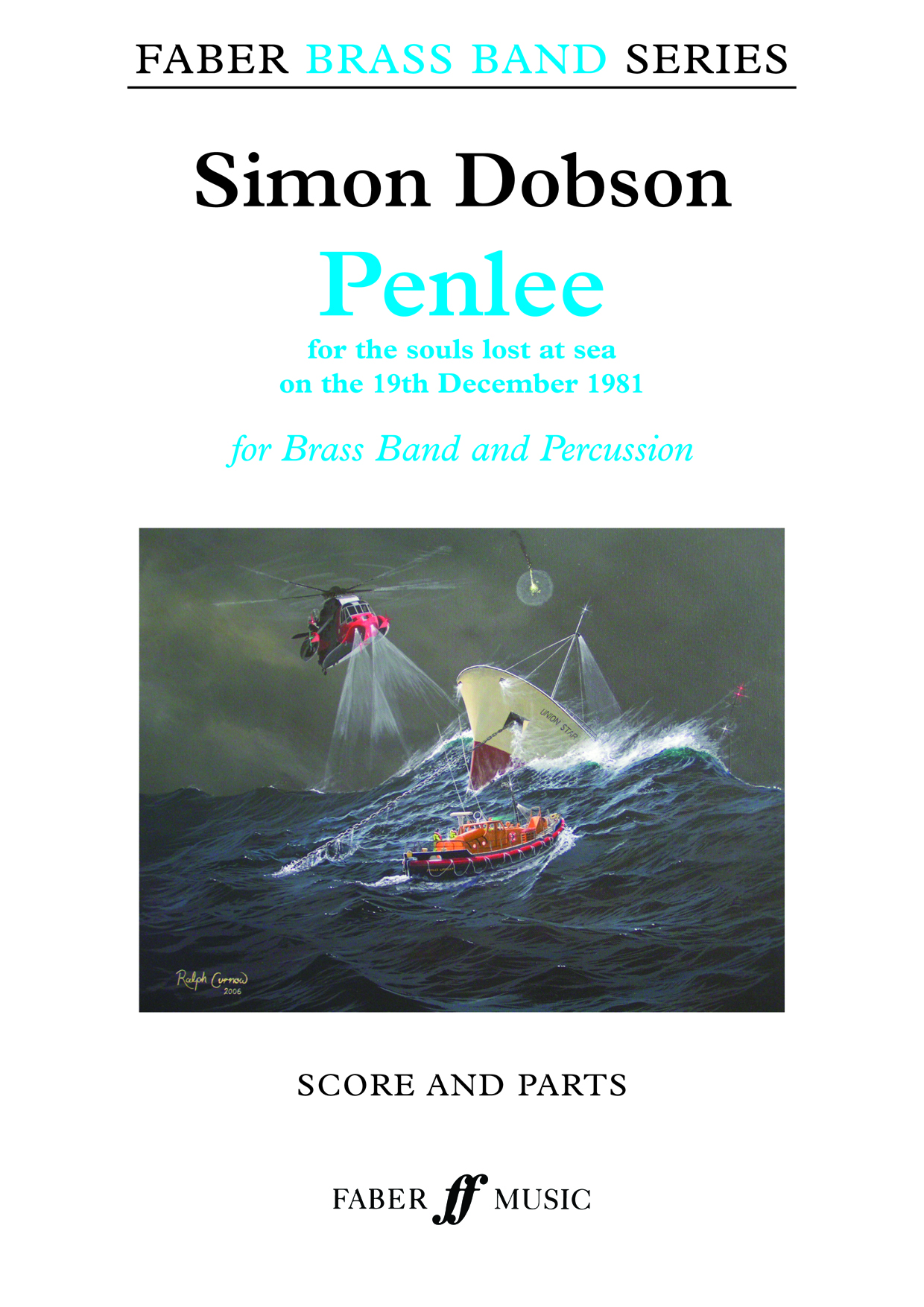
Penlee (Score & Parts) - Simon Dobson
To some, the tragic story of the Penlee lifeboat, Solomon Browne, would need no introduction, and to some the pain felt is still very much a reality. The composer, born just a few weeks before that fateful night on the 19th December 1981, has created this work as a musical homage to the bravery of the souls who lost their lives and has dedicated it to their memory.Penlee was commissioned by the Cornwall Youth Brass Band using funds bequeathed by Michael Pickett. The first performance was given by the Cornish Youth Brass Band, conducted by Ian Porthouse, at St. Michael's Church, Newquay, on 30th December 2008.Penlee has been voted into the Classic FM Hall of Fame 2011 at No.106. Not only is it the first time a brass work has been featured in the Hall of Fame, but it was also the highest new entry.The work has subsequently been recorded by the Leyland Band, conducted by Jason Katsikaris, on the CD entitled Penlee.Brass Band Grade 4: Advanced Youth and 3rd SectionDuration: 13 minutes
In Stock: Estimated dispatch 1-3 working days
-
 £29.95
El Torero - Jonathan Bates
DURATION: 4'00". DIFFICULTY: 3rd Section+. 'El Torero' was commissioned by the Elland Silver Youth Band for their appearance at the 2019 Brass in Concert Youth Championships, held at The Sage, Gateshead. 'Torero' is the generic term referring to any individual who takes part in bullfighting on foot, with this definition acting as an umbrella term for all ranks of Matador (whom often might sit on a horse for the fight). It also acts as the modern-day alternative to the popular 'Toreador', popularized by Bizet in his opera, 'Carmen'. . 'El Torero' paints every aspect of a bullfight, from the cautios and steady entrance into the bullring, the wild frenzy of the bullfight and ultimately the grandioso conclusion as the bull is slain and the Torero rises victorious. .
In Stock: Estimated dispatch 1-3 working days
-
 £29.95
Prayer to St Michael - Jonathan Bates
DURATION: 4'00". DIFFICULTY: Moderate. 'Prayer to Saint Michael' is a solo for Euphonium, composed for the Wantage Band and inspired by the life of a young Johann Sebastian Bach, who following the death of both parents by the age of only 10 moved to live with his older brother - Johann Christoph Bach - who was the church organist at St Michael's Church in Ohrdruf. It was in this church where Bach spent many hours studying and performing, being instructed by Johann Christoff on the clavichord. Within 6 years, the young Bach had been enrolled in the prestigious St Michael's School in Luneberg. . "St. Michael the Archangel, illustrious leader of the heavenly army, . defend us in the battle against principalities and powers, . against the rulers of the world of darkness and the spirit of wickedness in high places. Come to the rescue of mankind, . whom God has made in His own image and likeness, . and purchased from Satan's tyranny at so great a price. The Holy Church venerates you as her patron and guardian. The Lord has entrusted to you the task of leading the souls of the redeemed to heavenly blessedness. Entreat the Lord of peace to cast Satan down under our feet, . so as to keep him from further holding man captive and doing harm to the Church. Carry our prayers up to God's throne, . that the mercy of the Lord may quickly come and lay hold of the beast, . the serpent of old, Satan . and his demons, casting him in chains into the abyss, . so that he can no longer seduce the nations. Amen.". .
In Stock: Estimated dispatch 1-3 working days
-
£112.00
Diversity (Bra) - Yves Wuyts
Diversity is written for the royal fanfare band 'De Werkmanszonen' from Zichen-Bolder (Riemst) where Yves has been a conductor since 2005 and is dedicated to their chairman Sylvain Tans. The title 'Diversity' refers to the diversity of styles in the work but also to the diversity of a chairman. The work consists of three continuous movements. Part one starts with a fanfare motif that is later developed in a pop/rock and funky style. The second theme has a medieval character with a twist of the first theme. In the second movement we hear several lyrical solos. After the cadenza, the medieval theme returns but now in a more mysterious character. After this we come to the climax of this movement, which fades out into the third movement. The last movement has a resolute character where several previous motives and the opening theme are repeated to end with a dazzling finale!
Estimated dispatch 7-14 working days
-
£250.00
Continental Divide - Stig Nordhagen
The title is "Continental Divide" and it has nothing to do with tectonic plates, but is another word for "Watershed".It is the place where the the water flows in opposite directions. For example, when you drive up a mountain, the water flows downwards, the same does it when you drive down the other side. On top there is usually a water, and it is in this water, or musical idea if you like,that it is a continental divide. What I intend is that in this piece there are some musical motifs that change character and direction. They can be in the foreground and carry the play, or they may be in the background as a countermeasure. It can also be from horizontal lines to vertical.Or rhythmical patterns that dont find their match until far into the piece.
Estimated dispatch 7-14 working days
-
£103.00
Tornado - Fredrick Schjelderup
"Tornado" is based on sketches from the Royal Norwegian Naval Forces' Band (SFMK) Composer Workshop with composition students from The Grieg Aacademy in 2012. The working title of the piece, "Workshopping", reflects a young composer on "shopping" for new timbres and effects within the range of instruments and opportunities. The piece starts with a wind from afar (trills and tremolos) which then builds up in block harmony and various fragments that are processed across different keys and harmonies. Tension between chords and dissonances are then pressed up and develops the character and temperament. The title,Tornado, is selected on the basis of the energy and build up, something that can be translated with the weather phenomenon Tornado . Whirl- wind speed translates into the notation with fast tempo, tremolos and technical parts.
Estimated dispatch 7-14 working days
-
£59.95
MY STRENGTH, MY TOWER Rhapsodic Variations (Brass Band Set) - Dean Goffin
This music consists of a theme followed by five extensive variations. The theme is the composer's own tune set to the words, 'Thee will I love, my strength, my tower', a hymn by Johann Scheffler translated by John Wesley. A strong modal flavour is characteristic of the theme. Variation 1: This is a light and graceful variation with a good deal of imitative writing. It leads, without a break, into the next variation. Variation 2: Fire and ferocity are asked for in the course of this variation. Variation 3: This variation demonstrates the original approach of the composer. Solo lines for cornet and euphonium are included with their arabesques and arpeggii. Variation 4: Taking the form of a passacaglia, the 'ground' is given out at once by the basses. Fragments of the 'ground', plain or decorated, are combined and used in a number of ways, revealing the composer's mastery of counterpoint. Variation 5: The briskly moving and scintillating final variation abounds in sudden variations of dynamic. The tempo remains constant until an increase is called for in the coda. This 'contest' version has been prepared by Brian Bowen who was asked to re-work the percussion part and introduce a repiano cornet part (Salvation Army band publications do not, in general, have a part for repiano cornet).
Estimated dispatch 7-14 working days
-
 £32.95
Finale from Leading Edge (Brass Band - Score and Parts) - Wiffin, Rob
This finale from the suite Leading Edge is particularly well-suited to brass band. The drums lead into the energetic, dance-like theme that announces the Finale. Although the use of minor keys persists in this movement, the atmosphere is energetic and vivacious. A number of themes are considered before the flugelhorn introduces the theme that will go through a number of guises before emerging later in triumphant form in the whole band. The foregoing tension is banished and the music ends in a spirit of positive affirmation.Duration: 4.15
Estimated dispatch 7-14 working days
-
 £39.95
Liberty Trail (Brass Band - Score and Parts) - Bulla, Stephen
The Melbourne Staff Band celebrated its 125th anniversary in 2015 and this work was commissioned by Staff Bandmaster Ken Waterworth to feature in their programmes throughout the year.The music opens with fiery rhythmic figures, drawing on the band's technical brilliance. As the music progresses there are hits of traditional marches from early years, both in form and the minor key harmony used.The Trio section features The Homeward Trail, a song from the pen of Colonel Arthur Arnott, a Salvation Army officer who spent the majority of his career serving in Australia. The tune is then developed thematically and, following an interlude and key change, receives another treatment filled with fanfare and flourish that leads into the concluding moments of the work.Just prior to the closing bars, the music pays a brief homage to Australian composer Arthur Gullidge with a quote from his classic march Liberty, published in 1948, as a final salute to the great music that has come from this country.
Estimated dispatch 7-14 working days

 View Music