Results
-
 £10.00
Endurance
DescriptionMen wanted for hazardous journey. Small wages, bitter cold, long months of complete darkness, constant danger, safe return doubtful. Honour and recognition in case of success. - Ernest Shackleton, 4 Burlington StreetEndurance takes its title from the ship used by Sir Ernest Shackleton's Imperial Trans-Antarctic Expedition in 1914-15. After many months of fundraising (and reputedly running the above advert in The Times) the Endurance set sail from Plymouth on 6 August 1914. Whilst at sea news of the outbreak of war led Shackleton to put his ship and crew at the disposal of the Admiralty, but their services were not required and they were encouraged to continue. On October 26 1914 they left Grytviken on South Georgia for the Antarctic continent, hoping to find the pack ice shrinking in the Antarctic spring. Two days later, however, they encountered unseasonable ice which slowed their progress considerably. On 15 January 1915, when Endurance was only 200 miles from her intended landfall at Vahsel Bay, the ship became beset by ice which had been compressed against the land to the south by gale force winds. Trapped in the ice of the Weddell Sea, the ship spent the Antarctic winter driven by the weather further from her intended destination until, on 21 November 1915 Endurance broke up forcing the crew to abandon ship and set up camp on the ice at a site they named "Patience Camp".The crew spent several weeks on the ice. As the southern spring started to reduce the extent of the ice shelf they took to their three lifeboats, sailing across the open ocean to reach the desolate and uninhabited Elephant Island. There they used two of the boats to build a makeshift shelter while Shackleton and five others took the largest boat, an open lifeboat named the 'James Caird' and sailed it for 800 terrifyingly dangerous miles across the vast and lonely Southern Atlantic to South Georgia - a journey now widely regarded as one of the greatest and most heroic small-boat journeys ever undertaken. After landing on the wrong side of the island and having to climb over a mountain range in the dark with no map, Shackleton and his companions finally stumbled back into the Grytviken whaling station on 19 May 1916.After resting very briefly to recover his strength, Shackleton then began a relentless campaign to beg or borrow a ship to rescue the rest of his crew from Elephant Island; whaling ships were not strong enough to enter polar ice, but on 30 August 1916, over two years after their departure from Plymouth, Shackleton finally returned to Elephant Island aboard a steam tug borrowed from the Chilean government. Although some were in poor health, every member of the Endurance crew was rescued and returned home alive.Endurance is dedicated to the memory of my mum, who passed away in September 2017.Listen to a computer generated preview and follow the score below:
Estimated dispatch 7-14 working days
-
 £59.95
Bonnie Northumbria - Brass Band - LM786
COMPOSER: Laurie JohnstonProgramme NotesNorthumberland, or Northumbria as it is also known, is the most northern county in England and has magnificent and stunning landscapes just waiting to be explored. Filled with mystical castles, atmospheric ruins and historical sites and edged by spectacular coastal scenery, there is something wonderful to see at every turn. The Devils Causeway passes through Northumbria and reaches Berwick upon Tweed at the coast. Walkers and cyclists can also take the Coast and Castles Cycle Route or the North Sea Trail which journey through some of the most beautiful scenery along the way.The Blaydon Races is aGeordiefolk songwritten in the 19th century byGeordie Ridley, in a style deriving frommusic hall. It is regarded by many as the unofficialanthemofTynesideand is frequentlysungby supporters ofNewcastle United Football ClubandNewcastle Falconsrugby club.Blaydonis a small town inGateshead, situated about 4 miles (6.4km) fromNewcastle upon Tyne, inNorth East England. The race used to take place on the Stella Haugh 1 mile (1.6km) west of Blaydon.Stella South Power Station(demolished in 1995) was built on the site of the track in the early 1950s, after the races had stopped taking place in 1916.Water of Tyne (sometimes rendered as The Waters of Tyne) is a folk song (Roud number1364) from the north-east of England. The song is sung by a girl or woman lamenting the fact that her paramour is on the opposite bank of theRiver Tyne. Sleeve notes to Michael Hunt's recording of Tyneside songs states that "the ferry is believed to be that atHaughton Castleon theNorth Tyne". Alternatively the "rough river" in the last line may indicate a point further downstream, possiblyTynemouth.The song was collected byJohn Bellin 1810 and published two years later inRhymes of Northern Bards.The Keel Row is a traditional Tyneside folk song evoking the life and work of thekeelmenofNewcastle upon Tyne. A closely related song was first published in aScottishcollection of the 1770s, but may be considerably older, and it is unclear whether the tune is Scottish or English in origin.The opening lines of the song set it inSandgate, that part of the quayside overlooking the River Tyne to the east of the city centre where the keelmen lived and which is still overlooked by theKeelmen's Hospital.Versions of the song appear in both England and Scotland, with Scottish versions referring tothe Canongaterather than Sandgate. The earliest printing was in the 1770s inEdinburghin A Collection of Favourite Scots Tunes, edited by Charles Maclean, though the tune was also found in several late eighteenth-century English manuscript collections. As the term "keel" was used both sides of the border, it has not been determined which version was the original, althoughFrank Kidsonsurmised that like many other songs collected by Maclean it may originally have been aJacobiteair from the time of the1745 rebellion. Some versions of the song make reference to a "blue bonnet[...] with a snowy rose upon it", a clear attempt to evoke Jacobite symbolism, whether dating from 1745 or not.Kidson, however, also noted that he had found the tune of The Keel Row associated with an early dance called "The Yorkshire Lad" as early as 1748.By the 19th century the tune was well associated with the River Tyne; a few years before the 1850s the keelmen had met yearly to celebrate the founding of the Keelmen's Hospital, perambulating the town to the accompaniment of bands playing The Keel Row.Dance To Thy Daddyis a traditional Englishfolksong, originating inNorth East England. An early source for the lyrics, Joseph Robson's "Songs of the bards of the Tyne", published 1849, can be found on the Farne archive. In Farne's notes to the song, it is stated that these lyrics were written by William Watson around 1826.
In Stock: Estimated dispatch 3-5 working days
-
 £30.00
Amazing Grace (W. Walker arr. by Paul Pennicotte-Henrie) - Brass Band Sheet Music Full Score and Parts - LM642
COMPOSER: W. WalkerARRANGER: Paul Pennicotte-Henrie"Amazing Grace" is a Christian hymn published in 1779 by English Anglican clergyman, abolitionist, and poet John Newton. It is possibly the most sung and most recorded hymn in the world and is especially popular in the United States, where it is used for both religious and secular purposes. Newton wrote the words from personal experience; he grew up without any particular religious conviction, but his life's path was formed by a variety of twists and coincidences that were often put into motion by others' reactions to what they took as his recalcitrant insubordination. He was pressed into service with the Royal Navy, and after leaving the service, he became involved in the Atlantic slave trade.In 1748, a violent storm battered his vessel off the coast of County Donegal, Ireland, so severely that he called out to God for mercy. While this moment marked his spiritual conversion, he continued slave trading until 1754 or 1755, when he ended his seafaring altogether. Newton began studying Christian theology and later became an abolitionist.Ordained in the Church of England in 1764, Newton became the curate of Olney, Buckinghamshire, where he began to write hymns with poet William Cowper. "Amazing Grace" was written to illustrate a sermon on New Year's Day of 1773. It is unknown if there was any music accompanying the verses; it may have been chanted by the congregation. It debuted in print in 1779 in Newton's and Cowper's Olney Hymns, but settled into relative obscurity in England. In the United States, "Amazing Grace" became a popular song used by Baptist and Methodist preachers as part of their evangelizing, especially in the American South, during the Second Great Awakening of the early 19th century. It has been associated with more than 20 melodies. In 1835, American composer William Walker set it to the tune known as "New Britain" in a shape note format; this is the version most frequently sung today.
In Stock: Estimated dispatch 3-5 working days
-
£158.00
Banderole - Hakon Berge
Hakon Berge (born 22 April 1954 in Stavanger) is a Norwegian composer, conductor, arranger and music administrator, resident in Oslo. He studied at the Rogaland Conservatoire and at the Norwegian State Academy of Music.Berge has composed music for theatrical productions in venues such as the Rogaland Theatre, The National Theater in Bergen and the National Theatre in Oslo. He is also experienced in television production and was responsible for televised opera Gagarin - A Space Travel Opera(1991). He has composed a considerable number of commissions, including the music for the opening of the Alexandria Library, music for the opening of the Nobel Peace Centre in Oslo, and the test piece Brass Blot (for the European Brass Band Championships in Stavanger in 2008, in which Cory Band from South Wales won the first prize.Berge has also written the music to the documentary musical Byterminalen, also described as a rock opera, which was premiered in May 2008 in connection with the celebration of Stavanger as European City of Culture.Hakon Berge has held a number of offices in the musical life of Norway: he has been chairman both of the Norwegian Society of Composers and of TONO, the Norwegian performing rights organization.
Publisher Closed for Holidays. Est Delivery 13-14th Aug
-
 £40.00
Losgaintir. For solo Baritone/Euphonium and brass band
Recommended - Championship to 2nd Section Written for Katrina Marzella and the Black Dyke band, Losgaintir (or Luskentyre in English) is one of my favourite places in Scotland. Losgaintir is on the west coast of the isle of Harris in the Outer Hebrides and has an outstanding beach widely regarded as one of the most beautiful in the world. Losgaintir is a wonderful place to be on warm sunny days with its long stretch of white sands, aqua marine seas, the incredible mountain backdrop of south Lewis and the uninhabited island of Taransaigh in view. The weather in Harris is notorious for changing very quickly and this piece tries to reflect this. Although idyllic on a calm, sunny days, on stormy days Losgaintir's character becomes dark and foreboding, with low dark clouds and sweeping winds from the Atlantic creating a dark, brooding atmosphere. The opening melody (written modally like a traditional Scottish Gaelic air) depicts the calm serenity of Losgaintir on a beautiful summer's day. The character of the fast section that follows portrays winter in Losgaintir during a tempestuous storm with bracing winds. Includes score & parts Also see: Losgaintir for Solo Baritone/Euphonium & Piano
-
 £40.00
Legends of Cyfarthfa - Matthew Hall
Legends of CyfarthfaCombining the music of Joseph Parry and the legendary Cyfarthfa Band, Legends of Cyfarthfa is a technically challenging but musically rewarding concert work. Robert Crawshay owned the Cyfarthfa Ironworks in South Wales creating a business empire second to none.Cyfarthfa Castle was built by Crawshay as the family home from the income made via the ironworks. He wanted his own private band to play under the name of the ironworks with the best players in the world, playing on the highest quality instruments at the time. Employing the band members under the guise of iron workers, the Cyfarthfa Band was made up of virtuoso players, performing for the pleasure of the Crawshay dynasty.This virtuosity can be heard in some of the more technically challenging sections of Legends of Cyfarthfa. Joseph Parry was born in Cyfarthfa.He composed the first piece of music specifically written for brass band called Tydfil Overture for the Cyfarthfa Band, alongside many other memorable works for other instrumentation.Legends of Cyfarthfa incorporates many of Parry's works including his opera Blodwen, hymn tune Aberystwyth, folk melody Myfanwy and the Tydfil Overture, alongside many other melodies from Wales. Sospanfach, Men of Harlech, Lisa Lan and Calon Lan are just a number of the melodies that are used in this composition.The premiere performance was given by Tredegar Town Band under the direction of Ian Porthouse at the 2010 Brass in Concert Championships where it was awarded the Cyril Beere Memorial Trophy for Best New Composition or Arrangement.https://matthew-hall.co.uk/wp-content/uploads/2014/08/05-Legends-Of-Cyfarthfa.mp3Legends of Cyfarthfa
Estimated dispatch 5-7 working days
-
 £38.95
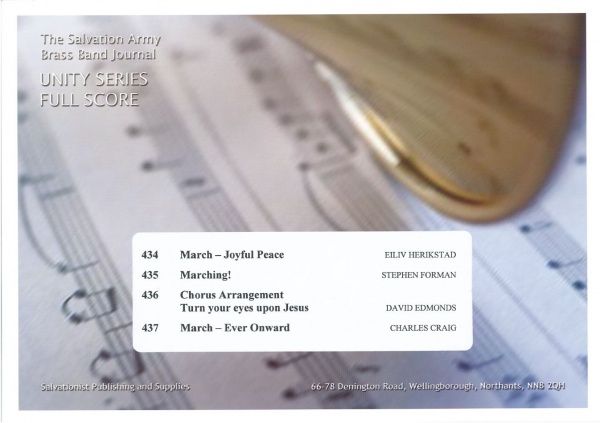
Unity Series Band Journal October 2015 Number 434 - 437
No. 434 March - Joyful Peace (Eiliv Herikstad)This march will pose few technical difficulties to most Unity Series bands. Keep the playing light and distinct throughout. Although the music is simple, please warn against carelessness!No. 435 Marching! (Stephen Forman)This bright energetic work from Major Stephen Forman features the well-known song 'We are marching' as its main theme. This South African song, called 'Siyahamba' in the original Zulu language, became popular in North American churches in the 1990s and soon spread internationally becoming a much featured song within many churches.No. 436 Chorus Arrangement - Turn your eyes upon Jesus (David Edmonds)A very simple, yet effective arrangement of this much-loved chorus, the words of which simply say:Turn your eyes upon Jesus,Look full in his wonderful face;And the things of earth will grow strangely dimIn the light of his glory and graceNo. 437 March - Ever Onward (Charles Craig)The Devonshire Corps of Tiverton celebrated its 140th birthday in 2014. Although small in number, it is highly regarded and respected for its Christian witness and work throughout the community.The march is written in a traditional style and should present no difficulties to the average band.
Estimated dispatch 7-14 working days
-
£225.00
Prillar&Halling - for Solo Clarinet and Wind Band - Stig Nordhagen
"Prillar" has it's origin from Norwegian folklorist music. It's a way of calling and singing the cattle home from the fields. Halling is a wellknown folk dance from the valleys in the eastern part of Norway.In this work, the clarinet use the prillar to get the other musicians to join in.The melodic material in Prillar and Halling hasn't got all the sound of Norwegian folklore exclusively. You can also hear folkloric music from other nations. The idea is to show the similarities between these and also the small differences there are between folkloristic elements from a large area. The piece also contains the folk tune "Adam in paradise", from south of Norway. At the end, the tunes are stacked on top of each other, and the similarities of origin turns out.- Stig Nordhagen -
Publisher Closed for Holidays. Est Delivery 13-14th Aug
-
 £38.95
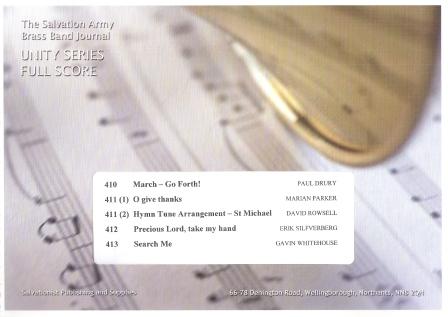
Unity Series Band Journal October 2013 Numbers 410 - 413
No. 410 March - Go Forth! (Paul Drury)This march was written as a tribute to Bandmaster Jack Spowart and the Bo'ness Salvation Army Band. The composer lives in the twon of Bo'ness and has had numerous opportunities to share with the band and the wider corps at various events. This march serves as recognition of the faithful service given in the Lord's name in the town by The Salvation Army for over 100 years. Two tunes are featured, both well-known and instantly recognisable, namely, Forward! be our watchword and We're marching on.No.411 (1) O give thanks (Marian Parker)The composer, Marian Parker, is a new contributor and is the Recruiting Sergeant at Leicester South Corps. This simple, yet rhythmic piece should not pose any technical problems for most bands and features the attractive arrangement of Joanne Pond's contemporary song, 'O give thanks'.No.411 (2) Hymn Tune Arrangement - St Michael (David Rowsell)The hymn tune 'St Michael' was composed in 1551 by French composer Louis Bourgeois and the composer provides a very useful arrangement of this historic hymn.No. 412 Precious Lord, take my hand (Erik Silfverberg O.F.)This well-known Gospel Song is a favourite of many. It has been recorded by many great artists, including Rosetta Tharpe, Elvis Presley and Aretha Franklin. The words were written by Reverend Thomas A. Dorsey, who is often known as the 'Father of Gospel song'.No. 413 Search Me (Gavin Whitehouse)The second new contributor to this journal is Gavin Whitehouse. gavin is the Assistant Music Director for the Greater New York Division and is also the USA Eastern Territorial Songster Leader. This piece combines two songs - one old and one new - which speak of a God who knows us intimately. 'Search me, O God and know my heart today' (associated with the beautiful Maori melody, 'Now is the hour') is woven with a contemporary setting of Psalm 139 by Rebecca St James, the first line of which says, 'You searchme, you know me'.
Estimated dispatch 7-14 working days
-
£125.00
New London Pictures - Nigel Hess
New London Pictures represents elements of London in the 21st Century. The Millennium Bridge describes the pedestrian's journey across this wonderful new landmark bridge over the Thames, starting at the imposing Tate Modern, crossing the busy river, and onwards to St. Paul's Cathedral with its bells ringing out over the great city. London Eye is an incredibly large ferris wheel situated on the South Bank of the River Thames. This movement depicts a 'flight' on this riverside wheel, at the top of which the panoramic view of London is breath-taking and the expanse of the music is a suitable depiction of the view. As with all modern cities, London is over-crowded with motor vehicles. London is the first major city in Europe to adopt a Congestion Charge, and this piece (with its stop and go traffic lights) is both racy and comical. Here are Londoners attempting to go about their business in the face of overwhelming odds.....Brass Band Grades 4/5: Premier Youth and 2nd SectionDuration: 15 minutes
In Stock: Estimated dispatch 1-3 working days