
Results
-
 £69.99
Tribute to Whitney Houston - Christopher Bond
It has been ten years since the American pop singer Whitney Houston passed away, but the world has not forgotten her beautiful voice. Her timeless hits - from ballads to wonderful dance tracks - are still heard on the radio. This attractive medley includes some of her greatest successes: 'How Will I Know', 'Saving All My Love for You', 'I Wanna Dance with Somebody', and 'I Will Always Love You'.
Estimated dispatch 10-14 working days
-
 £30.00
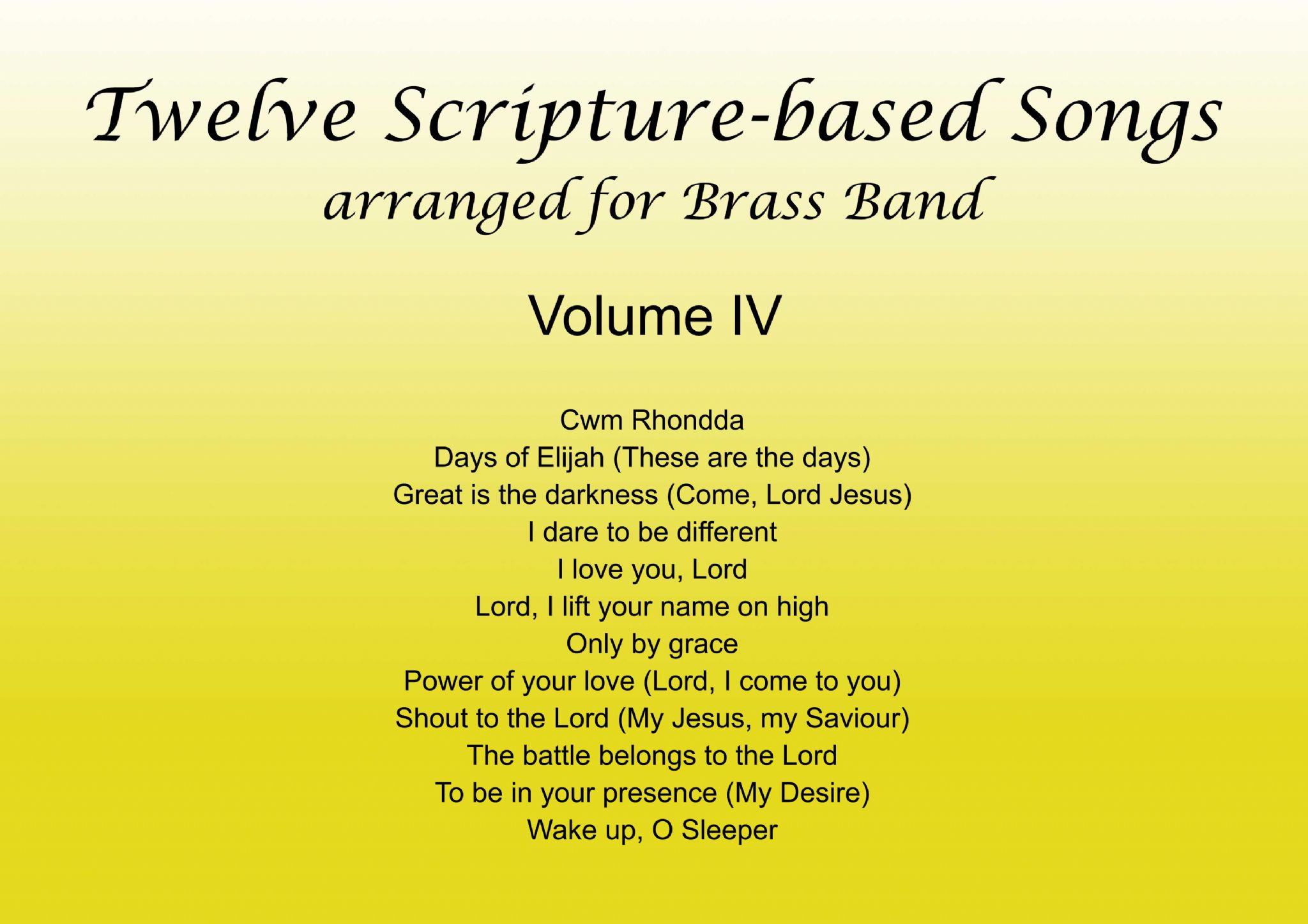
Twelve Scripture-Based Songs Volume IV
Twelve scripture-Based Songs arranged for Brass Band (Volume IV) are packaged and marketed in complete sets which include a full score and a set of master parts. It is intended that these parts be used as 'masters', for the purpose of photocopying a quantity of parts to accommodate the precise instrumentation needs of the band for which this has been purchased.Cwm RhonddaDays of Elijah (These are the days)Great is the darkness (Come, Lord Jesus)I dare to be differentI love you, LordLord, I lift your name on highOnly by gracePower of your love (Lord, I come to you)Shout to the Lord (My Jesus, my Saviour)The battle belongs to the LordTo be in your presence (My Desire)Wake up, O Sleeper
Estimated dispatch 7-14 working days
-
£13.00
Gilbert and Sullivan Melodies - Gilbert & Sullivan - Stephens, D
Sorry Her Lot; Poor Wandering One; I Built Upon A Rock; I Cannot Tell What; Take A Pair of Sparkling Eyes; Silvered Is The Raven Hair; The Sun Whose Rays; Were I Thy Bride; In Bygone Days; Prithee Pretty Maiden and True Love; Love Is A Plaintive Song; Oh Goddess Wise
In Stock: Estimated dispatch 1-3 working days
-
 £30.00
My Little Welsh Home - Traditional
A beautiful arrangement by Tim Paton of a Welsh song by W S Gwynne Williams. Created in memory of his mother, Tim has produced a wonderful version for brass band and has also included an optional vocal solo or unison choir line.Comments from the arranger:I have arranged [My Little Welsh Home] in memory of my mother. [She] was born, Doreen Davies, on 27th November 1918, in Haverfordwest, Pembrokeshire, a small town in South West Wales. She had a beautiful voice, and met my father, Bill Paton, during World War II, whilst she was singing in a troop concert at the County Theatre in her home town, and my father was the MC.Throughout her life, my mother and father entertained, and she was singing right up until the final months of her life. She spent many years in Weston-super-Mare, Somerset, a seaside town in South West England, and it was here that she passed away on 20th September 2004. During the last several months of her life, she often referred to the song My Little Welsh Home:Here are the words.I am dreaming of the mountains of my homeOf the mountains where in childhood I would roamI have dwelt 'neath southern skiesWhere the summer never diesBut my heart is in the mountains of my homeI can see the little homestead on the hillI can hear the magic music of the RhyllThere is nothing to compareWith the love that once was thereIn the lonely little homestead on the hillI can see the quiet churchyard down belowWhere the mountain breezes wander to and froAnd when God my soul will keepIt is there I want to sleepWith those dear old folks that loved me long agoLooking at the words, I can see why it meant so much to her. Haverfordwest is at the foot of the Preseli Mountains, and her home and church were at the top of a hill. My mothers' ashes were taken back to her own little Welsh home, and laid to rest in the grounds of the church where she had been Christened, Confirmed and Married.Look and Listen (Score-reading digital sound-sample):
In Stock: Estimated dispatch 3-5 working days
-
 £189.95
'The New Christmas Collection' - Full Set March Card Size
The new Christmas Collection carol books contain all the traditional Christmas Carols, with some new 'pop' music arrangements included to add more variety to your carolling this year.
* Note, these are not compatible with the New Christmas Praise books.
Full list of works in The Christmas Collection:-
• A child this day is born
Estimated dispatch 7-14 working days
• A Christmas lullaby
• A great and mighty wonder
• All I want for Christmas is you
• All my heart this night rejoices
• Angels, from the realms of Glory (Come and worship)
• Angels, from the realms of Glory (Iris)
• Angels we have heard on high
• A starry night
• As with gladness men of old
• Auld lang syne
• A virgin most pure
• Away in a manger (The manger scene)
• Away in a manger (Traditional)
• A winter’s tale
• Bethlehem
• Brightest and best (Spean)
• Brightest and best (Traditional)
• Calypso Carol
• Carol for the Nativity
• Carol of the bells
• Carol of the drum
• Child of Mary
• Christians Awake!
• Christ is born (Il est né)
• Christ was born on Christmas Day
• Come and join the celebration
• Come, children, come quickly
• Coventry Carol
• Deck the hall
• Ding dong! merrily on high
• Do you hear what I hear?
• Frosty the snowman
• Gabriel’s Message
• Gaudete
• Glory in the highest
• Glory in the highest Heaven
• God of God, the uncreated
• God rest you merry, gentlemen
• Good Christian men, rejoice
• Good King Wenceslas
• Go, tell it on the mountain!
• Happy Christmas (War is over)
• Hark the glad sound!
• Hark! the herald angels sing
• Have yourself a merry little Christmas
• Here we come a-wassailing
• How far is it to Bethlehem?
• Huron Carol
• Infant Holy
• In the bleak midwinter (Cranham)
• In the bleak midwinter (Darke)
• I saw mommy kissing Santa Claus
• I saw three ships come sailing in
• It came upon a midnight clear (Traditional)
• It came upon a midnight clear (Willis)
• It’s beginning to look a lot like Christmas
• It’s the most wonderful time of the year
• I wish it could be Christmas everyday
• I wonder as I wander
• Jesus, good above all other
• Jingle Bells
• Jingle bell rock
• Joy to the world!
• Last Christmas
• Let it snow!
• Little baby Jesus
• Little children, wake and listen
• Little Donkey
• Little Jesus, sweetly sleep
• Lo! he comes with clouds descending
• Long, long ago
• Love came down at Christmas
• Mary’s boy child
• Mary’s Child
• Masters in this hall
• Merry Christmas everyone
• Mistletoe and wine
• Noel
• O Christmas tree
• O come, all ye faithful
• O come, Immanuel
• O Heaven-sent King
• O holy night!
• O little town of Bethlehem (Christmas Carol)
• O little town of Bethlehem (Forest Green)
• O little town of Bethlehem (St Louis)
• Once in royal David’s city
• Past three o’clock
• Patapan
• Personent Hodie
• Praise ye the Lord
• Ring the bells
• Rise up, shepherd!
• Rockin’ around the Christmas tree
• Rudolph, the red-nosed reindeer
• Sans day carol
• Santa Claus is comin’ to town
• Saviour’s Day
• See, amid the winter’s snow
• Silent Night!
• Sleigh Ride
• Softly the night is sleeping
• So here it is, merry Christmas
• Stars are shining
• Still, still, still
• Stop the cavalry
• Sussex Carol
• Sweet chiming bells
• Sweet chiming Christmas bells
• The candle song
• The cherry tree carol
• The Christmas song
• The first Nowell
• The holly and the ivy
• The infant King
• The light has come
• The shepherds’ farewell
• The stable door
• The star in the east
• The twelve days of Christmas
• The virgin Mary had a baby boy
• They all were looking for a king
• Thou didst leave thy throne
• Three kings’ march
• Unto us a boy is born
• Walking in the air
• We gather round the manger-bed
• We three kings of Orient are
• We wish you a merry Christmas
• What child is this?
• When a child is born
• When Santa got stuck up the chimney
• Whence is that goodly fragrance flowing?
• When wise men came seeking
• While shepherds watched (Cranbrook)
• While shepherds watched (Handel)
• While shepherds watched (Winchester Old)
• White Christmas
• Who is he?
• Winter Wonderland
• Worldwide Christmas message
• Zither Carol
• A starry night
• Christmas Joy
• Christmas Praise
• Coventry Carol
• Infant Holy
• Mid-winter
• Rudolph, the red-nosed reindeer
• The everlasting light
• To celebrate his birth
• Yuletide Rag
-
 £38.95
Unity Series Band Journal - Numbers 546 - 549, October 2025
546: Tell that story! (Martin Cordner)A joyful and engaging arrangement combining the songs Blessd assurance and Tell me the stories of Jesus, celebrating the personal testimony of faith in Christ.547: This love I know (Dale Pittock)A reflective and harmonically rich setting of the classic hymn Jesus loves me! This I know, capturing the enduring message of Christ's love through close textures and lyrical phrasing.548: There's no one like Jesus (Douglas Engle)Inspired by mission experiences in Malawi, this energetic piece reflects global worship traditions with rhythmic vibrancy and a clear declaration of Christ's uniqueness.549: Thank you, Lord (Andrew Mackereth)Based on a beloved gospel chorus, this expressive tribute conveys heartfelt gratitude and testimony, supported by warm harmonies and a simple, sincere melodic line.
Estimated dispatch 7-14 working days
-
 £38.95
Unity Series Band Journal - Numbers 490 - 493, February 2021
490: March - Resounding Praise (David Rowsell)This march features the chorus God is so good and the song Praise him! Praise him! Jesus our blessd Redeemer (S.A.S.B. 231)491: I want to live right (arr. Simon Gash)A fun setting of this popular song, the chorus I want to live right originally derives from a West Indian melody.492: Remember God is love (Ruben Schmidt)An uplifting arrangement of the Sunday School chorus When you see a rainbow, remember God is love, based on the English folk song Early One Morning.493: March - Temple 1 (Wycliffe Kortin)Featuring the songs They'll sing a welcome home (S.A.S.B. 534) and Christ the Lord is risen today (S.A.S.B. 218), this march was written for the Nairobi Central Corps' inauguration as a Temple, making it the first Salvation Army Temple in East Africa.
Estimated dispatch 7-14 working days
-
£69.95
TRANSFORMATION (Brass Band Set) - Kenneth Downie
I believe in transformation, God can change the hearts of men, And refine the evil nature, till it glows with grace again'. So wrote John Gowans in the second verse of his great hymn, 'I believe that God the Father, can be seen in God the Son', written specifically to affirm Salvationists' beliefs. It is sung to the tune Bethany and in seeking to explore this great subject at the heart of the Christian gospel in musical terms, the composer has used this fine tune as the basis. Although it never appears in its entirety, it is seldom out of the picture and much of the work is derived from it. The other main source of material is the lovely, simple chorus, 'Some day I shall be like him, changed to heavenly beauty, when his face I see'. This chorus is especially prominent in the middle section but there are important references to it throughout. There are also brief references to Charles Wesley's hymn, 'Love Divine' and, in particular, the telling lines, 'Changed from glory into glory, till in Heaven we take our place'. The work suggests that, at times, the process of being transformed is a struggle, portrayed with many passages of fraught and demanding music. Considerable reserves of stamina and technique are required while, in contrast, the chorus, 'Some day I shall be like him' provides the warm, gentle centre of the work. The premiere of the work was given by The International Staff Band of The Salvation Army in Cadogan Hall on Friday 3rd June 2011, as part of the band's 120th anniversary celebrations.
Estimated dispatch 7-14 working days
-
£90.00
Fragile Oasis - Peter Meechan
Fragile Oasis is the name of a collective who describe themselves as aaa grass-roots participatory initiative that connects the shared perspective of astronauts from different countries and cultures with people on Earth, encouraging all to work together so that our planet is not only visibly beautiful, but beautiful for alla.Many involved in the project are astronauts on the International Space Station (I.S.S.), who post, on their website (http://www.fragileoasis.org) many different details of their experiments, photos from space, and some incredible video footage of our Earth.One such time lapse video (a video made up many still images) was posted on their website by astronaut Ron Garan (http://www.fragileoasis.org/blog/2011/11/coming-back-down-to-our-fragile-oasis-2/) in 2011. It is made up of images taken from the I.S.S. of what Garan described as aaa couple of laps around our Fragile Oasis before coming back down [to Earth]a and features all kinds of amazing views from space.Each of the five sections of this work relate to an aspect of the video - either something literal or something more metaphorical. The opening section, i: The lights from Above, is a musical description of the view of the Aurora Australis from above the lights. The second section, ii: The Storm from Above (part i), is also a musical portrayal of portions of the video clip - in this case the many lightning storms we see from above. The storms that are so powerful on Earth appear as small bolts of electricity dancing through the clouds.The third section, iii: Freya, has its roots in personal family tragedy. The name Freya derives from a Norse goddess who was associated with both beauty and love, and in this central section I wanted to write music that not only acknowledged how fragile life itself is, but that every day of it counts and should be celebrated.iv: The Storm from Above (part ii) is a again a reference to the lightning storms, but also to the huge hurricanes we see in the video. It leads us to the final section, v: The Oasis from Above - a description of the size and grandeur of Earth, our Fragile Oasis.Fragile Oasis was commissioned by Leyland Brass Band and Michael Bach, and partly funded by The John Golland Trust, for their appearance at the 2013 European Brass Band Championships in Oslo, Norway. It is dedicated to Natalie Youson, in friendship
Estimated dispatch 12-14 working days
-
 £69.95
Transformation (Brass Band - Score and Parts)
I believe in transformation, God can change the hearts of men, And refine the evil nature, till it glows with grace again'. So wrote John Gowans in the second verse of his great hymn, 'I believe that God the Father, can be seen in God the Son', written specifically to affirm Salvationists' beliefs. It is sung to the tune Bethany and in seeking to explore this great subject at the heart of the Christian gospel in musical terms, the composer has used this fine tune as the basis. Although it never appears in its entirety, it is seldom out of the picture and much of the work is derived from it. The other main source of material is the lovely, simple chorus, 'Some day I shall be like him, changed to heavenly beauty, when his face I see'. This chorus is especially prominent in the middle section but there are important references to it throughout. There are also brief references to Charles Wesley's hymn, 'Love Divine' and, in particular, the telling lines, 'Changed from glory into glory, till in Heaven we take our place'. The work suggests that, at times, the process of being transformed is a struggle, portrayed with many passages of fraught and demanding music. Considerable reserves of stamina and technique are required while, in contrast, the chorus, 'Some day I shall be like him' provides the warm, gentle centre of the work. The premiere of the work was given by The International Staff Band of The Salvation Army in Cadogan Hall on Friday 3rd June 2011, as part of the band's 120th anniversary celebrations.
Estimated dispatch 7-14 working days
 View Music