
Results
-
 £15.00
Harrison's Dream (Brass Band - Study Score) - Graham, Peter
At 8.00pm on the 22nd of October 1707, the Association, flagship of the Royal Navy, struck rocks off the Scilly Isles with the loss of the entire crew. Throughout the rest of the evening the remaining three ships in the fleet suffered the same fate. Only 26 of the original 1,647 crew members survived. This disaster was a direct result of an inability to calculate longitude, the most pressing scientific problem of the time. It pushed the longitude question to the forefront of the national consciousness and precipitated the Longitude Act. Parliament funded a prize of �20,000 to anyone whose method or device would solve the dilemma.For carpenter and self-taught clockmaker John Harrison, this was the beginning of a 40 year obsession. To calculate longitude it is necessary to know the time aboard ship and at the home port or place of known longitude, at precisely the same moment. Harrison's dream was to build a clock so accurate that this calculation could be made, an audacious feat of engineering.This work reflects on aspects of this epic tale, brilliantly brought to life in Dava Sobel's book Longitude. Much of the music is mechanistic in tone and is constructed along precise mathematical and metrical lines. The heart of the work however is human - the attraction of the �20,000 prize is often cited as Harrison's motivation. However, the realisation that countless lives depended on a solution was one which haunted Harrison. The emotional core of the music reflects on this, and in particular the evening of 22ndOctober 1707.- Peter GrahamJuly 2000 Recorded on Polyphonic QPRL219D Master Brass (Volume Fifteen). Duration: 14'30"
Estimated dispatch 7-14 working days
-
 £119.95
Harrison's Dream (Brass Band - Score and Parts) - Graham, Peter
At 8.00pm on the 22nd of October 1707, the Association, flagship of the Royal Navy, struck rocks off the Scilly Isles with the loss of the entire crew. Throughout the rest of the evening the remaining three ships in the fleet suffered the same fate. Only 26 of the original 1,647 crew members survived. This disaster was a direct result of an inability to calculate longitude, the most pressing scientific problem of the time. It pushed the longitude question to the forefront of the national consciousness and precipitated the Longitude Act. Parliament funded a prize of �20,000 to anyone whose method or device would solve the dilemma.For carpenter and self-taught clockmaker John Harrison, this was the beginning of a 40 year obsession. To calculate longitude it is necessary to know the time aboard ship and at the home port or place of known longitude, at precisely the same moment. Harrison's dream was to build a clock so accurate that this calculation could be made, an audacious feat of engineering.This work reflects on aspects of this epic tale, brilliantly brought to life in Dava Sobel's book Longitude. Much of the music is mechanistic in tone and is constructed along precise mathematical and metrical lines. The heart of the work however is human - the attraction of the �20,000 prize is often cited as Harrison's motivation. However, the realisation that countless lives depended on a solution was one which haunted Harrison. The emotional core of the music reflects on this, and in particular the evening of 22ndOctober 1707.- Peter GrahamJuly 2000 Recorded on Polyphonic QPRL219D Master Brass (Volume Fifteen). Duration: 14'30"
Estimated dispatch 7-14 working days
-
£44.95
Harrison's Dream (Brass Band - Score only) - Graham, Peter
At 8.00pm on the 22nd of October 1707, the Association, flagship of the Royal Navy, struck rocks off the Scilly Isles with the loss of the entire crew. Throughout the rest of the evening the remaining three ships in the fleet suffered the same fate. Only 26 of the original 1,647 crew members survived. This disaster was a direct result of an inability to calculate longitude, the most pressing scientific problem of the time. It pushed the longitude question to the forefront of the national consciousness and precipitated the Longitude Act. Parliament funded a prize of �20,000 to anyone whose method or device would solve the dilemma.For carpenter and self-taught clockmaker John Harrison, this was the beginning of a 40 year obsession. To calculate longitude it is necessary to know the time aboard ship and at the home port or place of known longitude, at precisely the same moment. Harrison's dream was to build a clock so accurate that this calculation could be made, an audacious feat of engineering.This work reflects on aspects of this epic tale, brilliantly brought to life in Dava Sobel's book Longitude. Much of the music is mechanistic in tone and is constructed along precise mathematical and metrical lines. The heart of the work however is human - the attraction of the �20,000 prize is often cited as Harrison's motivation. However, the realisation that countless lives depended on a solution was one which haunted Harrison. The emotional core of the music reflects on this, and in particular the evening of 22ndOctober 1707.- Peter GrahamJuly 2000 Recorded on Polyphonic QPRL219D Master Brass (Volume Fifteen). Duration: 14'30"
Estimated dispatch 7-14 working days
-
 £69.95
Transformation (Brass Band - Score and Parts) - Downie, Kenneth
I believe in transformation, God can change the hearts of men, And refine the evil nature, till it glows with grace again'. So wrote John Gowans in the second verse of his great hymn, 'I believe that God the Father, can be seen in God the Son', written specifically to affirm Salvationists' beliefs. It is sung to the tune Bethany and in seeking to explore this great subject at the heart of the Christian gospel in musical terms, the composer has used this fine tune as the basis. Although it never appears in its entirety, it is seldom out of the picture and much of the work is derived from it. The other main source of material is the lovely, simple chorus, 'Some day I shall be like him, changed to heavenly beauty, when his face I see'. This chorus is especially prominent in the middle section but there are important references to it throughout. There are also brief references to Charles Wesley's hymn, 'Love Divine' and, in particular, the telling lines, 'Changed from glory into glory, till in Heaven we take our place'. The work suggests that, at times, the process of being transformed is a struggle, portrayed with many passages of fraught and demanding music. Considerable reserves of stamina and technique are required while, in contrast, the chorus, 'Some day I shall be like him' provides the warm, gentle centre of the work. The premiere of the work was given by The International Staff Band of The Salvation Army in Cadogan Hall on Friday 3rd June 2011, as part of the band's 120th anniversary celebrations.
Estimated dispatch 7-14 working days
-
£34.95
Transformation (Brass Band - Score only) - Downie, Kenneth
I believe in transformation, God can change the hearts of men, And refine the evil nature, till it glows with grace again'. So wrote John Gowans in the second verse of his great hymn, 'I believe that God the Father, can be seen in God the Son', written specifically to affirm Salvationists' beliefs. It is sung to the tune Bethany and in seeking to explore this great subject at the heart of the Christian gospel in musical terms, the composer has used this fine tune as the basis. Although it never appears in its entirety, it is seldom out of the picture and much of the work is derived from it. The other main source of material is the lovely, simple chorus, 'Some day I shall be like him, changed to heavenly beauty, when his face I see'. This chorus is especially prominent in the middle section but there are important references to it throughout. There are also brief references to Charles Wesley's hymn, 'Love Divine' and, in particular, the telling lines, 'Changed from glory into glory, till in Heaven we take our place'. The work suggests that, at times, the process of being transformed is a struggle, portrayed with many passages of fraught and demanding music. Considerable reserves of stamina and technique are required while, in contrast, the chorus, 'Some day I shall be like him' provides the warm, gentle centre of the work. The premiere of the work was given by The International Staff Band of The Salvation Army in Cadogan Hall on Friday 3rd June 2011, as part of the band's 120th anniversary celebrations.
Estimated dispatch 7-14 working days
-
 £27.50
Sand and Stars (Brass Band - Score only) - Deleruyelle, Thierry
Sand and Stars illustrates the journey of the aviator-writer Antoine de Saint-Exupery when he attempted to break the record for a Paris-Saigon flight. Having started as planned, the journey ended prematurely in the heart of the Sahara with a broken plane and the rescue, just in time, of the pilot and his navigator. Written in six parts, this highly colourful piece varies between a mysterious atmosphere, the deafening noise of a plane hitting the ground and the vivacity of an Arabic dance, punctuated with cornet and euphonium solos, before concluding with spectacular musical fireworks.Duration: 17.45
Estimated dispatch 7-14 working days
-
£134.99
Sand and Stars (Brass Band - Score and Parts) - Deleruyelle, Thierry
Sand and Stars illustrates the journey of the aviator-writer Antoine de Saint-Exupery when he attempted to break the record for a Paris-Saigon flight. Having started as planned, the journey ended prematurely in the heart of the Sahara with a broken plane and the rescue, just in time, of the pilot and his navigator. Written in six parts, this highly colourful piece varies between a mysterious atmosphere, the deafening noise of a plane hitting the ground and the vivacity of an Arabic dance, punctuated with cornet and euphonium solos, before concluding with spectacular musical fireworks.Duration: 17.45
Estimated dispatch 7-14 working days
-
 £45.00
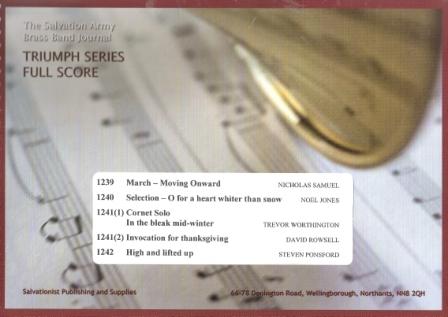
Triumph Series Band Journal July 2013 Numbers 1239 - 1242
No. 1239 March - Moving Onward (Nicholas Samuel)This march, written by Lieutenant Nicholas Samuel includes the melody from the song The Challenge of the Future written for the 125th Corps Anniversary at Upper Norwood. Other songs included are There's power in the blood of the Lamb , Here is the place and Wonder-working power.No. 1240 Selerction - O for a heart whiter than snow (Noel Jones)Eliza Edmunds Hewitt's song 'O for a heart that is whiter than snow', forms the basis for this selection written by retired Bandmaster Noel Jones. Brief references are also made to the choruses 'Grace ther is my every debt to pay' and 'Take up thy cross and follow me.No. 1241(1) Cornet Solo - In the bleak mid-winter (Trevor Worthington)A setting for cornet and band of the tune 'Cranham', written by Gustav Holst, with which we associate the words of the well-loved popular Christmas Carol.No. 1241(2) Invocation for thanksgiving (David Rowsell)Invocation, by definition, means ' a call to worship'. This music will serve this purpose for any Harvest or Thanksgiving service, using the tune, 'Come, ye thankful people, come'.No. 1242 High and lifted up (Steven Ponsford)This is music of an exciting yet relaxed nature, and it is intended that this piece be used to inspire and to 'lift up' listeners and players alike. Based on Michael W Smith's contemporary worship song, 'Open the eyes of my heart', this also contains the song 'Holy, holy, holy', to the tune of Nicea.
Estimated dispatch 7-14 working days
-
 £45.00
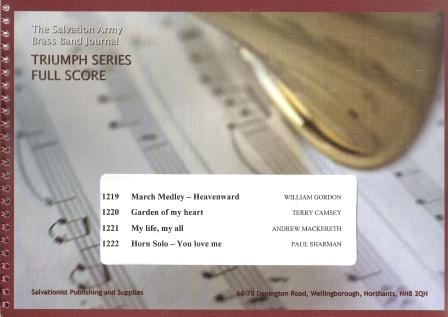
Triumph Series Band Journal November 2011 Numbers 1219-1222
No.1219 March Medley - Heavenward (William Gordon)A variety of songs are used in this up-tempo march medley which potrays the celebration of a life looking forward to an eternity in Heaven. The tunes used are 'When we all get to Heaven', 'When the roll is called up yonder' and 'We shall win'.No.1220 Garden of my heart (Terry Camsey)The publication of this music is, in a small part, a fitting tribute to Major Terry Camsey who was Promoted to Glory in June 2011. The title is taken from the refrain from a much-loved Sidney Cox song; 'Jesus, Jesus, Lily of the valley, Bloom in all thy beauty in the garden of my heart'.No.1221 My life, my all (Andrew Mackereth)This selection attempts to emphasise the personal nature of Christian commitment hence the emphasis given to the words 'my' and 'I' in the songs chosen. The tunes 'Rockingham', 'All I have I am bringing to thee' and 'At thy feet I bow adoring' are included.No.1222 Tenor Horn Solo - You love me (Brian Willetts arr. Paul Sharman)This arrangement was made at the request of David Lynch, Solo Horn player in The International Staff Band. Originally published in April 1993, the song speaks of the fact that, despite the wonder and vastness of God's creation, he still loves each one of us individually.
Estimated dispatch 7-14 working days
-
 £39.95
Pound the Streets (Brass Band - Score and Parts)
This piece was commissioned for the National Youth Band of Scotland by the Scottish Brass Band Association for the Tartan Heart Festival 2010.The Tartan Heart Festival is a huge musical festival that took place in the picturesque Belladrum Estate in Inverness-shire. It features many famous pop and rock artists including Feeder, Amy MacDonald, The Levellers, Divine Comedy and Badly Drawn Boy to name but a few.Special guests to open the festival were the National Youth Band of Scotland who performed a programme of music that started with this piece Pound The Streets. As they were playing at a rock festival I wanted to compose a piece that didn't follow the more traditional types of concert openers I have written in the past. So instead I opted for a fast paced piece that has a pounding rock rhythm from the drum kit and relentless riffs and ostinati from the brass ensemble.I had lots of fun composing this piece as it is so different to a lot of music I have composed in the past. It gave me the opportunity to incorporate musical styles that I enjoy listening to when I am away from brass bands and to write in a pop/rock style.So the end product is a brass rock piece that has lots of energy, a feel-good factor and is lots of fun to play and listen to. I hope you enjoy, Pound The Streets.Paul Lovatt-Cooper
Estimated dispatch 7-14 working days
 View Music