Results
-
£40.00
Lux Aeterna - Harper, P
The title Lux Aeterna (Eternal Light) can be interpreted on a number of levels. Musically it has a rather mystical feel to it, and the single note with which the piece begins continues uninterrupted throughout, like an inextinguishable flame, or a constant source of hope. There are lyrical and song-like solo lines for cornet, flugel and euphonium. In a recent review Paul Hindmarsh described the piece as a touching new work by Philip Harper that would have got my vote for best new work for its technical ingenuity if not its 'wow factor'.Listen to Cory BandCourtesy of World of Brass
In Stock: Estimated dispatch 1-3 working days
-
£45.00
The Four Seasons - Vivaldi, A - Harper, P
Philip Harper's new take on Vivaldi's masterpiece makes a very definite nod towards Ray Farr's well-known disco arrangement of Bach's Toccata in D Minor! This new arrangement has been receiving rave reviews as Cory Band's concert encoreChampionshipDuration 3 minsListen here - Courtesy of Cory Band
In Stock: Estimated dispatch 1-3 working days
-
£85.00
The Alchymist's Journal - Kenneth Hesketh
The Alchymist's Journal (Variants for Brass Band) was commissioned by Faber Music Band Consultant Paul Hindmarsh in 2001, with the support of the Brass Band Heritage Trust, as a substantial concert/contest challenge that would be within the compass of the country's most able youth and first section bands. It received its first performance in January 2002, by Black Dyke Band under Nicholas Childs, as part of the Royal Northern College of Music Festival of Brass.Since its original publication, composer Kenneth Hesketh has made a number of revisions to the work. Most of these were included in the recording made by Foden's Band (Bramwell Tovey) for NMC Recordings (NMC D142). This definitive new edition, including all the composer's revisions, has been specially prepared for the 2015 National Brass Band Championships of Great Britain and is the text that all bands performing will be required to use.Brass Band Grade 5: 1st SectionDuration: 12 minutes.
In Stock: Estimated dispatch 1-3 working days
-
 £22.50
Edward Gregson: Concertante for Piano and Brass Band
DescriptionProgramme NoteThe Concertante for Piano and Brass Band was written in 1966, when the composer was an undergraduate student at the Royal Academy of Music in London. It received its first public concert performance in 1967 at the Royal Festival Hall, London, when the composer was the soloist with the International Band of the Salvation Army, conducted by Bernard Adams. It was one of the first major works to be written for this particular combination.The Concertante is unashamedly romantic in idiom and is in three movements: Prelude, Nocturne and Rondo. The Prelude is cast in sonata form and opens with a short cadenza-like flourish from the soloist, followed by two main ideas - the first sweepingly dramatic, the second highly lyrical. The interplay between these two themes forms the main focus of the movement, and after a return to the opening theme, an exuberant codetta brings the music to a close, albeit a quiet one. https://morthanveld.com/wp-content/uploads/2017/09/Gregson-Concertante-1st-movt-clip.mp3The tender Nocturne opens with an introduction from the band that contains precursors of the two main ideas to follow. The solo piano announces the main theme, which has a slightly 'bluesy' character with its flattened third and seventh notes of the scale, and is a love song dedicated to the composer's wife-to-be. The band enters with phrases of a chorale already hinted at in the introduction - Ray Steadman-Allen's hymn tune 'Esher' - but never quite presented in its complete state. Both ideas are developed alongside each other, with eventually the first theme returning, this time with piano and band together, and building to a majestic climax, before subsiding to a peaceful coda - a return to the very opening of the movement. https://morthanveld.com/wp-content/uploads/2017/09/Gregson-Concertante-movt-2-clip.mp3The final Rondo is full of energetic rhythms and changing time patterns. The main theme is playful in character, with much interplay between soloist and band, whilst the middle section presents a new theme, and one that has more than a hint of the hymn tune 'Onward Christian Soldiers', in what amounts to a good humoured parody. The opening Rondo theme returns, this time leading to a powerful and dissonant climax from the band. This is followed by an extended piano cadenza, underlying the virtuoso aspect of the work, and leading to an energetic and life-affirming coda, which brings the work to a triumphant conclusion. https://morthanveld.com/wp-content/uploads/2017/09/Gregson-Concertante-movt-3-clip.mp3Duration: 18 minutesInstrumentation:Please note that there is no 1st/Repiano Cornet part in this work. The 1st/Repiano Cornet player should join the Solo Cornet bench. As such an extra Solo Cornet part is provided in the set of parts.Version for two pianosA version of the Concertante for two pianos is available for rehearsal purposes. Piano 1 is the solo part and Piano 2 the band reduction. However, for those pianists not needing to rehearse the work in this way, a solo piano part is also provided with the main set of band parts.To view a preview of the solo part for the first movement click here.The youthful Gregson (his work was written as a third year undergraduate) was seemingly a bit of a musical magpie - but one heck of a skilful one at that.These were shiny baubles of poise, panache and pastiche, with affectionate, remarkably mature nods of appreciation towards Gershwin, Rachmaninov, Ireland and even Elmer as well as Leonard Bernstein.The rich colour palette and flowing lines (with the tenderest of central Nocturnes) were a joy - as were the little buds of motifs that dotted the score like seeds ready to be planted on a future fertile brass band compositional field. - Iwan Fox, 4Barsrest.com, June 2019For more information on Edward Gregson's music please visit the composer's website: www.edwardgregson.com
Estimated dispatch 7-14 working days
-
 £30.00
Building on Sand - Jock McKenzie
This piece was composed with the intention of replicating some of the sounds of the New Orleans Brass Bands; particularly those whose music has a funky, riff-based edge to their sound e.g. the Hot 8, Rebirth, Dirty Dozen and Soul Rebels brass bands. As well as elements of the second line parade, the music also has a full-on, swing out section.
-
 £15.00
Auld Lang Syne - Traditional
This classic melody for celebrating the bringing in of each new year, has been scored here by Helen Douthwaite with a reduced-sized brass group in mind.Originally aimed at providing her own training band with relevant repertoire to learn, Helen has created a happily versatile piece which can be welcomed by beginner and more advanced groups alike.The set comes with score and parts for:Cornet 1Cornet 2Eb Tenor HornEuphonium/BaritoneTrombone 1Trombone 2Snare Drum
In Stock: Estimated dispatch 3-5 working days
-
 £25.00
First Attempt (brass band) - Tim Paton
This concert march, composed by Tim Paton for brass band, has taken inspiration from the inimitable style of the 'march king', Kenneth J Alford.It's an upbeat, cheerful march which has stood the test of time - it was premiered back in 1970 on the Rozel Bandstand by the Weston-Super-Mare Silver Band!Marches have always been a favourable choice in brass band concert programmes, so here's a great opportunity to bring a new offering to the table which helps lift spirits through its catchy pulse and creativity.Also available as a version for brass ensemble.
In Stock: Estimated dispatch 3-5 working days
-
 £15.00
Symphony in Two Movements (Study Score Only)
Selected as the Championship Section test piece for the National Brass Band Championships of Great Britain 2025This work was jointly commissioned by the National Youth Brass Band of Great Britain (NYBBGB) and the National Youth Brass Band of Wales (NYBBW), the latter with funding from T Cerdd (Music Centre Wales), to celebrate their 60th and 30th anniversaries respectively. The first performances were given at Cadogan Hall, London, in April 2012, by the NYBBGB, conducted by Bramwell Tovey; and at the Great Hall, Aberystwyth University, in July 2012, by the NYBBW, conducted by Nicholas Childs.When I was approached about a joint commission to write a new work to celebrate the anniversaries of these two outstanding youth bands I was delighted to accept, and decided to respond by writing a work apposite for the magnitude of these special occasions, namely a 'symphony for brass'.Through a long journey of writing music for brass band, which commenced with Connotations (1977), and continued with Dances and Arias (1984), Of Men and Mountains (1991), The Trumpets of the Angels (2000) and Rococo Variations (2008), I arrived at what I regard as the most important work of the cycle to date, combining as it does serious musical intent with considerable technical demands. It is perhaps my most abstract work for brass band, avoiding any programmatic content.The symphony lasts for some 19 minutes and is structured in two linked movements. The form is based on that used by Beethoven in his final piano sonata (Op.111), which is in two movements only: a compact sonata-form allegro, followed by a more expansive theme and four variations. Prokofiev also adopted this model in his 2nd Symphony of 1925.The opening Toccata of this Symphony is highly dramatic but compact, whilst still retaining the 'traditional' structural elements of exposition, development and recapitulation; indeed, it also has the 'traditional' element of a contrasting second subject - a gentle, lyrical modal melody first heard on solo cornets.In contrast, the longer and more substantial second movement Variations is built around a theme and four variations. The slowly unfolding chorale-like theme accumulates both added note harmony and increasing instrumentation, whilst the four variations which follow are by turn mercurial (fast, starting with all the instruments muted), march-like (menacing, with short rhythmic articulations underpinning an extended atonal melody), serene (a series of 'romances' for solo instruments alongside echoes of the chorale) with an emerging theme eventually bursting into a climax of passionate intent; whilst the final variation is a dynamic scherzo (concertante-like in its series of rapid-fire solos, duets, trios and quartets) with the music gradually incorporating elements of the main ideas from the first movement, thus acting as a recapitulation for the whole work. It reaches its peroration with a return to the very opening of the symphony, now in the 'home' tonality of F, and thus creating a truly symphonic dimension to the music.Most of the melodic material of the symphony is derived from the opening eleven-note 'row', which contains various intervallic sets, and although the work is not serially conceived it does use some typical quasi-serial procedures, such as canons, inversions, and retrogrades. The symphony uses somewhat limited percussion, in line with a 'classical' approach to the sound world of the brass band, alongside a use of multi-divisi instrumentation, whereby each player has an individual part rather than the traditional doubling within certain sections of the band.- Edward GregsonDuration: 19.00
Estimated dispatch 7-14 working days
-
 £38.95
Unity Series Band Journal - Numbers 538 - 541, February 2025
538: For Christ alone (Morgan Juel Stavik)This gentle and delicate march takes its title from the chorus of Fred Fry's song (S.A.S.B. 960).539: Calling Today! (Noel Jones)The words for this three-verse arrangement were written by Fanny Crosby, with music composed by George Cole Stebbins. While the song doesn't feature in the current Salvation Army Song Book, it was included in both the 1955 and 1986 editions. This arrangement was prepared during the pandemic, where people were encouraged to make contact by telephone as much as possible, and certainly welcomed phone calls from so many friends. Thinking of the calls, led to the words of this song.540: When the saints go marching in (Thomas Mack)This arrangement was written for the service celebrating the life of Irma Long at the request of her daughter. Irma, a gentle and kind woman, was a soldier for 70 years, 40 of which were at Corry Corps, Pennsylvania, USA, where she was also a songster, a pre-school Sunday School teacher, and corps treasurer. She drove the country roads from her village to Corry five times a week, even during the hard snow and ice of winters, so that she and her three daughters could attend corps activities. 541: There is sunshine (Wilfried Weiland)This work introduces a new composer to our band journals. Wilfried Weiland was the Band master at Berlin Central Corps and a member of the German Staff Band for several years. Although this is Wilfried's first published contribution with The Salvation Army, he has had several brass pieces published in the United Kingdom and abroad. The arrangement was originally written in July 2022 for the 25th anniversary of the Naumburg Corps, Germany. The reggae genre, employed here, has not been featured within our journals before but suits the style of a brass band well.
Estimated dispatch 7-14 working days
-
 £95.00
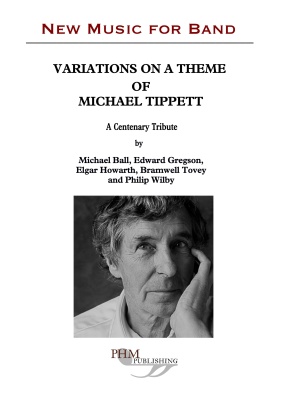
Variations on a Theme of Michael Tippett (Brass Band - Score and Parts)
A Centenary Tribute by Michael Ball, Edward Gregson, Elgar Howarth, Bramwell Tovey and Philip WilbyThis unique 'pice d'occasion' arose out of a telephone conversation in 2004 with Alan Wycherley, who was the soprano cornet player of the Foden's Richardson Band at the time. He indicated that the band would like to include an original birthday tribute for Edward Gregson (60) and Elgar Howarth (70) in its concert at the 2005 RNCM Festival of Brass in Manchester. I have been Artistic Director of Manchester's Festival of Brass since it was established in 1990 as a BBC Radio 3 series, As the centenary of the birth of Sir Michael Tippett fell on 5 January 2005, I devised this collective work as a way of embracing all three anniversaries in a novel way.The idea of joint compositions is not a new one in the classical music world. In the 1860s, Verdi was joined by a number of his contemporaries in a Requiem Mass for Rossini. In this country there have been a number of orchestral examples over the past fifty years, but never before for the brass band. Although Tippett composed only one work for brass band, Festal Brass with Blues, his orchestral works and operas are full of idiomatic brass writing. The theme I chose for this celebration is one of Tippet's most memorable miniatures featuring wind and brass. In the opera Midsummer Marriage it marks the entry of the Ancients. It is also included in the orchestral Suite in D (1948), for the Birthday of Prince Charles.I invited five of the leading contemporary voices in brass band music to add their own creative perspectives to the little Tippett theme, with it's characteristic rhythms, embellishments and modality - the Lydian mode. Each contribution was designed to fit into a tonal and formal template to give the whole work a flow and continuity. In Danse des Amis, Bramwell Tovey has composed a jazzy, humorous variation. Inspiration came from Tippett's love of jazz and, more personally, from the characteristically syncopated gait of the distinguished music critic John Amis, who Tovey once observed leaving a performance of Tippett's opera King Priam before the end. Incidentally, that performance was conducted by Elgar Howarth.We hear Edward Gregson in lyrical mode. His Midsummer Song is redolent of the sound world of Tippett's opera A Midsummer Marriage and it ends with a brief reference to a favourite of Gregson's, Tippett's Concerto for Orchestra. Michael Ball provides a brief moment of light, airy activity bringing to mind perhaps Tippett's love of Shakespearian fantasy, especially The Tempest. Elgar Howarth juxtaposes a slowed down version of the processional theme with distant recollections of fanfares from King Priam. Philip Wilby has rounded the tribute off with a spectacular fugue. During its inexorable progress Wilby ingeniously introduces the two other birthday references - the three-note musical signature that Elgar Howarth includes in much of his music and the characteristic theme which begins Edward Gregson's substantial work for brass an organ The Trumpets of the Angels. An elaborated reprise of Tippett's little theme is followed by a dynamic coda.- Paul HindmarshDuration: 13.00
Estimated dispatch 7-14 working days
 View Music