
Results
-
£27.00
-
£41.00
O Theotokos Ever-Vigilant In Prayer - Sergei Rachmaninov - Graham Ashton
Estimated dispatch 7-14 working days
-
£46.00
The Great Gate of Kiev - Modest Mussorgsky - Graham Ashton
Estimated dispatch 7-14 working days
-
£22.00
-
 £15.00
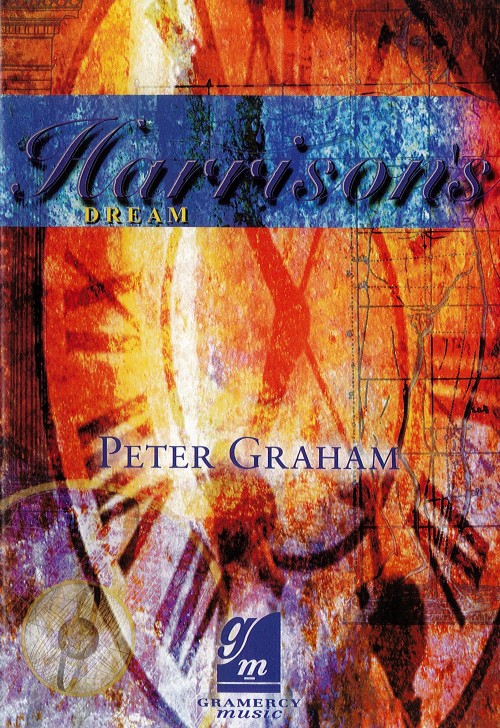
Harrison's Dream (Brass Band - Study Score) - Graham, Peter
At 8.00pm on the 22nd of October 1707, the Association, flagship of the Royal Navy, struck rocks off the Scilly Isles with the loss of the entire crew. Throughout the rest of the evening the remaining three ships in the fleet suffered the same fate. Only 26 of the original 1,647 crew members survived. This disaster was a direct result of an inability to calculate longitude, the most pressing scientific problem of the time. It pushed the longitude question to the forefront of the national consciousness and precipitated the Longitude Act. Parliament funded a prize of �20,000 to anyone whose method or device would solve the dilemma.For carpenter and self-taught clockmaker John Harrison, this was the beginning of a 40 year obsession. To calculate longitude it is necessary to know the time aboard ship and at the home port or place of known longitude, at precisely the same moment. Harrison's dream was to build a clock so accurate that this calculation could be made, an audacious feat of engineering.This work reflects on aspects of this epic tale, brilliantly brought to life in Dava Sobel's book Longitude. Much of the music is mechanistic in tone and is constructed along precise mathematical and metrical lines. The heart of the work however is human - the attraction of the �20,000 prize is often cited as Harrison's motivation. However, the realisation that countless lives depended on a solution was one which haunted Harrison. The emotional core of the music reflects on this, and in particular the evening of 22ndOctober 1707.- Peter GrahamJuly 2000 Recorded on Polyphonic QPRL219D Master Brass (Volume Fifteen). Duration: 14'30"
Estimated dispatch 7-14 working days
-
 £84.95
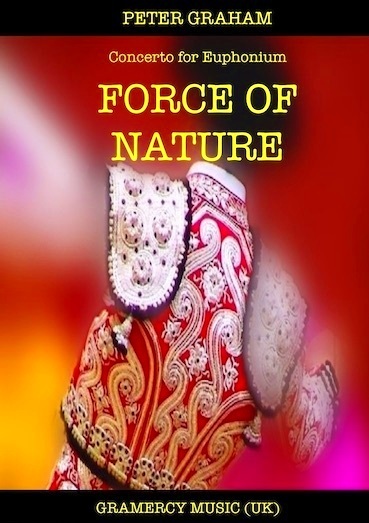
Force of Nature (Euphonium Solo with Brass Band - Score and Parts) - Graham, Peter
Concerto for EuphoniumIn his writings, Ernest Hemingway defined the American hero for a generation.He created a new type of fictional character - a "man's man" - a hard drinking pugilist who enjoyed bullfights, big game hunting, deep-sea fishing and other "macho" pursuits. In many respects Hemingway was the living embodiment of his creation, though his somewhat idealised life ended in suicide on July 2nd 1961 and the chapter on this Force of Nature came to a close. The concerto reflects upon moments in this extraordinary life.Matador - the traditions of the Spanish bullfight fascinated Hemingway. He wrote frequently on the subject, going beyond the superficial and exploring at a deeper level the nature of fear and courage. This flamenco-inspired music equally contrasts moments of uncertainty and resolve.Wayfarer (Reflections on Poor Wayfaring Stranger) - the tensions of Hemingway's early life in the midwest suburb of Oak Park (a town he reputedly described as "narrow-minded") fuelled his wanderlust. At the age of 18 he arrived at the Italian Front, serving as an ambulance driver. Within days he was seriously wounded and the horrors of war put paid to adolescent illusions of immortality.Pilar - Hemingway's beloved boat Pilar could cut through the waves off the coast of Cuba at sixteen knots full-out. The music conjures up the thrill of the chase as the great fish hoves into view.Duration: 14.00
Estimated dispatch 7-14 working days
-
 £69.95
Triquetra (Brass Band - Score and Parts) - Graham, Peter
Triquetra takes the form of a free fantasia on the familiar hymn Old Hundreth. The tune appears in full in four different guises - harmonically and rhythmically altered on each occasion. Fragments of the melody are also used to generate new ideas, most notably in the contrasting middle section where the opening phrase of the hymn appears in inversion.As to the title, the Triquetra (from the Latin triquetrus meaning three-corned) symbol is representative of the Christian Trinity and in that respect relates to the final line of text in Old Hundreth, also known as the Doxology: Praise God from whom all blessings flow; Praise Him, all creatures here below; Praise Him above, ye heavenly host; Praise Father, Son and Holy Ghost.Triquetra was written for Stephen Cobb in recognition of 30 years outstanding service as conductor of the International Staff Band of the Salvation Army.Duration: 7.00
Estimated dispatch 7-14 working days
-
 £44.95
Hymn for Bram (Brass Band - Score and Parts) - Graham, Peter
Hymn for Bram serves as homage to Bramwell Tovey (1953 - 2022) the internationally renowned, Grammy-winning orchestral conductor.The hymn is the central section from my large scale work Metropolis 1927, commissioned by Bram in 2014 for the National Youth Brass Band of Great Britain during his tenure as the bands' Music Director.Duration: 4.00
Estimated dispatch 7-14 working days
-
 £44.95
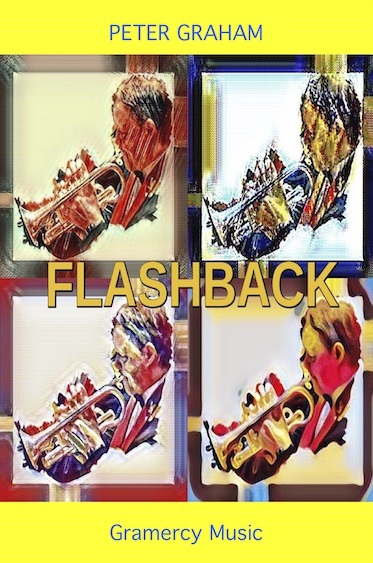
Flashback (Brass Band - Score and Parts) - Graham, Peter
Flashback was written for Lee Rigg and the Wardle Academy Youth Band and opened their winning programme at the 2022 European Youth Championships (Development Section) in Birmingham England.Prior to his transition to the conductors podium Lee was a long serving member of the Black Dyke Band and considered by many (including myself) to be perhaps the world's greatest repiano cornet player!In many respects our careers have run in parallel and a number of my works over the years have included solos with Lee in mind. In its short span Flashback makes references to some of these plus my first forays into band writing Dimensions and Prisms, both of which have featured on occasion at the European competition.- Peter GrahamDuration: 2.30
Estimated dispatch 7-14 working days
-
 £69.95
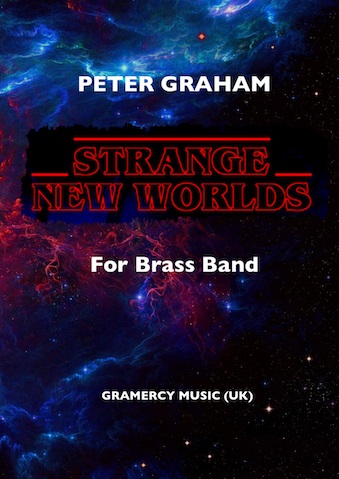
Strange New Worlds (Brass Band - Score and Parts) - Graham, Peter
Strange New Worlds was commissioned by Nicholas Childs for the National Children's Brass Band of Great Britain with funds provided by Arts Council England.The COVID-19 pandemic made it necessary for the 2020 course to transition from residential to virtual and the work was designed to accommodate this change. The participants individually filmed themselves to a click track and the videos were collated to create a "virtual" performance. The premiere was streamed live on YouTube on August 7, 2020.The work is in 5 movements with a narrative dictated by the individual movement titles. Although to me this narrative is clearly defined, multiple scenarios present themselves. Some may interpret the story as being one from the ancients while others might identify with the science-fiction of H.G. Wells. Others still will relate to the recent surge of interest in 1980s culture and the Netflix series Stranger Things (to which the title of my work pays homage). Nor would it be unreasonable to consider the piece an analogy reflecting events in 2020. Listeners will decide the story (or message) for themselves.The five movements are: I. Things to Come; II. Descent to Darkness (featuring Cornets, Trombones and Percussion); III. Resistance (featuring Horns, Baritones, Euphoniums, Basses and Percussion); IV/V. Aftermath/A New HopeDuration: 8.00
Estimated dispatch 7-14 working days
 View Music