
Results
-
 £83.66
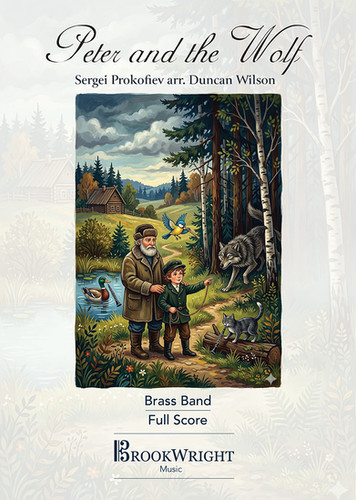
Peter and the Wolf (Brass Band, Narrator & Soloist) Prokofiev arr. Duncan Wilson
In 1936, Sergei Prokofiev was commissioned by Natalya Sats and the Central Children's Theatre in Moscow to write a musical symphony for children. Drawing from various sources, he created Peter and the Wolf, a work designed to introduce young audiences to the instruments of the orchestra. Prokofiev conducted both the Moscow premiere in May 1936 and the first English-language performance in Boston in 1938.In this adaptation for brass band, Duncan Wilson has abridged the original 25-minute score into a concert-friendly 18-minute version. All core material and principal themes remain intact.While the full band represents the character of Peter, the arrangement suggests seating the four other main characters (Bird, Duck, Cat, and Grandfather) slightly apart from the main ensemble. To enhance the performance, players may choose to develop their characters using costumes and accessories.To view a rolling score video please visit https://youtu.be/l8aXh-LiWb4Duration: approx. 18 minutesDifficulty Level: 2nd Section +This PDF download includes the full score and parts.Sheet music available at www.brassband.co.uk (UK) or https://satradecentral.org (USA)Instrumentation NotesThe Cat: Written for baritone, though bands may substitute a euphonium if preferred. If this substitution is made, the 1st baritone player should read the euphonium part.Instrumentation:NarratorThe Bird (Soprano Cornet Eb)The Duck (Flugel Horn Bb)The Cat (Baritone Bb)Grandfather (Bass Eb)Solo Cornet 1&2 BbSolo Cornet 3&4 BbRepiano Cornet Bb2nd Cornet Bb3rd Cornet BbSolo Horn Eb1st Horn Eb2nd Horn Eb2nd Baritone Bb1st Trombone Bb2nd Trombone BbBass TromboneEuphonium Bb2nd Bass EbBass BbTimpaniPercussion (2 players): Snare Drum, Bass Drum, Cymbals (clash and suspended), Woodblock, Triangle, Whip, Mark Tree, Glockenspiel, Xylophone & Tubular Bells
In Stock: Estimated dispatch 1-3 working days
-
 £34.22
The Lonely Shepherd (Brass Band) James Last arr. Mark Ford
Few melodies possess the haunting beauty and instant recognizability of The Lonely Shepherd. Originally composed by legendary bandleader James Last for a solo project titled Filmmusik Ohne Filme (Film Music Without Films), the track eventually found its home on the 1977 album Memories of Russia.It was this recording that catapulted pan flutist Gheorghe Zamfir to international superstardom, reaching the Top 25 on the German charts and becoming a permanent fixture in the global musical lexicon.While the original album title suggested "films without movies," the track didn't stay "homeless" for long. Its evocative, melancholic atmosphere has made it a favorite for directors across decades and continents.This brass band arrangement preserves the ethereal quality of the original, the soaring melodic lines and rhythmic intensity of the finale offering a brilliant showcase of phrasing and emotional depth.To view a rolling score video of the work please visit https://youtu.be/DgwjIij93OsDuration: Approx. 4.00 minutesDifficulty Level: 3rd Section +This PDF download includes the full score and parts.Sheet music available at www.brassband.co.uk (UK) or https://satradecentral.org (USA)Instrumentation:Soprano Cornet EbSolo Cornet BbRepiano Cornet Bb2nd Cornet Bb3rd Cornet BbFlugel Horn BbSolo Horn Eb1st Horn Eb2nd Horn Eb1st Baritone Bb2nd Baritone Bb1st Trombone Bb2nd Trombone BbBass TromboneEuphonium BbBass EbBass BbDrum KitPercussion 1-2
In Stock: Estimated dispatch 1-3 working days
-
 £30.42
March from 'The Love for Three Oranges (Brass Band) Prokofiev arr. Wilkinson
This thrilling brass band arrangement of the March from 'The Love for Three Oranges' by Prokofiev has been skillfully arranged by Keith M. Wilkinson. This setting captures the essence of the original orchestral work, while showcasing the power and brilliance of the brass band.In 1918, Sergei Prokofiev undertook his first visit to the United States. A number of concerts of his works were held in Chicago, which were received very favourably. As a result, the director of the Chicago Opera Association, Cleofonte Campanini, commissioned Prokofiev to write an opera. It just so happened that, during his trip, he had written a draft of a libretto, based on the Italian play by Gozzi, L'amore delle tre melarance, adding some additional surrealism to the text. Given Prokofiev's poor English, and Americans unlikely to accept an opera in Russian, French was his final choice. The result, L'amour des trois oranges (or The Love for Three Oranges), which premiered at the Auditorium Theatre in Chicago on 30 December 1921, conducted by Prokofiev himself.The March from this opera is probably the most familiar part and has been used by CBS in the radio-drama series The FBI in Peace and War. It was also used in films such as The Brink's Job and Prokofiev quoted it in the second act of his ballet Cinderella.To view a rolling score video of the work please visit www.youtube.com/watch?v=I136sf8hxlUDuration: Approx. 2.10 minutesDifficulty Level: 3rd Section +PDF download includes parts and score.Sheet music available from www.brassband.co.ukInstrumentation:Soprano Cornet EbSolo Cornet BbRepiano Cornet Bb2nd Cornet Bb3rd Cornet BbFlugel Horn BbSolo Horn Eb1st Horn Eb2nd Horn Eb1st Baritone Bb2nd Baritone Bb1st Trombone Bb2nd Trombone BbBass TromboneEuphonium BbBass EbBass BbTimpaniPercussion 1-2
In Stock: Estimated dispatch 1-3 working days
-
 £34.22
Polka from 'The Bartered Bride' (Brass Band) Smetana arr. Rob Bushnell
Considered a major contribution to the develop of Czech music, The Bartered Bride by Bedrich Smetana is a comic opera in three acts that premiered, in its final version, in 1870; having not been a great success when the original two-act version premiered at the Provisional Theatre, Prague on 30 May 1866. The opera was part of Smetana's aim to create a native Czech music after the conductor Johann von Herbeck commented that Czechs were incapable of making music of their own. Whilst he avoided the direct use of folksongs, Smetana did use numerous traditional Bohemian dance forms, such as the furiant and the polka, leading to music that was Czech in spirit.'Sold Bride', a more accurate translation of the original Czech title (Prodana nevesta), tells the story of two lovers (Marenka and Jenik) who want to marry despite Marenka's father's obligations for his daughter to marry the son of a wealthy landowner, Micha. Scheming, condition proposals and secret identities leads to a happy ending.The polka was not in the original 1866 version. A revision in October 1866 saw the addition of a gypsy dance near the start of act 2. But by the next performance in January 1869, this had been replaced by a polka. In June 1869, a new polka replaced the January version's (as well as being moved to the end of act 1) and this is the one that we know and love today.This arrangement is for British-style brass band, with *alternative parts for horns in F and bass-clef lower brass.Instrumentation:Soprano Cornet EbSolo Cornet BbRepiano Cornet Bb2nd Cornet Bb3rd Cornet BbFlugel Horn BbSolo Horn Eb*1st Horn Eb*2nd Horn Eb*1st Baritone Bb*2nd Baritone Bb*1st Trombone Bb*2nd Trombone Bb*Bass TromboneEuphonium Bb*Bass Eb*Bass Bb*TimpaniPercussion (Triangle, Cymbal(s) & Bass Drum)
In Stock: Estimated dispatch 1-3 working days
-
 £59.99
Second Star to the Right, The - Christopher Bond
This famous tune from the iconic Peter Pan movie has been arranged many times, but never for brass band. This arrangement for solo trombone and band is ideal for putting one of the trombones in the spotlight, with a solo part and accompaniment suitable for bands of third section standard and higher.
Estimated dispatch 10-14 working days
-
 £34.95
Lady of the Lake - Christopher Bond
A remote Carmarthenshire lake shrouded in Welsh legend has been named as one of the 1,000 must-see sights across the globe by an influential travel bible. Llyn y Fan Fach, 12km southeast of Llandovery in the Brecon Beacons, is the only spot in Wales to make the list, which was put together by Lonely Planet. "This isolated drop of blue, beneath a cirque of raw Welsh hills, is enchanting - and enchanted," Lonely Planet's 1,000 Ultimate Sights tells readers. The story goes that in the 13th Century, a farmer grazing cattle on the nearby slopes spotted the most beautiful woman he'd ever seen. She was a fairy maiden, who agreed to marry him on one proviso - he must not hit her more than twice. In time, the inevitable happened - three strikes, and the otherworldly wife disappeared back into the lake, taking her magic cows with her. This work, for flugel horn and brass band, is reflective in nature, portraying the dismay of the man in losing his wife for his own selfishness. The work was written for and premiered by Rob Nesbitt & City of Cardiff (Melingriffith) Band, at the 2019 Welsh Open Entertainment Contest in Porthcawl, Wales.
Estimated dispatch 10-14 working days
-
 £34.95
Puffing Devil, The - Christopher Bond
The Puffing Devil (2013) was commissioned by Camborne Trevithick Day Committee on the occasion of Camborne's 30th Trevithick Day celebration. The premiere performance of the work, written for brass band and children's choir, saw a massed performance by six brass bands and children from nine local schools. With the intention of being an educational work as well as a musical work, The Puffing Devil reflects the story of Richard Trevithick both in the lyrics and the musical material.A mysterious opening sees running semiquavers in the euphoniums as the flugel horn introduces the work with a solo, before the entry of the horns playing rhythmic quavers. The addition of the voices at the outset is for effect - working with the instruments to create the sound of a steam engine gathering pace simply to the words 'Trevithick'. Once a steady tempo is reached, themes are introduced and sung by the choir, where the vocal writing is a very simple singular-melody; easy for any primary school aged children to learn. An ending of grandeur in a majestic nature is presented, to create a big finish to a feel-good educational work.
Estimated dispatch 10-14 working days
-
 £34.95
Song of the Night Sky - Christopher Bond
Orpheus is known as the most talented music player of the ancient times. It is said that god Apollo was his father, from whom took his extreme talent in music, and the Muse Calliope was his mother. Tragedy struck when his wife, Eurydice stepped on a viper which in turn bit her, injecting its fatal venom. Nothing could stop his cries of anguish and sheer pain and sorrow upon realizing his beautiful Eurydice was dead. Orpheus decided to go into the Underworld to get his wife back. Apollo, his father, would talk to Hades, the god of the Underworld to accept him and hear his plea. And so Orpheus set off into the Underworld and was warned that for no reason must he look back while his wife was still in the dark, for that would undo everything he hoped for. As Orpheus was reaching the exit of the Underworld, he could hear the footfalls of his wife approaching him. As his was approaching the exit, his heart was beating faster and faster. The moment he stepped on the world of the living, he turned his head to hug his wife. Unfortunately, he got only a glimpse of Eurydice before she was once again drawn back into the underworld. When Orpheus turned his head, Eurydice was still in the dark, she hadn't seen the sun and, was drowned back to the dark world of the dead. Waves of anguish and despair swept over him and shuddering with grief he approached the Underworld again but this time, he was denied entry, the gates were standing shut and god Hermes, sent by Zeus, wouldn't let him in. His songs were no more joyful but extremely sad. His only comfort was to lay on a huge rock and feel the caress of the breeze, his only vision were the open skies. Song of the Night Sky was recorded by Tom Hutchinson and the Cory Band in June 2015, featuring on his debut solo album.
Estimated dispatch 10-14 working days
-
 £50.00
A Christmas Festival by Leroy Anderson arranged for brass band by Andrew Duncan
Leroy Anderson's A Christmas Festival is the most famous Christmas medley of all. Arranged for brass band by Andrew Duncan , Anderson's sparkling selection includes Joy to the World, Deck the Halls, God Rest Ye Merry Gentlemen, Good King Wenceslas and Hark the Herald Angels Sing . Originally composed in 1950 for Arthur Fiedler's Boston Pops Orchestra. Composer: Leroy Anderson Arranger: Andrew Duncan Difficulty: Suitable for Championship to 2nd Section bands Duration: 7 minutes Score and Parts Publisher: Faber
-
 £50.00
Grease! Suite from the musical by Casey and Jacobs arranged for Brass Band by Andrew Duncan
Recommended for - Suitable for all Bands A suite from the much loved musical Grease!, arranged for brass band by Andrew Duncan. Includes the songs: Summer Nights Look at me, I'm Sandra Dee Greased Lightning Hopelessly Devoted to You You're the One That I Want We Go Together Difficulty: Brass Band Grade 4 Advanced Youth and 3rd Section Duration: 4 mins 212 pages Includes Score and Parts