Results
-
£10.99
I'll Be There For You (Score) - arr. Andrew Duncan
A brass band arrangement by Andrew Duncan of The Rembrandt's I'll Be There For You, the celebrated theme tune for the ever-popular TV Sitcom, Friends.Brass Band Grade 4: Advanced Youth and 3rd SectionDuration: 4 minutes
In Stock: Estimated dispatch 1-3 working days
-
£50.00
I'll Be There For You (Score & Parts) - The Rembrandts
A brass band arrangement by Andrew Duncan of The Rembrandt's I'll Be There For You, the celebrated theme tune for the ever-popular TV Sitcom, Friends. Brass Band Grade 4: Advanced Youth and 3rd Section Duration: 4 minutes
In Stock: Estimated dispatch 1-3 working days
-
 £34.95
The Battle for Pride Rock - Jonathan Bates
DURATION: 4'00". DIFFICULTY: 1st+. 'The Battle for Pride Rock' was composed for Skelmanthorpe Band's programme of music celebrating the 30th anniversary of Walt Disney's 'The Lion King' at the 2024 Red Admiral Entertainment Championships. As the finale to the band's programme, the music depicts the fierce final battle between Scar and Simba as the latter aims to overthrow his wicked uncle and retaks control of the pride lands.
In Stock: Estimated dispatch 1-3 working days
-
 £30.00
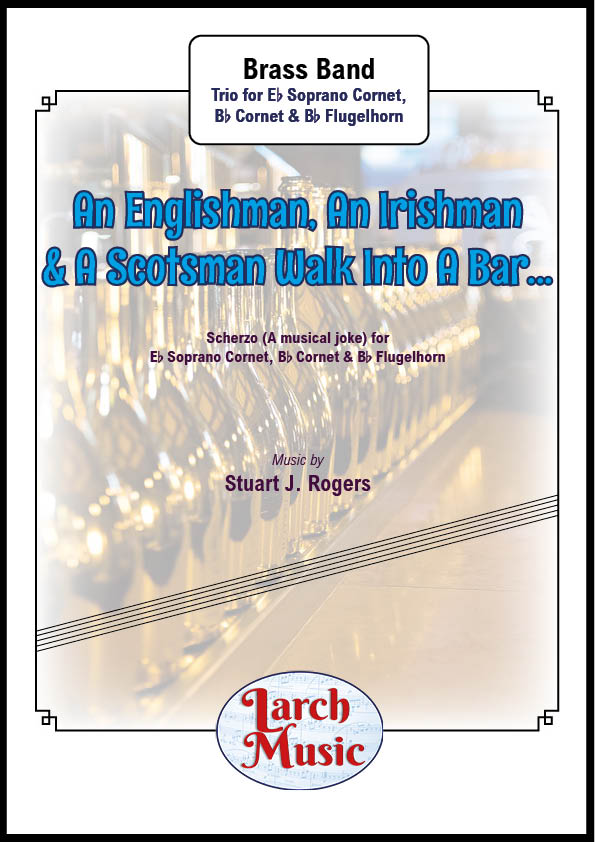
An Englishman, An Irishman & A Scotsman Walk Into A Bar - Trio & Brass Band Sheet Music Full Score & Parts - LM562
COMPOSER: Stuart J. RogersA delightful musical Scherzo (Joke) for the unlikely trio of Eb Soprano Cornet, Bb Cornet & Bb Flugelhorn.A great piece for both soloists and band alike with many a twist and turn.Suitable for 2nd Section and aboveLM562 - ISMN : 9790570005628
In Stock: Estimated dispatch 3-5 working days
-
£44.95
SCOTTISH FOLK VARIANTS (Euphonium Solo with Brass Band Set) - Stephen Bulla
This solo was written for the ISB120 event in June 2011 especially for Derick Kane and The International Staff Band. The material for the solo is indicative of Derick's Scottish roots and features in turn, 'The dashing white sergeant', 'My bonnie lies over the ocean', 'Skye boat song' and 'Bonnie Dundee'.
Estimated dispatch 7-14 working days
-
£59.95
CELESTIAL PROSPECT (Brass Band Set) - Wilfred Heaton
Selected as 2nd Section test piece for 2003 'Regionals'Wilfred Heaton originally composed Celestial Prospect in the 1940's but, so the story goes, it was rejected by the SA Editorial 'chiefs' as being too modern. The original manuscript was lost for many years, turning up in the 1980's in New York. Heaton re-worked it for the New York Staff Band, and it is now accepted as a classic of the SA 'Festival' genre.
Estimated dispatch 7-14 working days
-
£69.95
ENGLISH HERITAGE (Brass Band Set) - George Lloyd
English Heritage was first heard in the pleasant surroundings of Hampstead Heath as part of a Kenwood Lakeside concert given on 2nd July 1988. It was commissioned for English Heritage by Michael Webber, the organiser of Kenwood Concerts for English Heritage and subsequently chosen as the Championship Section test-piece for the National Brass Band Championships of Great Britain 1990. The sense of historic significance inherent in ensuring the preservation of England's fine buildings of the past drew from the composer music which seems to capture the essence of Olde England. This is a musical view of England's heritage concerned not only with pageantry and ceremonial but also catching some of the humour inherent in the English character as well as those quiet reflective moments which have surely fashioned England's past and influenced its present.
Estimated dispatch 7-14 working days
-
Duet For Two Cats - G. Rossini - Len Jenkins
"Duet For Two Cats" is often performed as an encore to vocal recitals and operatic galas. It may be sung by two sopranos, male-female pairs, or even as a tomcat duet and can be accompanied by a piano or a full orchestra. The lyrics are simple; the single word 'Miaow', repeated with various styles of inflexion and attitude throughout the piece. Our arrangement is for a cornet and trombone. The piece is generally ascribed to Rossini, though there is some doubt as to its actual origins and whether it is an authentic work by that composer. It is believed that an English composer, Robert Lucas Pearsall under the pseudonym G. Berthold may have assembled the various elements from Rossini and perhaps other composers into the piece as we now know it. In order to achieve the correct balance between band and soloists, there is a need to mute most of the band instruments. Recognising that not all bands will have the larger mutes which are expensive and sometimes unwieldy, we suggest a form of muting made famous by a jazz trumpeter and which works well on most instruments. It consists of a circle of heat resistant padded table covering or felt, slightly larger than the bell diameter, with an elasticated edge like a 'mop-hat'. With 3 holes in it to let the sound out, the mute is then simply stretched over the bell to achieve the desired effect and folded up when not required.
-
 £38.95
Unity Series Band Journal - Numbers 550 - 553, February 2026
550: March - Century of celebration (Stephen Smith)This march follows a traditional pattern and should be accessible for most bands. It was written for the 100th anniversary of Camp Gifford in Loon Lake, Washington, therefore included are well-known songs with references to water as the camp is located on the shores of Deer Lake.551: Going Home (Alan Williams)Richard Jukes' song I'm a soldier bound for Glory (S.A.S.B. 856) displays the confidence of someone with a steadfast faith who is certain that by loving and serving their God they will be accepted into his Kingdom. This assurance results in a joyful song of testimony. Whilst not a direct setting of the five verses, the dance-like rhythm of this cha-cha should reflect the positive and encouraging nature of the lyrics and be full of joy and spirit.552: Whosoever will may come (Noel Jones)This is a two-verse arrangement of the song Whosoever will may come (S.A.S.B. 405), with words written by William John McAlonan and music composed by Alfred Braine. This song is included in the Invitation and Challenge section of the song book. The arrangement should be played in a spirited style.553: March - Sing a praise of celebration (Marcus Venables)This music was written at the request of the Singapore Central Corps Band, who asked that the work be based on two specific meaningful melodies. The first is To the Glory and Praise of God by Robert Redhead, a tune rooted in corporate worship and joyful proclamation, calling God's people to lift their voices in thanksgiving. The other is Home, a beloved Singaporean song that speaks of belonging.
Estimated dispatch 7-14 working days
-
 £77.00
General Series Brass Band Journal, Numbers 2254 - 2257, April 2025
2254: Be glorified today (Martin Cordner)Built around Bob Kilpatrick's song In my life, Lord, be glorified today (S.A.S.B. 593), this concert opener was composed for Cambridge Citadel Band (UK and Ireland Territory) at the request of Bandmaster Simon Fisher. The piece pays homage to the city.2255: Driven by mission (Stephen Bulla)Stephen Bulla wrote this piece to commemorate Willis Howell and his wife's retirement from active officership. Bulla references St. Denio (S.A.S.B. 37), Melita (T.B. 442), For your mission and Men of Harlech (T.B. 756), and the assembling of the tunes and all they represent reflects the masterful artistry that always marks Bulla's works.2256: The Lord's my shepherd (Paul Sharman)This arrangement brings together two settings of Psalm 23; the familiar hymn tune Crimond (T.B. 68) and the more recent melody by Stuart Townend (T.B. 863).2257: Cornet Solo - I love you, Lord (Ian Robinson)Laurie Klein's chorus I love you, Lord (S.A.S.B. 369) has been popular for many years with Salvation Army congregations around the world and this work combines unconventional harmonies with sparse scoring to feature the soloist.
Estimated dispatch 7-14 working days