
Results
-
 £54.99
The Irish Dancemaster - William Vean
During the eighteenth century a person called 'the Dance Master' made his appearance in Ireland. He was a travelling dance-teacher, who moved from one village to another to teach the people there how to dance. They were often flamboyant personalities, gorgeously dressed and holding a staff in one hand. In order to teach their pupils the difference between their right and left leg, the dance master used to tie a small bunch of straw or hay to their leg and then would order them to either lift their 'hay-leg' or their 'straw-leg'. The dancing masters used to stay in one particular village for about six weeks (if they were not claimed by a neighbouringvillage), after which they continued their journey. Having a famous dance master gave a village a certain distinction and did not seldom lead to boasting and pride. Also on account of the popularity of Celtic music in general at the moment, William Vean was inspired to writing 'The Irish Dance Master'. He 'teaches' you two dances, the Reel and the Jig. In between these two dances there is a short breathing space, during which a traditional Irish rhythm can be enjoyed.
Estimated dispatch 5-14 working days
-
 £119.99
Flashback - Jan de Haan
A flashback is an interesting psychological phenomenon: a seemingly random trigger can bring back long-forgotten memories from the subconscious mind. The composer underwent a similar experience before writing this piece. He was asked to write a piece for The National Youth Fanfare Band in the Netherlands, one which he heard perform many years ago. All of a sudden he remembered Deep Harmony, a piece frequently programmed back then. He used his own flashback-experience as an inspiration to weave an old English hymn into his new composition, much like a musical flashback. The right idea at the right moment, as this piece will prove!
Estimated dispatch 5-14 working days
-
 £74.99
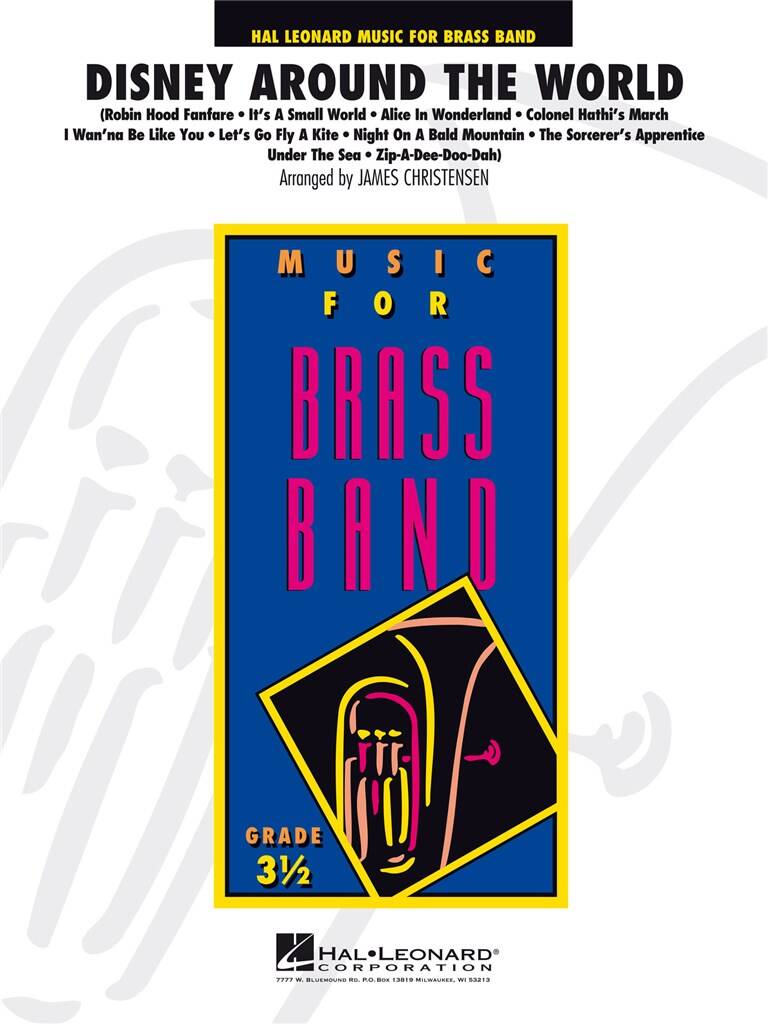
Disney Around the World - James Christensen
If you're a Disney fan, this is your moment! This medley for brass band by James Christensen contains many of the great hits from the rich Disney repertoire: Alice in Wonderland, Colonel Hathi's March, I Wanna Be Like You (Jungle Book), It's A Small World, Let's Go Fly A Kate (Mary Poppins), Night on Bald Mountain, Robin Hood, The Sorcerer's Apprentice, Under the Sea and Zip-A-Dee-Doo-Dah.
Estimated dispatch 5-14 working days
-
 £69.99
Have Mercy, Lord - Johann Sebastian Bach - Philip Sparke
Have Mercy, Lord from J.S. Bach's St Matthew Passion is one of the most beautiful arias from the baroque period. In Philip Sparke's arrangement, it is envisaged that the soloists stand together as a group stage right, while the other musicians stand behind to form the tutti group. This piece is easily playable for both the soloists and the band, and will create a beautiful moment of reflection whether performed on the concert stage or in a church.
Estimated dispatch 5-14 working days
-
£60.99
Unexpected Song - Andrew Lloyd Webber - Erik Mast
Andrew Lloyd Webber is without a doubt the most famous and successful composer of musicals of all times. Musicals such as 'Cats' and 'Phantom of the Opera' are played around the world and have been seen and heard by millions of people. Erik Mast re-discovered this unknown but exquisite piece which has been recorded once again by Sarah Brightman. A great moment of rest for your concert.
Estimated dispatch 5-14 working days
-
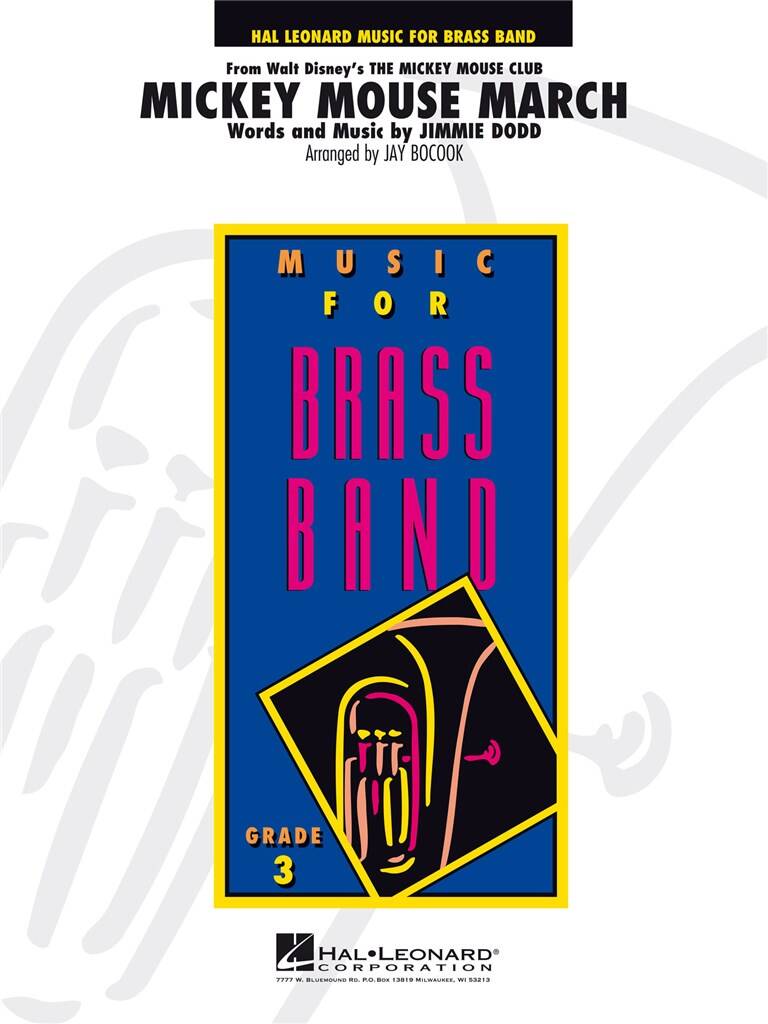 £39.99
Mickey Mouse March - Jimmie Dodd
The Mickey Mouse March goes back to the early 20's, but almost everybody knows it, whether you're 8 years old or 80 years old! This fresh arrangement was made by Philip Sparke and is a funny and joyful moment for your next concert!
Estimated dispatch 5-14 working days
-
 £25.00
Ring'd with the Azure World
DescriptionRing'd with the Azure World was commissioned by the Harmonia Brass quintet for their final recital at the University of Huddersfield in 2016.He clasps the crag with crooked hands; Close to the sun in lonely lands, Ring'd with the azure world, he stands.The wrinkled sea beneath him crawls; He watches from his mountain walls, And like a thunderbolt he falls.- The Eagle by Alfred, Lord TennysonThe music was inspired by Tennyson's poem reproduced above; it seeks simply to reflect the spirit of the poem. It opens in sparse, lonely mood as the eagle surveys the world beneath. The work quickens in three bursts using metrical modulation to disguise the actual moment of acceleration, reflecting the lazy energy stored in the circling raptor before concluding dramatically in a fall 'like a thunderbolt'. Tennyson's poem, although brief, has inspired much analysis and writing, and is notable for being written in the (then somewhat unfashionable) iambic tetrameter, indicating a foursquare emphasis reflected in the main theme of the music. This is heard first in an octatonic version and later in a purely tonal (if somewhat modal) version. The instrumentation reflects that of Harmonia Brass, a quintet composed of brass band instruments (two B flat cornets, an E flat tenor horn, tenor trombone and E flat tuba). However the music is also available for the more conventional brass quintet of two trumpets, french horn, trombone and tuba.To listen to an audio export preview and follow the music, click play on the video below!Performance Notes1st cornet/trumpet requires a cup mute, ideally with an adjustable cup (the marking "tight" denotes that the cup should be adjusted closer to the bell), and a harmon mute with the tube removed (denoted by "TR" in the score). 2nd cornet/trumpet requires a fibre straight mute and a harmon mute with the tube removed. Tenor horn require a fibre straight mute and a practice mute (any sort) - in the orchestral brass version the french horn requires a stop mute. Trombone requires a cup mute (only). Tuba requires a fibre straight mute and a practice mute (of any sort).Metronome marks should be closely observed - starting either too fast or too slow will have a disproportionate effect on the tempi later in the piece due to the metrically controlled tempo changes.
Estimated dispatch 7-14 working days
-
 £33.20
Disinformation! (Brass Band) Joe Galuszka
This atmospheric work by English composer Joe Galuszka is set in three movements: I. Fear II. Hope III. Solidarity (March for Truth) The composer writes: 'All around us is mistrust in the information we receive. Chinese misinformation. Russian disinformation. 'Fake News' in the United States. At every turn we doubt what we hear, what we see. Disinformation was composed in response to the ever-growing and all powerful misinformation campaigns worldwide that reached dizzying levels of influence, coming from some of the most eminent heads of states, during the turn of the 21st century. With division and disillusionment now rife and engrained in Western democracies, the unravelling of the social order is reflected in this short work for brass band. Opening with Fear, Disinformation starts with vast amounts of noise taking over the establishment and paints a world with people coming to terms with the cacophony of sound that is 'false information'. With a retreat to a brief moment of solace, Hope conjures up a calm escapism where on the outside, the brave and the wise look on to what is becoming of our new world. Maybe there is chance to pull together? Ending with a frenzied, brazen climax, the piece concludes with Solidarity - where people and the politicians come to loggerheads in a battle - where those who seek division are called out and the lies are laid bare for all to see, as we enter, once more, the unknown.' To listen to a recording of Solna Brassperforming the work please visit https://open.spotify.com/track/2gvPdCsvmykdWpm2yjz3Uk?si=68cc33805d16449c To view a rolling score video of this work please visit www.youtube.com/watch?v=z-0I47yfvM0 PDF download includes score and parts. Sheet music available from www.brassband.co.uk Difficulty Level: 1st Section + Length: 4.35 minutes Instrumentation: Soprano Cornet Eb Solo Cornet Bb Repiano Cornet Bb 2nd Cornet Bb 3rd Cornet Bb Flugel Horn Bb Solo Horn Eb 1st Horn Eb 2nd Horn Eb 1st Baritone Bb 2nd Baritone Bb 1st Trombone Bb 2nd Trombone Bb Bass Trombone Euphonium Bb Bass Eb Bass Bb Timpani Percussion 1-4 (Part 2 optional)
In Stock: Estimated dispatch 1-3 working days
-
 £29.51
Skidaddle (Brass Band) Barrie Gott
Skidaddle will be the perfect item to provide a lighter moment in your band's programme. The composer Barrie Gott writes: ''Skidaddle' literally means to move in a hurry. This piece means exactly that - to get moving. I was experimenting at the piano at school one morning waiting for my first students and this little ditty came to mind. Four hours later I had the first draft done! It is supposed to be a bit of fun with a few technical demands for cornet and euphonium in particular. The semi-quaver (sixteenth) work needs to be precise. Try and get the audience involved and they'll be yours for the larger works on the programme.' Difficulty Level: 2nd Section + Sheet music available at www.brassband.co.uk (UK) or https://satradecentral.org (USA) Instrumentation: Soprano Cornet Eb Solo Cornet Bb Repiano Cornet Bb 2nd Cornet Bb 3rd Cornet Bb Flugel Horn Bb Solo Horn Eb 1st Horn Eb 2nd Horn Eb 1st Baritone Bb 2nd Baritone Bb 1st Trombone Bb 2nd Trombone Bb Bass Trombone Euphonium Bb Bass Eb Bass Bb Timpani Drum Set Xylophone
In Stock: Estimated dispatch 1-3 working days
-
 £30.00
Flanfayre - Stephen Deazley
I was asked by Music for Youth to write a flexibly scored fanfare for the school proms at the Royal Albert Hall and at their National Festival in Birmingham in 2013. At its first performance at the National Festival, over 200 young brass players performed Flanfayre in Birmingham Town Hall, directed by Roger Argente, members of Superbrass and myself. The score is a progressive romp through some increasingly dance-like grooves, borrowing some of its swing from South America, from marches and big band, moving from a really quite straight opening to a "let-go" moment at the end. It is more like a flan full of different flavours, than a fanfare, hence the title. I set myself a challenge to write 100 bars but ended up with 102, which, after the introduction, can be broken down into 10 easily discernible sections each with their own mini-musical narrative. If you have time feel free to teach the audience the clapping groove. I also modelled the slow moving melody of the final section on the following words; "nothing beats a nice big cheesy, nothing beats a nice big cheesy, nothing beats a nice big cheesy, nothing beats a cheesy flan". Feel free to incorporate these too, and perform only under the strict instruction that you have fun ! - Programme Note copyright of Stephen Deazley
 View Music
 Watch video