
Results
-
 £48.56
Angel Voices (Rhapsody for Soprano Cornet & Band) Brian Bowen
This solo for soprano cornet and brass band was written by the late Brian Bowen for the New York Staff Band in 1989 when Gordon Ward was its very fine soprano cornetist. The title comes from a song by Ernest Rance (music) and Reginald Woods (lyrics) published by The Salvation Army in 1955. In this rhapsody Rance's melody is first alluded to by the horns at the pick-up to bars 19-21, then more fully with the soloist's entry to bar 51 (but in minor mode until bar 55). Much of the original music is ethereal in nature, maybe reflecting the angelic hosts. Published by BrookWright Music in 2023, the score now carries the inscription 'To the memory of Linda Ward' - Gordon Ward's wife who very sadly died in November 2021. The first commercial recording of the rhapsody was released in 1990, performed by Gordon Ward and the New York Staff Band on its Music Makers CD (TRCD 1049), available to listen to here: https://on.soundcloud.com/nHch1 PDF download includes score and parts. Sheet music available from: UK - www.brassband.co.uk USA - www.solidbrassmusic.com Difficulty Level: 2nd Section + Instrumentation: Soprano Cornet Soloist Eb Solo Cornet Bb Repiano Cornet Bb 2nd Cornet Bb 3rd Cornet Bb Flugel Horn Bb Solo Horn Eb 1st Horn Eb 2nd Horn Eb 1st Baritone Bb 2nd Baritone Bb 1st Trombone Bb 2nd Trombone Bb Bass Trombone Euphonium Bb Bass Eb Bass Bb Percussion
In Stock: Estimated dispatch 1-3 working days
-
 £33.62
Bagatelle No.25 in A Minor - Fur Elise (Brass Band) Beethoven arr. Olaf Ritman
Perhaps the most well-known piano piece by Ludwig van Beethoven, Bagatelle No. 25 in A Minor (written around 1810) is better known under its subtitle 'Fur Elise'. Even to this day it is still unknown who Elise was, with at least four theories claiming to tell the story. It might have been one of Beethoven's students or Therese Malfatti, a young lady who got much attention from him. The theory is that Beethoven's autograph Ludwig Nohl could not decipher his handwriting and might have read Elise instead of Therese. Nevertheless the piece has become extremely popular over the last two centuries and is often the very first real classical piece a beginner pianist goes to. Many classical pieces have been transcribed in contemporary fashion for brass bands in recent times, with Toccata in D Minor by J.S. Bach arranged by Ray Farr being the most popular and more recently Vivaldi's first part of Winter from The Four Seasons arranged by Philip Harper. This arrangement of Fur Elise fits in this series perfectly and seeks to bring a smile to its listeners. The last two bars are a direct tribute to Ray Farr's aforementioned arrangement of Toccata. To view a video of the Amsterdam Staff Band performing the work please visit https://www.youtube.com/watch?v=sdLI7U-aplw Duration: 3.15 minutes approx. Difficulty Level: 2nd Section + PDF download includes parts and score. Sheet music available from www.brassband.co.uk Instrumentation: Soprano Cornet Eb Solo Cornet Bb Repiano Cornet Bb 2nd Cornet Bb 3rd Cornet Bb Flugel Horn Bb Solo Horn Eb 1st Horn Eb 2nd Horn Eb 1st Baritone Bb 2nd Baritone Bb 1st Trombone Bb 2nd Trombone Bb Bass Trombone Euphonium Bb Bass Eb Bass BbTimpani Percussion 1-3
In Stock: Estimated dispatch 1-3 working days
-
 £48.56
Benedicamus Domino - Brass Band (Andrew Wainwright)
A spectacular major Christmas work for brass band, based on the well-known carols 'Unto us is born a son' and 'Infant Holy'. Set in three through-composed movements, the outer two sections are full of joy and vibrance, with a magical, ethereal middle movement featuring 'Infant Holy'. The work comes to a close with a grandioso finish and rendition of 'Unto us is born a son' in full glory. Includes score and full set of parts. To view a follow-the-score video of the work featuring the Canadian Staff Band, please visit www.youtube.com/watch?v=y6uprFRJolY Sheet music available exclusively from World of Brass - www.worldofbrass.com Difficulty Level: 1st Section + Instrumentation: Soprano Cornet Eb Solo Cornet Bb Repiano Cornet Bb 2nd Cornet Bb 3rd Cornet Bb Flugel Horn Bb Solo Horn Eb 1st Horn Eb 2nd Horn Eb 1st Baritone Bb 2nd Baritone Bb 1st Trombone Bb 2nd Trombone Bb Bass Trombone Euphonium Bb Bass Eb Bass Bb Timpani Percussion 1-3
In Stock: Estimated dispatch 1-3 working days
-
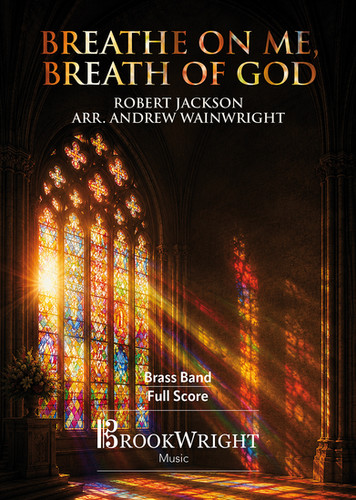 £29.88
Breathe on me, breath of God (Brass Band) Robert Jackson arr. Andrew Wainwright
Andrew Wainwright's sensitive setting of Breathe on Me, Breath of God was commissioned by Sione Malekamu Manu Jr for the 2026 Tonga Secondary School Music Festival, in memory of the late Sione Malekamu Manu. The piece offers a reflective yet powerful treatment of Edwin Hatch's beloved 1878 hymn. Set across two contrasting verses, the arrangement traces a spiritual journey from quiet contemplation to triumphant exaltation. The first verse opens with delicate textures and warm, blended tone, allowing the familiar melody - traditionally set to Robert Jackson's tune Trentham - to emerge with serene simplicity. Building seamlessly through a transitional passage, the setting broadens into a majestic second verse, celebrating the transformative power and majesty of the divine spirit. Concise yet profoundly moving, this arrangement showcases both the lyrical sensitivity and majestic power inherent to the traditional brass band. To view a rolling score video of this piece please visit www.youtube.com/watch?v=Oh7WRTwhpqM Duration: approx. 2.40 minutes Difficulty Level: 4th Section + This PDF download includes the full score and parts. Sheet music available at www.brassband.co.uk (UK) or https://satradecentral.org (USA) Instrumentation: Soprano Cornet Eb Solo Cornet Bb Repiano Cornet Bb 2nd Cornet Bb 3rd Cornet Bb Flugel Horn Bb Solo Horn Eb 1st Horn Eb 2nd Horn Eb 1st Baritone Bb 2nd Baritone Bb 1st Trombone Bb 2nd Trombone Bb Bass Trombone Euphonium Bb Bass Eb Bass Bb Timpani Percussion 1-2
In Stock: Estimated dispatch 1-3 working days
-
 £33.62
Christmas Singalong (Brass Band) Andrew Wainwright)
Arranged for The Illinois Brass Band for its 2019 Christmas concerts, this singalong gives your band the perfect opportunity to involve your audience and features attractive settings of Deck the Halls, The First Nowell, In the Bleak Midwinter and Joy to the World. Both Deck the Halls and Joy to the World feature two verses with optional cuts, should the decision be taken to include just one verse of either carol. In addition to a vocal part with the music and lyrics, a lyric sheet is also included for use by the audience. PDF download includes score and full set of parts, vocal part and lyric sheet. To view a rolling score video please visit www.youtube.com/watch?v=iwf9N19wmvg Difficulty Level: 3rd Section + Instrumentation: Vocal Soprano Cornet Eb Solo Cornet Bb Repiano Cornet Bb 2nd Cornet Bb 3rd Cornet Bb Flugel Horn Bb Solo Horn Eb 1st Horn Eb 2nd Horn Eb 1st Baritone Bb 2nd Baritone Bb 1st Trombone Bb 2nd Trombone Bb Bass Trombone Euphonium Bb Bass Eb Bass Bb Timpani Percussion 1-3
In Stock: Estimated dispatch 1-3 working days
-
 £29.88
Fanfare from La Peri(Brass Band) Dukas arr. Rob Bushnell
La Peri is a one-act ballet by the French composer Paul Dukas, best known for The Sorcerer's Apprentice (L'apprenti sorcier) as in the 1940 Disney film Fantasia. Dukas was commissioned to write La Peri by the Ballets Russes, producing a Poeme danse en un tableau ('dance poem in one scene') in 1911; this become his last published work. With Natalia Trouhanova due to play the Peri and Vaslav Nijinsky to play Iskender (the name of Alexander the Great in Persian, who is scouting around Iran in search of the Flower of Immortality), the production was ultimately cancelled because Serge Diaghilev feel Trouhanova was not a skilled enough dancer to be partnered to Nijinsky. Trouhanova later hired Ivan Clustine to choreograph the music, with the ballet premiering at the Theatre du Chatelet in Paris on 22 April 1912.The brilliant fanfare that precedes the ballet is often performed separately and is the arrangement available here. Arranged for British-style brass band, it has optional percussion parts as well as alternative parts for horns in F and bass-clef lower brass. The piece has been lowered by a tone compared to the original. A recording of the original composition can be found here: www.youtube.com/watch?v=7EDekMos1ok. Duration: Approx. 2 minutes Difficulty Level: 2nd Section + Duration: 4 or 5 minutes (depending on tempo and without any cuts) PDF download includes parts and score. Sheet music available at www.brassband.co.uk (UK) or https://satradecentral.org (USA) Instrumentation: Soprano Cornet Eb Solo Cornet Bb Repiano Cornet Bb 2nd Cornet Bb 3rd Cornet Bb Flugel Horn Bb Solo Horn Eb 1st Horn Eb 2nd Horn Eb 1st Baritone Bb 2nd Baritone Bb 1st Trombone Bb 2nd Trombone Bb Bass Trombone Euphonium Bb Bass Eb Bass Bb Timpani Percussion 1 - Snare Drum Percussion 2 - Bass Drum & Cymbal
In Stock: Estimated dispatch 1-3 working days
-
 £48.56
Finale from Symphony No.3 (Organ Symphony) (Brass Band) Saint-Saens arr. Norbury
Saint-Saens' magnificent Finale from Symphony No.3 (widely known as the 'Organ Symphony') has here been arranged for brass band with optional organ by Kevin Norbury. It was recorded by The International Staff Band on its CD Manuscripts, although this version has been revised in places. Saint-Saens decided to add the organ and piano to his 3rd symphony as a pragmatic orchestration innovation. The composition of this symphony was probably started in 1885 and a first draft was completed in Prague in 1886. Saint-Saens later recalled its eventful genesis: 'The Symphony in C was three-quarters sketched out when I found it impossible to write the finale. I did not know how to resolve this situation, until one night I suddenly woke up and, in a sort of hallucination, I heard the whole finale, which I hastily wrote down in outline, knowing that if I went back to sleep without having put anything on paper, I would have forgotten it all the next day.' The symphony was first performed under the composer's direction at Saint James's Hall in London on May 19, 1886. This arrangement by Kevin Norbury can both function as a stand-alone brass band piece, and be performed with an organ by omitting the notes found in square brackets in the parts and score. To view a rolling score video please visit www.youtube.com/watch?v=OlUd_FppBY8 PDF download includes score and parts. Additional parts (Horn in F and Baritone, Trombone, Euphonium & Tuba in Bass Clef) available here. Sheet music available from: UK - www.brassband.co.uk USA - https://satradecentral.org Difficulty Level: 1st Section + Length: 8.30 minutes Instrumentation: Soprano Cornet Eb Solo Cornet Bb Repiano Cornet Bb 2nd Cornet Bb 3rd Cornet Bb Flugel Horn Bb Solo Horn Eb 1st Horn Eb 2nd Horn Eb 1st Baritone Bb 2nd Baritone Bb 1st Trombone Bb 2nd Trombone Bb Bass Trombone Euphonium Bb Bass Eb Bass Bb Timpani Glockenspiel Percussion Organ (optional)
In Stock: Estimated dispatch 1-3 working days
-
 £37.35
Great is Thy Faithfulness (Brass Band) Runyan arr. Dan Forrest trs. Wainwright
This marvelous setting by Dan Forrest of the classic hymn Great is thy Faithfulness has quickly become a popular item for choirs around the world. This setting for brass band by English composer Andrew Wainwright was commissioned by the Melbourne Staff Band to commemorate Bandmaster Ken Waterworth's final year as Bandmaster before his retirement. It begins with quiet assurance, a beautiful combination of strength and gentleness which continues to build to a dramatic final statement of truth. For bands looking to combine with a choir, this setting is in the same key and format as the original choral version. To view a rolling score video of Melbourne Staff Band performing the piece please visit www.youtube.com/watch?v=bPtXdxaEPHc Duration: Approx. 5.30 minutes Difficulty Level: 3rd Section + PDF download includes parts and score. Sheet music available from www.brassband.co.uk (UK) or https://satradecentral.org (USA) Instrumentation: Soprano Cornet Eb Solo Cornet Bb Repiano Cornet Bb 2nd Cornet Bb 3rd Cornet Bb Flugel Horn Bb Solo Horn Eb 1st Horn Eb 2nd Horn Eb 1st Baritone Bb 2nd Baritone Bb 1st Trombone Bb 2nd Trombone Bb Bass Trombone Euphonium Bb Bass Eb Bass BbTimpani Percussion 1-2
In Stock: Estimated dispatch 1-3 working days
-
 £29.88
Still, Still, Still (Horn Section Feature with Brass Band) arr. Stephen Tighe
Still, still, still is an Austrian Christmas carol and lullaby. The melody is a folk tune from the Salzburg area and the tune appeared for the first time in 1865 in a folksong collection. The words describe the peace of the infant Jesus and his mother as the baby is sung to sleep. They have changed slightly over the years, but the modern standard German version was established in the mid-19th century. This arrangement by Stephen Tighe features the flugelhorn and horn section with brass band. PDF download includes score and parts. Sheet music available from: UK - www.brassband.co.uk USA - www.solidbrassmusic.com Difficulty Level: 4th Section + Instrumentation: Soprano Cornet Eb Solo Cornet Bb Repiano Cornet Bb 2nd Cornet Bb 3rd Cornet Bb Flugel Horn Bb Solo Horn Eb 1st Horn Eb 2nd Horn Eb 1st Baritone Bb 2nd Baritone Bb 1st Trombone Bb 2nd Trombone Bb Bass Trombone Euphonium Bb Bass Eb Bass Bb Timpani Sleigh Bells Drum Kit Glockenspiel
In Stock: Estimated dispatch 1-3 working days
-
 £37.35
The First Nowell (Brass Band, opt. Choir & Piano) Traditional arr. Barrie Gott
This charming setting by Australian composer Barrie Gott is of the favourite carol The First Nowell. Although this version is for brass band, choir and piano, it is orchestrated such that it will work for standalone brass band. The arranger writes: 'I have always been fascinated with the words and music of this majestic carol. It was first written for choir and piano and then orchestrated for the Brisbane Lord Mayor's Carols with the Queensland Pops Orchestra. A further arrangement for brass band was prepared for a Salvation Army event. The setting is for four verses (1,2,5 and 6) and tells the Gospel story in a nutshell. It starts very simply and builds to a spectacular climax.' To view a rolling score video of this work please visit www.youtube.com/watch?v=2KH6u0MUiaY Duration: 4.45 minutes approx. Difficulty Level: 3rd Section + PDF download includes parts and score. Sheet music available from www.brassband.co.uk or www.durhammusicshop.co.uk (UK) or https://satradecentral.org (US) Instrumentation: Soprano Cornet Eb Solo Cornet Repiano Cornet Bb 2nd Cornet Bb 3rd Cornet Bb Flugel Horn Bb Solo Horn Eb 1st Horn Eb 2nd Horn Eb 1st Baritone Bb 2nd Baritone Bb 1st Trombone Bb 2nd Trombone Bb Bass Trombone Euphonium Bb Bass Eb Bass BbTimpani Percussion 1-2 SATB Choir (optional) Piano (optional)
In Stock: Estimated dispatch 1-3 working days
 Watch video