
Results
-
 £22.50
Music of a Legacy (Brass Band - Score only) - Ponsford, Steven
This piece pays tribute to the vast heritage of Salvation Army brass band music. Written in one movement, it is rhapsodic in nature and quotes references from just a few of the many iconic pieces from the past, progressing naturally through the different styles of music; firstly marches, followed by meditations, major works and then solos. The underpinning theme that binds the work together is the much-loved hymn, by Timothy Dudley-Smith, drawing particular attention to the last line of the first verse; 'Lord for the years, we bring our thanks today'. This is music of thanksgiving to the rich inheritance that inspires writers today to continue the mission of the gospel through this very special and unique genre.
Estimated dispatch 7-14 working days
-
£29.50
Celebration - Lawrence Killian
Celebration for Brass Band is a suite of music in three movements.The piece's overall aim is to provide both the players and the audience with a positively uplifting and fun musical showcase. The listener is taken on a journey through the various moods and feelings associated with three types of celebration: birthday, anniversary, and jubilee. The music is generally light in character, a subtle blend of the familiar and not-so-familiar, with a few 'cheesy bits' to make you smile in between.The first movement is 'Birthday Treat', a light-hearted look at the fun and games surrounding a birthday party for any age. Opportunity is given within the music for the players and audience to join in and echo the sounds of a live party with exclamations of: "Happy Birthday!", "Congratulations!", "Well done!".The second movement in the suite is 'Anniversary', a touching musical tableau recalling memories of bygone days.The final movement, 'Jubilee', is precisely that. Full of jubilation, energy, and carnival, the music will engage the listener from the start. Listen out for musical snippets recalling the musical moods heard earlier in the first two movements.
In Stock: Estimated dispatch 1-3 working days
-
£49.95
SPITFIRE: PRELUDE AND FUGUE (Brass Band) - Walton, William - Howarth, Elgar
Originally part of the score Walton wrote for the film The First of the Few, this fabulous music found greater fame in the concert version he made in 1942. Now, at last, here is an authorised version for brass band by an acknowledged master of the art, Elgar Howarth. The Prelude - essentially a march in his best Crown Imperial style leads to a dazzling Fugue which incorporates a quiet interlude before the dramatic finale. Whether used as a concert opener or roof-raising finale it is sure to delight audiences and players alike. Recorded on Polyphonic QPRL220D Master Brass (Volume Sixteen).
Estimated dispatch 7-14 working days
-
Play a Simple Melody - Irving Berlin - Len Jenkins
"Play a Simple Melody" is a song from the 1914 musical, "Watch Your Step"; the first stage musical that Berlin wrote. It is one of the few true examples of counterpoint in American popular music. First a "simple melody" plays alone; this is then followed by a jaunty contrasting melody, and finally, the two melodies play together, each with independent lyrics. Another example of this genre is "(I wonder why) You're Just in Love", also available for Brass Band from Wobbleco Music.
-
 £44.95
The Rising - Andrew Ford
To human beings, bushfires are terrifying and often deadly events. But to the Australian bush, they bring the prospect of regeneration. After the conflagration, comes peace. It is often only a few days after the fire that the first shoots...
Estimated dispatch 5-7 working days
-
 £22.50
Petite Suite de Ballet (Score Only)
This composition consists of four 'miniatures', simple in construction, yet not without technical demands upon the players.The music is for a ballet which so far exists only in the imagination! Like most ballet, it has a touch of the fantastic, and must be interpreted with a light, deft touch.The first movement, Parade, brings many characteristics on to the stage, marching perkily, leggily, with almost puppet-like movements.In the next movement, Pas Seul (Solo Dance), one lone figure holds the stage, with a mixture of grace and sauciness. At the end he (or she) runs off with a snap of the fingers.The third movement is a Minuet. A chosen few, richly garbed, perform this stately, courtly dance, while the rest of the company look on at some ritual in which they are not allowed to join.The final Ensemble commencing with the return of the lone figure, gradually brings the whole company to the stage. Various groups come forward for a few moments, and then rejoin the general pattern of the dancing. Towards the end a stately procession is formed, but this finally breaks up in a sudden flurry of leaping and capering, and in a moment, as though at some magic call, the dances have disappeared, whilst the sonorous tones of the final bars of music follow them with a rather disapproving air.Our little fantasy in over.
Estimated dispatch 7-14 working days
-
 £19.95
Mythical Tales (Brass Quintet)
Mythical Tales (2012) is a ten minute work in three movements which represents three of the most popular folk stories or indeed in the case of the first movement, true stories, in Welsh culture.I. Owain GlyndwrOwain Glyn Dwr was born around the 1350s into an Anglo-Welsh gentry family. His estates provided him with a modest power base in north-east Wales. After a number of disputes, he proclaimed himself prince of Wales in September 1400.Glyn Dwr led several battles with the English, although he was never captured. Over the next few years punitive measures were enacted to keep control of Wales, but these were matched by many acts of Welsh rebellion - among them the capture of Conwy Castle in April 1401. In June 1402, at the Battle of Pilleth on Bryn Glas Hill, Glyn Dwr led his troops to victory over an English army. By now Glyn Dwr was leading a national revolt. In 1404, he led a march towards Wocester, but failed, with the English capturing parts of Wales. He died defending his country.II. MyfanwyMyfanwy was the most beautiful woman in Powys, but she was vain and liked nothing better than to be told how beautiful she was. Many handsome men would court her, but she would not show interest because they couldn't sing and play to her, reflecting her true beauty.Luckily, a penniless bard, Hywel ap Einion was in love with Myfanwy, and one day plucked up the courage to climb up the hill to the castle with his harp, to sing and play to her. He's allowed in to play for her, and while he's playing and complimenting her on her beauty she can neither listen nor look at any other man. Because of this Hywel believes that she has fallen in love with him. But his hopes are dashed when a richer, more handsome and more eloquent lover comes along. The music of the second movement portrays the despair and upset that Hywel must have felt.III. Battle of the DragonsMany centuries ago when dragons roamed the land, a white ice dragon descended on a small village and decided to live there, not knowing that a red fire dragon was already living nearby.Six months later the red dragon awoke to find a huge white dragon wrapped around his village that he cared for. He could tell that his people were ill from the cold. The Land was bare; nothing was able to grow not even the pesky dandelions. The people were starving. The people longed for the red dragon to free them from the icy misery, so that their life and land could return to the sunny and warm climate that it was once before.The red fire dragon challenged the white ice dragon to a single combat fight at the top of the cliff the next day. The people of the village watched in terror awaiting their fate. The red dragon beat the white dragon, and the crowd cheered with joy as the red dragon roared with triumph. The mayor of the village declared that the land should always fly a flag with the symbol of a Red dragon on it. The flag's background should be half green and half white; the green to represent the lush green grass of the land and the white to represent the ice. This way no one would ever forget what happened.
Estimated dispatch 7-14 working days
-
 £29.95
Soliloquy II (Euphonium Solo with Brass Band - Score and Parts)
A few years ago, I wrote a Soliloquy based on a Salvation Army song by George Marshall called Soliloquy (In the Stillness), since published in the General Series. This solo follows up the form of that previous work, though it is quite different in emotional content, and was a commission during Covid lockdown from Euphonium player Micah Dominic Parsons.The main inspiration is the tune Cross of Jesus by John Stainer as well as a motif from some older Euphonium Studies from the Royal Military School of Music, Kneller Hall, that Micah had discovered. The tune is used in a chorale form and, after an introduction, the very first section is a reversal of the chorale that appears in the second half of the work. The Euphonium exclamations are all derived from the main tune and the study motif. The work begins in quite a dark reflective manner, representing those aspects of the song, without being too specific. The second half reflects the more positive characteristics and finds a triumphal nature in its conclusion. The soloist lines throughout have a very declamatory style and can have a freedom in performance.There is one new element in the coda, where the triplet motif (bars 87-89) is a direct quotation from Romans 8 - A brass celebration by Ray Steadman-Allen. RSA was a good friend, mentor and encourager to me. The glorious climax of Romans 8 is his presentation of the same tune (Cross of Jesus) used in this work. And so the piece ends with a final and personal reference to RSA!- Howard Evans
Estimated dispatch 7-14 working days
-
 £49.99
Shelter Island (From East Coast Pictures) (Brass Band - Score and Parts)
Shelter Island is the first movement of East Coast Pictures. It is a depiction of the Shelter Island itself, a few hours drive east of New York. In the summer it becomes a crowded tourist trap; but in the winter it is gloriously deserted and bravely faces the onslaught of the turbulent Atlantic, shrouded in sea mists and driving rain. This picture is a fond memory of a winter weekend on Shelter Island. Suitable for Premier Youth/2nd Section Bands and above. Duration: 6.00
Estimated dispatch 7-14 working days
-
 £95.00
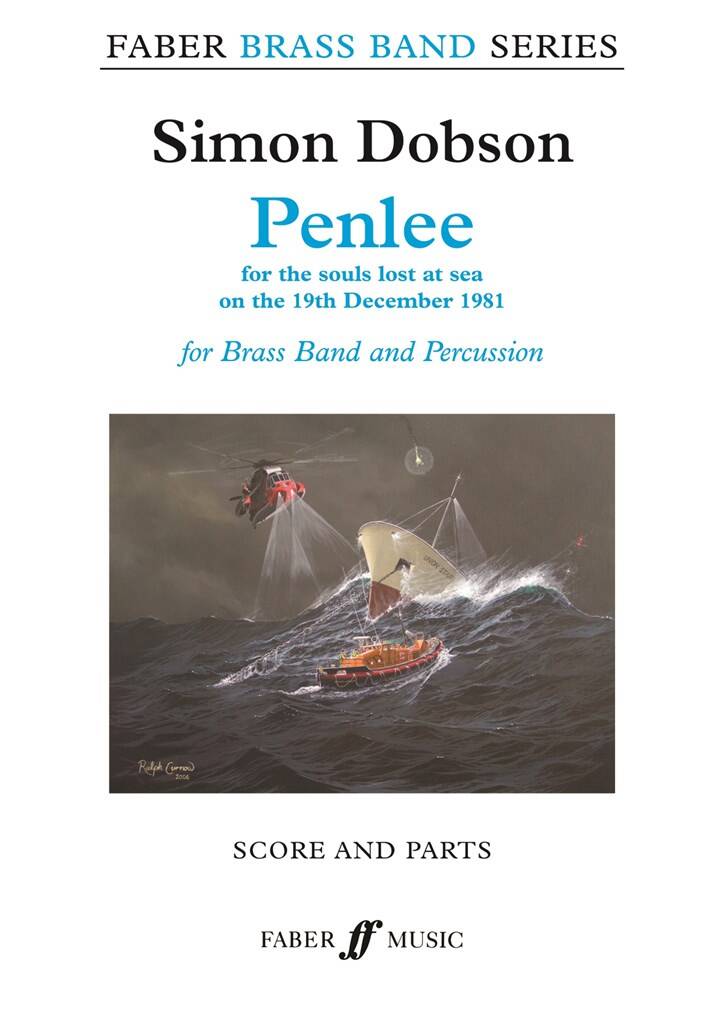
Penlee - Simon Dobson
To some, the tragic story of the Penlee lifeboat, Solomon Browne, would need no introduction, and to some the pain felt is still very much a reality. The composer, born just a few weeks before that fateful night on the19th December 1981, has created this work as a musical homage to the bravery of the souls who lost their lives and has dedicated it to their memory. Penlee was commissioned by the Cornwall Youth BrassBand using funds bequeathed by Michael Pickett. The first performance was given by the Cornish Youth Brass Band, conducted by Ian Porthouse, at St. Michael's Church, Newquay, on 30th December 2008.Penleehas been voted into the Classic FM Hall of Fame 2011 at No.106. Not only is it the first time a brass work has been featured in the Hall of Fame, but it was also thehighest new entry. The work has subsequently been recorded by the Leyland Band, conducted by Jason Katsikaris, on the CD entitled Penlee.Brass Band Grade 4: Advanced Youth and 3rd Section Duration: 13 minutes
Estimated dispatch 5-14 working days
 Listen to MP3
 View Music